



Antivirus software remains a central part of digital security, but the way people use it has changed. Built-in protections from operating systems now handle many basic threats, while standalone antivirus products increasingly compete by offering ransomware defense, phishing protection, identity monitoring, VPN access, and password tools. This shift matters for both households and businesses because cyberattacks now target more than infected files; they also exploit stolen credentials, unsafe links, vulnerable software, and social engineering.
For consumers, antivirus helps protect personal computers and mobile devices from malware, malicious downloads, and fraudulent websites. In business environments, endpoint protection can help stop infected files, detect suspicious activity, and reduce the risk that one compromised device affects a wider network. Adoption patterns also differ sharply by device, operating system, age group and country, while pricing and trust continue to influence whether users choose free, paid or built-in protection. The statistics in this article show how antivirus adoption, effectiveness, market growth and user behavior are evolving.
Editor’s Choice
- Around 169 million American adults used antivirus software in 2025, making antivirus one of the most widely adopted consumer cybersecurity technologies.
- Roughly 10 million Americans who did not currently use antivirus planned to adopt it within six months, equal to 11% of non-users surveyed.
- Only 25% of antivirus users described the technology as “very effective” in the 2025 survey, down from 31% in 2022.
- Meanwhile, 63% of Americans said safe browsing habits matter more than antivirus software, highlighting a shift toward behavior-based protection.
- In 2026, 74% of people who had experienced cybercrime said that experience influenced their decision to continue using or adopt antivirus protection.
- Favorable attitudes toward AI-powered threat detection fell from 77% in 2025 to 47% in 2026, a 30-percentage-point decline in one year.
- Among people aware of controversies involving antivirus providers, 82% said the information affected their trust or purchasing decisions.
- Antivirus users also show considerable product loyalty; 84% made no change to their antivirus software during the previous 12 months in the 2025 consumer study.
Recent Developments
- Security systems processed more than 100 trillion security signals per day in the latest 2025 global threat dataset, illustrating the scale required for modern automated threat detection.
- Those systems blocked roughly 4.5 million net-new malware files each day, showing how quickly previously unseen malicious files continue to emerge.
- Security platforms analyzed approximately 38 million identity-risk detections per day, reflecting the growing overlap between antivirus, identity protection and endpoint security.
- Around 5 billion emails were screened each day for malware and phishing threats in the 2025 reporting period.
- Identity-based attacks increased 32% during the first half of 2025, adding credential protection to the threat areas that endpoint security products must address.
- More than 97% of those identity attacks involved passwords, emphasizing why antivirus suites increasingly bundle password managers, breach alerts and account-monitoring tools.
- Extortion and ransomware represented more than 52% of cyberattacks with known motivations in the 2025 threat dataset. By comparison, espionage accounted for only 4%.
- Attackers sought to steal data in 80% of investigated incidents, reinforcing the shift from antivirus products that simply remove malware toward suites that also monitor web activity, credentials and sensitive files.
- Meanwhile, 2026 research found that 9% of users said AI features would make them less likely to use antivirus, indicating that adding AI does not automatically increase consumer trust.
Antivirus Adoption Statistics
- In 2025, 25% of American adults used antivirus across both personal and business devices. That share remained unchanged from 2024.
- Another 41% used antivirus only on personal devices in 2025, up from 39% one year earlier.
- Only 0.4% used antivirus exclusively on business devices in 2025, down slightly from 0.6% in 2024.
- The share of Americans classified as antivirus non-users declined slightly from 35% in 2024 to 34% in 2025.
- 85% of Americans agreed that computers need antivirus protection, creating a 19-percentage-point gap between perceived necessity and actual overall adoption in the same survey.
- First-time antivirus adoption reached 9% of users in 2025, more than double the 4% recorded in 2022.
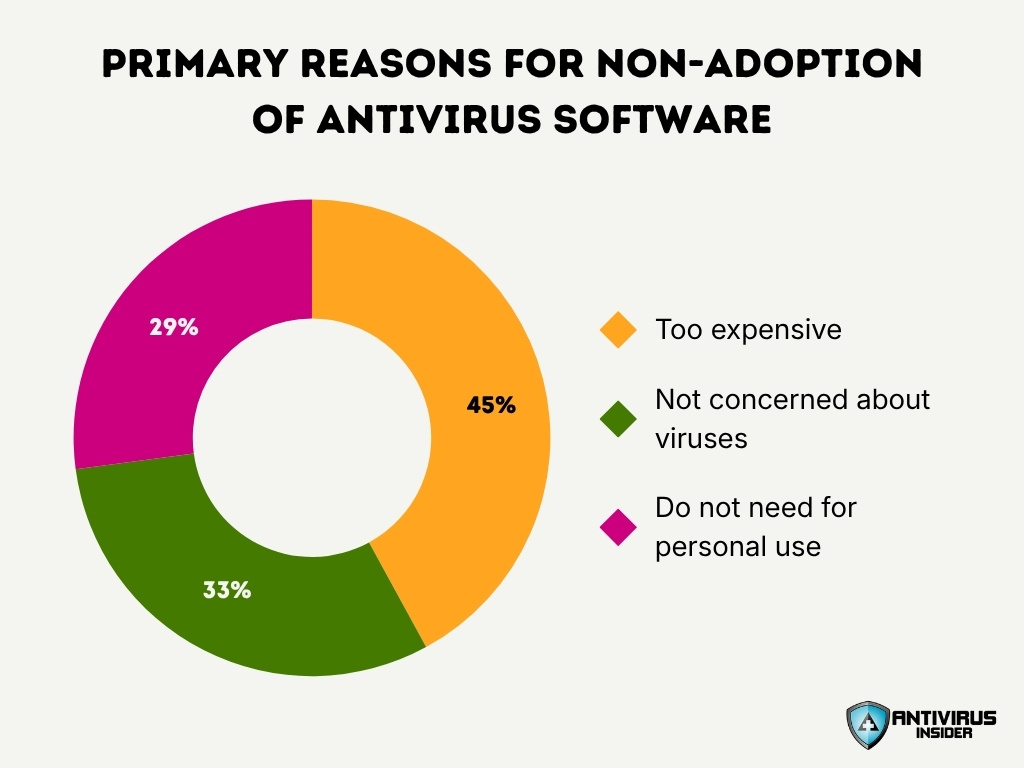
- Cost remains a significant adoption barrier; 45% of PC users without antivirus said antivirus software was too expensive.
- Another 33% of non-users said they were not concerned about viruses, while 29% said they did not need antivirus for personal use.
- Privacy also affects adoption decisions, as 57% of Americans worried that antivirus companies could collect and misuse personal data.
Antivirus Usage by Device
- In 2026, 85% of surveyed Americans used a personal smartphone outside work, compared with 63% who relied on a personal PC or laptop.
- Built-in security protected 53% of PC users as their primary defense in 2026, representing roughly 139 million U.S. adults.
- On mobile devices, 51% primarily relied on built-in security, equivalent to roughly 134 million U.S. adults based on the survey’s population estimate.
- Third-party antivirus reached 41% of computer users in 2026, compared with only 18% of mobile users.
- Around 14% of mobile users had no cybersecurity tools at all, exposing a sizeable portion of smartphone owners to avoidable risk.
- A further 16% of mobile users were unsure which security tools they used, suggesting that automatic protection can make security less visible to consumers.
- Third-party mobile antivirus usage fell from 28% in 2025 to 18% in 2026, while computer antivirus adoption moved in the opposite direction.
- Third-party computer protection increased from 39% in 2025 to 41% in 2026, a two-percentage-point rise.
- A separate 2025 consumer study found antivirus installed on 84% of computers, 68% of smartphones and 60% of tablets, reinforcing the consistent device gap across different surveys.
Antivirus Usage by Age Group
- Among Americans ages 18-29, 51% used antivirus on personal computers in the 2025 consumer survey, the lowest adoption rate among the four age groups measured.
- Adoption rose to 61% among adults ages 30-44, placing the group 10 percentage points above adults ages 18-29.
- Among Americans ages 45-59, PC antivirus usage reached 64%, continuing the upward pattern with age.
- Adults 60 and older recorded 73% adoption, creating a 22-percentage-point gap compared with the youngest adult group.
- Despite their lower overall usage rate, adults ages 18-29 had a 21% first-time antivirus adoption rate in 2025, indicating stronger recent uptake among younger users.
- In another U.S. dataset, adults ages 34-45 recorded the highest antivirus usage in 2025, with 70% using antivirus on computers and 34% using it on mobile devices.
- By 2026, antivirus usage in that same 34-45 group declined to 47% on computers and 25% on mobile devices, reflecting a substantial year-over-year change in reported third-party use.
- In a separate global security survey, about 30% of users ages 34 and younger chose free desktop security, compared with roughly 20% of respondents older than 34.
- The 2026 global survey also found that North America had its oldest respondent profile; more than half of North American participants were 55 or older, while more than 80% of Asian respondents were younger than 44.
Antivirus Usage by Operating System
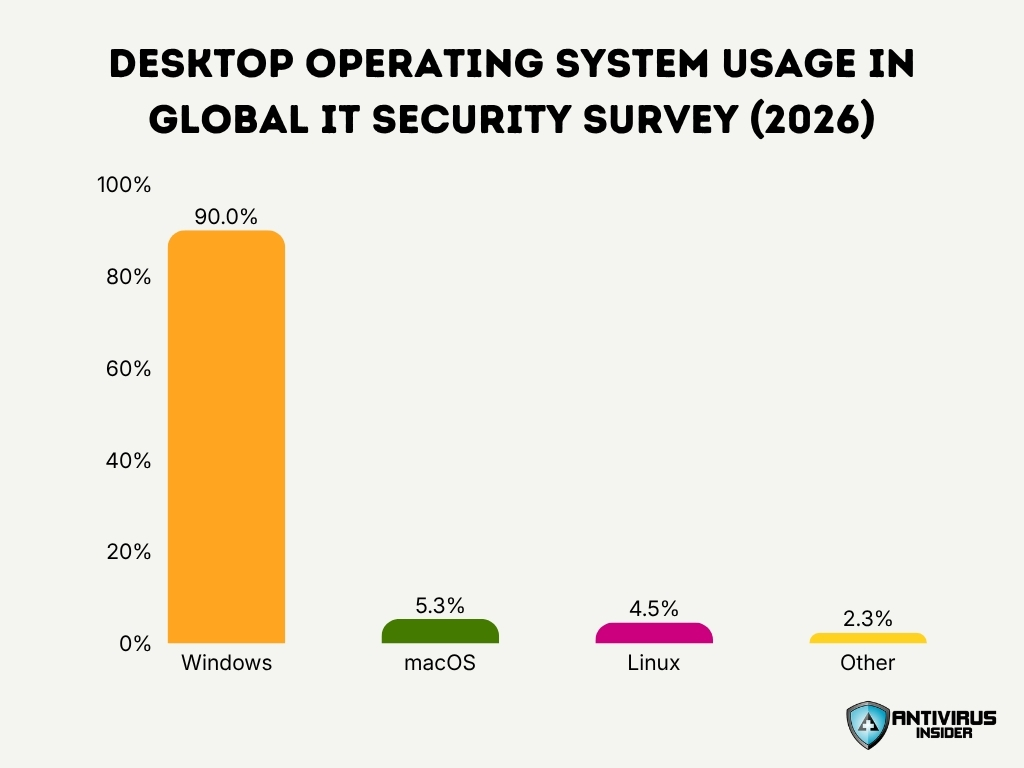
- Approximately 90% of participants in a late-2025 global IT security survey used Windows as their primary desktop operating system, making Windows the dominant platform within that security-focused sample.
- macOS accounted for 5.3% of desktop systems in the same 2026 survey, while Linux accounted for 4.5%.
- Other desktop operating systems, including older Windows versions, represented just 2.3% of the survey base.
- Android represented 74% of mobile operating systems among respondents to the 2026 global IT security survey.
- By comparison, Android represented 75% of mobile operating systems in the 2025 edition of the survey, indicating little year-over-year movement within this security-focused audience.
- 40.2% of 2026 respondents used no additional mobile anti-malware solution, suggesting that many smartphone owners depend on native OS safeguards rather than standalone apps.
- Among IT professionals, the no-additional-mobile-security rate rose to 44%, even though this group generally has greater cybersecurity knowledge.
- In the 2025 version of the same survey, 39.3% used no mobile anti-malware, showing that the share increased slightly heading into 2026.
- Earlier U.S. consumer data found that 48% of Windows users used third-party antivirus, compared with 31% of Mac users and 24% of users on other desktop operating systems such as Linux.
Antivirus Usage in Businesses and Small Businesses
- In a 2025 U.S. survey, 47% of small and midsize businesses implemented new security technology during the previous year.
- Another 48% upgraded or added employee cybersecurity training, showing that companies increasingly pair security software with workforce education.
- About 25% of U.S. SMBs used AI for cybersecurity in 2025, even though broader adoption of dedicated AI-powered security products remained much lower in another SMB study.
- Only 11% of surveyed U.S. SMBs used AI-powered security tools in a separate 2025 study, indicating that advanced automated protection had not yet reached mainstream small-business adoption.
- About 54% of U.S. SMBs already had network endpoint security, including anti-malware and firewall or intrusion-protection capabilities, in a February 2025 survey. Another 23% planned investment during the following 12 months.
- Mobile protection remained less mature; 23% already had mobile device management or anti-malware capabilities, while 51% planned investment during the next year.
- A late-2025 U.S. SMB study found 41% had endpoint protection, compared with 58% using network firewalls and 52% using email or spam filters.
- Cost remains a major barrier. Roughly two-thirds of SMBs said cost prevented security-tool upgrades, and only about 7% believed their current cybersecurity budget was completely sufficient.
- Business size strongly affects preparedness; only 47% of the smallest businesses had a security plan, compared with nearly 90% of larger SMBs.
- The U.S. has about 34.8 million small businesses, representing roughly 99% of all businesses, so even modest changes in SMB antivirus and endpoint-security adoption affect millions of organizations.
Free vs. Paid Antivirus Usage
- 61% of U.S. antivirus users relied on free protection in 2025, up from earlier survey levels and making free antivirus the dominant consumer model.
- Paid antivirus accounted for 36% of U.S. users in 2025, giving free products a 25-percentage-point advantage.
- In a separate 2026 international IT-security survey, 75% of participants paid for their desktop security program, illustrating how adoption looks very different among a security-focused and technically experienced audience.
- Approximately 30% of users ages 34 and younger in that survey selected free desktop protection, compared with about 20% of respondents older than 34.
- Cost helps explain the appeal of free products; 45% of U.S. PC users without antivirus said antivirus software was too expensive.
- Free antivirus adoption also benefits from built-in tools. Microsoft Defender alone accounted for 23% of primary antivirus usage among surveyed American antivirus users in 2025.
- In a 2025 community poll focused specifically on free antivirus products, Microsoft received 34.78% of votes, while the second-place product received 21.74%.
- Paid-product preferences differed sharply in the same poll; ESET received 44% of paid-antivirus votes, while two competing products each received 16%.
- Despite the growing appeal of free protection, paid security remains especially common among advanced users because subscriptions typically combine antivirus with privacy, identity, and web-protection features rather than malware scanning alone. In the 2026 IT-security survey, roughly three in four participants chose paid desktop protection.
Antivirus Software Market Growth Statistics
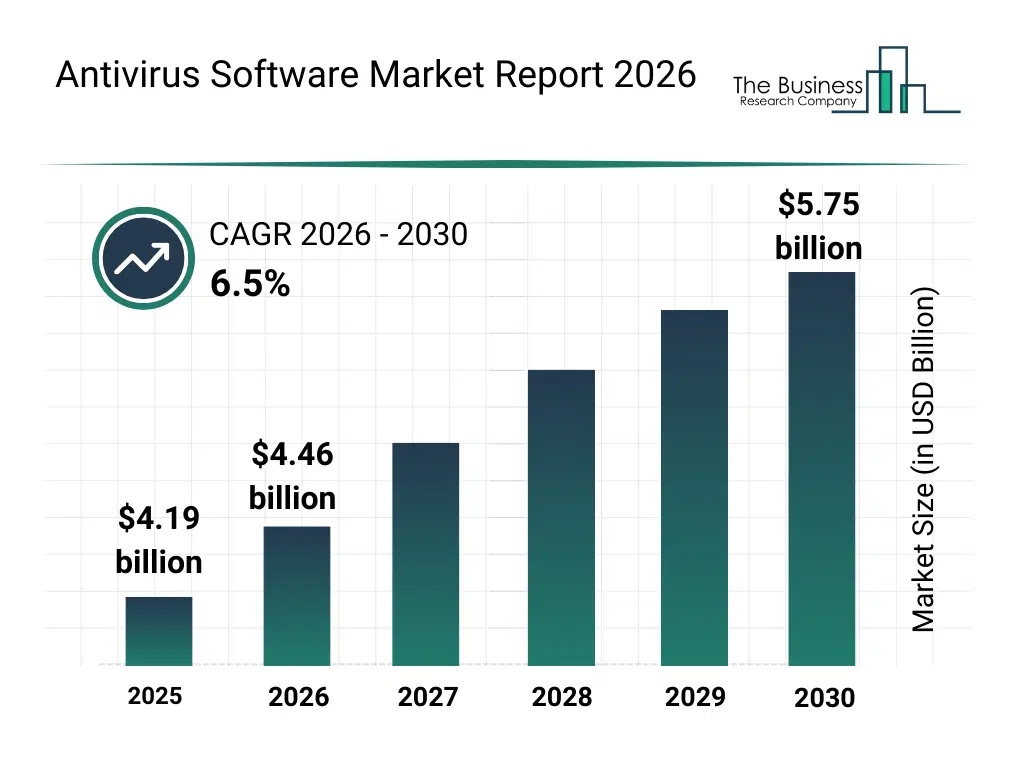
- The global antivirus software market is projected to grow from $4.19 billion in 2025 to $5.75 billion by 2030, indicating sustained demand for cybersecurity protection.
- In 2026, the antivirus software market is expected to reach $4.46 billion, up roughly 6.4% from 2025.
- The market is forecast to expand at a 6.5% CAGR from 2026 to 2030, reflecting steady growth over the forecast period.
- By 2027, the antivirus software market could reach approximately $4.75 billion if it maintains the projected growth trajectory.
- The market is estimated to surpass $5 billion in 2028, reaching approximately $5.06 billion.
- By 2029, antivirus software revenue could climb to approximately $5.39 billion, before reaching $5.75 billion in 2030.
- Overall, the market is expected to add approximately $1.56 billion in value between 2025 and 2030, representing growth of about 37%.
Antivirus Market Share by Region and Company
- North America generated 34.4% of global endpoint-security revenue in 2025 under one current market estimate, giving it the largest regional share.
- A second industry estimate placed North America’s 2025 share at 39.3%, confirming regional leadership despite differences in market definitions.
- Under that estimate, North American endpoint-security revenue reached $6.46 billion in 2025 and is projected to reach $7 billion in 2026.
- Europe represented 26.4% of global endpoint-security revenue in 2025, with an estimated market value of $4.3 billion.
- Asia-Pacific accounted for 24.2% of the market in 2025, generating approximately $3.85 billion. Its market value is projected to reach $4.31 billion in 2026.
- Latin America represented approximately 4.7% of 2025 revenue, while the Middle East and Africa held about 5.4%.
- In the U.S. consumer antivirus market, the top three primary products together accounted for 54% of users in 2025, leaving nearly half the market distributed among smaller competitors and other products.
- Microsoft Defender held the largest individual U.S. consumer share at 23% in 2025, followed by McAfee at 18% and Norton at 13%.
- Regional product preferences differ substantially. A 2026 global IT-security survey ranked ESET first among respondents in North America and Europe, while Kaspersky ranked first in Asia and South/Central America.
- Asia-Pacific is expected to remain one of the fastest-expanding endpoint-security regions, with one 2026 analysis forecasting a 12.22% CAGR through 2031.
Antivirus Usage by Country
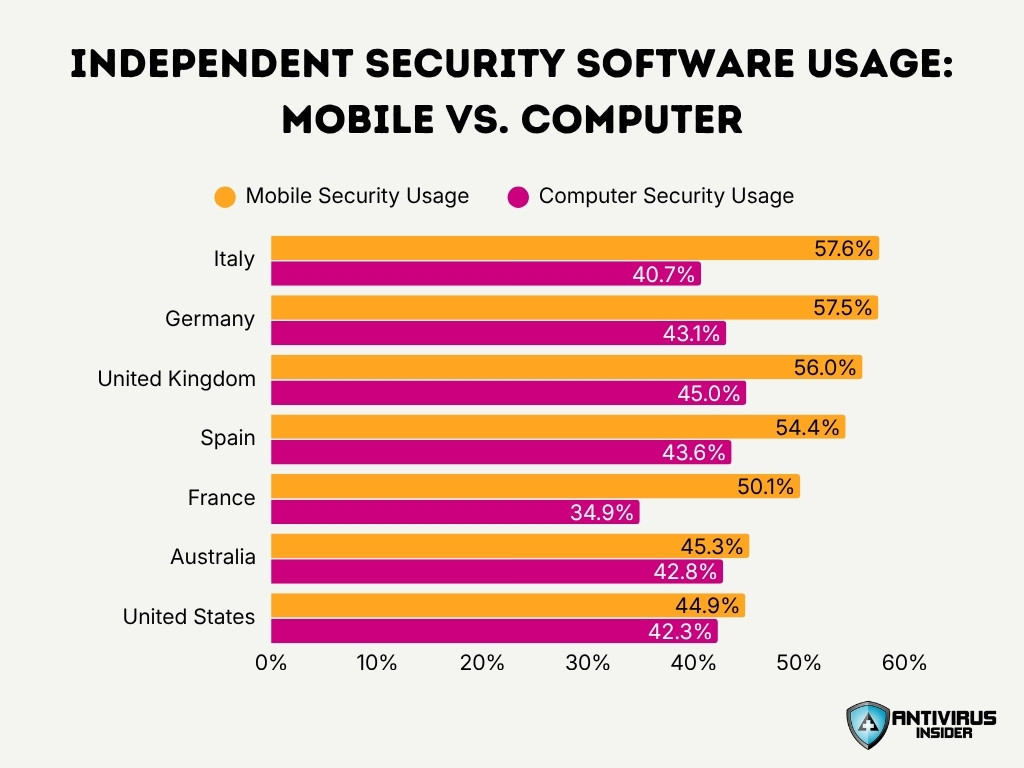
- In the United States, 44.9% of surveyed consumers used an independent security solution on their phones, while 42.3% used one on a computer. Another 23.7% said they did not use an independent security product.
- In the United Kingdom, 56% used independent security software on a phone and 45% used one on a computer. Only 15.9% reported using no independent security solution.
- Germany recorded 57.5% mobile security adoption, the second-highest phone rate among the seven surveyed countries. Computer use reached 43.1%, while 15.8% used no independent solution.
- In Italy, 57.6% protected their phones with an independent security product, the highest phone adoption rate in the survey. Computer usage stood at 40.7%.
- Spain reported 54.4% phone security usage and 43.6% computer security usage. About 16.2% of respondents said they used no independent security product.
- In France, 50.1% used independent security on smartphones, compared with 34.9% on computers. One-quarter of French respondents used no independent solution, the highest non-use rate among the seven markets.
- Australia had 45.3% mobile security usage and 42.8% computer usage. Around 22% reported using no independent security software.
- Across these markets, the United States stood out because independent phone security use remained below the rates reported in the U.K., France, Germany, Italy and Spain, despite the country’s large cybersecurity market.
- A separate 2025 international cybersecurity survey covered more than 7,000 people across seven countries, including the U.S., U.K., Germany, Australia, India, Mexico and Brazil, showing how security behavior increasingly requires multinational comparison rather than U.S.-only measurement.
Antivirus Pricing, Subscription, and Renewal Statistics
- In 2026, Norton 360 Deluxe listed a $49.99 first-year price for five devices, compared with a standard annual renewal rate of $124.99.
- That pricing structure represents a 60% first-year discount relative to the listed Norton 360 Deluxe renewal price.
- Norton 360 Standard listed a $39.99 introductory annual price and a $94.99 renewal rate, producing an initial discount of about 57%.
- Norton Mobile Security for Android and iOS listed a $19.99 first-year price for one device, compared with a $29.99 annual renewal price.
- The March 2026 renewal schedule listed Norton 360 Premium I at $149.99 per year for 10 devices and 100 GB of storage.
- Norton 360 Premium Plus carried a $174.99 annual renewal price for 10 devices and 250 GB of cloud storage in the same 2026 schedule.
- McAfee+ Premium Individual was available at approximately $49 for the first year in August 2026, while its subsequent annual renewal price was reported at $149.
- The difference between that introductory and renewal price equals $100 per year, showing why consumers need to compare renewal costs rather than evaluating antivirus subscriptions only by promotional pricing.
- Free products continue to place pricing pressure on subscriptions; 61% of U.S. antivirus users chose free protection in 2025, while 36% used paid products.
- Despite subscription-price changes, customer switching remains limited; 84% of antivirus users kept the same product over the previous year, indicating relatively strong retention across the category.
Antivirus False Positive and Scan Performance Statistics
- The average false-positive score across qualifying products was 8 false alarms.
- The top-performing product recorded 0 false positives across all tested files and websites.
- Second-tier products generated just 1 and 2 false alarms during testing.
- 5 major products produced 5 false alarms each, remaining below the test average.
- The worst-performing product triggered 83 false positives, over 10 times the average.
- 10 of 14 packages earned a perfect score of 6 out of 6 points for system performance.
- The remaining 4 products scored 5.5 out of 6 points, within 0.5 points of the top score.
- Microsoft Defender added 0% measurable delay to application downloads on standard and high-end PCs.
- Application installations showed a 22% slowdown on standard PCs versus the 30% industry average.
- High-end PCs experienced a 51% installation delay, outperforming the 60% industry average.
Most Used Antivirus Brands Among PC and Smartphone Users
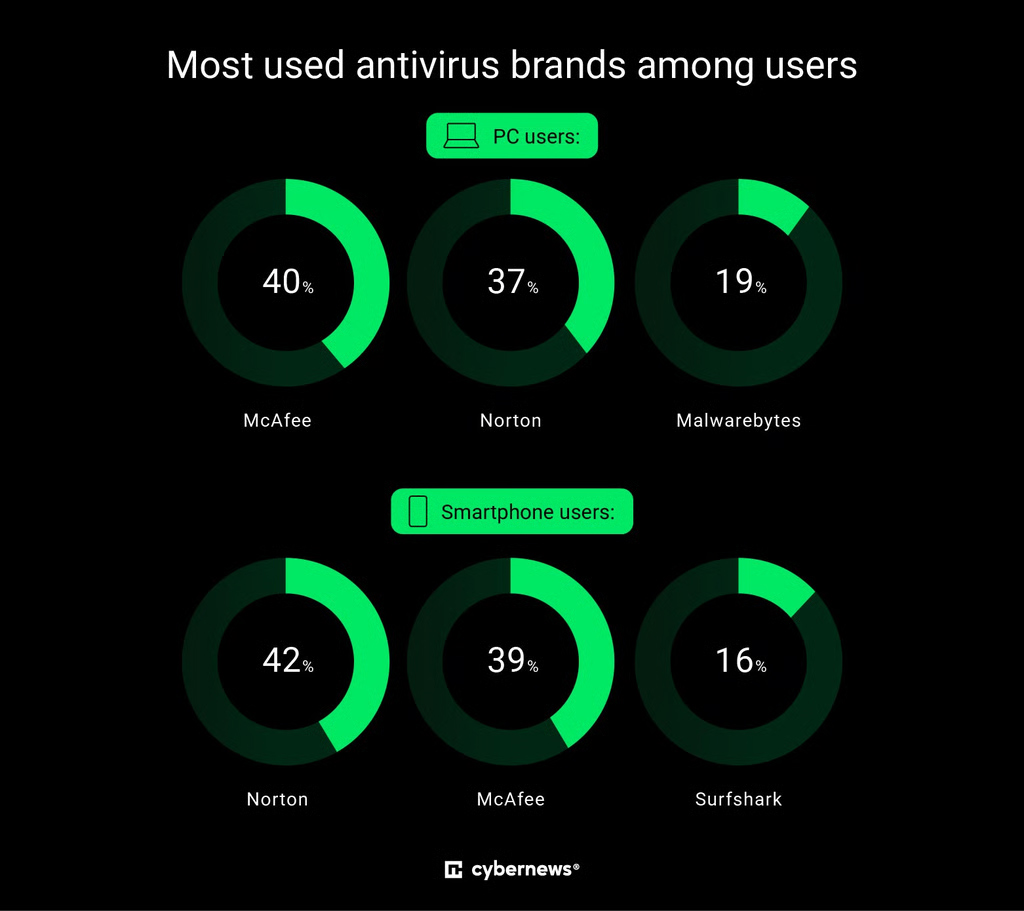
- McAfee leads among PC users, with 40% reporting that they use the antivirus brand.
- Norton ranks second on PCs at 37%, just 3 percentage points behind McAfee.
- Malwarebytes is used by 19% of PC users, less than half the share recorded by McAfee.
- Among smartphone users, Norton takes the top spot at 42%, making it the most widely used antivirus brand on mobile devices in the data.
- McAfee follows closely with 39% of smartphone users, only 3 percentage points behind Norton.
- Surfshark accounts for 16% of smartphone users, considerably below Norton and McAfee.
- Overall, Norton and McAfee dominate antivirus usage across both PCs and smartphones, while other brands have substantially smaller shares.
Antivirus Ransomware, Phishing, and Web Protection Statistics
- Ransomware appeared in 44% of analyzed breaches in 2025, after ransomware activity increased 37% year over year.
- The 2026 breach dataset shows ransomware increasing further to 48% of all breaches, making it one of the most persistent threats facing organizations.
- Software vulnerability exploitation now starts 31% of breaches, overtaking stolen passwords as the leading initial access route in the 2026 dataset.
- Phishing or social engineering accounted for 28% of initial breach access in a major 2025 incident-response dataset.
- Compromised credentials served as an initial access vector in 22% of breaches examined in another 2025 breach analysis.
- Human involvement remained present in 60% of analyzed breaches, showing why web filtering and antivirus software cannot fully replace employee and consumer awareness.
- Security infrastructure scanned about 5 billion emails every day for phishing and malware during the 2025 reporting period.
- Of ransomware victims examined alongside stolen-credential datasets, 54% had their domains appear in credential dumps, while 40% had compromised corporate email addresses represented in the data.
- During 2025, authorities received more than 3,600 ransomware complaints with reported direct losses exceeding $32 million; 63 new ransomware variants were identified during the year.
Antivirus User Satisfaction, Trust, and Awareness Statistics
- 87% of Americans considered antivirus at least somewhat effective in the latest U.S. antivirus survey, showing broad acceptance even as confidence in its effectiveness has softened.
- Only 25% rated antivirus as “very effective,” down from 31% in 2022, while 62% classified it as only somewhat effective.
- 57% of Americans worried that antivirus companies might collect or misuse personal information, making privacy concerns a significant barrier to adoption.
- At the same time, 55% believed paid antivirus software offers more comprehensive protection than free alternatives.
- A broader 2025 consumer security survey found that 70% worried about Data Privacy and security, up from 60% one year earlier.
- Only 27% expressed high or very high trust that technology providers keep their personal data secure.
- In 2026, 84% of surveyed Americans said they felt secure online, yet only 29% followed all recommended cybersecurity best practices.
- Around 69% of Americans encountered a scam during the previous year, and 26% said they became a victim, highlighting the gap between perceived security and actual exposure.
- Cybersecurity awareness does not always translate into software use; a separate 2026 survey found 65% of adults used protective software, while 80% enabled multifactor authentication.
Antivirus Detection and Effectiveness Statistics
- A February-May 2026 real-world protection test exposed antivirus products to 400 live malicious cases drawn from threats that users could encounter while browsing or downloading files.
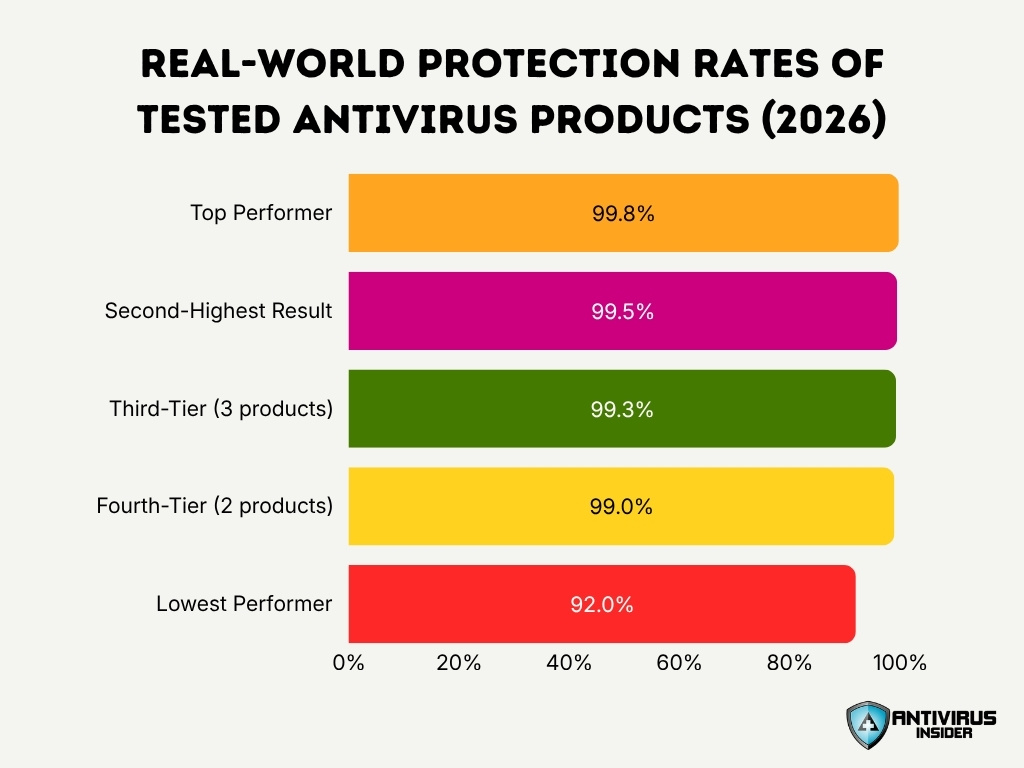
- The strongest performer blocked 399 of 400 threats, producing a 99.8% real-world protection rate.
- The second-highest result stopped 398 attacks for a 99.5% protection rate, while three products each blocked 397 threats and reached 99.3%.
- Two products blocked 396 of the test cases, giving them a 99.0% protection rate against the live internet threats used in the 2026 evaluation.
- The lowest protection result among the 20 tested products was 92.0%, meaning 32 of the 400 test cases compromised the system.
- A separate March-April 2026 Windows 11 evaluation challenged 14 security packages with more than 12,000 malware samples covering zero-day and recently discovered threats.
- Eight of 14 products detected every malicious sample in that Windows 11 evaluation, while 11 products received the maximum six-point protection score.
- In May and June 2026 testing, Microsoft Defender achieved 100% detection of widespread malware in both months and 100% protection against zero-day threats in both months.
- The June 2026 Windows 11 evaluation gave 12 of 16 consumer security products the maximum six-point protection score, showing that high malware detection has become common among leading products.
Antivirus Industry Trends and Future Outlook
- Generative AI already assists 15% of attack techniques tracked in the 2026 breach dataset, suggesting security vendors will need faster automated detection as attackers expand AI use.
- Security systems now process more than 100 trillion security signals daily, giving cloud-connected antivirus and endpoint platforms far more telemetry than traditional signature-only scanners once had.
- Modern security infrastructure blocks approximately 4.5 million new malware attempts each day, illustrating the scale at which automated threat classification now operates.
- The same infrastructure processes roughly 38 million identity-risk detections per day, showing how endpoint security increasingly overlaps with account and credential protection.
- Among American computer users, third-party antivirus adoption rose from 39% in 2025 to 41% in 2026, suggesting dedicated PC protection remains resilient despite stronger built-in defenses.
- Mobile antivirus moved in the opposite direction, dropping from 28% adoption in 2025 to 18% in 2026, as more smartphone users relied on native operating-system protection.
- Consumer demand increasingly extends beyond malware scanning; 48% of U.S. consumers said they would pay for scam protection in a 2026 survey.
- Security has also become a purchasing factor for other digital services, with 82% of U.S. consumers saying cybersecurity influences their choice of telecommunications provider.
- Independent antivirus testing remains highly competitive; 19 Windows consumer security products completed the full major comparative test series during 2025, covering real-world threats, malware detection, advanced attacks, performance and false alarms.
Frequently Asked Questions (FAQs)
The highest consumer real-world protection rate reached 99.8%, with 399 of 400 malicious test cases blocked.
In a March 2026 malware test involving 10,000 samples, the top products blocked 9,998 samples, producing a 99.98% online protection rate.
In March-June 2026 business testing, the three highest-performing products achieved 99.8% real-world protection, blocking 399 of 400 test cases.
Consumer real-world protection rates ranged from 92.0% to 99.8% across 20 antivirus products tested between February and May 2026.
In July-October 2025 testing, the three leading products achieved a 100% protection rate, while another seven products reached 99.5%.
Conclusion
Antivirus remains an important part of digital security, but users increasingly expect more than basic malware scanning. Built-in operating system defenses now compete with standalone products, while paid security suites expand into identity monitoring, ransomware protection, phishing detection, VPN services and scam prevention. At the same time, strong independent test results show that leading antivirus products can still stop very high percentages of malware, although false positives, system performance and pricing vary across products.
The broader data also shows why antivirus alone cannot address every digital threat. Ransomware remains common in breaches, phishing continues to exploit human behavior, and stolen credentials give attackers another route around traditional malware defenses. Consumers and businesses therefore benefit most when antivirus works alongside software updates, multifactor authentication, secure passwords, employee awareness, and careful browsing habits.
Looking ahead, AI-assisted detection, cloud-based threat intelligence and integrated identity protection will continue to reshape the antivirus industry. Mobile users may rely more heavily on built-in security, while PC users and businesses are likely to keep using dedicated endpoint protection where broader controls and centralized management matter. Overall, antivirus is shifting from a standalone malware tool into one layer of a wider cybersecurity strategy designed to protect devices, accounts, data, and online activity.
