



Data privacy has become a core business and consumer concern as organizations collect, process, and store unprecedented amounts of personal information. From AI-powered services and cloud platforms to healthcare systems and financial institutions, privacy practices now influence customer trust, regulatory compliance, and cybersecurity outcomes. As privacy laws expand and cyber threats evolve, understanding the latest data privacy statistics helps organizations make better decisions and reduce risk. Explore the latest numbers shaping the global privacy landscape.
Editor’s Choice
- The global average cost of a data breach reached $4.44 million in 2025, down from $4.88 million in 2024 due largely to faster breach detection and containment.
- The average U.S. data breach cost climbed to a record $10.22 million in 2025, making the United States the most expensive country for breach recovery.
- Cisco’s 2026 privacy study surveyed more than 5,200 privacy, security, and technology professionals across 12 markets, highlighting the growing importance of privacy governance.
- 90% of organizations reported expanding privacy and governance programs because of AI-related risks and requirements.
- 93% of businesses plan additional privacy investments to address AI-driven regulatory and operational challenges.
- 53% of consumers are now aware of privacy laws in their country, a significant increase from previous years.
- 81% of consumers who understand privacy laws feel confident protecting their personal data, compared with 44% among those unaware of such laws.
Recent Developments
- The first decline in global breach costs in five years occurred in 2025, with average losses falling from $4.88 million to $4.44 million.
- Organizations reduced average breach identification and containment time to 241 days, the lowest level recorded in nine years.
- 13% of organizations reported security incidents involving AI models or AI applications during 2025.
- Among companies experiencing AI-related incidents, 97% lacked proper AI access controls.
- 63% of organizations reported having no formal AI governance policies in place.
- Privacy spending accelerated sharply, with 38% of organizations investing more than $5 million annually in privacy programs in 2026, compared with 14% in 2024.
- 99% of organizations reported measurable business benefits from privacy investments and governance programs.
- 96% of enterprises stated that strong privacy frameworks improve innovation and operational agility.
- 95% of organizations said privacy is essential for building trust in AI-powered products and services.
Global Data Privacy Trends
- More than 1.35 billion individuals had personal information exposed or compromised during 2024.
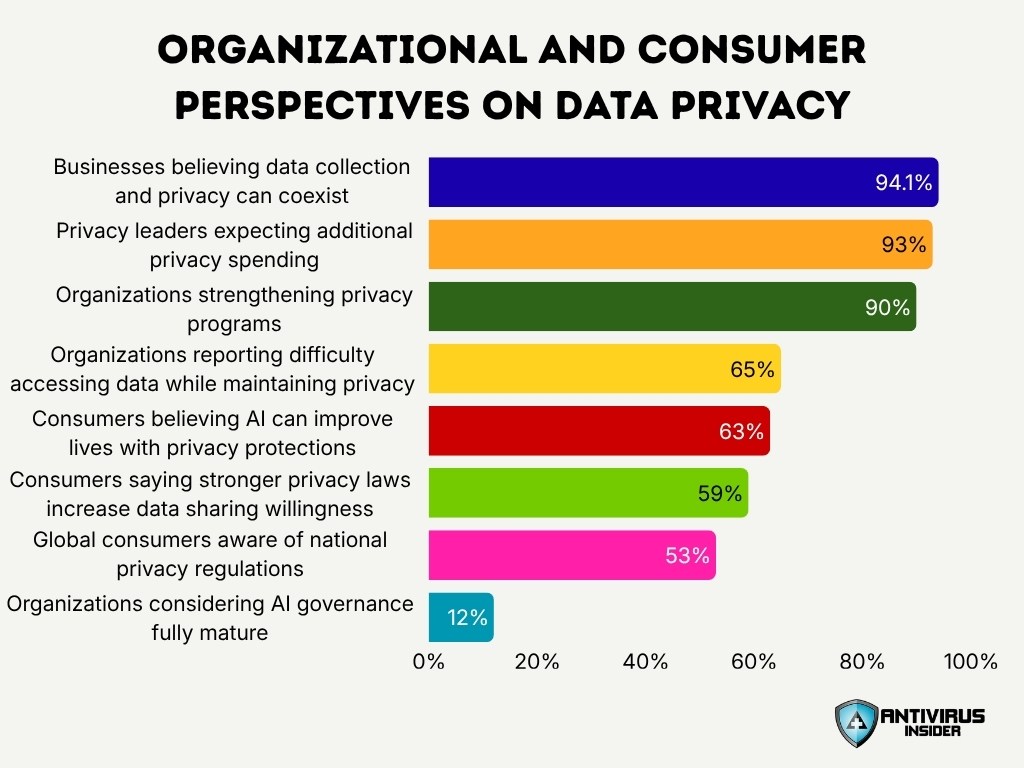
- 90% of organizations are strengthening privacy programs in response to AI adoption and expanding data ecosystems.
- 93% of privacy leaders expect additional privacy spending as compliance requirements become more complex.
- 53% of global consumers report awareness of national privacy regulations.
- 59% of consumers say stronger privacy laws increase their willingness to share data with AI applications.
- 63% of consumers believe AI can improve their lives when supported by responsible privacy protections.
- 94.1% of businesses believe effective data collection and customer privacy can coexist.
- 65% of organizations report difficulty accessing high-quality data while maintaining privacy and governance requirements.
- Only 12% of organizations consider their AI governance capabilities fully mature.
Consumer Trust and Privacy Attitudes
- 79% of Americans are concerned about how companies use their personal information.
- 88% of consumers say their willingness to share personal data depends on trust in the organization collecting it.
- 54% of consumers believe it has become harder for companies to earn their trust than in previous years.
- 81% of privacy-law-aware consumers feel capable of protecting their personal information, compared with only 44% of those who lack awareness.
- 53% of consumers now understand their country’s privacy regulations, marking continued growth in privacy awareness.
- 61% of individuals believe they have a limited ability to protect their privacy online despite increasing awareness.
- Nearly 50% of digital-native users said they would reduce app permissions after learning how companies infer information from collected data.
- Consumers consistently rank transparency, control, and data security among the most important factors influencing digital trust.
- Research shows contextual advertising generates significantly lower perceived privacy violations than behavior-based tracking approaches.
Data Breach Statistics
- The global average cost of a data breach was $4.88 million in 2024, the highest level recorded at that time.
- Average breach costs declined to $4.44 million in 2025, ending a five-year streak of annual increases.
- Healthcare remained the most expensive industry for breaches, with average losses of $7.42 million in 2025.
- The average cost per compromised record stood at approximately $160 in 2025.
- 13% of organizations experienced breaches involving AI systems or applications.
- 20% of organizations reported breaches linked to unauthorized or “shadow AI” usage.
- AI-related breaches added an average of $670,000 to total incident costs.
- One-sixth of reported breaches involved cybercriminals using AI during attack execution.
- 37% of AI-assisted attacks involved AI-generated phishing campaigns.
- 35% of AI-assisted attacks involved deepfake-enabled fraud or impersonation attempts.
Data Loss by Marketing Channel Due to Privacy Restrictions
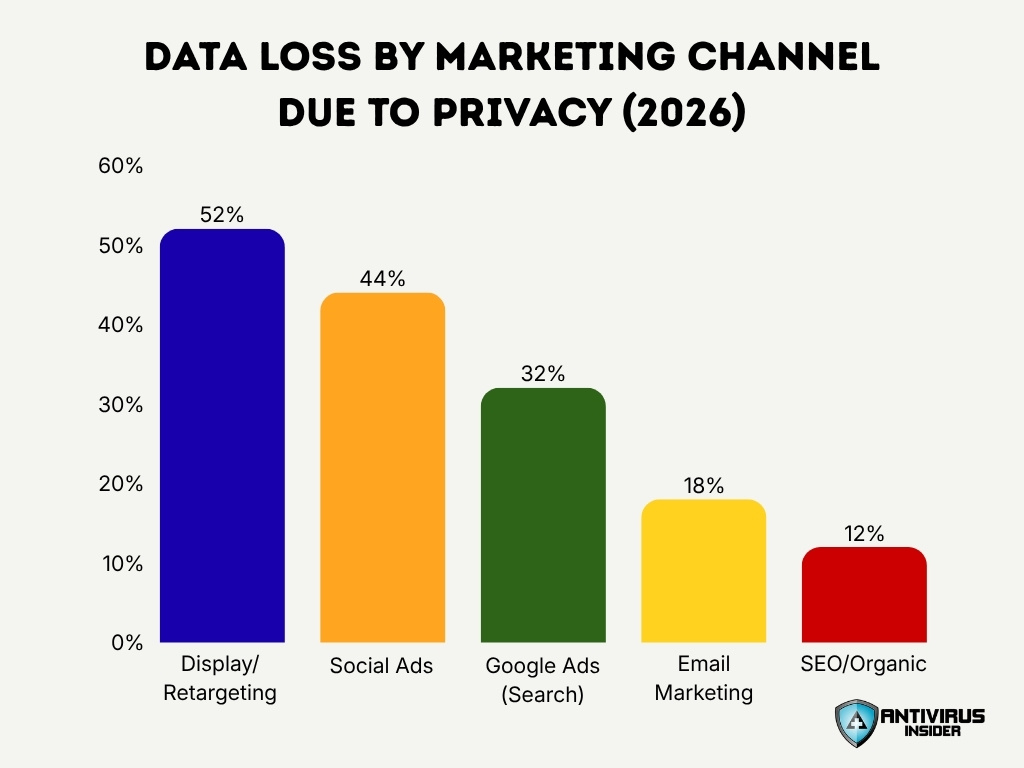
- Display/Retargeting experiences the highest privacy-related data loss at 52%, making it the most affected digital marketing channel.
- Social Ads lose 44% of measurable data due to privacy restrictions, significantly impacting audience targeting and attribution.
- Google Ads (Search) faces 32% data loss, showing that search advertising remains relatively more resilient than display and social campaigns.
- Email Marketing records only 18% data loss, highlighting its strength as a first-party data-driven channel.
- SEO / Organic is the least affected channel with just 12% data loss, making it one of the most privacy-resistant marketing strategies.
- The gap between Display/Retargeting (52%) and SEO / Organic (12%) is 40 percentage points, underscoring the growing value of owned and organic traffic sources.
- Channels dependent on third-party cookies and user tracking suffer substantially higher data loss than first-party or organic channels.
- The findings suggest marketers should increasingly invest in SEO, email marketing, and first-party data collection to mitigate privacy-related measurement challenges.
The Financial Impact of Data Breaches
- U.S. organizations faced average breach costs of $10.22 million in 2025, the highest globally.
- Global breach costs rose from $4.45 million in 2023 to $4.88 million in 2024, a 10% increase.
- Hybrid and multi-environment breaches cost organizations an average of $5.05 million.
- Breaches involving only on-premises environments averaged $4.01 million in losses.
- Healthcare organizations absorbed average breach costs exceeding $7.4 million in 2025.
- AI-related incidents generated an additional $670,000 in average breach expenses.
- Organizations facing cyber staff shortages represented more than half of breached entities in a major breach-cost study.
- A 2026 academic analysis found that the social costs borne by breach victims can exceed settlement values by several multiples in major breach events.
- In 2025, 63% of ransomware victims refused to pay ransom demands, up from 59% in 2024, reflecting changing risk-management strategies.
Data Privacy Laws and Compliance Regulations
- As of 2026, more than 140 countries have enacted comprehensive data protection and privacy legislation covering the majority of the world’s population.
- The United States now has privacy laws in 20+ states, reflecting a rapid expansion from only a handful of state-level privacy frameworks a few years ago.
- 75% of the global population’s personal data is expected to be covered by modern privacy regulations, according to long-term regulatory projections.
- Seven new U.S. state privacy laws became effective during 2025, adding compliance obligations for businesses operating nationwide.
- 89% of organizations report that complying with privacy regulations delivers positive business benefits beyond legal compliance.
- Organizations generate an average return of 1.6 times their privacy spending through reduced risk, increased trust, and operational improvements.
- 94% of businesses state that customers would not buy from them if personal information was not adequately protected.
- Nearly 70% of privacy professionals identify regulatory complexity across multiple jurisdictions as a top compliance challenge.
- More than 60% of enterprises have increased legal and compliance budgets to address expanding privacy requirements.
- Companies operating internationally often manage compliance across 50 or more regulatory obligations, including privacy, cybersecurity, and sector-specific requirements.
Largest GDPR Fines by Country
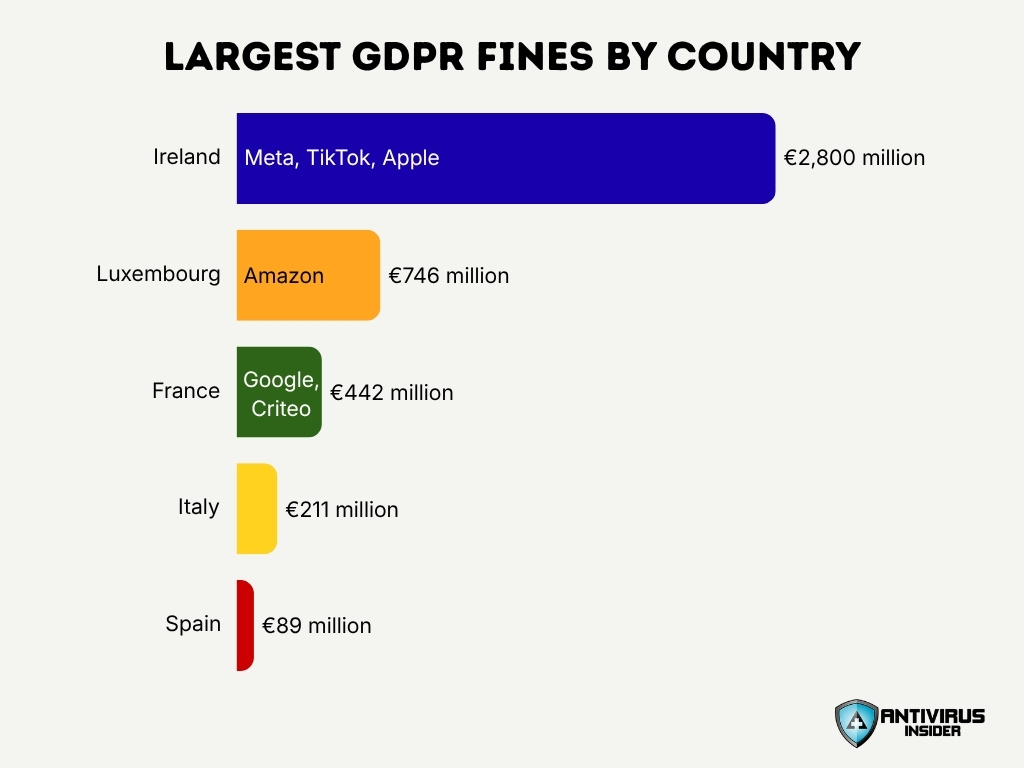
- Ireland leads all countries with €2.8 billion in cumulative GDPR fines, driven largely by enforcement actions against Meta, TikTok, and Apple.
- Luxembourg ranks second with €746 million in GDPR penalties, primarily linked to enforcement against Amazon.
- France has imposed €442 million in cumulative GDPR fines, including major penalties on Google and Criteo.
- Italy has issued €211 million in GDPR fines, placing it fourth among the highest-fining countries.
- Spain rounds out the top five with €89 million in cumulative GDPR penalties since May 2018.
- Ireland’s €2.8 billion total is nearly 3.8 times higher than Luxembourg’s €746 million, highlighting its dominant enforcement role.
- The top 3 countries alone account for nearly €4 billion in GDPR fines, reflecting concentrated enforcement across major EU tech hubs.
- Most of the largest GDPR penalties have targeted major technology companies, including Meta, TikTok, Apple, Amazon, and Google.
- The gap between Ireland (€2.8 billion) and Spain (€89 million) exceeds €2.7 billion, showing significant variation in GDPR enforcement outcomes.
- Since May 2018, GDPR enforcement has generated billions of euros in penalties across Europe, with Ireland emerging as the clear leader.
GDPR Compliance and Enforcement Statistics
- Since GDPR enforcement began, regulators have issued over €5.6 billion in cumulative fines across the European Economic Area.
- GDPR penalties exceeded €1.2 billion during 2024, making it one of the most active enforcement years on record.
- The largest GDPR fine remains the €1.2 billion penalty issued against a major technology company for unlawful data transfers.
- Regulators received more than 130,000 data breach notifications annually across EU member states in recent reporting periods.
- Cross-border GDPR investigations increased by approximately 30% year over year as regulators coordinated enforcement efforts.
- 67% of organizations report GDPR as the privacy regulation with the greatest influence on their global privacy programs.
- More than 80% of multinational enterprises use GDPR requirements as a baseline standard for privacy governance worldwide.
- Organizations with mature GDPR compliance programs experience lower regulatory exposure and faster incident response times than less mature peers.
- Data subject access requests continue rising, with many enterprises reporting annual growth rates exceeding 20%.
- Privacy-by-design practices introduced under GDPR are now incorporated into product development processes at many large organizations worldwide.
Corporate Data Privacy Investments and ROI
- 99% of organizations report receiving measurable benefits from privacy investments.
- Companies realize an average return of 1.6x on privacy spending through improved efficiency, trust, and reduced losses.
- 38% of organizations now invest more than $5 million annually in privacy programs, up significantly from 2024 levels.
- 93% of businesses plan to increase privacy-related spending because of AI governance and compliance requirements.
- Organizations with mature privacy practices experience fewer costly security incidents and lower regulatory exposure.
- 96% of enterprises believe privacy investments support innovation by enabling the responsible use of customer and operational data.
- More than 90% of privacy leaders report that privacy programs strengthen customer trust and brand reputation.
- Businesses with advanced privacy frameworks often reduce breach response costs by hundreds of thousands of dollars per incident.
- Privacy automation tools have helped many organizations reduce compliance management workloads by 20% to 40%.
- Over 70% of executives consider privacy spending a strategic business investment rather than a compliance expense.
Key Data Privacy and Cybercrime Statistics
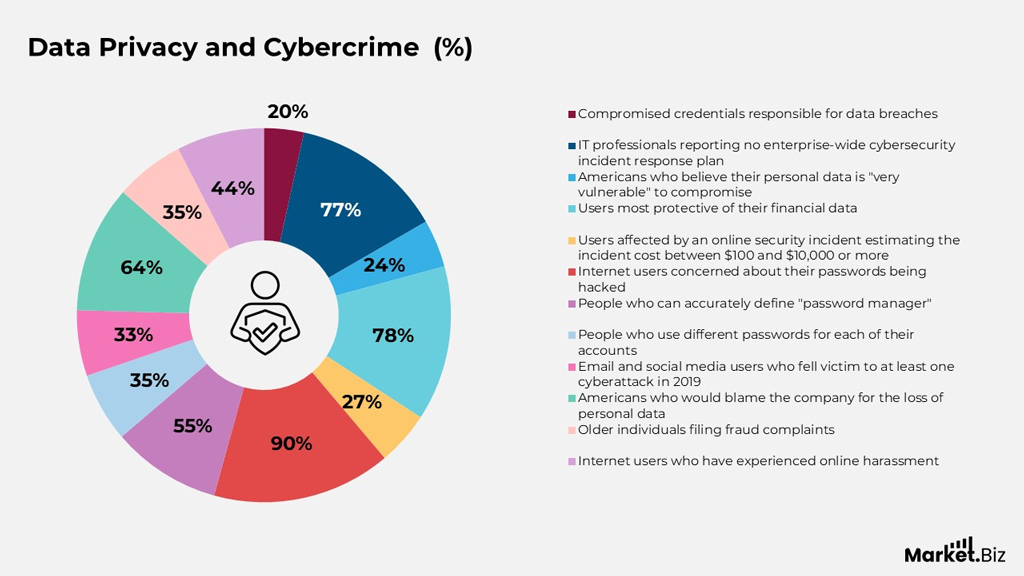
- 90% of internet users are concerned about their passwords being hacked, making it the top cybersecurity concern.
- 78% of users are most protective of their financial data, highlighting strong concerns over monetary security.
- 77% of IT professionals report having no enterprise-wide cybersecurity incident response plan in place.
- 64% of Americans would blame the company if their personal data were lost in a breach.
- 55% of people can accurately define a password manager, indicating moderate cybersecurity awareness.
- 44% of internet users have experienced online harassment, reflecting widespread digital safety issues.
- Only 35% of people use different passwords for every account, increasing exposure to credential theft.
- 35% of older individuals have filed fraud complaints, showing significant vulnerability among seniors.
- 33% of email and social media users fell victim to at least one cyberattack in 2019.
- 27% of users affected by online security incidents estimated losses between $100 and $10,000+.
- 24% of Americans believe their personal data is very vulnerable to compromise.
- 20% of data breaches are caused by compromised credentials, emphasizing the importance of strong authentication.
Artificial Intelligence (AI) and Data Privacy
- 90% of organizations have expanded privacy programs because of AI-related risks and governance concerns.
- 95% of organizations believe privacy protection is essential for building trust in AI systems.
- 13% of enterprises reported breaches involving AI models or AI applications during 2025.
- 63% of organizations still lack formal AI governance policies, exposing them to privacy and compliance risks.
- Only 12% of organizations consider their AI governance programs fully mature.
- 65% of organizations struggle to access high-quality data while maintaining privacy controls and regulatory compliance.
- 59% of consumers say privacy protections make them more willing to use AI-powered services.
- AI-related security incidents increase average breach costs by approximately $670,000.
- 97% of organizations experiencing AI-related breaches lacked adequate AI access controls.
- More than 80% of enterprises are evaluating privacy-enhancing technologies such as federated learning, synthetic data, and differential privacy for AI development.
Mobile and App Privacy Statistics
- 82% of users express concern over how apps collect and use personal data.
- Over 77% of mobile apps expose personally identifiable information through insecure practices.
- Roughly 80% of collected app data serves purposes unrelated to core functionality.
- About 60% of smartphone apps share customer data with third parties for advertising.
- Apps tracking consumers see a 2.2 times larger drop in downloads after mandatory privacy disclosures.
- Nearly 43% of smartphone users remain confused by the actual purpose of app tracking.
- Business applications are three times more likely to leak login credentials than average apps.
- More than 75% of all published mobile apps contain at least one high-risk security vulnerability.
Social Media Privacy Statistics
- More than 5.7 billion people use social media platforms worldwide as of 2026.
- Nearly 70% of social media users worry about how platforms collect and monetize their personal data.
- 38% of users report reducing their social media engagement due to data privacy concerns.
- 73% of people report that social platforms silently gather their personal information for targeting.
- 54% of consumers state that companies must work harder to earn their trust regarding data handling.
- 29% of internet users have actively changed their default privacy settings to restrict data access.
- 36% of users have completely deleted a social media account because of severe privacy worries.
- 31% of the public has zero confidence in social media companies to safeguard their data effectively.
- 89% of users are highly concerned about how social media platforms obtain personal data from children.
- Top social platforms have been fined over $3.1 billion collectively by regulators for data privacy violations.
Why Users Stay on Social Media Despite Privacy Concerns
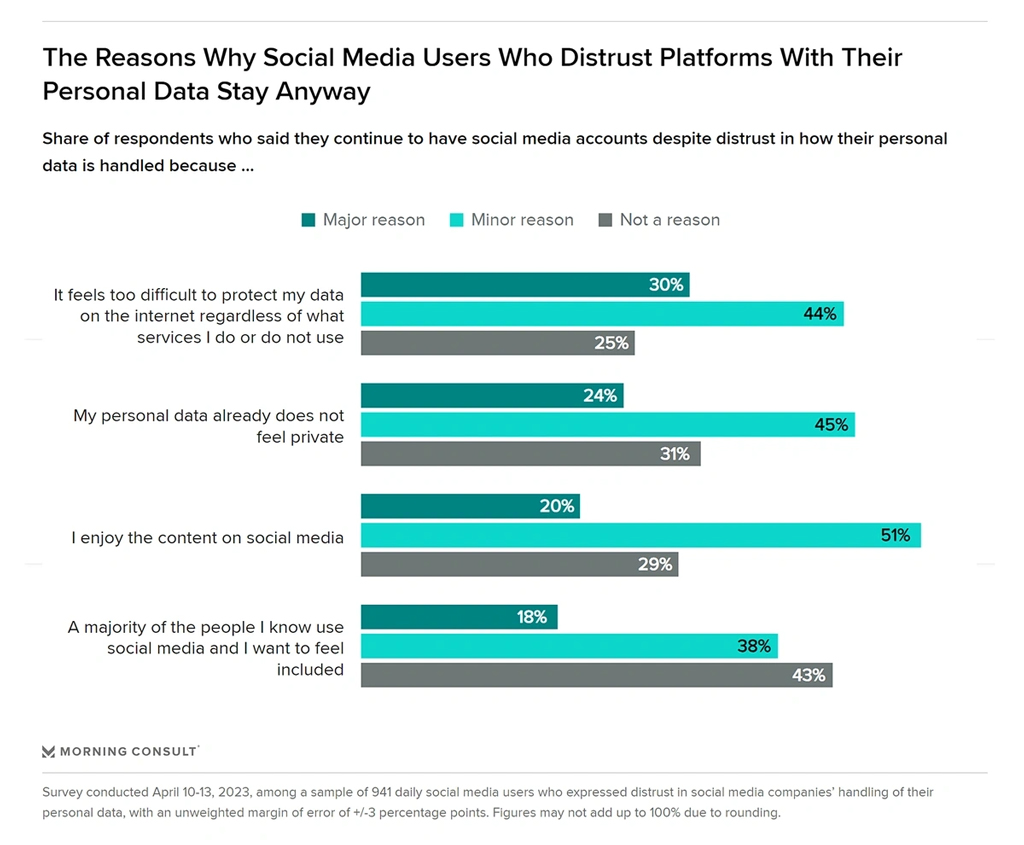
- 74% of users who distrust social media platforms stay because they feel protecting personal data online is too difficult (30% major reason, 44% minor reason).
- 69% continue using social media because their personal information already does not feel private (24% major reason, 45% minor reason).
- 71% remain active on social platforms because they enjoy the content, including 20% who consider it a major reason.
- 56% keep their accounts due to social inclusion and peer influence, while 43% say this is not a reason for staying.
- The most common motivation is content enjoyment, cited by 51% of respondents as a minor reason for remaining on social media.
- Nearly one-third (31%) of users believe their data is already exposed, making privacy concerns less influential in their decision to leave.
- Only 18% view staying connected with friends and social circles as a major reason for continuing to use social media.
- Just 25% say difficulty protecting personal data is not a reason, highlighting widespread privacy resignation among users.
- Privacy fatigue is evident, with 69%–74% of respondents citing data protection challenges or lost privacy as reasons for staying.
- Despite distrust in data handling practices, a majority of users continue using social media due to a mix of convenience, entertainment, and social connectivity.
Enterprise Data Privacy Statistics
- 99% of organizations report receiving measurable business value from privacy investments, including stronger customer trust and reduced risk exposure.
- 96% of enterprises say privacy has become a critical factor for enabling innovation and responsible data use.
- More than 90% of organizations expanded privacy governance programs due to AI adoption and increasing regulatory pressure.
- 89% of companies believe privacy compliance generates positive business outcomes beyond legal requirements.
- Enterprises with mature privacy programs achieve an average return of 1.6 times their privacy-related spending.
- 38% of organizations now spend more than $5 million annually on privacy and governance initiatives, up sharply from previous years.
- Over 70% of executives consider privacy a strategic business priority rather than a compliance function.
- Large enterprises increasingly integrate privacy teams into product development, cybersecurity, legal, and AI governance functions.
- More than 60% of organizations report increased board-level oversight of privacy and data governance risks.
- Enterprises with privacy-by-design frameworks generally experience faster regulatory response times and lower incident-management costs.
Cloud Data Privacy Statistics
- More than 94% of enterprises use cloud services in some form, making cloud privacy and governance central business concerns.
- Hybrid cloud environments experience average breach costs of approximately $5.05 million, higher than many traditional environments.
- Cloud misconfigurations remain among the leading causes of data exposure incidents worldwide.
- Nearly 45% of data breaches involve information stored across multiple environments, including cloud infrastructure.
- Organizations using security AI and automation in cloud environments reduce breach costs by over $1.7 million on average.
- More than 80% of enterprises identify cloud data governance as a top cybersecurity priority.
- Cloud-native security investments continue rising as organizations move sensitive workloads and regulated data into cloud platforms.
- Multi-cloud strategies are now common, with many enterprises operating across two or more major cloud providers.
- Encryption remains one of the most widely adopted cloud privacy controls for protecting customer and enterprise data.
- Organizations increasingly deploy privacy-enhancing technologies to support secure analytics and AI workloads in cloud environments.
Data Management Concerns Statistics
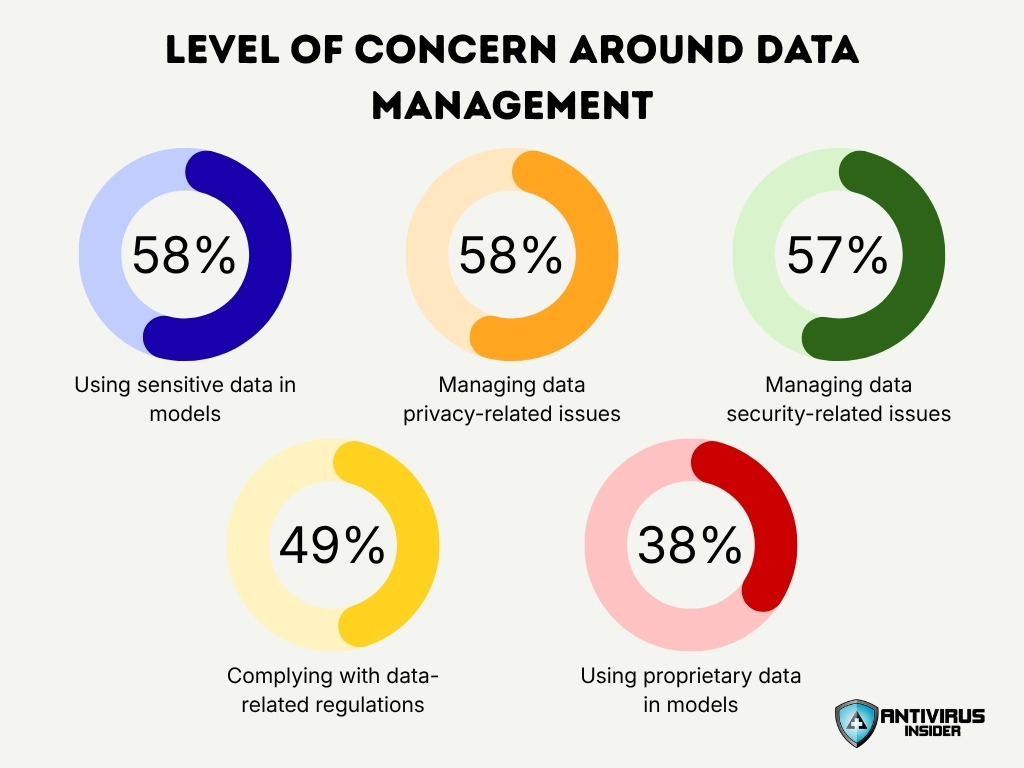
- Using sensitive data in models and managing data privacy-related issues are the top concerns, each cited by 58% of respondents.
- 57% of respondents are concerned about managing data security-related issues, making it a close third-ranked challenge.
- Nearly half (49%) of respondents worry about complying with data-related regulations and evolving compliance requirements.
- Concern over using proprietary data in models is lower but still significant, affecting 38% of respondents.
- The data shows that privacy, security, and sensitive data usage remain the most pressing data management challenges, with concern levels above 55%.
Employee and Remote Work Privacy Statistics
- Approximately 28% of paid workdays in the United States are performed remotely.
- Human error directly contributes to roughly 68% of all security and privacy incidents.
- More than 50% of breached organizations report significant cybersecurity staffing shortages.
- Over 70% of remote workers admit to using unsecured personal devices for official work tasks.
- Nearly 60% of employers currently utilize monitoring software to track remote workforce activity.
- About 45% of remote employees report experiencing targeted phishing attacks on their personal networks.
- Roughly 30% of remote workers regularly share their primary work devices with family members.
- Almost 80% of privacy professionals classify remote and hybrid work as a top enterprise vulnerability.
- Data breaches involving remote workforce vulnerabilities cost companies an average of $1 million more than traditional breaches.
Third-Party Tracking and Cookie Privacy Statistics
- Google’s decision to retain third-party cookies directly impacts Chrome’s massive 65% browser market share.
- Surveys confirm that over 70% of internet users remain highly concerned about behavioral advertising and data privacy.
- Approximately 65% of global websites now deploy cookie consent banners to meet strict international compliance standards.
- Users actively decline optional tracking frequently, driving average global cookie acceptance rates down to just 39%.
- Privacy-focused browsers like Safari and Firefox that block tracking by default now capture over 23% of web traffic.
- Contextual advertising has rebounded significantly, matching cookie-based targeting performance within a narrow 5% to 8% margin.
- Strict consent laws are causing organizations to lose up to 50% of their marketing analytics and user visibility.
- Leveraging first-party data boosts repeat purchases by 35% while slashing brand privacy risks by nearly 80%.
- Regulatory audits reveal that 28% of websites still utilize manipulative dark patterns to artificially inflate tracking consent.
- Modern privacy-enhancing technologies and server-side tracking can successfully recover up to 30% of lost conversion signals.
Future Data Privacy Predictions
- By 2028, 50% of organizations will adopt zero-trust data governance due to unverified AI-generated data.
- An estimated $3.425 billion in privacy-related fines were distributed by U.S. states throughout 2025.
- By 2027, over 40% of AI data breaches will stem from improper cross-border generative AI misuse.
- By 2028, 50% of enterprise cybersecurity incident response will focus on custom AI-driven applications.
- Around 84% of enterprise executives expect their organizations to increase funding for GenAI by 2026.
- By 2030, 50% of organizations will rely on autonomous AI agents to enforce governance and compliance.
- By 2028, exactly 25% of enterprise data breaches will be traced back to malicious AI agent abuse.
- By 2027, 60% of leaders will face critical failures in managing synthetic data, threatening AI governance.
Frequently Asked Questions (FAQs)
The average global cost of a data breach was $4.44 million in 2025.
The average cost of a data breach in the United States reached $10.22 million in 2025.
90% of organizations reported expanding their privacy programs due to AI-related requirements and risks.
93% of organizations planned to increase investments in privacy and data governance programs.
38% of organizations spent $5 million or more on privacy programs, up from 14% in 2024.
Conclusion
Data privacy continues to evolve from a compliance obligation into a strategic business priority. The statistics presented throughout this report show that organizations face growing pressure from consumers, regulators, cybercriminals, and emerging technologies such as artificial intelligence. At the same time, companies that invest in privacy governance, transparency, and security controls consistently report stronger trust, lower breach costs, and improved business outcomes.
Looking ahead, privacy regulations will likely expand, AI governance will become more sophisticated, and organizations will increasingly adopt privacy-enhancing technologies to protect sensitive information. Businesses that proactively strengthen privacy programs today will be better positioned to meet future regulatory requirements, reduce risk, and maintain customer confidence in an increasingly data-driven economy.
