



Fraud detection and prevention have become essential business functions as criminals exploit digital payments, compromised identities, social engineering and AI-assisted impersonation. Banks use fraud controls to screen account openings, monitor transactions and detect account takeover, while retailers and ecommerce companies analyse identity, device and payment signals to reduce chargebacks without unnecessarily blocking legitimate customers. At the same time, organizations face growing pressure from synthetic identities, deepfakes, mobile scams and first-party fraud, which often bypass traditional rule-based systems. The latest statistics show that fraud losses remain substantial, detection methods are evolving and investment in AI, biometrics and automated monitoring is accelerating across industries.
Editor’s Choice
- Reported U.S. consumer fraud losses reached about $16 billion in 2025, approximately 25% higher than in 2024 and the highest amount recorded in the underlying consumer-reporting data.
- Americans reported nearly $21 billion in losses from internet crime in 2025, while cryptocurrency-related complaints alone generated more than $11 billion in reported losses.
- Investment fraud produced approximately $8.65 billion in cyber-enabled fraud losses in 2025, making it the largest loss category within the published cyber-enabled fraud breakdown.
- Only 1 in 5 financial institutions in a 2025 North American study primarily used automated fraud strategies, while 44% relied mostly or entirely on manual processes.
- The global suspected digital fraud rate declined to 3.8% in 2025, but the suspected account takeover fraud rate increased 37% year over year.
- 8.3% of digital account creation attempts analyzed globally in 2025 showed suspected fraud, making account creation the highest-risk stage of the measured consumer lifecycle.
- Occupational fraud cases in the 2026 global study produced more than $3.4 billion in combined losses. The median loss reached $104,000, while the average exceeded $1.4 million.
Recent Developments
- In 2025, imposter scams generated $3.5 billion in reported U.S. consumer losses, nearly three times the amount reported in 2020.
- Nearly one-third of fraud reports in 2025 involved imposter scams, making impersonation the most frequently reported consumer fraud category.
- Consumers reported nearly $1 billion in losses to business impersonators during 2025, while government impersonation produced about $920 million in losses.
- New-account identity fraud accelerated in 2025: victims increased 31%, from 4.2 million in 2024 to 5.4 million in 2025.
- Account takeover also expanded. Victims increased 18%, from 5.1 million in 2024 to 6 million in 2025.
- U.S. data breach volume increased 47% from 2024 to 2025, adding more compromised identity data that criminals can potentially exploit in account creation and takeover attacks.
- Among U.S. businesses surveyed in 2025, 72% expected AI-generated fraud to become a major challenge, showing how generative AI and deepfakes have moved into mainstream fraud-risk planning.
- Financial institutions also reported more account takeover activity: 23% experienced account takeover fraud in the latest U.S. risk survey, a seven-percentage-point increase from 2024.
Global Fraud Statistics Overview
- The 2026 occupational fraud study analyzed 2,402 cases in 143 countries, providing a broad view of employee, management and executive fraud across organizations worldwide.
- Fraud examiners estimate that organizations lose approximately 5% of annual revenue to occupational fraud. The estimate remained a central benchmark in the 2026 global study.
- 20% of occupational fraud cases analyzed in the 2026 study produced losses exceeding $1 million.
- Among consumers surveyed across 18 countries and regions, 26% said they lost money to digital fraud during the previous year.
- In an earlier global survey covering late 2024, 53% of adults said criminals had targeted them through email, online channels, phone calls or text messages.
- Among surveyed consumers who lost money to those fraud schemes, the median reported loss was $1,747.
- Global suspected digital account takeover attempts increased 20% from 2023 to 2024, illustrating the shift toward compromised-account attacks before the further rise recorded in 2025.
- Historically, financial crime operates at an even larger scale than direct fraud losses. Research covering 2023 estimated more than $485 billion in global fraud losses and approximately $3.1 trillion in illicit funds and money laundering activity.
Fraud Detection and Prevention Market Growth
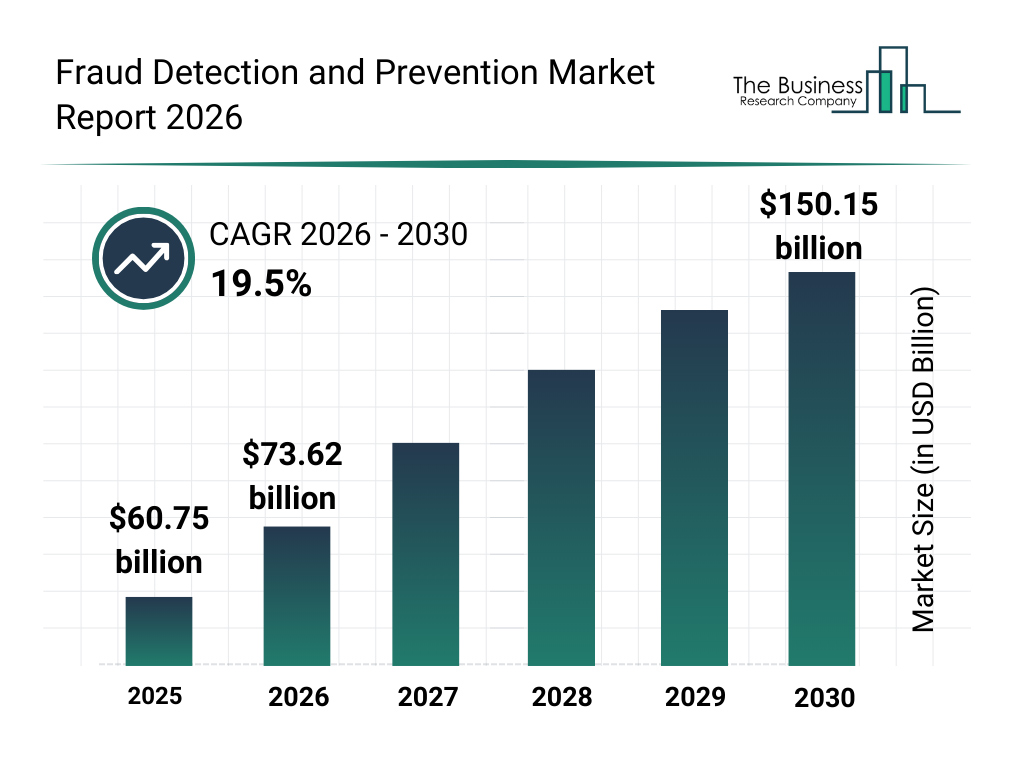
- The global fraud detection and prevention market is projected to grow from $60.75 billion in 2025 to $150.15 billion by 2030, highlighting strong demand for fraud-fighting technologies.
- In 2026, the market is expected to reach $73.62 billion, up significantly from $60.75 billion in 2025.
- Between 2026 and 2030, the fraud detection and prevention market is forecast to expand at a robust 19.5% CAGR.
- By 2030, the market is expected to be worth more than 2.4 times its 2025 value, reflecting rapid investment in fraud prevention solutions.
- The market is projected to add approximately $89.4 billion in value between 2025 and 2030, representing substantial growth over the five-year period.
Fraud Losses by Industry Sector
- U.S. financial services organizations incurred an estimated $5.75 in total costs for every $1 lost directly to fraud in the 2025 fraud-cost study, compared with $4 in 2021.
- U.S. retail and ecommerce businesses reached approximately $5.13 in total costs per $1 of direct fraud loss in the 2026 study, crossing the $5 threshold.
- For comparison, U.S. merchants faced an average $4.61 cost for every $1 lost to fraud in the 2025 retail and ecommerce study.
- Mobile transactions accounted for 33% of U.S. merchant fraud expenses in the 2025 study, covering channels such as digital wallets, peer-to-peer payments and QR-code transactions.
- Health care accounted for more than $5.7 billion of the $6.8 billion-plus in False Claims Act settlements and judgments reported for fiscal 2025.
- A major 2025 U.S. health care enforcement action charged 324 defendants in alleged schemes involving more than $14.6 billion in intended losses. Authorities also seized more than $245 million in assets.
- Debit cards generated 40% of total payments-fraud losses reported by surveyed U.S. financial institutions in the latest 2026 risk study. In addition, 75% of institutions experienced debit-card fraud attempts.
- U.S. publicly traded companies in a 2024 study reported known fraud losses equal to a median 1.06% of annual revenue, demonstrating that internal fraud can materially affect large corporations even before unknown losses enter the calculation.
Fraud Detection Rates and Performance Metrics
- Tips detected 43% of occupational fraud cases in the 2026 global study, making tips the leading detection method once again.
- Employees supplied more than half of fraud-detection tips, highlighting the measurable role of internal reporting channels in detecting workplace fraud.
- A typical occupational fraud scheme continued for 12 months before detection in the 2026 study.
- Fraud schemes detected within six months generated a median loss of about $40,000, showing the financial benefit associated with faster detection.
- In contrast, occupational fraud schemes that continued for more than five years produced median losses above $1.1 million.
- The median loss across all occupational fraud cases analyzed in 2026 was $104,000, while the average reached approximately $1.457 million because large cases pulled the mean sharply upward.
- 84% of occupational fraud perpetrators displayed at least one behavioral red flag before detection, giving organizations another measurable signal for fraud-risk programs.
- After detection, employers terminated 68% of identified occupational fraud perpetrators, while 54% of the analyzed cases were referred to law enforcement.
Most Common Types of Fraud
- Imposter scams generated over 1 million reports, remaining the most frequently reported U.S. consumer fraud category in 2025.
- Investment scams caused the largest consumer losses in that dataset, reaching approximately $7.9 billion in 2025.
- Cyber-enabled investment fraud produced $8.65 billion in losses in 2025, followed by business email compromise at $3.05 billion.
- Tech-support fraud generated approximately $2.13 billion in cyber-enabled losses in 2025.
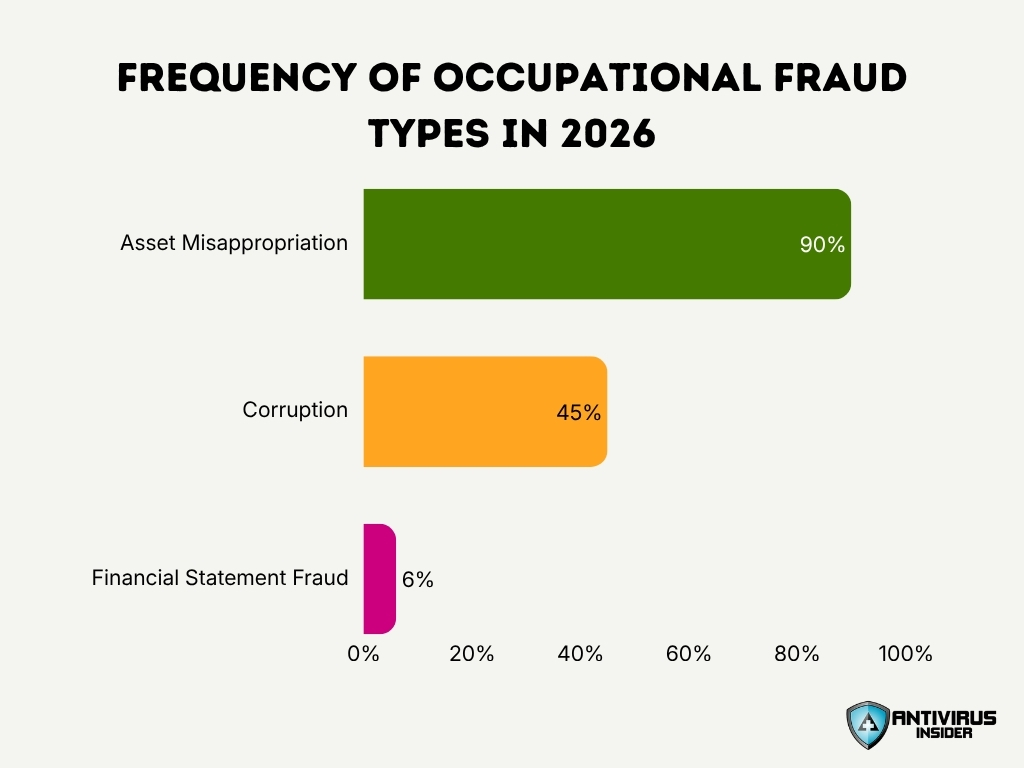
- Asset misappropriation appeared in 90% of occupational fraud cases in 2026, making it the most common workplace fraud.
- Corruption appeared in 45% of occupational fraud cases in 2026, compared to just 10% in 1996.
- Financial statement fraud occurred in only 6% of cases but generated a median loss of $1 million per case.
- Check-fraud attempts were reported by 63% of U.S. financial institutions, with 32% reporting an increase in counterfeit checks.
Account Takeover and Identity Fraud Statistics
- The suspected global digital account takeover fraud rate increased 37% from 2024 to 2025, even as the overall suspected digital fraud rate declined.
- Account takeover affected approximately 6 million U.S. victims in 2025, an 18% increase from 5.1 million victims in 2024.
- New-account identity fraud affected about 5.4 million people in 2025, up 31% from 4.2 million in 2024.
- Traditional identity fraud caused $27.3 billion in losses during 2025 and affected approximately 18 million victims.
- Victims spent an average of 10.4 hours resolving identity fraud in 2025. Account takeover victims spent roughly 17 hours, while new-account fraud victims spent 17.8 hours.
- More than 5,100 U.S. account takeover complaints filed from January through November 2025 reported losses exceeding $262 million.
- Separate industry estimates put U.S. account takeover losses above $15.6 billion in 2024, compared with $12.7 billion in 2023.
- Account takeover reports submitted through U.S. suspicious activity reporting channels increased by more than 36% in 2024 compared with 2023.
- In another 2025 fraud dataset, 78,387 account takeover cases were recorded, 6% more than in 2024. Identity fraud and account takeover together represented 72% of recorded fraud-risk cases.
- Among U.S. consumers who lost money to digital fraud, 29% identified identity theft and 27% identified account takeover as a cause of their losses.
Payment and Transaction Fraud Statistics
- Debit cards remained the most commonly targeted payment type among surveyed U.S. financial institutions, with 75% reporting attempted debit-card fraud and 56% reporting resulting losses.
- Debit-card fraud represented approximately 40% of total payment fraud losses reported by surveyed financial institutions.
- Check fraud attempts affected 63% of surveyed institutions, while 31% experienced actual check-related losses. Checks represented about 18% of total reported payment fraud losses.
- ACH fraud attempts affected 34% of institutions, while 10% experienced losses. ACH transactions represented about 8% of payment fraud losses.
- Faster payments, including bank mobile payments, showed the largest year-over-year increase: attempted fraud rose 6 percentage points, while institutions reporting losses increased four points.
- Nonbank payment applications generated fraud attempts at 35% of surveyed institutions, with 18% reporting losses connected to these payment channels.
- In one European payments market, fraudulent bank transfers, card transactions and cash withdrawals increased 30% to roughly 658,000 transactions in 2025. Their combined value increased 22% to €198 million.
- Card transactions accounted for 514,000 fraudulent payments in that market during 2025, more than 25% higher than in 2024. Their fraud value increased from €36 million to €41 million.
- Across the European Economic Area, payment fraud reached approximately €4.2 billion in 2024, compared with €3.5 billion in 2023, although fraud represented only around 0.002% of total payment value.
- Payment authentication continues to limit conventional unauthorized card fraud, but regulators report increasing losses from payer-manipulation scams, where criminals convince legitimate users to authorize payments themselves.
Ecommerce Fraud Trends
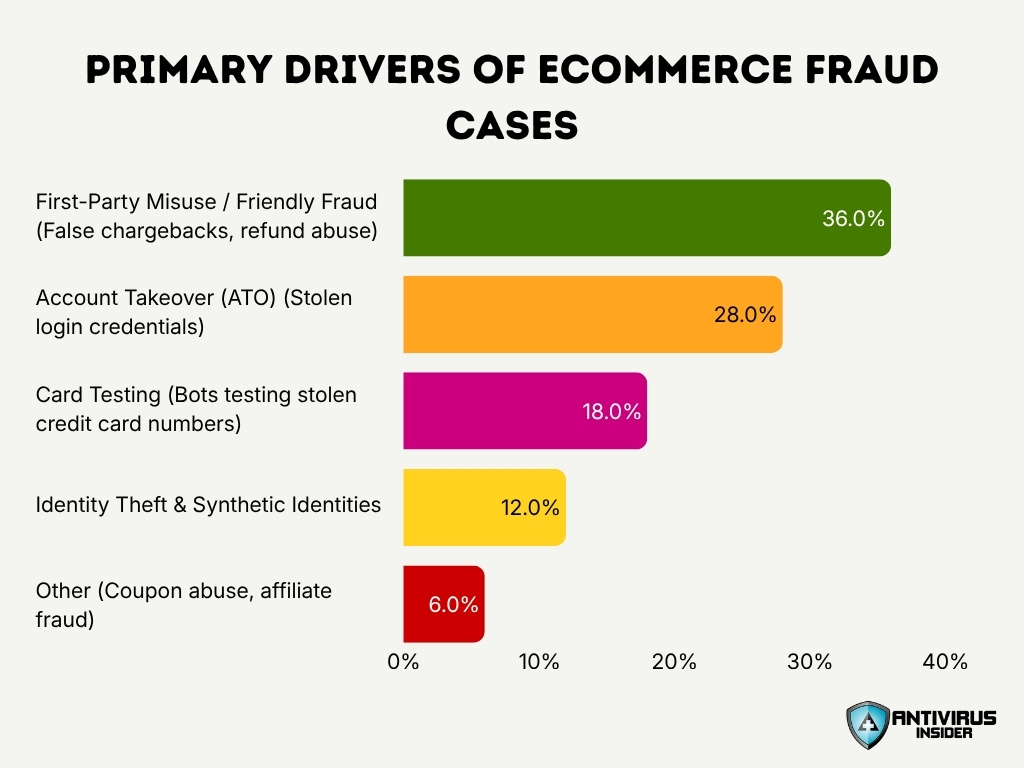
- First-party misuse and friendly fraud is the largest ecommerce fraud category, accounting for 36% of total cases, primarily through false chargebacks and refund abuse.
- Account takeover (ATO) ranks second at 28%, highlighting the persistent threat posed by stolen login credentials and compromised customer accounts.
- Card testing represents 18% of ecommerce fraud cases, as fraudsters use automated bots to verify stolen credit card details before larger transactions.
- Identity theft and synthetic identities contribute another 12%, showing that fraudulent or fabricated customer identities remain a significant risk for online merchants.
- Coupon abuse, affiliate fraud, and other schemes collectively make up the remaining 6% of reported ecommerce fraud cases.
- Combined, friendly fraud and account takeover account for 64% of all cases, making these two categories the dominant drivers of ecommerce fraud in 2026.
False Positives and Decline Rates
- Around 6 in 10 ecommerce merchants in a 2025 global survey reported false-positive rates between 2% and 10% of disputed ecommerce orders.
- The share of merchants reporting false-positive rates above 10% declined from 19% in 2024 to 14% in 2025.
- Meanwhile, 32% of surveyed merchants reported false-positive rates between 2.01% and 5% in 2025, compared with 24% in the previous survey.
- Among merchants participating in a specialized fraud-risk community, 55% reported false-positive rates of 2% or less, compared with just 13% of comparable nonmember enterprises.
- Half of enterprise businesses surveyed for a 2026 fraud report said false declines were increasing, while static controls could block as many as 10% of legitimate customers at checkout.
- In the same 2026 study, 58% of businesses reported increasing manual-review costs, showing how overly cautious fraud decisions also raise operational expenses.
- Global ecommerce sales lost to false declines were estimated at approximately $201 billion in 2025 and are projected to reach roughly $231 billion in 2026.
- An estimated 1.51% of annual ecommerce sales are lost because legitimate transactions receive false declines.
- False declines have a measurable loyalty impact: 33% of surveyed consumers said they would not shop with a business again after experiencing one.
- Scam-alert accuracy remains difficult for banks. In a global banking survey, 58% could not provide false-positive data, among the institutions that did, half reported scam-alert false-positive rates above 80%.
AI and Machine Learning in Fraud Detection
- In an August 2026 U.S. survey, 80% of businesses said they use machine learning or generative AI within fraud management environments.
- The comparable 2025 survey found that only more than one-third of businesses reported using AI, including generative AI, to fight fraud, illustrating the pace of adoption over the past year.
- Another financial-services survey found 99% of organizations already used some form of AI or machine learning to combat fraud, while 93% believed AI would transform fraud detection.
- In 2026 financial-crime research, 58% of organizations had machine learning in production, while 35% had generative AI or large language models operating in production environments.
- The same study found 89% of financial institutions were either using or evaluating AI-based anti-financial-crime technology.
- Fraud detection ranked among the highest-value AI applications: 21% of respondents identified it as one of the areas where AI produced the greatest efficiency and effectiveness gains.
- Among EMEA banks surveyed in 2025, 58% used AI for fraud detection, AML or Know Your Customer models. Adoption among insurers stood at 30%.
- Machine learning remains a foundational fraud technology, with 66% of surveyed banks using ML for fraud prevention and 48% already applying generative AI to the same function.
- Among midsize companies, 45% reported using AI for fraud detection in 2025, compared with 48% in 2024 and 35% in 2023.
- Despite growing deployment, organizational readiness remains limited: only 7% of anti-fraud professionals surveyed globally in 2026 said their organizations were more than moderately prepared to detect or prevent AI-enabled fraud.
AI Leads Investment in Modern Fraud Prevention
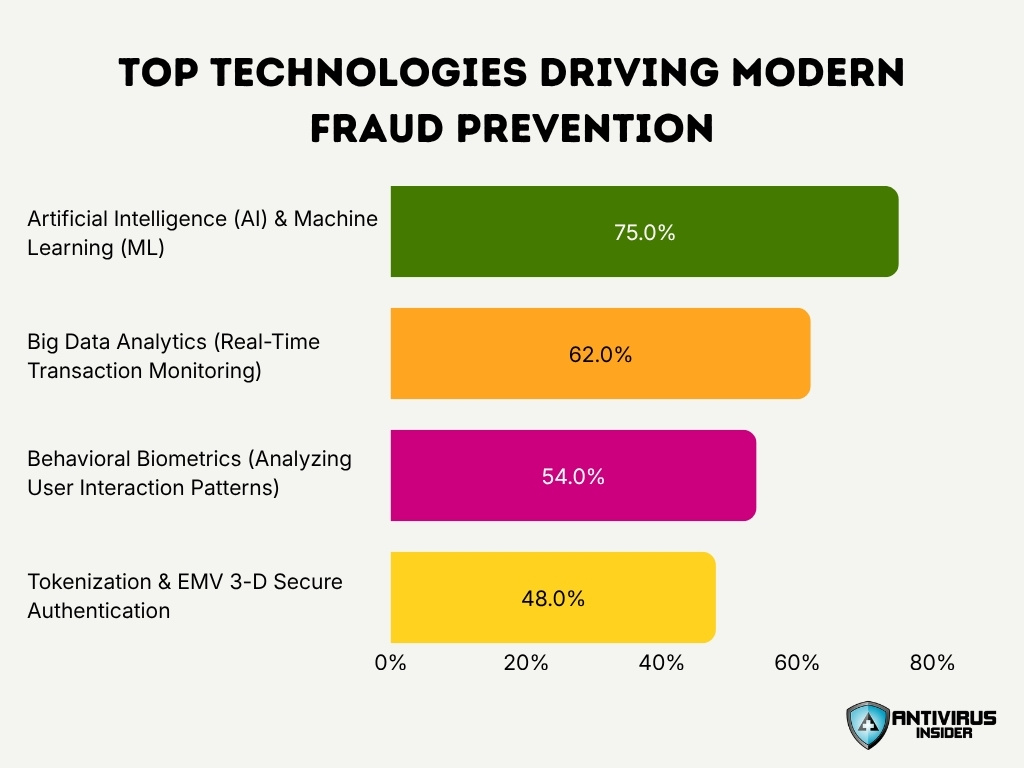
- AI and machine learning lead fraud prevention investments, with 75% of enterprises actively investing in these technologies.
- Big data analytics ranks second at 62%, highlighting strong demand for real-time transaction monitoring.
- Behavioral biometrics attracts investment from 54% of enterprises, as organizations increasingly analyze user interaction patterns to identify suspicious activity.
- Tokenization and EMV 3-D Secure authentication account for 48%, showing that nearly half of enterprises are strengthening payment and authentication security.
- The 27-percentage-point gap between AI/ML and tokenization technologies indicates that enterprises are prioritizing intelligent, data-driven fraud detection alongside traditional security controls.
First-Party vs. Third-Party Fraud Statistics
- First-party fraud accounted for approximately 20% of payment disputes in 2025, based on research involving merchants and issuers.
- 48% of consumers in the same research had disputed at least one charge that they later recognized as legitimate, showing why some first-party disputes originate from confusion rather than intentional abuse.
- In a global business survey, first-party application fraud represented 16% of reported fraud losses, while third-party application fraud represented another 16%.
- U.S. businesses reported a different mix: first-party application fraud generated approximately 13% of reported fraud losses, compared with 10% for third-party application fraud.
- Account takeover caused 31% of fraud losses reported by U.S. businesses, exceeding both first-party and third-party application fraud in the same dataset.
- Synthetic identity fraud accounted for approximately 24% of U.S. business fraud losses, illustrating how blended or fabricated identities blur the boundary between conventional first- and third-party schemes.
- Globally, synthetic identity fraud represented 20% of business fraud losses, equal to the share attributed to account takeover.
- Scams and authorized fraud remained the largest global category in that survey, causing 24% of business fraud losses, compared with 16% each for first- and third-party application fraud.
- False applications declined 24% during 2025 in one large fraud database, with 16,431 cases recorded. Bank-account false applications declined 27%.
- Nearly 70% of businesses surveyed in 2026 expected fraud and abuse to restrict revenue growth during the following 12 to 24 months, reflecting the commercial impact of first-party misuse as well as conventional external fraud.
Deepfake and AI-Enabled Fraud Growth
- Deepfake selfies used in identity attacks increased 58% during 2025, showing continued growth in AI-generated biometric fraud.
- Injection attacks, which feed manipulated images or video directly into identity-verification systems, increased 40% year over year.
- Deepfakes accounted for approximately 1 in 5 biometric fraud attempts in recent identity-verification data.
- Among anti-fraud professionals surveyed in 2026, 77% reported an increase in deepfake social-engineering fraud during the previous two years. It recorded the largest increase among the AI-enabled fraud methods studied.
- Generative AI document fraud or forgery increased according to 75% of surveyed fraud professionals, placing fabricated documents alongside consumer scams as one of the fastest-growing AI risks.
- Deepfake digital injection attacks increased according to 72% of respondents, highlighting the growing use of generated content to bypass remote verification systems.
- Looking forward, 55% of fraud professionals expect deepfake social engineering to increase significantly during the next 24 months. The same percentage expects a significant increase in generative AI document fraud.
- One 2026 identity-fraud analysis projects that deepfake identity fraud could increase approximately 495% during 2026 compared with 2025 if first-half trends continue.
- AI-enabled fraud already reaches consumers directly: 20% of adults globally in a 2026 survey said they had encountered an AI-enabled scam.
- In India, consumers reported encountering an average of four deepfakes per day in a 2026 survey, while more than one-third said they lacked confidence in their ability to identify a deepfake scam.
Synthetic Identity and Document Fraud Data
- U.S. lender exposure to synthetic identities across auto loans, bank cards, retail cards and unsecured personal loans reached an all-time high of $3.3 billion at the end of 2024.
- Synthetic identity fraud represented 24% of reported U.S. business fraud losses in one global survey, making it one of the largest fraud-loss categories for American organizations.
- Globally, synthetic identities accounted for approximately 20% of business fraud losses, equal to the share attributed to account takeover.
- Digital document forgeries increased 244% year over year in data published for the 2025 identity fraud landscape.
- Digital forgery accounted for approximately 57% of document fraud during the earlier reporting period, overtaking physical counterfeit documents for the first time in that dataset.
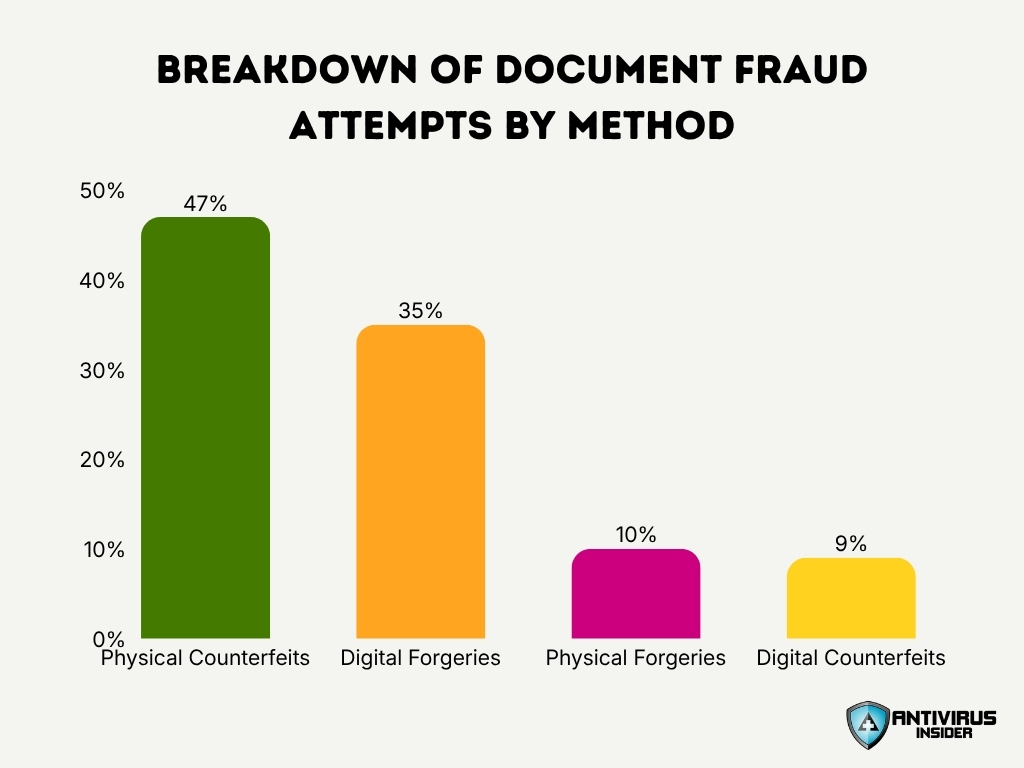
- More recent 2025 verification data showed digital forgeries at 35% of document fraud attempts, compared with 47% for physical counterfeits, 10% for physical forgeries and 9% for digital counterfeits.
- National identity cards accounted for 46% of fraudulent document submissions globally in 2025, including approximately 60% in Asia-Pacific and 45% in Europe, the Middle East and Africa.
- In the Americas, driver’s licenses represented 37% of fraudulent document submissions, making them a particularly prominent regional target.
- U.S. synthetic identity document fraud increased by more than 300% in the first quarter of 2025 compared with the first quarter of 2024 in one cross-industry verification dataset.
- Analysis of more than 4 million global fraud attempts found that identity cards accounted for approximately 72% of fraudulent documents in the 2025 reporting period, while sophisticated fraud increased 180% from the prior year.
Mobile and Digital Channel Fraud Statistics
- Mobile fraud sessions in a 2026 Indian banking dataset increased 67% year over year, demonstrating how attacks continue to migrate from desktop browsers toward smartphones.
- Fraud sessions originating on iOS devices increased 86%, substantially faster than the overall mobile fraud rate in the same analysis.
- Android-based fraud sessions increased 35%, confirming that the rise in mobile fraud affected both major smartphone ecosystems.
- Meanwhile, browser-based fraud sessions declined 10%, providing further evidence of the shift from conventional web fraud toward mobile-first attacks.
- Text-message-based scams increased 146% when the second half of 2025 and first half of 2026 were compared with the equivalent year-earlier period.
- Among Indian consumers who had experienced scams, 46% encountered scammers through messaging applications, making messaging the most commonly reported contact channel.
- SMS represented another major mobile attack channel, cited by 37% of scam victims in the same consumer research. Voice calls reached 32%.
- More than 10% growth in fraud targeting mobile transactions was reported by many U.S. and Canadian retail and ecommerce organizations surveyed for a 2026 study.
- Mobile money processed more than $2 trillion in transactions during 2025, around one-fifth more than the previous year. Although this figure does not represent fraud losses, it shows the expanding financial value that mobile-fraud controls must protect.
- Mobile money merchant payments grew by almost 50% to $155 billion in 2025, expanding the transaction environment in which mobile identity, payment and account controls operate.
Regional Fraud Statistics
- The global suspected digital fraud rate stood at 3.8% in 2025, providing a benchmark for comparing individual markets.
- The U.S. recorded a 3.4% suspected digital fraud rate during 2025, slightly below the measured global rate.
- Canada recorded a higher 4.4% rate, one percentage point above the U.S. figure in the same global dataset.
- India recorded a 7.1% suspected digital fraud rate in 2025, nearly twice the global benchmark despite a decline from earlier periods.
- The Philippines recorded a 4.1% suspected digital fraud rate in 2025 after rates had reached substantially higher levels during earlier reporting periods.
- The U.K. recorded a 2% suspected digital fraud rate, while Spain stood at 2.6% in the same international comparison.
- Nicaragua recorded a 12.5% suspected digital fraud rate, the highest rate among the countries and territories displayed in the 2025 global comparison.
- The Dominican Republic recorded 6.5%, while Brazil stood at 3.8%, Mexico at 2.1% and Colombia at 2.3%.
- Across ASEAN markets, the share of consumers saying they had been scammed rose from 31% in 2024 to 45% in 2025 in a regional 2026 update.
- Across a separate 2026 APAC survey, 23% of consumers had personally been targeted by scams within the previous two years, and 42% of those targeted lost money.
Fraud Detection Technology Adoption Rates
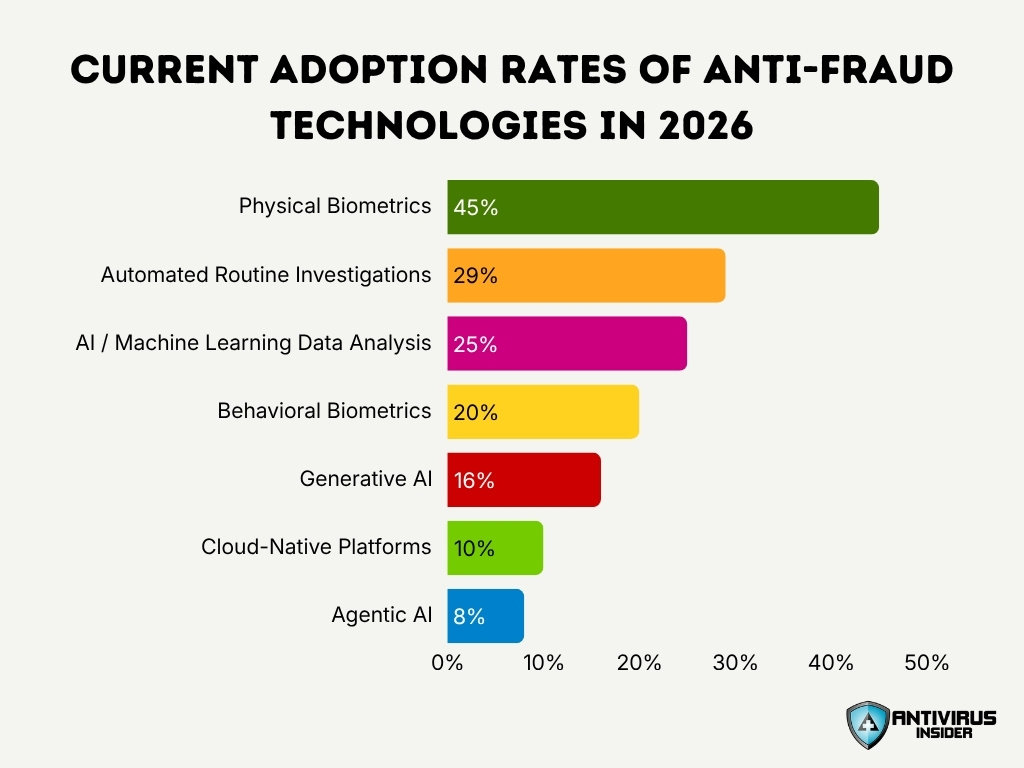
- 25% of organizations surveyed in 2026 used AI or machine learning in their anti-fraud data-analysis programs, up from 18% in the 2024 study.
- Another 28% expect to adopt AI or machine learning by 2028, which could push these technologies into use by more than half of surveyed organizations if plans materialize.
- Generative AI currently forms part of fraud prevention at 16% of organizations, while another 58% say they plan to use it in the future.
- Among current generative AI users, 49% apply it to phishing and scam detection, 46% use it for risk identification or assessment, and 45% use it for report writing.
- Agentic AI remains less common: 8% of organizations currently use AI agents for fraud fighting, although another 31% expect to deploy them by 2028.
- Physical biometrics reached 45% adoption in 2026, up from 34% in 2022, making it the most widely adopted emerging anti-fraud technology measured in the study.
- Behavioral biometrics is currently used by 20% of surveyed organizations, with another 19% expecting to implement it within the next two years.
- Only 29% of organizations automate routine fraud-investigation tasks, leaving substantial room for automation in case triage, data gathering and investigative workflows.
- Cloud-native fraud detection platforms have reached only 10% adoption, despite the need to analyze increasingly large volumes of digital transactions and identity data.
- Investment should continue rising: 55% of surveyed organizations expect anti-fraud technology budgets to increase during the next two years.
Emerging Fraud Trends and Predictions
- 67% of business leaders across a 2026 international study expect their organizations to experience more fraud attacks in 2026 than they did in the previous year.
- At the same time, 68% say their existing fraud technology cannot keep pace with increasingly sophisticated attacks, indicating a significant gap between threat growth and defensive capability.
- Agentic commerce represents a new risk category: 85% of financial-services respondents expect AI agents eventually to initiate and execute payments on behalf of consumers.
- However, 65% believe autonomous AI payments will require a new authorization model, reflecting uncertainty over who should approve, authenticate and assume liability for an AI-initiated transaction.
- Fraud detection already ranks among the main AI-agent applications in financial services, with 41% citing it as a use case.
- Quantum technology is moving onto fraud teams’ long-term agendas: 62% of anti-fraud professionals expect quantum computing or quantum AI to materially affect fraud detection and prevention by 2030.
- Another 11% say quantum technology already affects fraud detection or prevention, despite the technology remaining early in commercial deployment.
- Ecommerce organizations also see AI-enabled abuse accelerating: 64% of merchants surveyed in 2026 experienced AI-enabled fraud or abuse during the previous year.
- Yet approximately one-third of those merchants lacked AI-powered anti-fraud tools, creating a defensive gap as attackers automate more activity.
- Customer abuse is also becoming a larger concern: 43% of ecommerce merchants reported an increase in customer-originated fraud during the previous year, showing that future controls must address legitimate customers as well as stolen identities.
Frequently Asked Questions (FAQs)
U.S. consumers reported $15.9 billion in fraud losses in 2025, up from more than $12 billion in 2024.
Americans reported nearly $21 billion in internet crime losses in 2025, a 26% increase from 2024.
The global suspected digital fraud rate was 3.8% in 2025, while 8.3% of digital account-creation attempts were suspected of fraud.
The suspected digital account takeover fraud rate increased 37% from 2024 to 2025, while the number of U.S. account takeover victims increased 18% to 6 million.
In 2026, 25% of organizations reported using AI or machine learning in anti-fraud data analysis, up from 18% in 2024, while another 28% expect to adopt the technology by 2028.
Conclusion
Fraud detection now extends well beyond blocking suspicious transactions. Organizations must distinguish legitimate customers from compromised accounts, synthetic identities, deepfakes, manipulated documents and increasingly automated attacks while also limiting false declines and unnecessary customer friction. The data shows that fraud is expanding across payments, ecommerce, mobile channels and digital identity, while AI is strengthening both criminal tactics and defensive capabilities.
Businesses are responding by increasing investment in machine learning, biometrics, behavioral analytics and automated investigations. However, technology alone does not eliminate fraud risk. Effective prevention increasingly depends on combining accurate identity signals, real-time transaction monitoring, strong authentication and faster detection with controls that adapt as attack methods change. As fraud becomes more automated and identity-focused, organizations that improve both detection accuracy and customer experience will be better positioned to reduce financial losses and maintain trust.
