



Biometric technology has become a core part of digital identity, secure authentication, and fraud prevention across the US and worldwide. Organizations now use fingerprints, facial recognition, iris scans, voice authentication, and behavioral biometrics to protect users while reducing reliance on passwords. Banks verify customers in seconds, airports automate passenger screening, and healthcare providers secure patient records through biometric authentication. As AI continues to improve biometric accuracy and speed, the technology is expanding into new industries and everyday devices. Explore the statistics below to understand how biometric technology is shaping security, digital services, and customer experiences.
Editor’s Choice
- The global biometrics market is projected to grow from $58.98 billion in 2025 to $67.86 billion in 2026, representing a 15.1% annual increase.
- The global biometrics market is forecast to reach $136.86 billion by 2031, driven by digital identity programs and passwordless authentication.
- The next-generation biometric authentication market is expected to expand from $66.97 billion in 2025 to $82.17 billion in 2026, reflecting a 22.7% CAGR.
- Fingerprint recognition remains the largest biometric modality across consumer electronics because of its balance of cost, speed, and accuracy.
- North America accounted for approximately 36% of the global facial recognition market in 2025, making it the largest regional market.
- Governments continue expanding biometric identity programs to improve border security, digital services, and national ID systems worldwide.
- AI-powered multimodal authentication is becoming the preferred enterprise approach because it combines multiple biometric traits to improve security while reducing false matches.
Recent Developments
- During 2026, biometric vendors increasingly shifted toward cloud-native identity platforms that support large-scale authentication across enterprises.
- Governments worldwide continue investing in digital identity infrastructure, accelerating deployments of biometric verification for public services.
- Financial institutions expanded facial verification and liveness detection to strengthen online account opening and fraud prevention throughout 2025-2026.
- Retail businesses increased the rollout of biometric payment systems, allowing customers to complete purchases without cards or phones.
- Airports continue adopting biometric boarding, passport verification, and automated immigration checkpoints to reduce passenger processing times.
- Organizations increasingly combine AI with behavioral biometrics to identify suspicious login behavior in real time.
- Privacy regulations in Europe and several other regions continue encouraging vendors to improve consent management and responsible biometric data handling.
- Several governments introduced additional oversight for AI-enabled biometric systems during 2026, reflecting growing attention to security and governance.
- Passwordless authentication initiatives accelerated across enterprises as organizations replaced passwords with biometrics and security keys.
Biometrics Market Growth Statistics
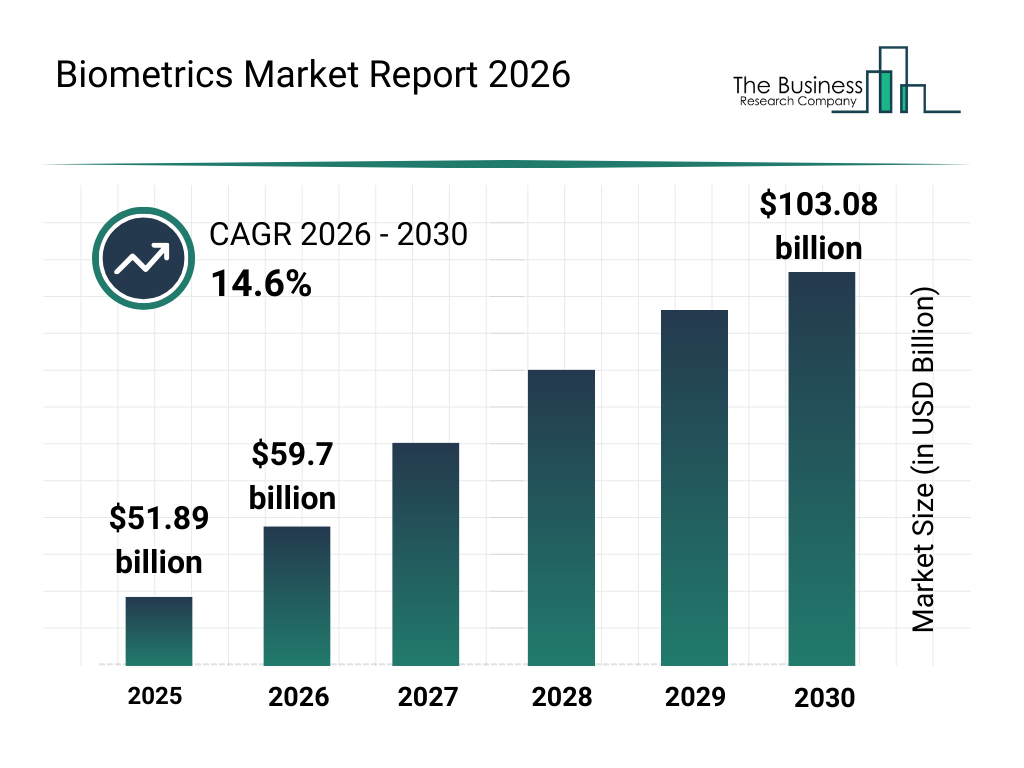
- The global biometrics market was valued at $51.89 billion in 2025.
- Market revenue is expected to increase to $59.70 billion in 2026.
- The biometrics market is projected to reach approximately $68.42 billion by 2027.
- By 2028, the market could expand to nearly $78.40 billion.
- Global biometrics revenue is estimated to approach $89.85 billion in 2029.
- The market is forecast to surpass $103.08 billion by 2030.
- From 2026 to 2030, the biometrics market is expected to grow at a strong 14.6% CAGR.
- Overall, the market is projected to gain more than $51 billion between 2025 and 2030.
Fingerprint Recognition Statistics
- The global fingerprint sensors market is projected to grow from $4.44 billion in 2025 to $8.44 billion by 2035.
- In 2025, the Asia-Pacific region dominated the fingerprint sensor market with a 44% market share.
- The smartphones and tablets segment accounted for roughly 55% of the fingerprint sensor market in 2025.
- Touch fingerprint sensors are expected to dominate the biometric market with a 58% share in 2026.
- The banking and finance sector is anticipated to hold 44.6% of the fingerprint sensor market in 2026.
- Optical fingerprint sensors are projected to account for 53.8% of the overall market share in 2026.
- The U.S. fingerprint sensor market was valued at $1.80 billion in 2025 and will reach $3.42 billion by 2035.
- Approximately 77% of consumers using mobile biometrics express high satisfaction with the technology.
- Roughly 62% of consumers are willing to switch banks to receive a secure biometric payment card.
- The global mobile biometrics demand is projected to rise at a 22.6% CAGR from 2025 to 2032.
Facial Recognition Statistics
- The global market is projected to grow from $8.58 billion in 2025 to $9.95 billion in 2026.
- Analysts expect the global facial recognition market to reach $20.88 billion by 2031.
- Industry forecasts estimate a 12.8% CAGR, reaching $19.6 billion by 2033.
- North America accounted for approximately 36% of global market revenue in 2025.
- The security and access control segment holds a significant market share of 46.9%.
- 3D facial recognition systems are over 90% more accurate in detecting spoofing attempts.
- AI-powered facial recognition in surveillance has reduced human error by up to 40%.
- Organizations using AI-driven biometric authentication achieved a 99% accuracy rate.
- The retail and e-commerce sectors accounted for 22% of global market revenue in 2025.
Biometric Authentication Market Share
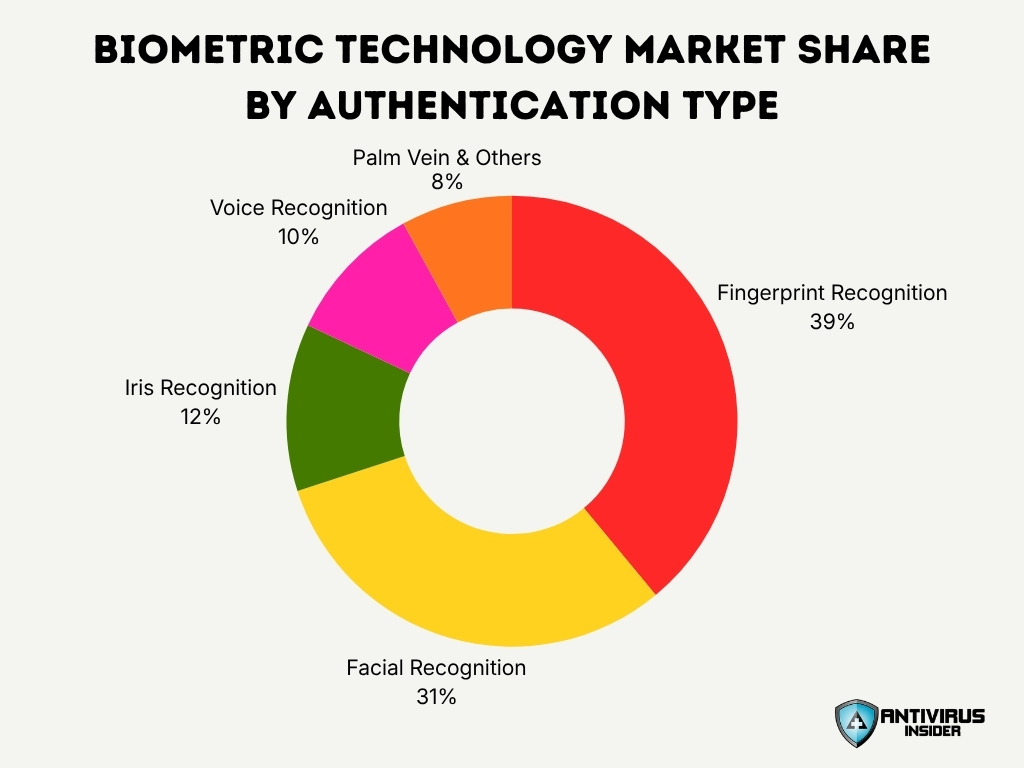
- Fingerprint recognition leads the biometric authentication market with a 39% share, making it the most widely adopted method in 2026.
- Facial recognition ranks second with 31%, showing strong demand across smartphones, security systems, banking, and identity verification.
- Together, fingerprint and facial recognition account for 70% of the market, highlighting the dominance of convenient and contactless authentication technologies.
- Iris recognition holds a 12% market share, supported by its high accuracy in border control, government identification, and secure access applications.
- Voice recognition represents 10% of the market, with adoption growing in customer service, banking, and voice-enabled digital platforms.
- Palm vein and other biometric methods account for the remaining 8%, indicating a smaller but emerging market for advanced authentication solutions.
Iris and Retina Scan Statistics
- The iris recognition market is forecast to grow from $5.14 billion in 2025 to $6.15 billion in 2026.
- The market is projected to reach $15.09 billion by 2031, expanding at a 19.68% CAGR.
- Another market forecast estimates iris recognition revenue will increase from $9.91 billion in 2024 to $35.57 billion by 2030.
- The projected 2025-2030 CAGR of 23.4% highlights strong enterprise demand for iris-based authentication.
- North America currently represents the largest regional iris recognition market.
- Government agencies increasingly use iris recognition for border management, immigration, and national identity verification.
- Banking, healthcare, and enterprise security continue expanding iris authentication for high-security access control.
- Iris recognition offers one of the lowest false acceptance rates among mainstream biometric technologies, making it suitable for high-security environments.
- Contactless iris scanning continues gaining popularity because it improves hygiene while maintaining authentication accuracy.
Voice Recognition Statistics
- Mobile biometrics, including voice authentication, are projected to grow from $54.6 billion in 2025 to $66.1 billion in 2026.
- The mobile biometrics market is expected to reach $237.6 billion by 2033, expanding at a 20.1% CAGR.
- North America represented 33% of the global mobile biometrics market in 2025.
- The global voice biometrics market is projected to surge to $22.76 billion by 2034.
- The voice biometrics industry is expected to expand at an impressive 25.88% CAGR between 2026 and 2034.
- The passive voice biometrics segment is projected to hold a massive 67.60% market share in 2026.
- The banking and financial sector is estimated to capture a dominant 41.95% share of the market in 2026.
- Roughly 81% of contact-center leaders already deploy or plan to integrate voice verification technology.
- Passive voice biometrics authentication can reduce average call handling time by 30 to 45 seconds.
- Cloud-based deployments processed 67.10% of voice biometrics traffic in 2025.
Biometric Adoption Across Major Industries
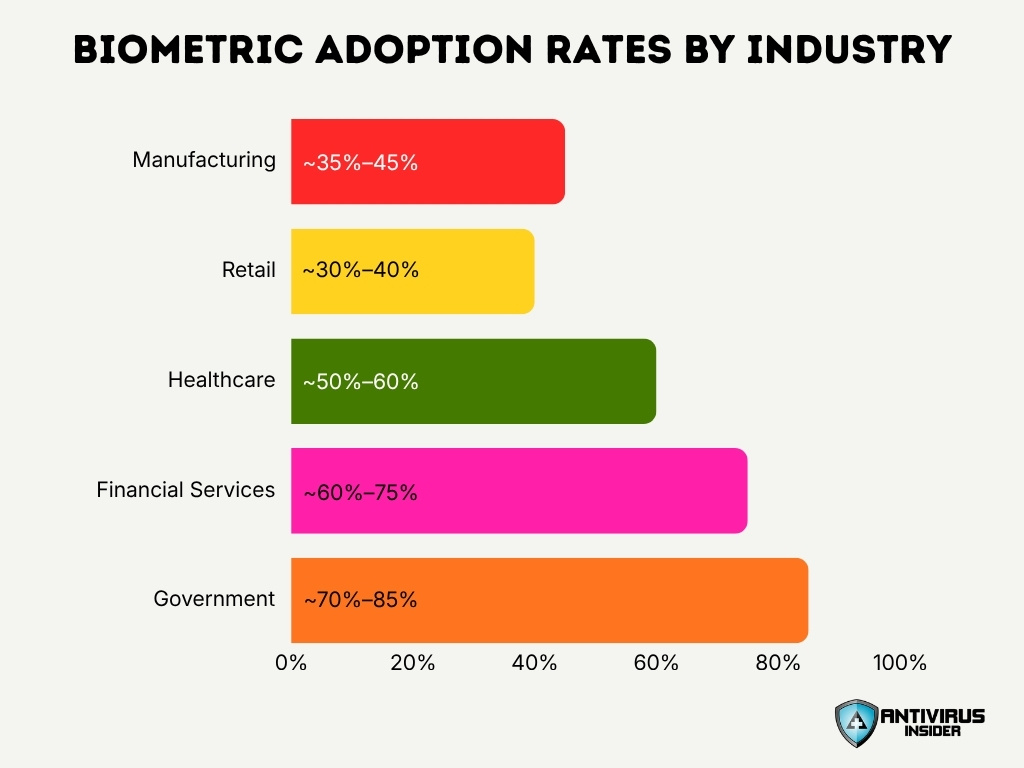
- Government organizations lead biometric adoption at approximately 70% to 85%, reflecting widespread use in national identification, border control, public security, and citizen services.
- Financial services companies report adoption rates of around 60% to 75%, driven by the need for secure banking access, fraud prevention, and customer identity verification.
- Healthcare organizations have reached an estimated biometric adoption rate of 50% to 60%, using the technology to protect patient records and verify staff and patient identities.
- Manufacturing companies record biometric adoption of approximately 35% to 45%, mainly for employee attendance, restricted-area access, and workplace security management.
- Retail businesses show adoption rates of around 30% to 40%, with biometrics increasingly used for payments, loss prevention, employee access, and personalized customer experiences.
- The adoption gap between government and retail ranges from roughly 30 to 55 percentage points, highlighting major differences in security requirements and technology investment.
- Overall, biometric adoption is strongest in industries where identity verification, fraud prevention, regulatory compliance, and secure access control are critical operational priorities.
Behavioral Biometrics Statistics
- The behavioral biometrics market is expected to increase from $2.72 billion in 2025 to $3.45 billion in 2026.
- Industry forecasts project the global market will reach $11.38 billion by 2031.
- The market is expanding at a rapid 26.95% CAGR between 2026 and 2031.
- North America dominated the global market in 2022, capturing the largest revenue share of 33.6%.
- The BFSI sector is an undisputed early leader, contributing over 27.82% of global market revenue.
- On-premise deployments have historically dominated the market, generating over 63.44% of the total revenue.
- Behavioral biometrics technology successfully stopped an estimated $3.7 billion in fraudulent activities in 2024 alone.
- Around 81% of consumers consider biometrics significantly more secure than traditional authentication methods.
Multimodal Biometrics Statistics
- The global multimodal biometrics market was valued at approximately $3.67 billion in 2024.
- The market is expected to grow to $4.2 billion in 2026.
- Analysts forecast the market will reach $8.3 billion by 2030.
- The industry is projected to expand at a 14.5% CAGR between 2025 and 2030.
- Organizations increasingly combine fingerprint, facial recognition, iris scanning, and behavioral biometrics to improve authentication accuracy.
- Multimodal authentication significantly reduces both false acceptance and false rejection rates compared with single-modal systems.
- Government agencies, banking organizations, and healthcare providers remain among the largest adopters of multimodal biometric systems.
- AI-driven multimodal platforms dynamically select the most reliable biometric trait based on user conditions and device capabilities.
- Increasing privacy regulations continue encouraging organizations to deploy secure, consent-driven multimodal authentication frameworks.
Consumer Device Biometric Adoption
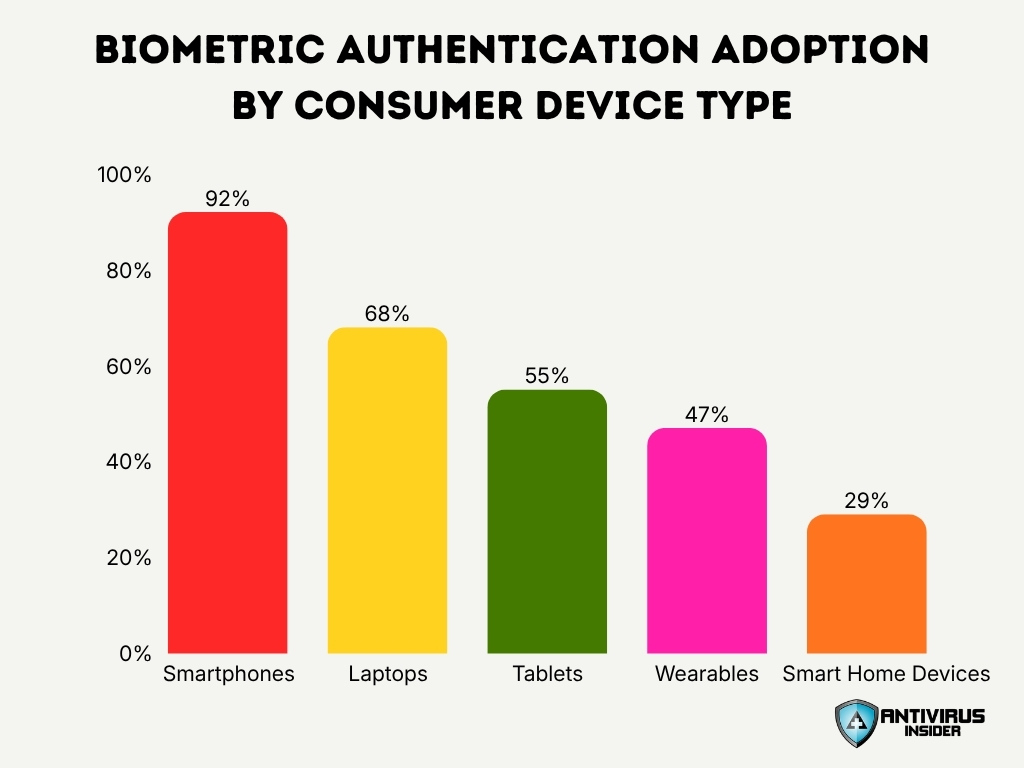
- Smartphones dominate biometric adoption, with 92% of devices using technologies such as fingerprint scanning or facial recognition.
- Laptops rank second at 68%, showing that biometric login has become increasingly common in personal and workplace computing.
- Tablets record a 55% adoption rate, indicating that more than half now support biometric authentication for secure access.
- Wearables reach 47% adoption, reflecting growing use of biometrics in smartwatches and other connected personal devices.
- Smart home devices have the lowest adoption rate at 29%, suggesting significant room for future biometric integration.
- The 63 percentage point gap between smartphones and smart home devices highlights the uneven adoption of biometrics across consumer technology categories.
Biometrics in Banking and Payments
- The biometric payments market is projected to reach $14.65 trillion in 2026 and $24.98 trillion by 2031.
- Facial recognition represented 36.12% of biometric payment transaction value in 2025, making it the leading modality.
- Mobile devices accounted for 71.26% of biometric payment transaction value during 2025.
- In-app payments represented 47.05% of biometric payment activity in 2025.
- Retail and e-commerce generated 33.78% of biometric payment market activity in 2025.
- Asia-Pacific accounted for 48.69% of the global biometric payments market in 2025.
- Travel, tourism, and hospitality are forecast to record the fastest growth, with a 13.37% CAGR through 2031.
- Remote and online biometric payments are projected to grow at a 12.96% CAGR through 2031.
- Banks increasingly deploy facial recognition, fingerprint authentication, and palm-vein verification to strengthen digital onboarding, payment authorization, and fraud prevention.
Biometrics in Healthcare
- The global healthcare biometrics market is projected to hit $42.00 billion by 2030, growing at a 23.8% CAGR.
- Implementing biometric patient identification in medical facilities has successfully reduced medical errors by 35%.
- Approximately 50% to 60% of healthcare organizations use biometric technology to secure sensitive patient data.
- Demand for contactless biometric technology within the healthcare sector increased by 60% after the pandemic.
- The hospitals and clinics sector dominated the industry by capturing a 49.2% revenue share in 2023.
- Single-factor biometric systems can achieve up to a 99.7% accuracy rate in controlled healthcare environments.
- Improved biometric authentication could have prevented 65% of healthcare data breaches reported in 2022.
- Over 70% of medical facility providers actively utilize biometric devices for accurate patient identification.
- Hospitals integrating biometric systems have reported average annual cost savings of roughly $1.5 million.
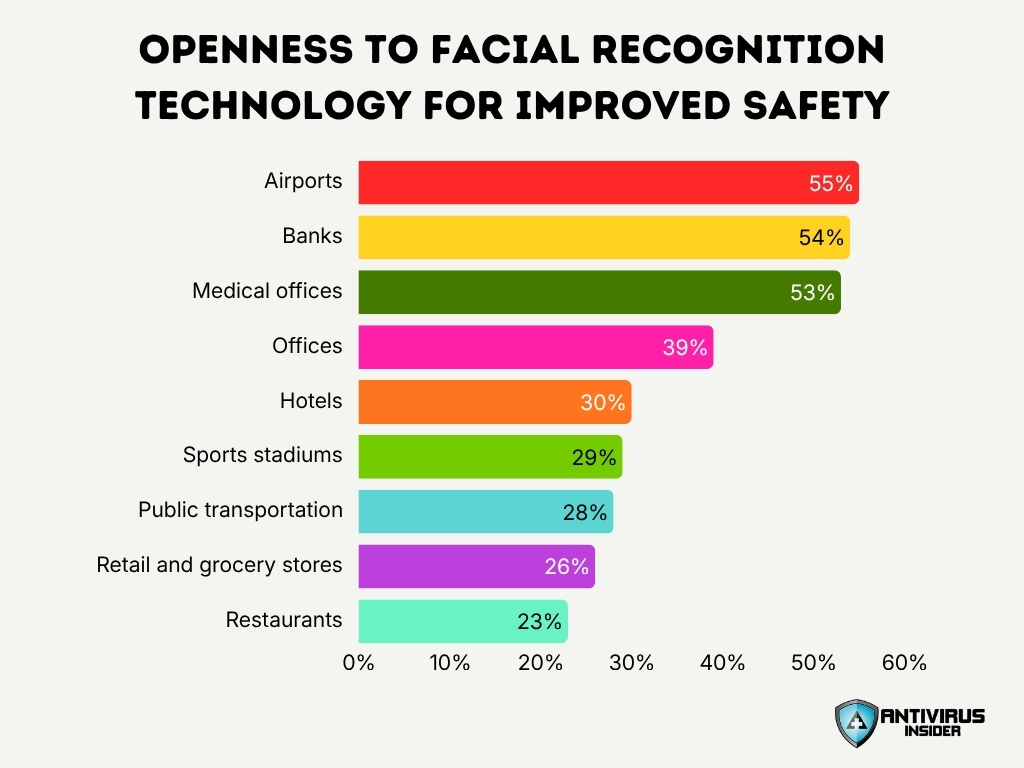
Public Openness to Facial Recognition for Safety
- Airports rank first, with 55% of respondents open to facial recognition technology for improved safety.
- Banks follow closely at 54%, showing strong support for biometric security in financial environments.
- Medical offices receive 53% support, suggesting broad acceptance where identity verification and patient safety are important.
- Openness drops to 39% for offices, creating a 14 percentage point gap compared with medical offices.
- Hotels record 30% support, indicating more cautious attitudes toward facial recognition in hospitality settings.
- Sports stadiums and public transportation receive similar support at 29% and 28%, respectively.
- Only 26% are open to facial recognition in retail and grocery stores, reflecting lower comfort in everyday shopping environments.
- Restaurants rank last at 23%, making them the least accepted location for facial recognition use.
- Overall, people appear more comfortable with facial recognition in high security or identity-sensitive locations than in routine commercial spaces.
Biometrics in Government and Law Enforcement
- Governments remain among the largest adopters of biometric technologies for national identity, border management, and digital public services.
- The world’s largest biometric identity program now supports approximately 1.34 billion live identity holders.
- That same identity ecosystem has processed more than 1.7 trillion authentication transactions, demonstrating biometric authentication at national scale.
- A national fingerprint identification system contained 12.6 million criminal fingerprint records as of March 2026, with around 90,000 new records added each month.
- The fingerprint identification platform has successfully matched 8,831 latent fingerprints from crime scenes since its launch, helping investigators solve interstate and cold cases.
- During the 2023-24 reporting year, one national document verification service processed 121.5 million identity verification requests across government and private organizations.
- The same reporting period recorded 1.94 million face verification transactions while reporting no security breaches involving the verification platform.
- Border security agencies continue expanding biometric verification using facial recognition, fingerprints, and iris scans to accelerate passenger processing while strengthening security.
- Governments continue investing in forensic biometric databases to improve investigation speed, evidence management, and criminal identification.
User Trust and Acceptance of Biometrics
- A 2026 privacy survey found that 70% of respondents trust border security organizations to handle biometric information responsibly.
- Approximately 66% expressed trust in police organizations handling their sensitive biometric data.
- Around 60% reported trusting general government agencies with their personal biometric information.
- Trust in businesses handling biometric information fell to 13% in 2026, dropping from 24% in 2023.
- Globally, 81% of consumers consider biometrics to be a more secure method of identity verification than traditional passwords.
- Over 72% of consumers globally prefer facial biometrics over passwords for completing secure online processes.
- Around 55% of consumers say they would be more likely to use government services online if a secure biometric login were available.
- About 40% of travelers would be more open to biometric solutions if they were assured their personal information remained secure.
- Roughly 58% of users report feeling entirely comfortable with facial recognition, iris scans, and voice recognition systems.
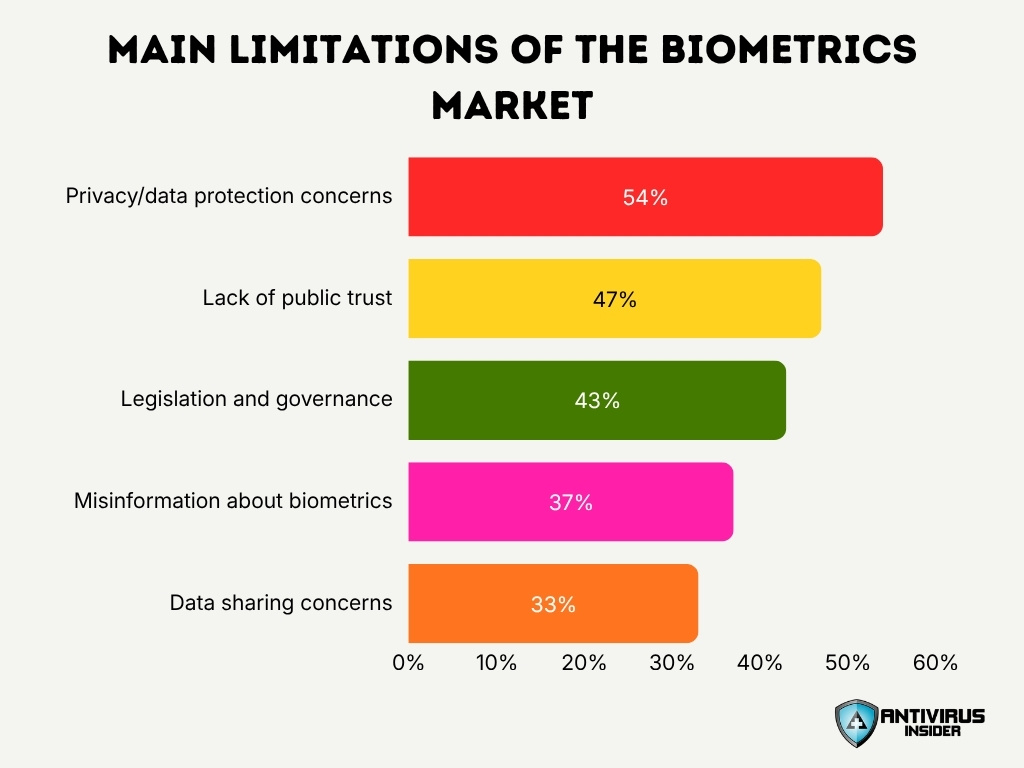
Key Limitations Affecting the Biometrics Market
- Privacy and data protection concerns are the biggest market limitation, reported by 54% of respondents.
- Lack of public trust ranks second, with 47% concerned about how biometric systems collect and use personal data.
- Legislation and governance challenges affect 43%, highlighting the need for clearer rules and stronger regulatory frameworks.
- Misinformation about biometrics is cited by 37%, showing that inaccurate perceptions may slow public acceptance.
- Data sharing concerns impact 33%, particularly where biometric information is exchanged between organizations or platforms.
- Overall, the findings show that trust, privacy, and regulation remain the main barriers to wider biometric technology adoption.
Biometric Security and Fraud Prevention
- Around 73% of global enterprises are adopting biometric authentication to replace passwords due to a 62% reduction in identity fraud cases.
- Over 61% of biometric vendors are currently investing heavily in AI-based liveness detection and fraud prevention technologies.
- Approximately 67% of financial institutions globally integrate biometrics into mobile systems to effectively reduce fraud incidents.
- About 69% of enterprises integrate multimodal biometric systems to improve authentication accuracy to above 97%.
- Nearly 33% of cybersecurity providers now actively integrate behavioral biometrics into their modern fraud detection platforms.
- Around 78% of financial institutions rely on biometric verification to successfully reduce unauthorized access incidents by 64%.
- Approximately 68% of consumers are willing to use biometric authentication if it helps significantly reduce overall fraud risk.
- A massive 83% of businesses report at least one account takeover incident, highlighting the urgent need for biometric security.
- Banks implementing seamless passive liveness checks have observed a 35% improvement in overall onboarding completion rates.
Biometric Technology Trends
- The global biometric system market is projected to grow from $51.22 billion in 2025 to $134.06 billion by 2032.
- Passwordless authentication is expected to expand at a CAGR of 17.86%, reaching $100.59 billion by 2034.
- Cloud-based biometric solutions are rapidly scaling and are projected to capture 58.6% of the banking market by 2035.
- Expanding across multiple sectors, contactless biometric technologies are expected to reach a value of $17.50 billion in 2026.
- Driven by edge computing, the global mobile biometrics market is projected to surge to $200.8 billion by 2032.
- The government sector heavily invests in digital identities, currently holding a 21.44% market share in biometrics.
- Around 72% of global consumers now prefer using facial biometrics over traditional passwords for secure online access.
- Organizations shifting to passwordless biometric environments report an 81% reduction in login-related security incidents.
- Advancements in artificial intelligence are anticipated by 26% of industry professionals to lead biometrics over the next five years.
- Fingerprint recognition remains dominant, holding 60% of the smartphone biometric authentication market share in 2026.
Frequently Asked Questions (FAQs)
The global biometric technology market is projected to reach $41.1 billion in 2026 and is expected to grow to $150.6 billion by 2030 at a 20.4% CAGR.
The next-generation biometric authentication market is forecast to grow at a 27.1% CAGR from 2025 to 2030, increasing from $44.7 billion in 2026 to $118.7 billion by 2030.
North America accounted for 30.7% of the global biometric technology market revenue, making it the largest regional market.
Fingerprint recognition accounted for more than 40% of the global consumer electronic biometrics market revenue in 2024, making it the leading biometric technology in consumer devices.
The global biometric payment market is projected to reach $13.48 billion in 2026 and grow to $44.69 billion by 2034, with a 16.2% CAGR.
Conclusion
Biometric technology continues to evolve from a convenient authentication tool into a foundational component of digital identity, cybersecurity, healthcare, banking, and government services. Current statistics show sustained market expansion, rapid AI integration, and growing adoption of passwordless authentication across industries. At the same time, organizations are investing more heavily in privacy safeguards, multimodal authentication, and fraud prevention to strengthen user trust. As digital transformation accelerates, biometrics will play an increasingly important role in securing identities while delivering faster, more seamless user experiences worldwide.
