


Biometric authentication has become a core security layer for modern banking. Instead of relying only on passwords or PINs, banks now verify customers through fingerprints, facial recognition, voice recognition, iris scans, and behavioral patterns. This shift strengthens account security while making digital banking faster and more convenient.
Banks use biometric authentication to secure mobile banking logins, digital account opening, payment approvals, ATM access, and high-value transactions. Financial institutions also rely on biometrics to reduce account takeover fraud, comply with identity verification requirements, and improve customer onboarding. As AI-powered fraud continues to evolve, biometric authentication is becoming a strategic investment across retail banking, commercial banking, and fintech. Explore the statistics below to understand how this technology is reshaping banking.
Editor’s Choice
- The global biometric identity verification market is projected to grow from $8.88 billion in 2025 to $17.81 billion by 2030, representing a 14.9% CAGR.
- The global biometric and passwordless authentication market is estimated at $26.55 billion in 2025 and is forecast to reach $57.71 billion by 2030.
- North America remains the largest regional market for biometric and passwordless authentication, while Asia-Pacific is expected to record the fastest growth through 2030.
- The BFSI sector is expected to remain the largest end-user industry for biometric identity verification throughout the forecast period.
- Fingerprint recognition accounted for more than 32% of the global next-generation biometric authentication market in 2024, maintaining its leadership entering 2026.
- Banking executives ranked fraud prevention and cybersecurity investments among their highest technology priorities in 2025 as digital banking usage continued to expand.
- AI-powered face authentication continues to gain momentum, with Aadhaar-based face authentication surpassing 115 crore cumulative transactions by early 2025, including significant adoption by banks and financial institutions.
Recent Developments
- During 2026, banks continue replacing password-only authentication with device-based biometric verification supported by passkeys and FIDO standards.
- AI-enhanced liveness detection has become a standard feature in facial recognition systems to reduce spoofing attacks during remote identity verification.
- Financial institutions increasingly combine behavioral biometrics with fingerprint or facial authentication to monitor users throughout an online banking session rather than only at login.
- The BFSI industry continues expanding biometric identity verification for digital onboarding, KYC, fraud prevention, and transaction approval, making it one of the fastest-growing deployment segments.
- Banking technology leaders report increased spending on fraud prevention technologies as cyberattacks become more sophisticated across digital channels.
- Face authentication adoption expanded across banking, fintech, lending, and payment services, with additional financial institutions joining national digital identity ecosystems during 2025.
- Open banking regulations continue encouraging financial institutions to adopt biometric authentication that satisfies Strong Customer Authentication (SCA) requirements while improving customer experience.
- Cloud-native biometric platforms now allow banks to integrate authentication into mobile apps, online banking portals, and payment platforms with shorter deployment cycles.
What Is Biometric Authentication in Banking
- Biometric authentication verifies a customer’s identity using unique biological or behavioral characteristics instead of relying solely on passwords or PINs.
- Common banking biometrics include fingerprints, facial recognition, iris recognition, voice recognition, and behavioral biometrics.
- Banks use biometric verification to secure mobile banking, online banking, ATM transactions, branch authentication, and digital onboarding.
- Biometric authentication reduces dependency on passwords, lowering the risk of credential theft and password reuse.
- Modern banking systems increasingly combine biometrics with multi-factor authentication (MFA) for higher-risk financial transactions.
- AI-powered liveness detection helps confirm that biometric samples originate from a live person instead of photographs, recordings, or synthetic media.
- Regulatory initiatives such as PSD2 have accelerated biometric authentication by encouraging stronger digital identity verification across financial services.
- Banks increasingly deploy continuous authentication, allowing systems to monitor user behavior throughout a banking session instead of verifying identity only once.
Biometrics for Banking Market Insights
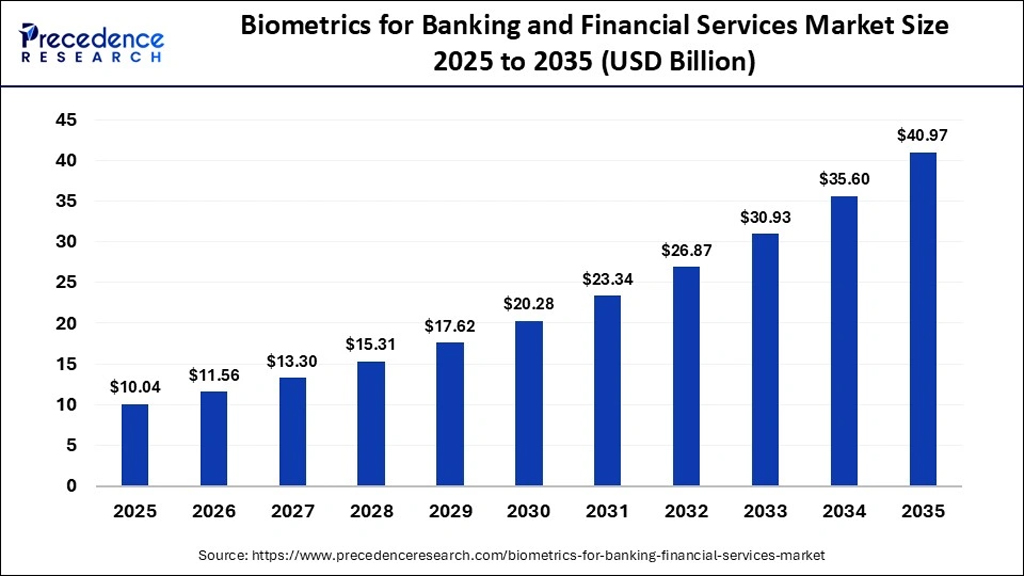
- The global biometrics for banking and financial services market is projected to grow from $10.04 billion in 2025 to $40.97 billion by 2035.
- The market is expected to expand by more than four times over the 10-year forecast period.
- Market value is forecast to surpass $20 billion in 2030, reaching approximately $20.28 billion.
- By 2032, the industry is projected to reach $26.87 billion, up from $23.34 billion in 2031.
- The market is expected to cross the $30 billion milestone in 2033, reaching $30.93 billion.
- The largest annual increase occurs between 2034 and 2035, when market value rises by approximately $5.37 billion.
- From 2025 to 2035, the market is projected to add nearly $30.93 billion in total value.
- Consistent year-over-year growth highlights the rising adoption of biometric authentication, fraud prevention, and digital banking security.
Key Biometric Authentication Technologies Used in Banking
- Fingerprint recognition dominates banking with a 34% market share and extremely low false acceptance rates below 0.001%.
- Facial recognition is rapidly expanding, with 72% of global consumers preferring it over traditional passwords for secure online processes.
- Iris recognition offers exceptional accuracy rates above 99.8% and is currently deployed in 23% of high-security banking vaults.
- Voice biometrics deployed in call centers can save an estimated $6.25 million annually for an average bank with 5 million customers.
- The behavioral biometrics market is projected to grow at a 7.1% CAGR as institutions increasingly analyze user navigation to detect suspicious activity.
- Implementing multimodal biometric authentication into mobile banking applications reduces overall fraud losses by 34% compared to PIN-only systems.
- Modern AI-powered biometric systems maintain authentication success rates exceeding 98% while dropping session abandonment rates by 29%.
- The global biometrics banking market is anticipated to reach a massive $40.97 billion by 2035 due to the rising demand for passwordless experiences.
Adoption of Biometric Authentication by Banks and Financial Institutions
- By 2026, 75% of consumers will have enabled passkeys on at least some of their online accounts.
- Around 68% of organizations have deployed or are piloting passkeys for workforce authentication.
- Over 53% of credit cardholders would switch banks if not offered biometric authentication options.
- Fingerprint recognition holds 60% of the smartphone biometric authentication market share in 2026.
- Biometrically authenticated remote mobile payments are projected to reach $1.2 trillion globally by 2027.
- More than 3 billion people are forecast to use biometric payments worldwide by 2026.
- Globally, 72% of consumers prefer facial biometrics over passwords for secure online processes.
- The global biometrics market for banking and financial services is predicted to hit $40.97 billion by 2035.
- 81% of consumers consider biometrics more secure for identity verification than traditional methods.
Biometric Authentication in Mobile and Online Banking Channels
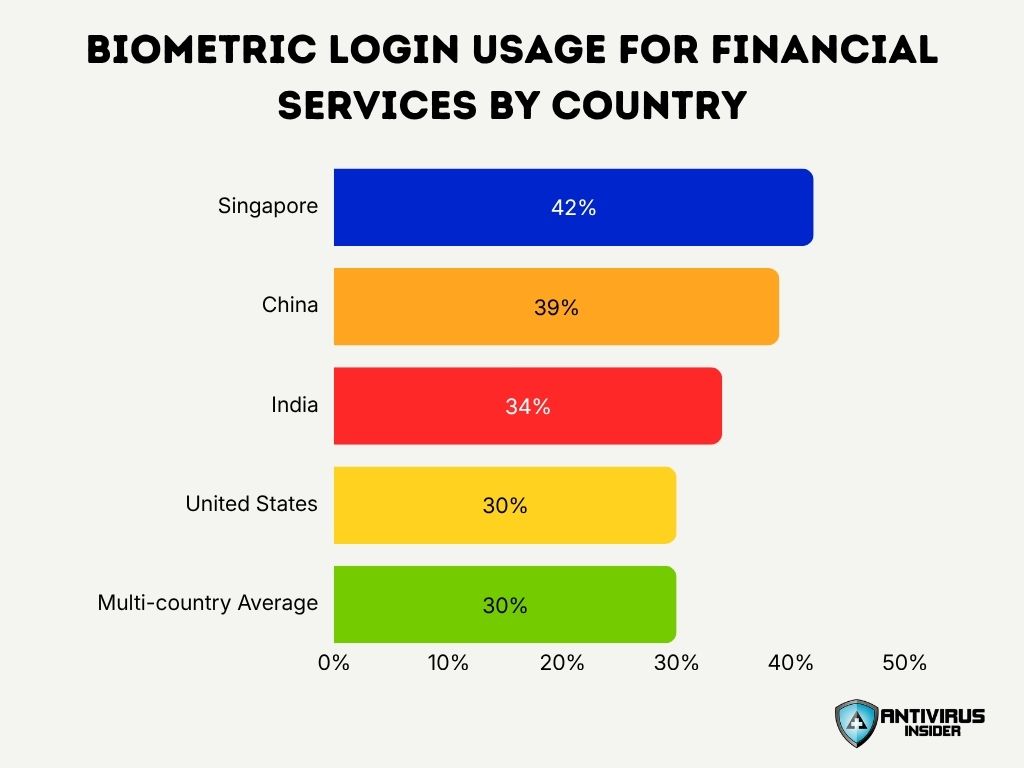
- In a multi-country consumer survey, 30% of respondents reported using biometrics such as fingerprint or facial recognition to access financial services accounts.
- In the United States, 30% of respondents used biometric authentication for financial services logins during the previous 60 days.
- Singapore recorded one of the highest usage levels, with 42% of consumers using biometrics for financial account access.
- China reported 39% biometric usage for financial account authentication among surveyed consumers.
- India recorded 34% biometric login usage for financial services, reflecting growing adoption across mobile banking platforms.
- Banks increasingly embed biometric login directly into smartphone operating systems, allowing users to authenticate without entering passwords.
- Mobile banking applications now combine device biometrics, passkeys, and risk-based authentication to protect sensitive financial transactions.
- AI-powered liveness detection has become a common component of remote customer onboarding and identity verification through banking apps.
Regional Adoption of Biometric Banking
- The global biometric banking market is projected to expand to $40.97 billion by 2035.
- North America continues to dominate the biometric financial services sector with a 40% market share.
- The Asia-Pacific region is forecast to command a substantial 35.8% revenue share by 2035.
- More than 144 crore national biometric identities were issued by March 2026 to support financial inclusion.
- A remarkable 58.16 crore Jan Dhan bank accounts were actively utilizing biometric-enabled access by April 2026.
- Broad 5G connectivity successfully covered 99.9% of districts to support expanded mobile banking infrastructure.
- Single-factor fingerprint recognition currently holds a dominant 35% share of the authentication market.
- Over 70% of consumers strongly prefer modern banking services that integrate fast biometric authentication.
- Scalable cloud-based biometric solutions are projected to capture 58.6% of the banking market by 2035.
- The deployment of secure biometric hardware components accounted for a major 50% market share in 2025.
Authentication Performance Statistics
- 83% of consumers rate face scans as an excellent banking security method.
- Facial recognition is the #1 highest-rated biometric option over fingerprint authentication.
- 96% of consumers find fraud alerts from their bank to be highly valuable.
- 3 in 5 consumers report receiving fraud alerts regarding suspicious account activity.
- Combining AI and liveness detection with biometrics prevents 99% of spoofing attacks.
- Risk-based authentication successfully restricts step-up verification to the top 5% of high-risk logins.
- Passwordless authentication eliminates 100% of credential phishing by securing data on-device.
- Continuous behavioral authentication provides 100% session visibility to prevent account takeover.
Leading Biometric Technologies Used by Banks
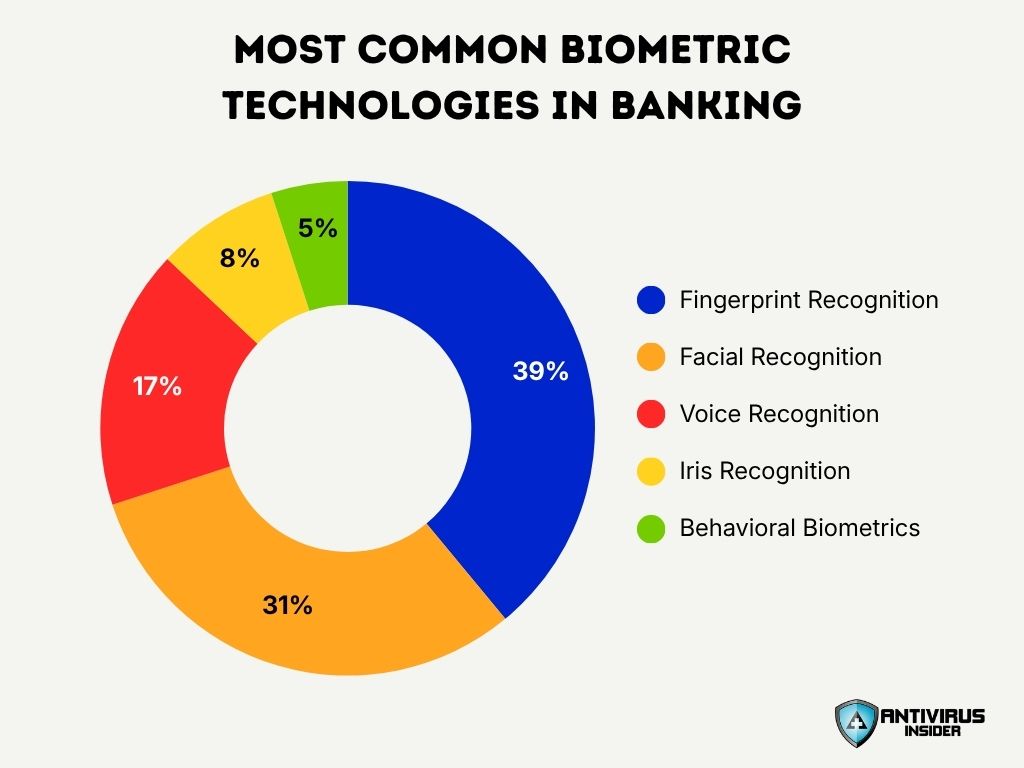
- Fingerprint recognition is the most widely used biometric technology in banking, accounting for 39% of adoption.
- Facial recognition ranks second with a 31% share, showing strong use in mobile banking and digital onboarding.
- Together, fingerprint and facial recognition represent 70% of biometric technology usage in banking.
- Voice recognition holds a 17% share, making it the third most common biometric method.
- Iris recognition accounts for only 8%, indicating relatively limited adoption across banks.
- Behavioral biometrics has the smallest share at 5%, despite its growing role in continuous fraud detection.
Behavioral Biometrics for Continuous Authentication in Banking
- The global behavioral biometrics market is expected to reach $11.38 billion by 2031.
- Platforms using behavioral biometrics report a 70% reduction in credential-stuffing attacks.
- Cloud-based authentication solutions accounted for 55.85% of the market share in 2025.
- Account takeover attacks impacted six million victims in 2025, a 141% increase since 2021.
- Banks implementing these layers achieve 25% faster fraud detection cycles than legacy systems.
- Keystroke dynamics led the sector with a 39.25% revenue share in 2025.
- Consumers lost $27.2 billion to identity fraud in 2024, driving continuous authentication demand.
- Platforms utilizing continuous behavioral analysis saw a 73% decrease in account takeover attempts.
- Registration abandonment dropped by 64% when banks switched to passive behavioral monitoring.
- Generative AI has pushed global financial fraud losses beyond $400 billion annually.
Impact of Biometric Authentication on Fraud Reduction and Security
- The mandatory implementation of biometric authentication has proven to reduce fraud-related accounts by up to 72%.
- An estimated 88% of web application attacks involve stolen credentials, highlighting the critical need for biometrics.
- Approximately 81% of consumers now consider biometrics to be significantly more secure than traditional passwords.
- Organizations shifting to 100% passwordless biometric environments report an 81% reduction in login-related security incidents.
- A massive 3,000% increase in AI-powered phishing attacks on credentials has accelerated the demand for FIDO-based biometrics.
- Advanced AI fraud detection models utilizing behavioral biometrics achieve impressive detection accuracy rates of 90-98%.
- The total volume of secure biometrically authenticated mobile payments is projected to hit $1.2 trillion globally by 2027.
- Banks integrating layered machine learning and biometrics consistently report a 40-60% reduction in false positive security alerts.
Customer Attitudes and Trust in Biometric Banking
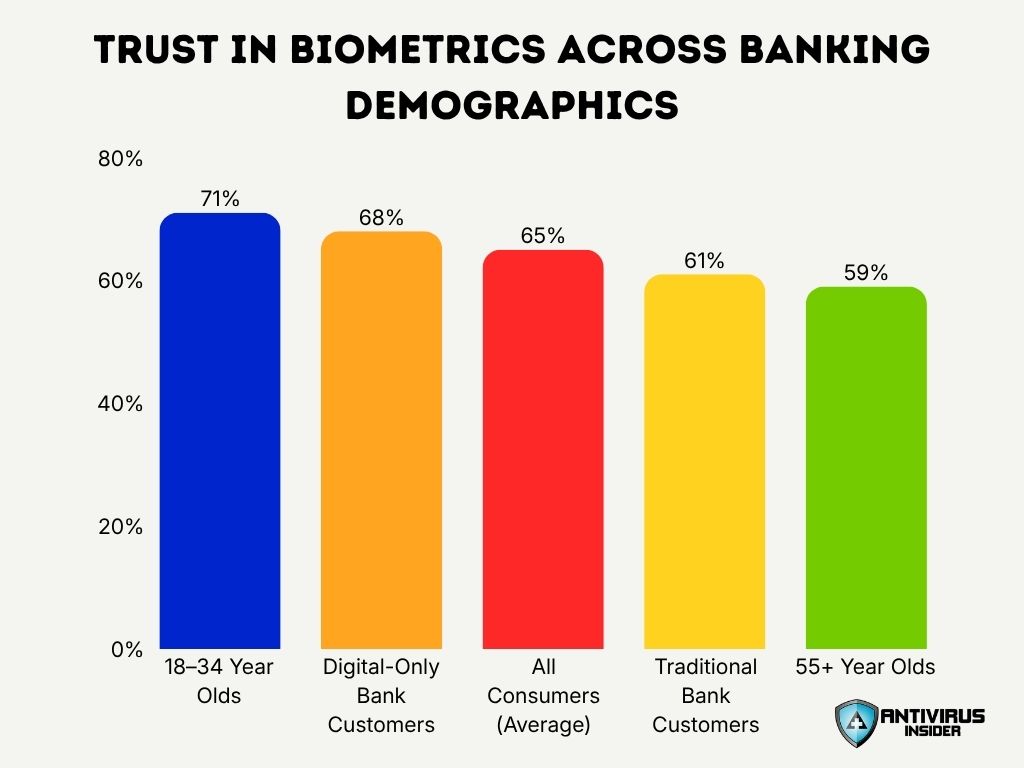
- 65% of consumers consider biometric authentication the most secure way to access banking services, according to a 2025 survey across six European markets.
- Among digital-only bank customers, confidence rises to 68%, compared with 61% among customers of traditional banks.
- 71% of consumers aged 18–34 view biometrics as the most secure authentication method, versus 59% of consumers aged 55 and older.
- 86% of respondents understand why their bank requires authentication during banking sessions.
- 73% say authentication gives them greater control over the security of their personal information.
- 78% believe their bank’s authentication process is easy to use.
- 78% would like the option to choose their preferred authentication method instead of relying on a single approach.
- In the United States, 9 in 10 consumers agree their bank takes proactive steps to protect them from fraud and scams, reinforcing confidence in modern authentication technologies.
Impact of Biometrics on Customer Experience and Onboarding
- In the UK digital identity sector, 38% of providers report customer onboarding as a primary use case.
- Around 53% identify KYC and AML compliance as leading deployment areas for digital identity.
- Currently, 50% of organizations use digital identity technologies primarily for fraud prevention.
- Approximately 23% report using remote identity verification to support secure customer enrollment.
- A massive 72% of consumers globally prefer face biometrics over traditional passwords.
- Over 53% of credit cardholders would switch banks without biometric authentication options.
- Biometric digital ID processes can drastically reduce onboarding costs by up to 90%.
- Slow and inefficient onboarding processes cause 36% of financial institutions to lose clients.
- Impressively, 81% of consumers view biometrics as a highly secure method of identity verification.
Biometric Payment Authentication in Cards and Digital Wallets
- The global biometric payment market is projected to grow to $13.48 billion in 2026.
- Contactless payments utilizing biometric technology are forecast to surpass $10 trillion by 2027.
- Approximately 58% of global consumers currently prefer biometric verification over traditional PINs.
- Fingerprint recognition systems account for 52% of all biometric payment integrations worldwide.
- The facial recognition payment market is expanding rapidly, demonstrating a strong 19.32% CAGR.
- Roughly 41% of banks globally have successfully implemented biometric-based payment systems.
- Data shows that 73% of millennials consistently utilize biometric-enabled contactless payments in 2026.
- The global biometric payment cards market is expected to reach a value of $8.7 billion by 2036.
- Around 46% of crypto wallet providers successfully integrated biometric authentication features in 2026.
Biometrics in ATM and Branch Banking Authentication
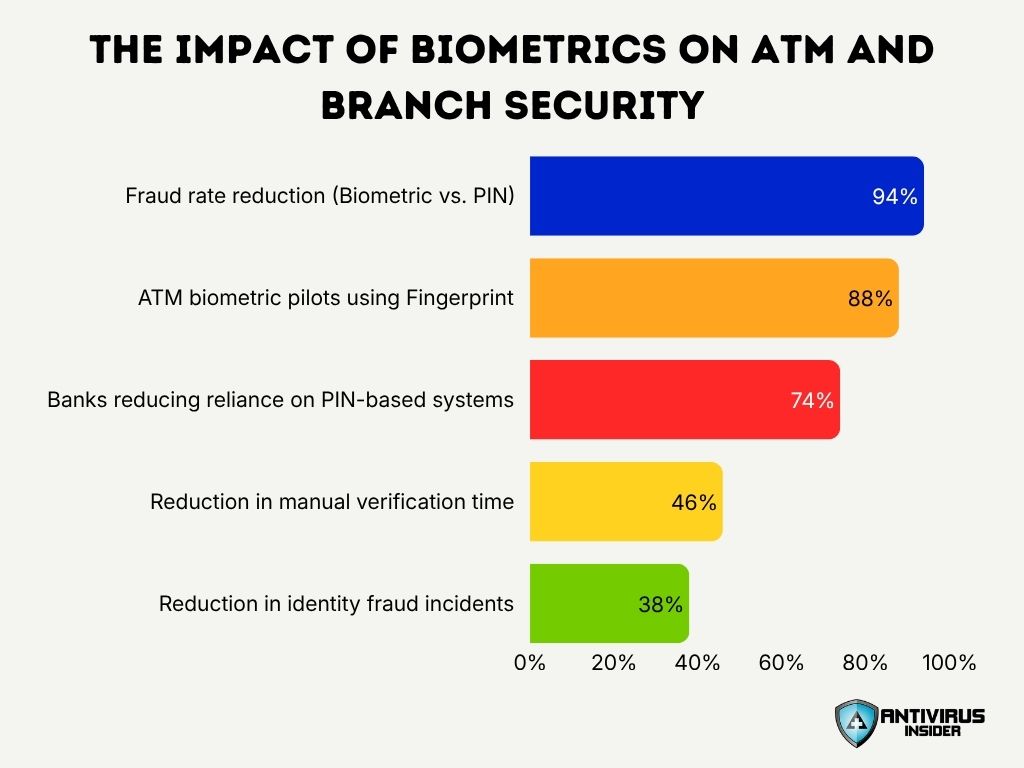
- Financial institutions report that biometric authentication reduces identity fraud incidents by 38%.
- Biometric-authenticated ATM transactions experience fraud rates that are 94% lower than PIN-only methods.
- Fingerprint recognition currently holds a 34% market share within the banking biometrics industry.
- Over 6,400 banking branches utilize biometric systems to slash manual verification time by 46%.
- The financial services sector maintains a high biometric adoption rate of 60% to 75% for secure access.
- The global banking biometrics market is projected to reach a massive $40.97 billion by the year 2035.
- Fingerprint authentication is utilized in 88% of ATM biometric pilots to mitigate card skimming risks.
- Approximately 74% of banks are reducing reliance on PIN-based systems to enable passwordless banking.
- Biometric authentication success rates consistently exceed 98.6% across controlled banking environments.
Regulatory and Compliance Landscape for Biometric Banking
- The global biometrics for banking market is projected to reach $40.97 billion by 2035.
- More than 3.4 billion bank customers globally utilized biometric authentication for services in 2025.
- Over 83% of global financial institutions are actively exploring or using biometric verification methods.
- KYC and AML compliance management applications using biometrics will grow at a 15.2% CAGR through 2034.
- Biometric authentication is expected to secure over $2.5 trillion worth of mobile payment transactions.
- Digital identity verification checks across systems are anticipated to hit 86 billion globally by 2025.
- Approximately 28% of biometric technology deployment in the United States operates within the financial industry.
- The hardware component segment for banking biometrics held a 50% market share to meet regulatory compliance.
- Nearly 63% of banking consumers prefer completely passwordless account access, relying entirely on biometrics.
- Identity fraud losses targeting global financial institutions exceeded an estimated $43 billion in 2025.
Privacy, Data Protection, and Ethical Concerns in Biometric Banking
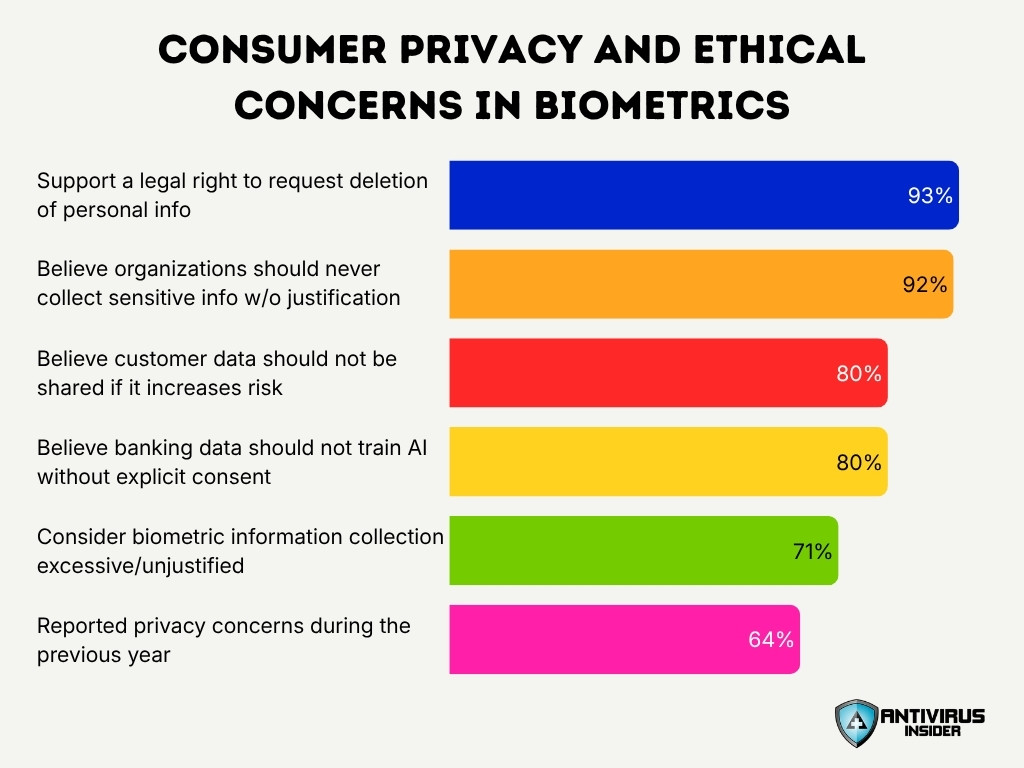
- 71% of Australians consider biometric information excessive or unjustified to collect in many situations unless clearly necessary.
- 92% believe organizations should never collect certain categories of sensitive personal information without strong justification.
- 80% of U.S. consumers believe companies should not use banking data to train AI models without explicit customer consent.
- 80% also believe customer data should not be shared if doing so increases security or privacy risks.
- 93% support a legal right to request deletion of personal information held by organizations.
- 64% reported privacy concerns during the previous year, yet many chose not to file formal complaints.
- Banks and financial institutions achieved 46% confidence in handling privacy complaints, ranking higher than many other commercial sectors.
- Privacy experts continue warning that unlike passwords, biometric identifiers cannot simply be changed if compromised, increasing the importance of secure storage and governance.
Future Trends and Emerging Use Cases in Biometric Banking
- The global passwordless authentication market is projected to reach $59.71 billion by 2032 due to rising banking security demands.
- The behavioral biometrics market is forecast to hit $11.38 billion by 2031, heavily driven by fraud detection capturing 42.35% of revenue.
- By 2033, the biometric payment card market is expected to surge to $115.03 billion, with the BFSI sector holding 52.8% of the share.
- The fingerprint recognition segment is projected to dominate the banking biometrics space by capturing a 47.46% market share in 2026.
- Demonstrating rapid adoption, biometric-based digital transactions in India recently surpassed 611 million in June 2026, valued at Rs. 25,416 crores.
- The broader biometrics for banking and financial services market is anticipated to expand at a 15.10% CAGR, reaching $40.97 billion by 2035.
- Modern cloud-based biometric deployments are leading the financial industry transition, having already secured 55.85% of the market share in 2025.
- The hardware segment of biometric payments is projected to account for a 57.84% share in 2026 to ensure faster authentication processing.
Frequently Asked Questions (FAQs)
The global biometrics for banking and financial services market is projected to reach $22.24 billion by 2032, growing from $10.34 billion in 2026 at a 13.52% CAGR.
Approximately 87% of global banks now use biometric authentication as part of their security and identity verification strategies.
According to a global 2026 survey, 75% of consumers have enabled passkeys on at least some of their online accounts, while 90% are familiar with passkeys.
More than 611 million UPI transactions worth approximately ₹25,416 crore were authenticated using biometrics in June 2026, representing about 2.7% of all UPI transactions that month.
While 32% of banking leaders currently use AI-enabled biometrics for payments and access management, 72% plan to adopt the technology within the next three years.
Conclusion
Biometric authentication has evolved from an optional security feature into a foundational component of digital banking. Financial institutions are accelerating investments in fingerprint recognition, facial authentication, behavioral biometrics, and passwordless identity verification to combat increasingly sophisticated fraud while improving customer convenience.
The latest statistics show strong market growth, rising consumer confidence, and expanding regulatory support for biometric identity technologies. At the same time, privacy protection, secure data governance, and transparent customer consent remain critical priorities. As AI, digital identity wallets, and continuous authentication mature, biometric banking is expected to play an even greater role in delivering secure, seamless, and trusted financial services worldwide.
