


Multi-factor authentication (MFA) has become a core security requirement as organizations face rising phishing attacks, credential theft, and identity-based breaches. Businesses use MFA to secure cloud applications, remote work environments, online banking platforms, and customer accounts. At the same time, emerging technologies such as biometrics and passkeys are reshaping how users verify their identities. Explore the latest MFA statistics to understand adoption trends, market growth, and the technologies driving authentication security.
Editor’s Choice
- 99.9% of automated account compromise attacks can be blocked by MFA, according to large-scale account security research.
- The global MFA market is projected to exceed $30 billion by 2030, driven by cloud adoption and zero-trust security initiatives.
- More than 80% of organizations worldwide now require MFA for at least a portion of their workforce.
- Credential theft remains involved in the majority of cyberattacks, making MFA one of the most widely recommended security controls.
- Passkey adoption accelerated significantly throughout 2024 and 2025 as major platforms expanded passwordless authentication support.
- Financial institutions report some of the highest MFA adoption rates among regulated industries due to compliance requirements.
- Biometrics, authenticator apps, and passkeys continue to replace SMS-based verification methods across enterprise environments.
Recent Developments
- In 2025, passkey support expanded across major consumer and enterprise platforms, accelerating passwordless authentication adoption.
- Researchers identified growing deployment of passkeys among high-traffic websites, with adoption closely correlated to site popularity.
- Zero-trust security frameworks increasingly mandate MFA verification for every access request rather than only during login.
- Many enterprises have begun replacing SMS authentication with phishing-resistant methods such as FIDO2 security keys and passkeys.
- Regulatory requirements across healthcare, finance, and government sectors continue to strengthen MFA implementation standards.
- Cyber insurers increasingly require MFA deployment before issuing or renewing cyber liability policies.
- Enterprise identity providers expanded adaptive authentication capabilities that assess user risk in real time.
- Hardware security key adoption grew among organizations seeking stronger protection against credential phishing.
- Authentication vendors introduced AI-driven anomaly detection to strengthen MFA decision-making.
- Passwordless authentication pilots expanded across the workforce, banking, and customer-facing applications during 2025 and early 2026.
Multi-Factor Authentication Market Growth Statistics
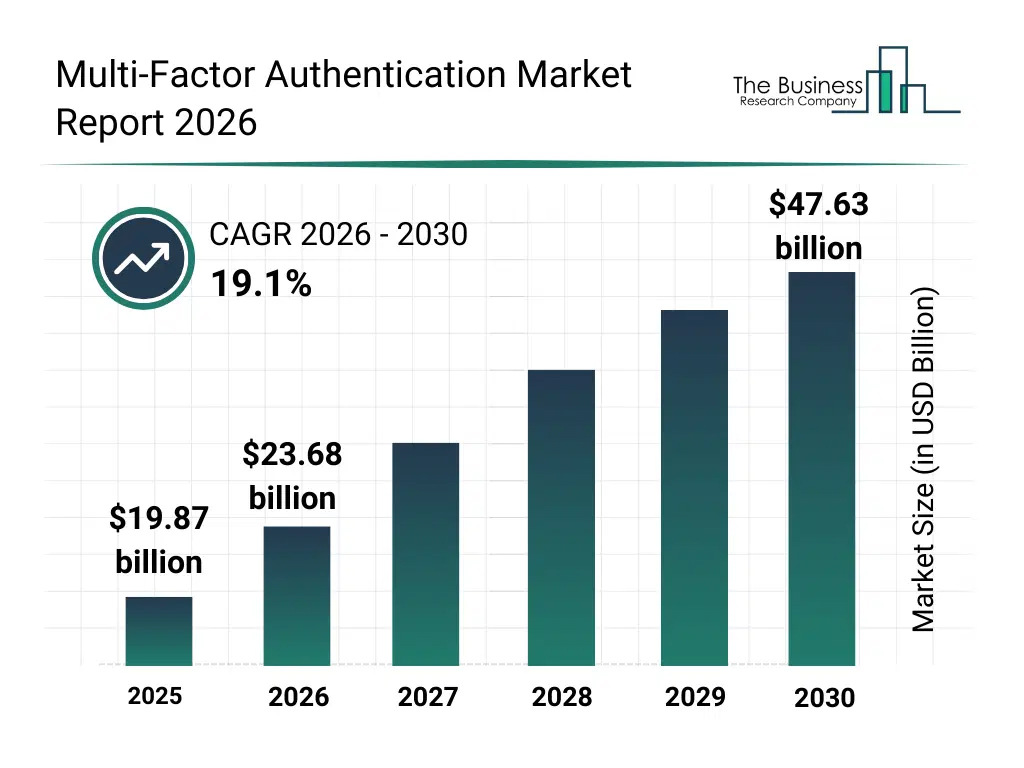
- The Multi-Factor Authentication market is projected to grow from $19.87 billion in 2025 to $23.68 billion in 2026, reflecting strong annual expansion.
- The market is expected to achieve a robust 19.1% CAGR between 2026 and 2030.
- Global MFA market value is forecast to reach $47.63 billion by 2030, more than doubling from 2025 levels.
- The industry is set to add approximately $27.76 billion in market value between 2025 and 2030.
- Market revenue is projected to increase by nearly 140% from $19.87 billion in 2025 to $47.63 billion in 2030.
- The 2026 market size of $23.68 billion represents an increase of $3.81 billion over 2025.
- By 2030, the MFA market is expected to be more than 2.3 times larger than its 2025 valuation.
- Rising cybersecurity threats and identity protection needs are driving sustained double-digit market growth through 2030.
Global Multi-Factor Authentication Adoption Statistics
- Over 83% of organizations globally now use MFA for at least some users and applications.
- North America remains the largest MFA adoption region, contributing heavily to a projected $42.5 billion global market by 2033.
- Europe has experienced strong MFA growth, highlighted by countries like Germany seeing a 1.5x increase in usage in a single year.
- Asia-Pacific represents one of the fastest-growing MFA markets, with regional adoption climbing 7 percentage points year over year.
- Government agencies worldwide increasingly mandate MFA, contributing to a 5% adoption growth across highly regulated sectors.
- Large organizations with distributed workforces report significantly higher MFA deployment rates at 87% compared to smaller, on-site operations.
- Cloud applications drive global MFA adoption, with software-based authentication methods now preferred by 95% of workforce users.
- Small and medium-sized businesses are increasing MFA implementation, though current adoption sits at just 34% for mid-sized firms.
- Financial services and healthcare consistently report above-average MFA usage levels, reaching up to 74% adoption in healthcare.
- Phishing-resistant authentication is gaining market share, with its adoption rising 63% in a single year as organizations move beyond traditional SMS.
Multi-Factor Authentication Usage by Industry
- The financial services sector consistently reports MFA adoption rates above 90% for employee and customer-facing systems due to regulatory requirements.
- Approximately 87% of healthcare organizations use MFA for privileged account access, driven by growing ransomware threats and patient data protection mandates.
- More than 80% of government agencies in developed economies have implemented MFA for workforce identity verification.
- Around 76% of educational institutions report using MFA for faculty and administrative accounts, up from roughly 60% three years earlier.
- Retail organizations increased MFA deployment by over 20 percentage points between 2022 and 2025 as e-commerce fraud attempts continued to rise.
- Nearly 85% of technology companies require MFA for cloud application access and software development environments.
- Manufacturing organizations report MFA adoption rates near 70%, reflecting increased focus on operational technology security.
- Insurance companies rank among the most mature adopters, with over 90% requiring MFA for critical systems and customer portals.
- Energy and utility providers continue expanding MFA coverage, with approximately 75% of operators securing remote access through MFA.
- Professional services firms increasingly mandate MFA, with more than 80% of large firms protecting employee accounts through multi-factor verification.
MFA Adoption Rates by Organization Size
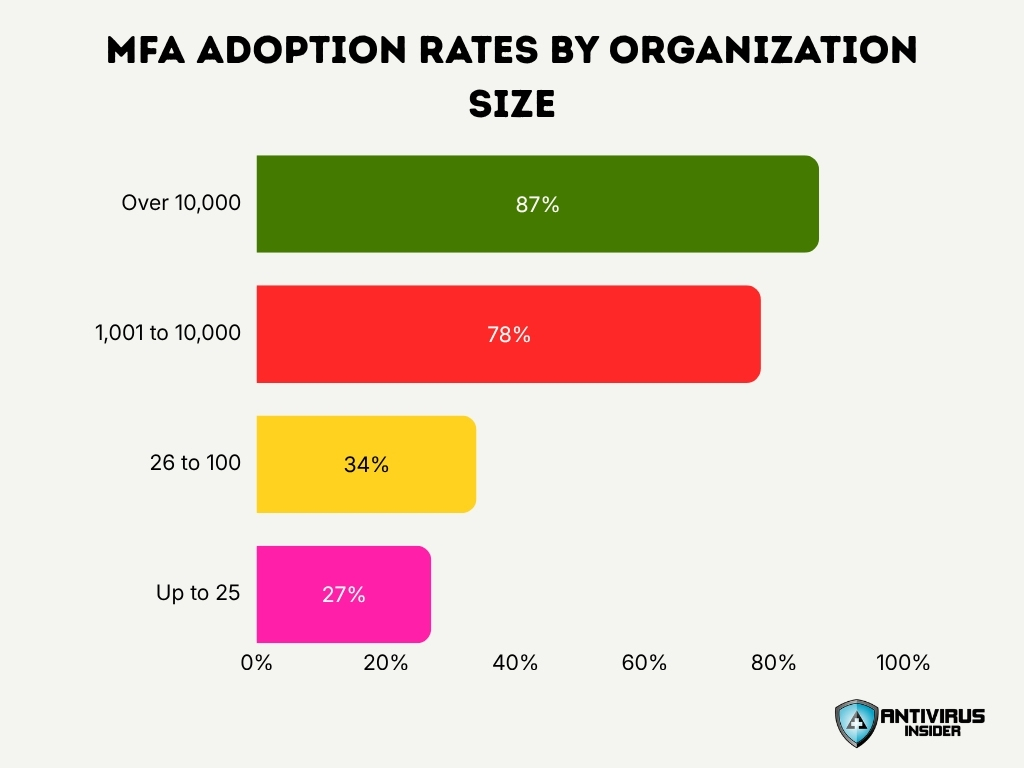
- 87% of organizations with over 10,000 employees have successfully adopted MFA.
- The MFA adoption rate stands at 78% for businesses with 1,001 to 10,000 employees.
- Only 34% of medium-sized firms with 26 to 100 employees currently use MFA.
- Small businesses with up to 25 employees have the lowest MFA penetration at 27%.
- 62% of small to mid-sized organizations globally do not implement MFA for user accounts.
- 89% of US-based small and medium-sized businesses implement MFA compared to 35% globally.
- 95% of employees using MFA prefer software-based options due to lower deployment costs.
- 44% of small to medium-sized businesses cite cost as the primary barrier to MFA adoption.
- Highly regulated industries saw MFA adoption grow by over 5% in a single year.
Authenticator App Usage Statistics
- 95% of employees using MFA prefer software-based solutions like authenticator apps.
- Workforce MFA adoption reached 70% of users globally as of January 2025.
- The technology sector currently leads authenticator adoption with an 87% implementation rate.
- Adoption of phishing-resistant authenticators surged by 63% within a single one-year period.
- Approximately 45% of small businesses have adopted authenticator apps to secure company data.
- Using authenticator apps can reduce the risk of account compromise by 99.22%.
- Utilizing authenticator apps enables a fast 8.5-second average login time for enterprise users.
- A massive 73% of global MFA transactions rely directly on smartphone-based authenticators.
- An overwhelming 92% of organizations report that authenticator apps are highly effective.
- The global MFA market revenue officially stood at $12.5 billion in the year 2022.
Biometric Authentication Statistics
- More than 70% of smartphones globally now include biometric authentication capabilities.
- Nearly 60% of consumers report using biometric authentication at least once per day on devices.
- Biometric login success rates generally exceed 95% under normal operating conditions.
- Fingerprint recognition accounts for 60% of the biometric authentication market share in smartphones.
- More than 176 million Americans use facial recognition technology, with 131 million using it daily.
- Over 3 billion people are forecast to use biometric payments worldwide by the end of 2026.
- The global biometric system market is projected to grow to $95.14 billion by the year 2030.
- Around 73% of millennials consistently use contactless payments with biometric integration.
- Approximately 61% of large institutions will integrate AI-enabled biometric fraud analytics by 2026.
- The contactless biometric technologies market is expected to reach a value of $17.50 billion in 2026.
Most Popular MFA Methods and Technologies
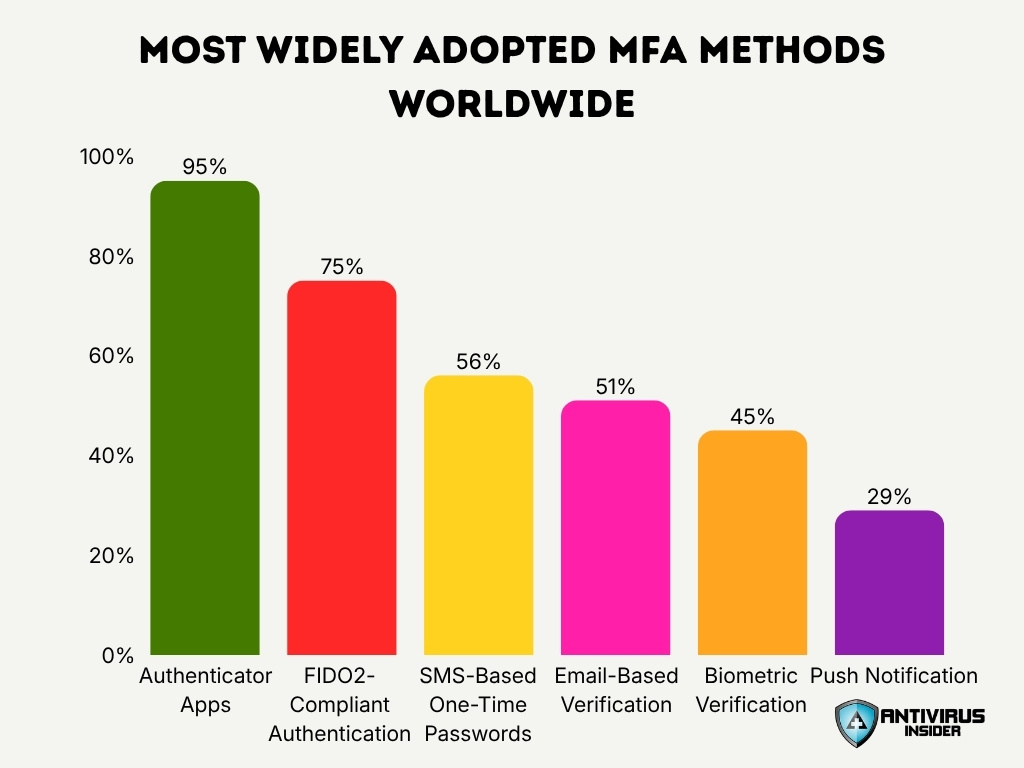
- Software-based mobile authenticator apps dominate the enterprise space, being the preferred choice for 95% of all active MFA users.
- SMS-based one-time passwords continue to maintain a significant market share, currently utilized by approximately 56% of global organizations.
- Push notification authentication serves as the primary secondary factor for 29% of users due to its frictionless login experience.
- The adoption of hardware security keys and other phishing-resistant authenticators surged by 63% year-over-year by early 2025.
- Biometric verification is rapidly expanding, with data indicating it is actively integrated into 45% of all MFA implementations globally.
- Despite known vulnerabilities, email-based verification remains heavily relied upon, supported by 51% of businesses worldwide.
- FIDO2-compliant authentication is seeing massive consumer adoption, with 75% of global users enabling it on at least one personal account.
- The shift toward adaptive MFA solutions is driving rapid market growth, pushing the global MFA valuation toward $42.5 billion by 2033.
- Passkey adoption experienced explosive enterprise growth, surging 67% year-over-year through mid-2026 across various industries.
- Risk-based authentication and continuous passwordless strategies are currently being deployed or piloted by 68% of surveyed enterprises.
Multi-Factor Authentication Effectiveness and Breach Prevention Statistics
- MFA can prevent up to 99.9% of automated cyberattacks on user accounts.
- Enabling MFA reduces the overall risk of account compromise by 99.2%.
- Nearly 80% to 90% of all cyberattacks could be prevented by using multi-factor authentication.
- Cyberattacks involving stolen credentials currently account for 49% of modern data breaches.
- Over 98.5% of login attacks utilizing leaked credentials are successfully blocked by MFA.
- Implementing MFA effectively reduces the risk of suffering a material breach by 50%.
- Securing access with MFA helps organizations save an average of $2.2 million on data breach costs.
- Roughly 78% of modern enterprises mandate MFA to secure their privileged user accounts.
- Only 57% of global organizations have fully implemented MFA across all their system entry points.
Password Vulnerability and Cyber Hygiene Statistics
- More than 80% of hacking-related breaches involve stolen, weak, or reused credentials, making passwords one of the most exploited attack vectors.
- The average internet user manages over 100 passwords, contributing to password reuse and insecure storage habits.
- Approximately 65% of users reuse passwords across multiple accounts despite growing awareness of cyber risks.
- Credential stuffing attacks continue to rise, fueled by billions of leaked credentials available on underground marketplaces.
- Around 30% of internet users have experienced a data breach due to compromised credentials at least once.
- Weak passwords such as “123456” and “password” still appear among the most commonly used passwords globally.
- Organizations that enforce password managers report significantly lower rates of password reuse among employees.
- Nearly 50% of users admit to writing down passwords or storing them in unsecured locations.
- Cybersecurity teams increasingly recommend passwordless authentication because passwords remain highly vulnerable to phishing and social engineering.
- Security awareness programs combined with MFA adoption produce stronger cyber hygiene outcomes than password policies alone.
Passwordless Authentication Preferences Among IT Leaders
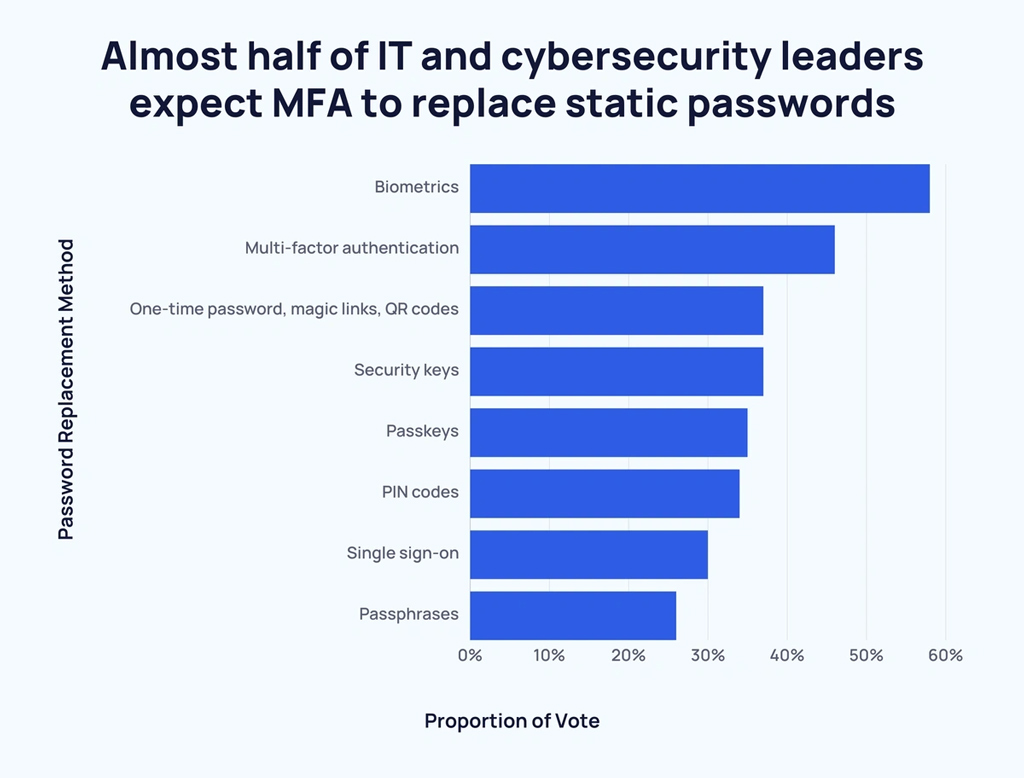
- 58% of IT and cybersecurity leaders believe biometrics will replace static passwords, making it the top-ranked alternative.
- 46% expect multi-factor authentication (MFA) to replace passwords, showing strong confidence in layered security.
- 37% of respondents favor one-time passwords, magic links, and QR codes as password replacements.
- 37% also support security keys, tying with OTP-based authentication methods in adoption expectations.
- 35% of leaders view passkeys as a viable passwordless authentication solution.
- 34% expect PIN codes to remain a relevant alternative to traditional passwords.
- 30% believe single sign-on (SSO) can effectively reduce reliance on static passwords.
- Only 26% see passphrases as the future replacement for conventional password systems.
The Financial Impact of Authentication-Related Data Breaches
- The average global cost of a data breach recently reached a historic peak of $4.88 million.
- Incidents initiated by stolen or compromised credentials cost affected organizations an average of $4.81 million.
- Organizations operating without a strict Zero Trust framework incur average breach costs $1.04 million higher than those with one.
- Phishing-related data breaches, which frequently target authentication systems, generate an average financial loss of $4.88 million.
- Cyberattacks exploiting compromised credentials require an average of 292 days to identify and resolve, significantly escalating expenses.
- Lost business revenue and customer attrition contribute approximately $1.3 million to the total financial impact of an average breach.
- Publicly traded corporations typically suffer an average 7.5% decline in stock value immediately following a major security incident.
- Companies failing to implement multi-factor authentication can face steep cyber insurance premium hikes of up to 50%.
- Investing heavily in security AI and automation has been shown to reduce overall breach-related financial losses by $2.22 million.
Banking and Financial Services MFA Statistics
- The Banking, Financial Services & Insurance (BFSI) sector accounted for 48% of the MFA market share in key regions during 2025.
- The average cost of a data breach in the financial sector reached $5.56 million in 2025, driving strict MFA compliance.
- Roughly 65% of financial services organizations were hit by ransomware last year, cementing MFA as a critical defense layer.
- Online payment and banking institutions were the target of 30.9% of all phishing attacks in the first quarter of 2025.
- Software-based methods like mobile banking applications are preferred by 95% of all MFA users over hardware tokens.
- The global multifactor authentication market is experiencing massive growth and is projected to reach $78.53 billion by 2034.
- The adoption of phishing-resistant passwordless authentication grew by 63% in just one year to combat sophisticated cyber threats.
- An estimated 98% of organizations worldwide now support multiple authentication methods to protect highly sensitive accounts.
Common Barriers and User Resistance to MFA Implementation
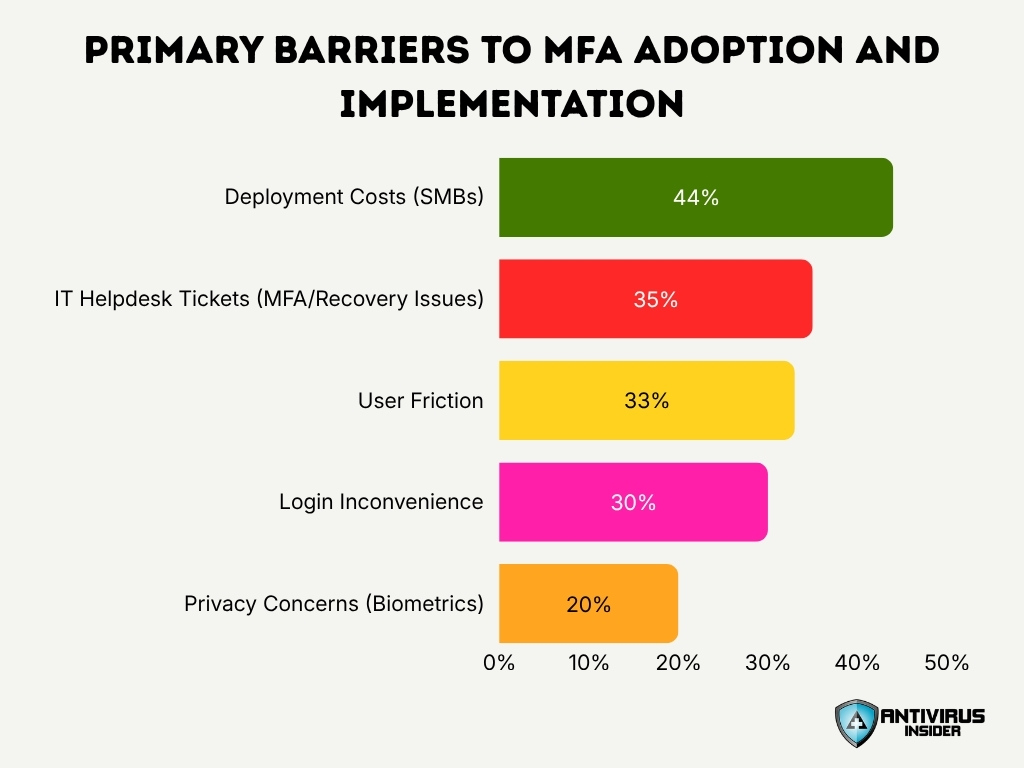
- Approximately 33% of organizations cite user friction as a major challenge when deploying MFA.
- Nearly 44% of small businesses identify deployment costs as the primary barrier to implementation.
- Around 35% of IT helpdesk tickets are frequently related to MFA and account recovery issues.
- Only 57% of global organizations have fully implemented MFA due to technical complexity and staff pushback.
- Over 25% of companies indicate that legacy systems create significant integration challenges for modern MFA solutions.
- More than 30% of employees report login inconvenience as a primary reason for resisting MFA adoption.
- Up to 20% of users express privacy concerns as a notable obstacle to biometric authentication deployment.
- Nearly 85% of SMBs avoid requiring customer MFA due to fears that additional steps could reduce engagement.
- Almost 49% of data breaches involve stolen credentials, highlighting the severe risk of delaying MFA integration.
Cloud Security and Zero Trust Authentication Statistics
- Around 81% of organizations have implemented or are currently adopting a Zero Trust security model.
- The global Zero Trust Security market is projected to reach a massive $148.68 billion by 2034.
- Approximately 63% of organizations adopt Zero Trust primarily to enhance their cloud environment security.
- The implementation of multi-factor authentication (MFA) can prevent up to 80–90% of cyber-attacks.
- The technology sector currently leads global MFA implementation with an 87% adoption rate.
- Cloud security incidents remain high, with 61% of organizations reporting breaches in the past year.
- Adopting a Zero Trust framework enables an average of 50% faster threat detection and response times.
- Nearly 44% of organizations report a 90% drop in security incidents after fully adopting Zero Trust.
Workforce and Remote Access MFA Statistics
- More than 99.9% of compromised accounts lack MFA protection.
- Nearly 92% of organizations trust MFA for securing sensitive data.
- Around 68% of companies globally mandate MFA for their remote workers.
- Approximately 78% of enterprises enforce MFA for privileged user accounts.
- Up to 95% of MFA users prefer mobile applications over hardware tokens.
- Only 57% of global organizations have fully implemented MFA across all systems.
- About 87% of large enterprises with over 10,000 employees utilize MFA.
- Nearly 85% of small businesses do not require MFA for external access.
- Exactly 73% of individuals favor smartphones as their primary MFA device.
MFA Volume Growth by Country Statistics
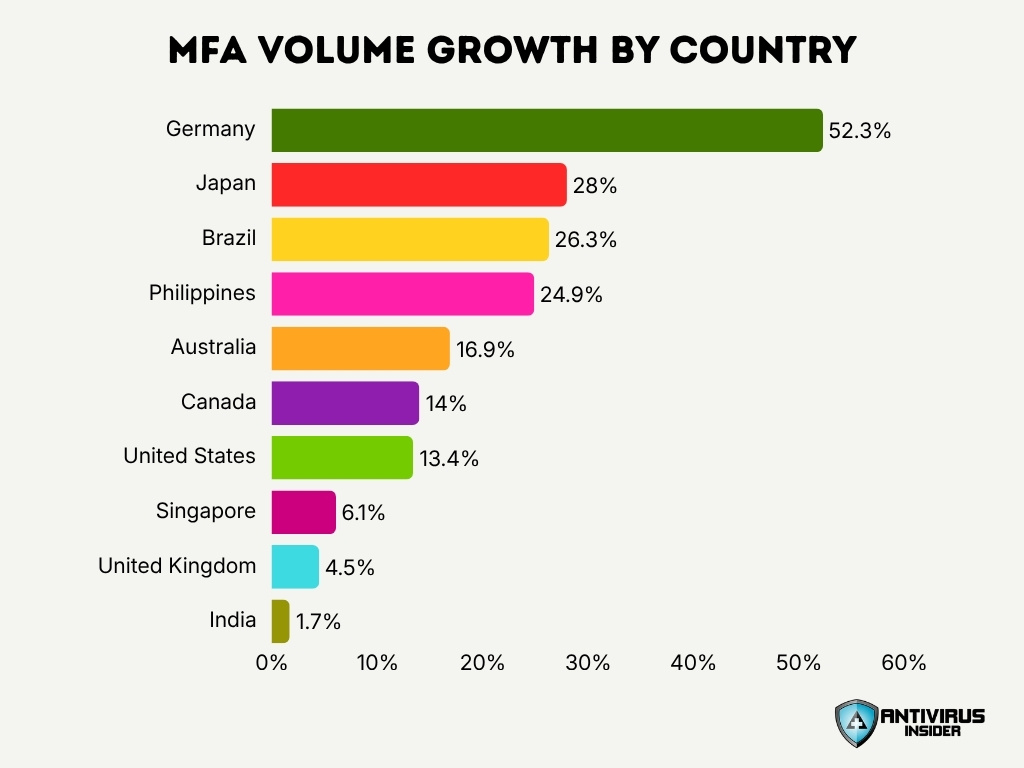
- Germany recorded the highest MFA volume increase at 52.3%, nearly doubling the growth rate of most other countries.
- Japan ranked second with a 28.0% increase in MFA volume during 2023.
- Brazil saw a strong 26.3% rise in MFA adoption, leading growth in South America.
- The Philippines reported a notable 24.9% increase, highlighting rapid MFA expansion in Asia.
- Australia achieved a 16.9% growth rate, the highest among the Oceania nations listed.
- Canada and the United States posted similar MFA volume increases of 14.0% and 13.4%, respectively.
- Singapore experienced a moderate 6.1% increase in MFA volume during 2023.
- The United Kingdom recorded a relatively low 4.5% increase compared to other major economies.
- India had the smallest MFA volume increase at just 1.7% among the countries analyzed.
- Asia dominated the ranking with four countries appearing in the top ten for MFA volume growth.
Emerging Trends in Biometrics and Passwordless Authentication
- Consumer awareness of passkeys has reached an impressive 90% in 2026, with 75% of users enabling them on at least one account.
- Approximately 68% of organizations are currently deploying, piloting, or rolling out passkeys for employee authentication to eliminate traditional passwords.
- The global behavioral biometrics market is expected to reach $3.45 billion in 2026, growing at a remarkable 26.95% compound annual growth rate.
- By early 2026, more than 8 billion devices globally are estimated to support FIDO2 passkeys, providing a massive installed base for phishing-resistant logins.
- Artificial intelligence and behavioral scoring can reduce false positive fraud alerts by up to 85% while cutting incident response times by 45%.
- Over 82% of enterprises report that achieving fully passwordless authentication is a strategic goal they have already reached or are actively pursuing.
- Implementing passkeys alongside adaptive authentication models has helped early-adopting organizations reduce auth-related support tickets by 50%.
- The global passwordless authentication market is projected to hit $24.85 billion in 2026 and is forecast to continue growing at a 14.95% CAGR through the next decade.
Frequently Asked Questions (FAQs)
Multi-factor authentication can block over 99.9% of account compromise attacks, and MFA reduces the risk of account compromise by 99.22% overall and 98.56% for accounts with leaked credentials.
The global multi-factor authentication market is forecast to reach between $41.29 billion and $53.0 billion by 2030, depending on the market model used.
Industry forecasts estimate the MFA market will grow at a 14.0% to 17.1% CAGR through the end of the decade.
The global MFA market was valued at approximately $21.1 billion to $21.5 billion in 2025.
Microsoft reported that more than 99.9% of compromised accounts did not have MFA enabled, highlighting the security impact of deploying MFA.
Conclusion
Multi-factor authentication has evolved from a recommended security practice into a fundamental requirement for modern digital environments. Throughout, organizations accelerated MFA deployment to defend against phishing, credential theft, ransomware, and identity-based attacks. At the same time, passwordless technologies such as passkeys, biometrics, and FIDO2-based authentication gained momentum as organizations sought stronger security and improved user experiences.
The data shows that MFA adoption continues to expand across industries, organization sizes, and geographic regions. Financial institutions, healthcare providers, government agencies, and cloud-first enterprises remain among the most mature adopters. Looking ahead, advances in biometrics, adaptive authentication, and passwordless identity systems are expected to further strengthen account security while reducing reliance on traditional passwords.
