



Artificial intelligence has moved from limited experimentation into everyday legal work, changing how lawyers research, draft, review, analyze, and manage matters. Law firms and corporate legal departments are using AI for legal research, document review, summarization, contract drafting, correspondence, eDiscovery, and workflow automation, while clients increasingly expect faster service and clearer value from AI-enabled work. Adoption is also spreading beyond basic generative AI into more advanced systems that can support multistep legal processes.
At the same time, rapid adoption is creating new questions around confidentiality, hallucinations, pricing, governance, training, and professional responsibility. The statistics in this article show how widely AI is being used across the legal sector, where firms are seeing the strongest productivity and revenue gains, and which risks are shaping the next stage of legal AI adoption.
Editor’s Choice
- 41% of law firms used GenAI in 2026, a 13-percentage-point increase from 28% in 2025.
- 47% of corporate legal departments reported GenAI use in 2026, more than double the 23% recorded in 2025.
- 80% of legal GenAI users used the technology for legal research in 2026, making research the leading reported legal use case.
- 74% used GenAI for document review, while 73% used it for document summarization.
- In a 2026 Texas attorney survey, overall AI use reached 62%, more than double the 30% recorded in the comparable 2024 survey.
- Solo and small-firm adoption remained substantial in 2026; 71% of solo practitioners and 75% of small-firm legal professionals reported using AI.
- Agentic AI has begun entering professional workflows; 15% of organizations reported already using some form of agentic AI in 2026, while another 53% were planning or considering adoption.
Recent Developments
- Organization-wide GenAI adoption across professional services increased from 22% in 2025 to 40% in 2026, indicating that implementation accelerated sharply over a single year.
- Law-firm GenAI adoption climbed from 28% to 41% between 2025 and 2026, a relative increase of about 46%.
- Corporate legal adoption rose even faster, from 23% in 2025 to 47% in 2026, effectively doubling year over year.
- Government adoption also accelerated. GenAI use increased from 13% in 2025 to 32% in 2026 among surveyed government organizations.
- Early enterprise GenAI adoption across law firms and legal departments stood at 14% in early 2024 but had reached about 43% two years later, illustrating how quickly organization-level deployment expanded.
- The legal industry has also entered the agentic AI stage; 15% of organizations were already using agentic AI in 2026, while 53% were either planning or evaluating it.
- Only 18% of professional-services organizations said they tracked AI return on investment in 2026, showing that adoption has advanced faster than formal financial measurement.
- In September 2026, California lawmakers passed legislation requiring lawyers to take reasonable steps to verify AI-generated legal content and disclose certain AI use in court filings, illustrating how regulation is beginning to catch up with adoption.
Generative AI in Legal Market Growth Statistics
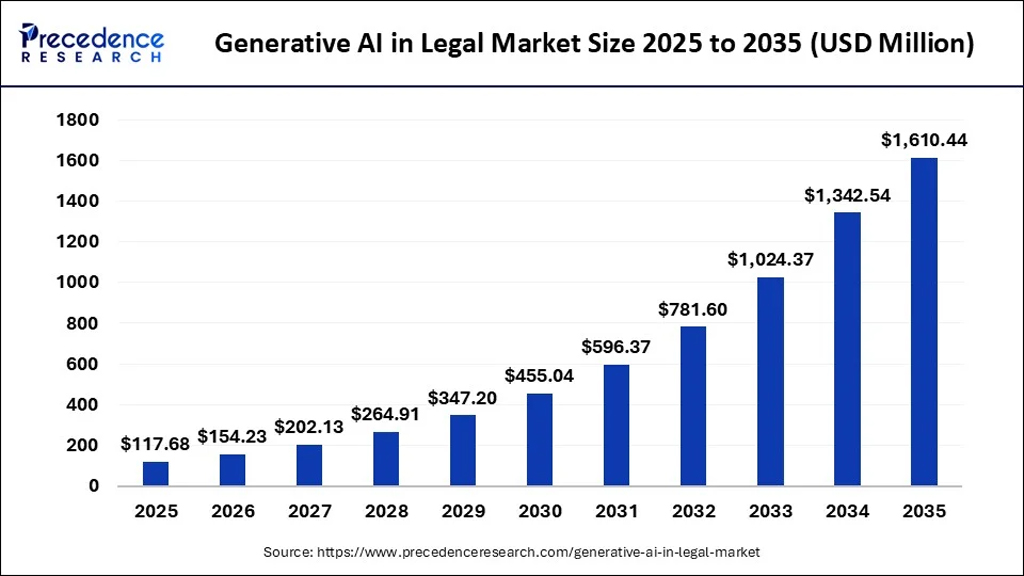
- The generative AI in legal market is projected to grow from $117.68 million in 2025 to $1.61 billion by 2035, highlighting rapid expansion across the legal sector.
- In 2026, the market is expected to reach $154.23 million, up from $117.68 million in 2025.
- The market is forecast to surpass $200 million in 2027, reaching approximately $202.13 million.
- By 2030, generative AI in the legal market is projected to reach $455.04 million, nearly four times its 2025 size.
- Market growth is expected to accelerate further, climbing from $596.37 million in 2031 to $781.60 million in 2032.
- The generative AI legal market is projected to cross the $1 billion milestone in 2033, reaching approximately $1.02 billion.
- By 2034, the market is forecast to expand to $1.34 billion, before reaching $1.61 billion in 2035.
- Overall, the market is expected to grow by nearly 13.7 times between 2025 and 2035, indicating substantial long-term demand for generative AI applications in legal services.
How Lawyers Are Using AI in Daily Practice
- More than 80% of current GenAI users across professional services engaged with the technology at least weekly in 2026.
- In 2025, 72% of legal professionals already using GenAI reported using it at least weekly, and more than 40% used it at least once a day.
- Legal research reached 80% usage among legal GenAI users in 2026, making it the most frequently reported legal application.
- Document review ranked second at 74%, reflecting AI’s growing role in analyzing case files, contracts, discovery materials, and other text-heavy records.
- Document summarization reached 73% among legal GenAI users in 2026, allowing lawyers to condense lengthy source material before deeper review.
- 59% used GenAI for briefs or memo drafting, showing that drafting support has become a mainstream use case while lawyers retain responsibility for review and accuracy.
- Correspondence drafting reached 55%, placing emails, letters, and other routine communications among the most common AI-assisted activities.
- Contract drafting accounted for 49% of legal GenAI use cases in the 2026 findings, illustrating the technology’s growing role in transactional practice.
- In one 2026 U.S. attorney survey, 53% of AI users identified legal research as their most common AI application, providing a regional example consistent with the broader international pattern.
AI Adoption Rates in the Legal Industry
- 41% of law firms said their organizations were already using GenAI in 2026.
- The equivalent figure for law firms was 28% in 2025, showing a 13-percentage-point year-over-year increase.
- 47% of corporate legal departments reported organizational GenAI use in 2026, compared with 23% in 2025.
- Across all professional-services organizations surveyed, 40% used GenAI in 2026, versus 22% one year earlier.
- A broader legal-industry study found 79% of legal professionals used AI in some capacity in both 2024 and 2025.
- However, only 40% of legal professionals in that 2025 research reported using a legal-specific AI product, indicating a sizable gap between general AI experimentation and specialized legal AI adoption.
- General-purpose AI use reached 46% in 2025, up from 36% in the prior reporting period in the same research series.
- Another U.S. attorney survey found 62% AI use in 2026, compared with 30% in 2024, providing a state-level example of adoption more than doubling within two years.
- Earlier industry data provide a useful baseline, AI-based technology use among surveyed lawyers rose from roughly 11% in 2023 to 30% in 2024.
AI Usage by Law Firm Size and Type
- In 2026, 71% of solo legal professionals reported using AI in some capacity.
- Among small law firms, the comparable 2026 adoption rate reached 75%, slightly above the solo rate.
- Earlier 2025 data put AI adoption among solos at 72% and among small firms at 67%, highlighting both high adoption and differences between survey populations.
- Larger firms showed substantially deeper implementation in the same research; 85% used AI in some capacity, and 35% said they had adopted it widely or universally.
- By comparison, only 8% of solo firms and 4% of small firms reported wide or universal AI adoption, showing that occasional use remains much more common than full integration in smaller practices.
- Mid-sized firms recorded particularly strong adoption in 2025; 93% used AI in some capacity, while 51% said usage was wide or universal.
- A separate survey focusing on legal-specific GenAI found 39% adoption among firms with 51 or more lawyers, compared with approximately 20% among firms with 50 or fewer lawyers.
- Earlier AI-tool data showed a similar size effect: in 2024, 47.8% of lawyers at firms with 500 or more attorneys reported their offices used AI-based technology, compared with 17.7% of solo practitioners.
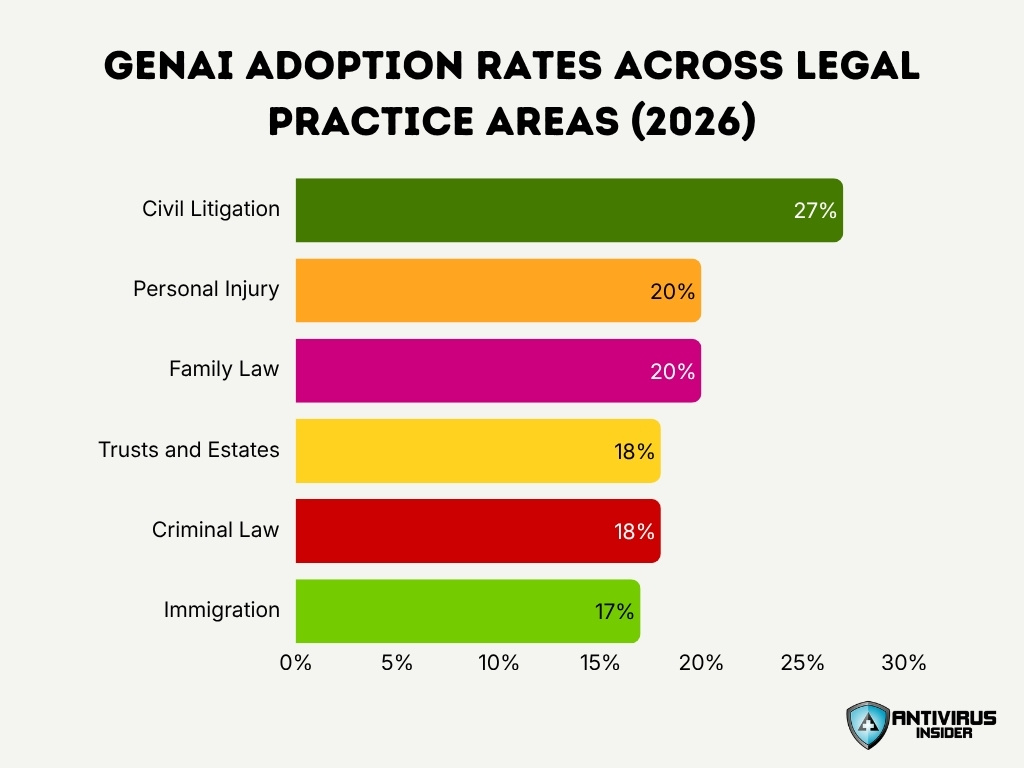
- Practice area also matters. Recent firm-level data placed GenAI adoption at 27% in civil litigation, 20% in personal injury, 20% in family law, 18% in trusts and estates, 18% in criminal law, and 17% in immigration practices.
Top AI Use Cases in Legal Workflows
- Legal research, 80%: Research ranked first among legal GenAI use cases in the 2026 professional-services data, up from 74% in comparable 2025 reporting.
- Document review, 74%: Nearly three-quarters of legal users applied GenAI to reviewing documents in 2026.
- Document summarization, 73%: Summarizing long records, agreements, filings, and other legal materials ranked third.
- Brief and memo drafting, 59%: More than half of users relied on GenAI to assist with first drafts, outlines, or portions of legal memoranda and briefs.
- Correspondence drafting, 55%: AI increasingly supports routine client and matter communications, reducing the time required for first-pass drafting.
- Contract drafting, 49%: Almost half of legal GenAI users reported contract drafting as a use case in 2026.
- Mid-sized firms provide another view of workflow adoption: 66% used AI-powered legal research, 60% used document drafting or automation, 53% used eDiscovery tools, and 52% used predictive legal analytics in 2025.
- Among solo firms that had adopted AI, 54% used legal research platforms, 25% used document drafting or automation tools, and 20% used eDiscovery solutions.
- Small firms followed a similar pattern: 56% used AI-enabled legal research, 30% used drafting or document automation, and 19% used eDiscovery tools.
- AI use is also expanding beyond conventional GenAI. 15% of organizations had adopted agentic AI in 2026, and another 53% were planning or considering it, signaling a shift from tools that answer prompts toward systems capable of carrying out multistep workflows.
AI’s Impact on Law Firm Revenue and Pricing
- In 2026, 52% of law firms surveyed internationally said revenue had increased by 6% to 20% following AI adoption.
- Within that group, 30% reported revenue gains of 6% to 10%, while 19% reported increases between 11% and 20%.
- Looking more broadly at legal professionals, about 32% attributed revenue growth of 11% to 20% directly to AI, indicating that the financial effect extends beyond simple labor savings.
- Smaller practices have seen more modest results. In 2026, 32% of solo firms and 31% of small firms reported an AI-associated revenue increase.
- Pricing has changed much more slowly than productivity. 86% of solo firms and 78% of small firms had not changed their pricing models to account for AI use in the latest small-firm data.
- Across a broader 2026 law-firm sample, just 28% had changed their pricing structure in response to AI, despite much higher adoption rates.
- Conversely, 62% of law-firm professionals said their pricing structure remained unchanged despite AI, exposing a widening gap between technology-driven efficiency and commercial strategy.
- Nearly 50% of legal professionals surveyed in 2026 believed AI would change law-firm billing practices, 25% expected fewer hours to be spent per matter, while 22% anticipated increased use of flat fees and alternative fee arrangements.
- The 2025 evidence also linked formal AI strategy with stronger commercial results; organizations with a visible AI strategy were twice as likely to report AI-related revenue growth as organizations taking an informal or ad hoc approach.
Time Savings and Productivity Gains from AI
- In 2026, 62% of surveyed legal professionals said AI saved them between 6% and 20% of their working week.
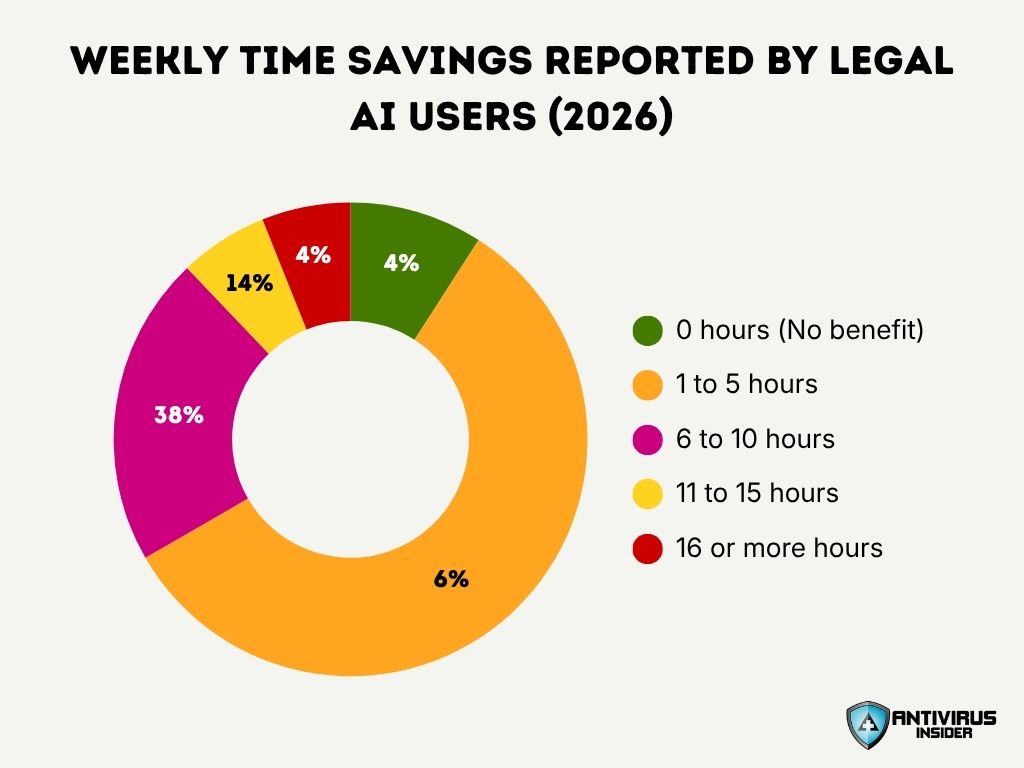
- Another 2026 legal-industry survey found 38% of AI users saved one to five hours per week, making that the most common reported time-saving range.
- A further 14% saved six to 10 hours per week in 2026, showing that a meaningful minority has moved beyond modest efficiency gains.
- About 4% saved 11 to 15 hours weekly, while another 4% reported saving 16 hours or more each week.
- Only 6% of 2026 AI users reported no productivity benefit, down sharply from 16% to 17% in the prior year’s findings, depending on the reporting cut.
- Productivity does not always appear as time saved. 33% of respondents said AI improved the quality of their work even when it did not reduce the number of hours required.
- The 2025 data showed larger reported individual savings among existing AI users: 65% saved one to five hours per week, 12% saved six to 10 hours, and 7% saved at least 11 hours.
- At the firm level in that 2025 research, 61% said AI had somewhat increased efficiency, while another 21% reported a significant efficiency increase; only 2% reported lower efficiency.
- Legal professionals surveyed in 2025 expected AI to free up nearly 240 hours per professional per year, up from an expected 200 hours in 2024. The estimated annual value of that released capacity reached about $19,000 per professional.
Client Attitudes Toward AI in Legal Services
- In 2026, 77% of corporate and government legal clients said receiving AI-enabled quality improvements from outside firms was very important or essential. Yet only 5% said most or all of their providers currently delivered those improvements.
- 71% of in-house legal professionals now expect outside firms to change how they charge for services as AI use increases.
- Another 61% of in-house teams reported pressure from internal stakeholders to adopt AI faster, increasing expectations that outside counsel will keep pace.
- 22% of in-house professionals said in 2026 that they would reconsider existing law-firm relationships within the next 12 months if their firms failed to demonstrate AI-enabled value; another 11% were already reconsidering relationships.
- The 2025 corporate legal survey found 64% expected GenAI to reduce their reliance on outside counsel, suggesting that AI can shift work from firms back into legal departments.
- In the same 2025 research, 50% expected AI to lower outside-counsel spending, while 61% intended to push firms to change the way legal services were delivered or priced.
- Despite those expectations, 59% of corporate legal respondents said in 2025 that they had not yet received any AI-related savings from their outside law firms.
- Client demand was already visible in earlier 2025 data; 59% of corporate legal clients wanted their outside firms to use GenAI, compared with 44% of government legal clients.
- Consumer attitudes remain more cautious. A 2026 client survey found 45% were comfortable with AI supporting legal-service delivery, while 32% were uncomfortable and 22% remained unsure. Business clients were considerably more comfortable than personal clients, at 62% versus 42%.
Public Perception of AI in the Justice System
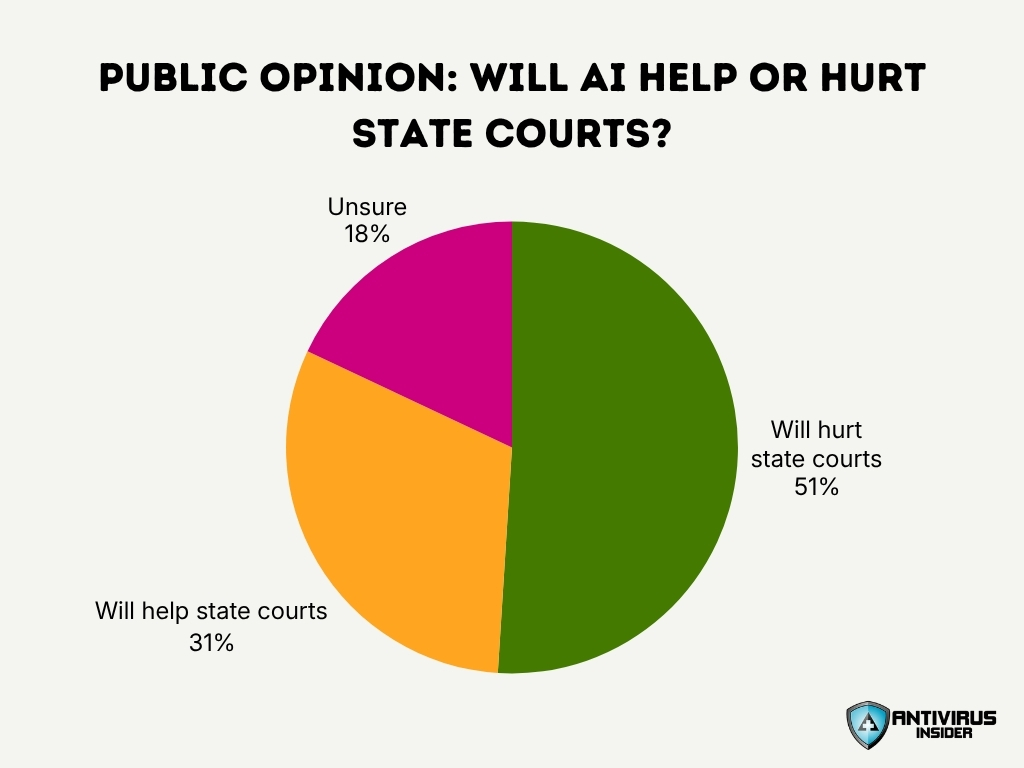
- In the national 2025 court survey, 51% of registered voters said AI would hurt state courts by increasing the risk of mistakes and reducing trust in court decisions.
- By comparison, 31% believed AI would help state courts work faster and more efficiently by cutting paperwork, reducing backlogs, and improving case-management tools.
- The remaining 18% were unsure whether AI would help or hurt courts, leaving almost one in five voters without a settled view.
- Overall confidence in state courts remained considerably stronger than attitudes toward court AI, 62% expressed confidence in state courts in 2025, compared with 63% in 2024 and 61% in 2023.
- Only 44% of Americans agreed in 2025 that state courts provide equal justice for all, down from 62% in 2014. That wider trust gap creates a challenging environment for deploying AI in judicial processes.
- Age affects attitudes toward courts more broadly. Adults ages 18 to 29 were 3 percentage points more likely than the overall population to regard state courts as fair and impartial, at 53% versus 50%.
- The same younger group was 6 points more likely to describe state courts as transparent and accountable, at 47% versus 41%, and 9 points more likely to view them as innovative, at 42% versus 33%.
- Actual judicial adoption remains cautious. A 2026 random-sample survey found more than 60% of responding federal judges had used at least one AI tool for judicial work, but only 22.4% used AI weekly or daily and 38.4% had never used the listed tools.
- Only one-third of surveyed federal judges permitted or encouraged AI use by chamber staff, while 20.4% formally prohibited it and 17.6% discouraged it without imposing a formal ban.
Generational and Experience-Based Differences in AI Use
- Among lawyers who graduated from ABA-accredited law schools in 2022, 48% said AI had become an essential part of their daily legal work by 2026.
- An additional 30% of those early-career lawyers had access to AI but used it infrequently, while 22% did not use AI at all.
- This cohort experienced an unusually sharp technology transition; 96% had not used AI tools in law school, yet almost half considered AI essential to their daily practice only four years after graduation.
- Early-career lawyers most frequently used AI for legal research at 57%, followed by compiling and synthesizing information at 55% and document drafting at 40%.
- A smaller 2025 study of legal professionals found 44% of respondents ages 26 to 35 used AI weekly, while 28% used it daily and only 8% reported no AI use.
- Among respondents ages 36 to 45 in that study, 35.7% reported no AI use, while 28.6% used it daily and 14.3% used it weekly. The sample was small, so these results serve as a niche indicator rather than a national benchmark.
- Law students show similarly high engagement. Nearly 6 in 10 students surveyed in 2026 said they used AI several times per week for academic work.
- Experience also changes how students rate institutional preparation; 36% of first-year students believed their school adequately prepared them for AI in practice, but that figure fell to 30% among third-year students.
- Generational openness also appears among legal clients. In 2026, 50% of clients ages 18 to 29 and 56% of those ages 30 to 44 were comfortable with AI use in legal services, compared with just 25% of respondents ages 75 and older.
AI in Legal Education and Training
- 72% of law students surveyed in April 2026 said AI literacy was an essential professional skill.
- At the same time, 74% recognized that overreliance on AI could weaken development of their underlying legal skills, showing that high adoption does not equal unconditional trust.
- Nearly 60% of law students used AI several times per week for academic work in 2026, even though much of their AI learning remained self-directed.
- 48% said AI policies varied by professor, leaving almost half of students working under different AI rules from one course to another.
- 32% said their law school did not provide the AI skills they needed for their future careers.
- Another 15% reported no AI curriculum integration whatsoever at their institution in 2026.
- Only 35% of students overall agreed or strongly agreed that their school supplied the AI skills required for their future career, while 32% disagreed or strongly disagreed.
- Almost half, 47% of law students, expected entry-level legal positions to decline as AI absorbs work traditionally assigned to junior professionals.
- The training gap continues after graduation. In a 2026 law-firm survey, 54% said their firm offered no AI training and had no plans to provide it, while only 11% reported mandatory AI training.
- Courts face a similar challenge: 45.5% of surveyed federal judges said court administration had not offered AI training, while 15.7% did not know whether it had been offered. However, three-quarters of judges who received an AI-training opportunity attended.
How Law Schools Are Responding to AI
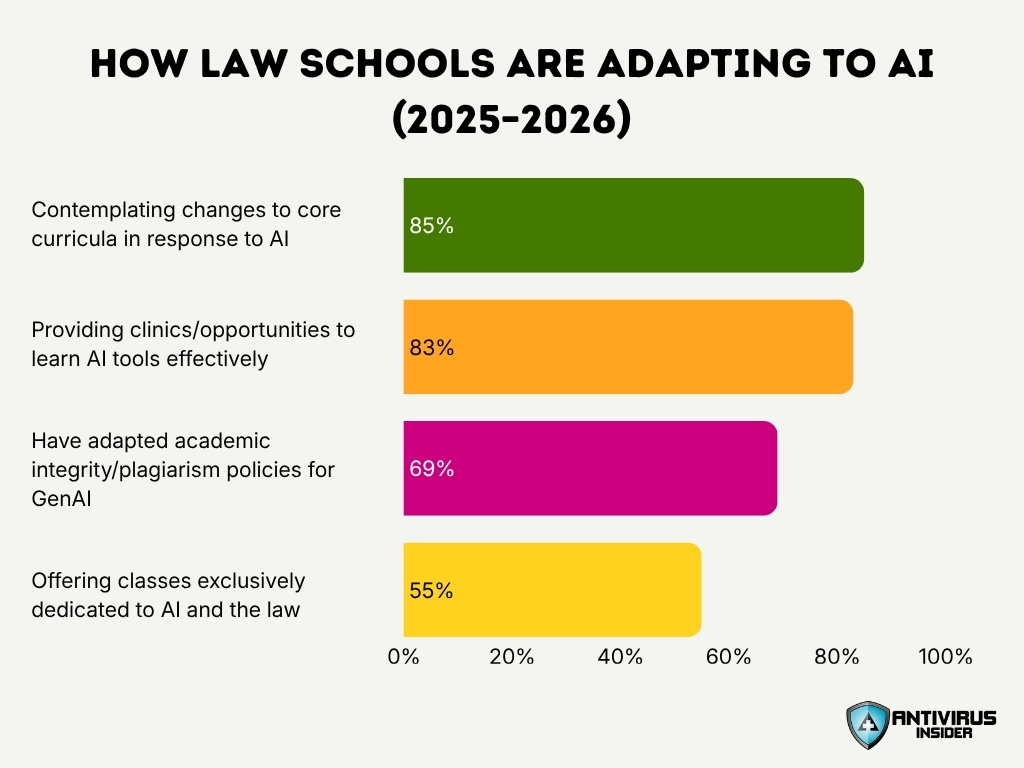
- 85% of law schools are considering changes to their core curricula in response to the growing influence of AI in legal education and practice.
- 83% of law schools provide clinics or other learning opportunities designed to help students use AI tools effectively.
- 69% of law schools have already updated their academic integrity or plagiarism policies to address the use of generative AI.
- 55% of law schools now offer dedicated classes focused exclusively on AI and the law, showing that AI is becoming a formal area of legal education.
- Overall, the data indicates that AI integration is becoming mainstream in law schools, with curriculum reform and practical AI training receiving the strongest institutional attention.
AI Hallucinations, Accuracy, and Court-Related Errors
- A 2025 peer-reviewed evaluation of more than 200 legal research queries found that leading retrieval-based legal AI systems still produced hallucinations in roughly 17% to 33% of queries, depending on the system.
- The best-performing system in that study returned accurate and grounded answers to 65% of queries, meaning more than one-third of responses were either incomplete or contained inaccuracies.
- A second tested legal research system achieved about 41% to 42% accuracy and hallucinated in roughly one-third of responses.
- Another tested system produced fully accurate answers for only 19% of queries and returned incomplete responses on more than 60% of the test set.
- Legal-specific systems still performed substantially better than general-purpose models on legal questions. Earlier testing of general-purpose LLMs found hallucination rates of at least 58%, with some models reaching 82% on legal queries.
- Court incidents rose quickly during 2025. One legal-proceedings database had recorded 426 AI-induced-error cases by early October 2025, after beginning with only a handful of incidents in 2023.
- A separate June 2025 review had documented 95 court-related AI hallucination incidents since June 2023, with 58 occurring in 2025 alone; reported sanctions included penalties of $1,000, $6,000, and $31,100 in individual cases.
- By January 2026, another review reported that more than 280 court filings since 2023 had contained AI-generated hallucinated citations, demonstrating that fabricated authorities remained a recurring litigation problem rather than an isolated early-GenAI error.
- More recent tracking shows further acceleration; one July 2026 analysis counted 524 U.S. incidents in 2025 and 668 during 2026 to date. Of the 2026 incidents, lawyers accounted for 256, self-represented litigants for 405, judges for four, and experts for two.
- The risk reached the judiciary itself in 2026. In one federal dispute, a judge acknowledged inaccuracies after a law clerk used AI, and an appellate proceeding subsequently focused on fictitious people and erroneous legal citations in the ruling. Separately, California lawmakers passed legislation on Sept. 1, 2026, requiring lawyers to take reasonable steps to verify AI-generated legal content and citations.
AI Governance, Policies, and Training in Law Firms
- 43% of law firms surveyed in 2026 had no formal AI governance policy and no plans to establish one.
- Another 24% were developing an AI policy, suggesting that almost one-quarter of firms recognized the governance gap but had not yet closed it.
- Only 9% of firms reported having a written AI policy that they actively enforced throughout the organization.
- A further 10% had an informal or inconsistently enforced policy, leaving significant room for lawyers within the same firm to follow different AI practices.
- Training gaps were equally pronounced; 54% of firms provided no responsible-AI training and had no plans to introduce it.
- Only 11% provided mandatory AI training to all staff, while another 11% offered training on an optional basis.
- Another 17% planned to introduce AI training within 12 months, showing that formal skills development continues to trail actual employee usage.
- A separate 2026 law-firm study produced a more developed training picture: 63% of firms offered some AI training, including 28.57% that made training mandatory and 34.69% that offered it optionally. The different result reflects a separate survey population.
- In the UK and Ireland, 17% of firms allowed or encouraged AI despite having no formal AI policy, highlighting that governance gaps extend beyond the U.S. market.
- Governance also affects client transparency. Although 81% of firms in that regional study said they disclosed AI use to clients at least occasionally, only 7% of clients remembered their lawyer proactively telling them that AI played a role in their matter.
Ethical, Confidentiality, and Data Security Risks of Legal AI
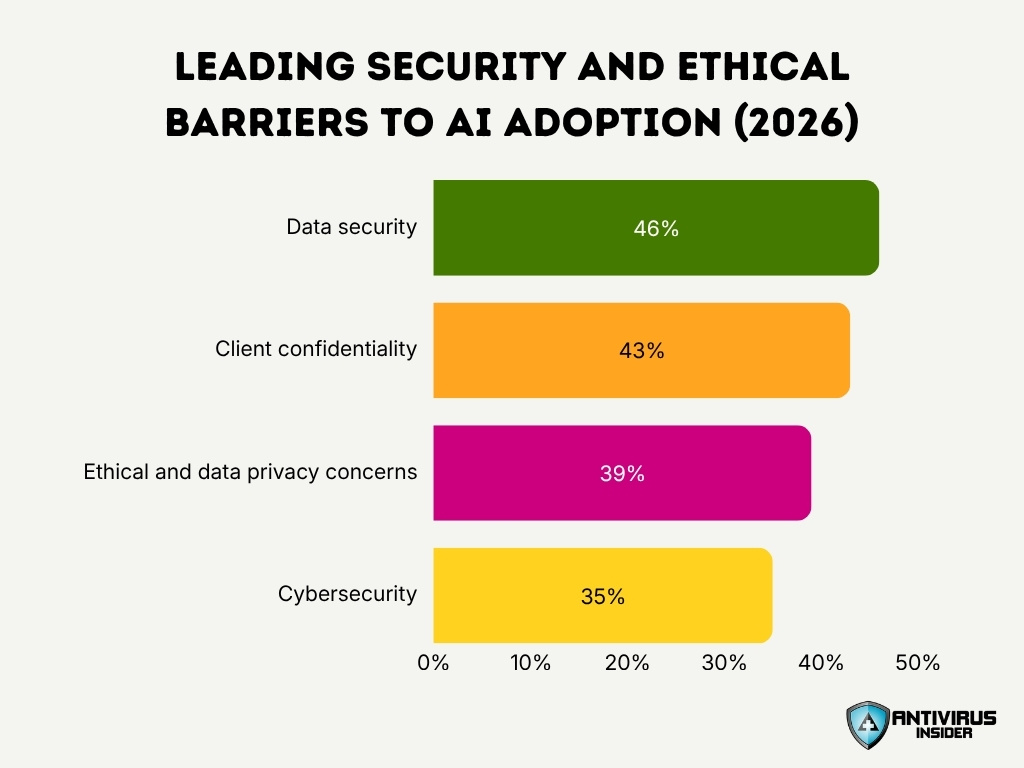
- In 2026, 46% of legal professionals identified data security as a significant barrier to wider AI adoption.
- 43% of legal professionals identified maintaining client confidentiality as a major information-security challenge in 2026.
- Ethical concerns involving AI and data privacy affected 39% of surveyed legal professionals, placing them among the leading obstacles to further implementation.
- Another 35% cited cybersecurity as a significant concern as firms expanded their use of AI-supported legal workflows.
- Looking beyond AI alone, 80% of legal professionals expect information-security risks to have a significant impact on their organizations during the next three years.
- Yet only 31% of legal organizations described themselves as very prepared to address those information-security challenges, exposing a substantial readiness gap.
- An academic survey found 79% of respondents believed processing confidential client information through generative AI could compromise lawyers’ confidentiality duties. Concerns centered on storage, reuse, third-party processing, and cross-border data handling.
- Data-protection risks also influence technology selection; 46% of 2026 respondents said adherence to ethical obligations was an important factor when choosing legal AI providers.
- Risk is increasingly becoming a regulatory issue as well. On Sept. 1, 2026, California lawmakers passed legislation requiring lawyers to take reasonable steps to verify AI-generated legal content and restricting the input of confidential or nonpublic information into generative AI systems.
AI’s Effect on the Billable Hour Model
- 62% of corporate legal-department respondents in 2026 believed AI-driven efficiency would significantly reduce the prevalence of billable-hour pricing.
- Law-firm professionals were slightly less certain, but 57% still expected AI to reduce reliance on billable hours.
- Nearly 71% of in-house legal professionals expected outside professional firms to change how they charge as AI usage grows.
- In contrast, 62% of law-firm professionals said their firm’s pricing structure had not changed in response to AI, revealing a sizable gap between client expectations and firm action.
- A separate 2026 survey found nearly 50% of legal professionals expected AI to change law-firm billing, including 25% who anticipated fewer hours per matter and 22% who expected more flat fees or alternative arrangements.
- U.S. billing data show that 72% of law firms now offer some form of alternative fee arrangement, even though hourly billing continues to dominate actual legal spending.
- In 2025, 58% of firms said AI had not changed their billing practices or reduced billable hours, demonstrating how slowly commercial models initially responded to rapid technology adoption.
- Among firms that had widely adopted AI in 2025, 45% reported adjusting their pricing, while 20% reported difficulty meeting billable targets as AI reduced the time needed for some work.
- Pricing experimentation is broadening beyond simple discounts. In a 2025 legal-industry survey, 32% of respondents expressed interest in dynamic pricing based on risk or complexity, and the same share showed interest in packages combining AI tools with expert human review.
- Corporate pressure intensified by September 2026 as major financial clients began demanding clearer evidence of AI-related savings. Average associate hourly rates had reached $798, up 33% since 2023, adding further pressure for firms to justify time-based charges.
Regional AI Adoption and Market Differences
- In a 2026 corporate legal survey, active AI adoption reached 62% in the United States, putting U.S. teams slightly ahead of two comparable Asia-Pacific markets.
- Australia recorded 59% active AI adoption, only 3 percentage points behind the United States despite differences in regulatory and organizational approaches.
- New Zealand reached 60%, indicating that active legal AI adoption has converged around similar levels across these three surveyed markets.
- Governance showed a different regional pattern: 60% of New Zealand legal teams had enabling AI policies, compared with 56% in the United States and 50% in Australia.
- Australia had the highest level of restrictive or prohibitive AI policies among those markets at 41%, partly reflecting the regulated sectors represented in the survey.
- In the UK and Ireland, 89% of legal professionals reported using AI in some capacity in 2026, with 70% saying they had started using it during the preceding year.
- However, only 27% of UK and Ireland firms had embedded AI widely across their organizations, demonstrating the difference between individual tool use and deep operational integration.
- Integration difficulties also differed by organization size in the region; 40% of midmarket firms cited workflow integration as a major obstacle, compared with 23% of smaller practices.
- From a commercial-market perspective, North America accounted for 46% of global legal AI revenue in 2024, giving the region the largest measured share entering the current adoption cycle.
- Regulatory approaches are also diverging. Major AI transparency provisions took effect across the European Union on Aug. 2, 2026, while U.S. legal AI rules continue to develop through a mixture of professional-conduct standards, court rules and state legislation.
Frequently Asked Questions (FAQs)
92% of surveyed legal professionals report using at least one AI tool in their daily workflow.
62% report that AI saves them between 6% and 20% of their workweek.
52% report revenue increases after AI adoption, with about 32% attributing revenue growth of 11% to 20% directly to AI.
The global legal AI market is estimated at $2.1 billion in 2026 and projected to reach $3.9 billion by 2030, representing a 17.3% CAGR from 2025 to 2030.
41% of law firms report active GenAI use in 2026, up from 28% in 2025, while only 22% have a visible AI strategy.
Conclusion
AI in legal services has moved beyond the question of whether lawyers will use the technology. The more important issue is how effectively firms can integrate AI into legal workflows while maintaining accuracy, confidentiality, professional judgment, and client trust. Current data shows that adoption is rising across law firms, corporate legal departments, legal education, and court-related environments, with the strongest use cases centered on research, document review, drafting, summarization, and workflow efficiency.
The financial and operational effects are becoming clearer as well. 60% of legal professionals expect AI investment to increase, while 81% expect AI regulation to significantly affect their organizations. Firms are also facing growing pressure to rethink pricing as AI reduces time spent on some tasks and clients demand that efficiency gains translate into better service, lower costs, or alternative fee structures.
The next phase of legal AI will depend less on simple access to the technology and more on governance, training, security, measurement, and responsible implementation. Firms that can combine AI efficiency with strong human oversight are likely to be better positioned to improve productivity, manage risk, and deliver measurable value as legal AI becomes a more permanent part of professional practice.
