



Artificial intelligence now plays a central role in modern cybersecurity. Organizations use AI to detect threats faster, automate incident response, and analyze billions of security events that human analysts cannot review manually. At the same time, cybercriminals use AI to create more convincing phishing campaigns, automate malware development, and accelerate attacks. These trends affect industries ranging from banking and healthcare to manufacturing and government. Explore the statistics below to understand how AI is reshaping both cyber defense and cybercrime.
Editor’s Choice
- The global information security market is projected to reach $240 billion in 2026, up from $213 billion in 2025, driven largely by AI adoption, cloud security, and rising cyber threats.
- Security teams using AI increased from 50% in 2025 to 78% in 2026, highlighting one of the fastest adoption rates ever recorded for cybersecurity technologies.
- AI-enabled adversary operations increased 89% year over year during 2025 as attackers expanded the use of AI for reconnaissance, credential theft, and evasion.
- The average eCrime breakout time dropped to just 29 minutes in 2025, while the fastest observed compromise occurred in 27 seconds, leaving defenders with very limited response windows.
- Gartner predicts that by 2028, 50% of enterprise incident response efforts will focus on AI-driven applications and related security incidents.
- IBM reported that 13% of organizations experienced breaches involving AI models or AI applications during the latest reporting period, making AI infrastructure an emerging attack target.
- Global organizations continue increasing AI-related cyber investments, with 85% planning to boost cybersecurity spending because of advanced AI threats.
Recent Developments
- Microsoft, Google, IBM, and several cybersecurity vendors introduced dedicated AI security models and platforms throughout 2025–2026 to defend against AI-assisted attacks.
- Google expanded its cybersecurity portfolio through its acquisition of Wiz, reflecting increasing investment in AI-native cloud security capabilities.
- AI application security has become a major enterprise priority as organizations increasingly deploy internally developed generative AI systems.
- Security leaders now prioritize AI governance alongside traditional endpoint and network security because AI models introduce new attack surfaces.
- AI-enabled prompt injection attacks and attacks against enterprise AI infrastructure continued rising during 2025, according to enterprise security surveys.
- AI-assisted identity protection, behavioral analytics, and autonomous threat detection became among the fastest-growing security technology segments entering 2026.
- Organizations increasingly shifted toward autonomous detection and continuous monitoring instead of reactive security operations to counter AI-powered threats.
- Vendors are rapidly embedding AI copilots into SOC platforms to automate investigation, prioritization, and response workflows across enterprise environments.
AI in Cybersecurity Market Size
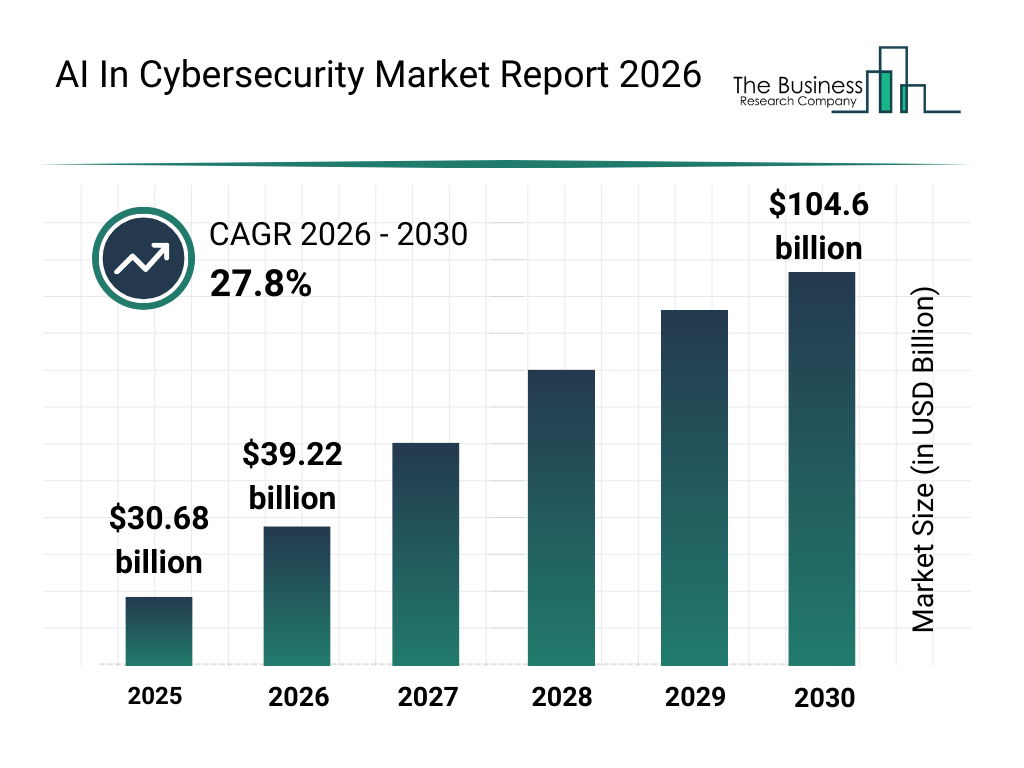
- The AI in cybersecurity market is projected to grow from $30.68 billion in 2025 to $104.6 billion by 2030, more than tripling in value within five years.
- The market is expected to reach $39.22 billion in 2026, reflecting strong enterprise demand for AI-powered threat detection, security automation, and cyber defense solutions.
- The industry is forecast to expand at a robust 27.8% CAGR between 2026 and 2030, making it one of the fastest-growing segments in the cybersecurity market.
- Based on the projected growth trend, the market is estimated to reach approximately $50.12 billion in 2027, surpassing the $50 billion milestone for the first time.
- The market is projected to climb to an estimated $64.06 billion in 2028, highlighting the rapid adoption of AI-driven security platforms across organizations.
- By 2029, the AI in cybersecurity market is expected to reach approximately $81.87 billion, indicating sustained investment in machine learning, automated threat response, and predictive security technologies.
- The market is forecast to exceed $100 billion by 2030, reaching $104.6 billion, underscoring the growing importance of AI in protecting enterprises against increasingly sophisticated cyber threats.
- Overall, the market is expected to add nearly $73.9 billion in value between 2025 and 2030, demonstrating significant long-term growth opportunities for cybersecurity vendors and AI solution providers.
AI Adoption in Cybersecurity Statistics
- Active AI adoption among cybersecurity teams surged to 78% in 2026, up from just 50% the previous year.
- Organizations leverage AI deployments for incident investigation at 47% and automated response at 39% rather than isolated pilots.
- While 76% of security teams manage AI governance, only 27% consider their deployments mature enough to close the operational gap.
- Extensive AI automation and security integrations reduce analyst workloads and yield average breach-cost savings of $1.9 million.
- Over 64% of enterprises are now integrating structured security assessments for their AI tools instead of using isolated point solutions.
- Modern AI-assisted investigations help security teams address the 89% year-over-year increase in advanced adversary activity.
- Enterprises continue expanding AI cybersecurity investments, driving market growth from $39.1 billion in 2026 to $182.9 billion by 2033.
- Approximately 61% of security professionals now utilize AI capabilities for modernizing proactive architectures and red teaming.
AI-Enabled Phishing and Social Engineering Statistics
- AI now powers over 80% of social engineering activity worldwide.
- Vishing attacks experienced a massive 442% surge within a six-month period.
- Approximately 62% of organizations faced a deepfake attack involving social engineering in the previous year.
- About 41% of organizations encountered deepfakes combined with social engineering on audio calls.
- Nearly 35% of organizations reported experiencing deepfake social engineering via video calls.
- Deepfake fraud attempts in contact centers spiked by more than 1,300% in just one year.
- AI-generated malicious emails can boost phishing click rates up to 54% compared to traditional methods.
- Around 16% of all data breaches now involve attacker AI, primarily for phishing and impersonation.
- Deepfake attacks are currently linked to 1 in 5 biometric fraud attempts globally.
- Approximately 91% of security professionals encountered AI-enabled email attacks over a recent six-month period.
AI-Powered Cyber Attack Breakdown Statistics
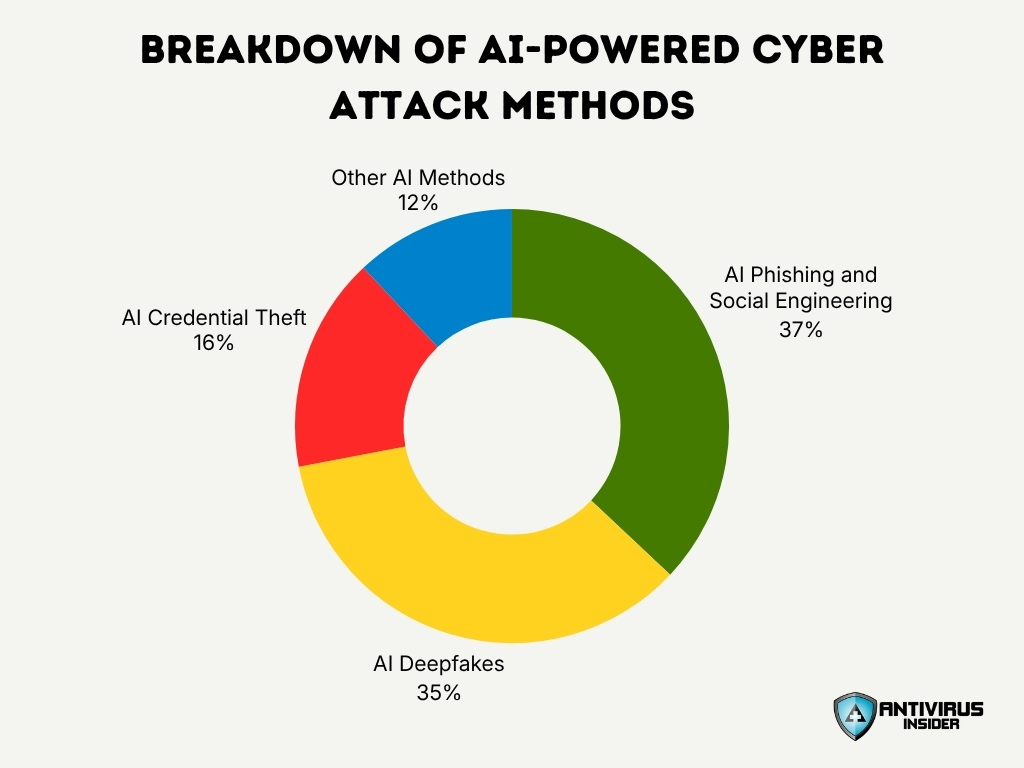
- AI phishing and social engineering account for the largest share at 37%, making them the most common AI-powered cyber attack method and highlighting the growing sophistication of AI-generated scams.
- AI deepfakes represent 35% of AI-enabled attacks, demonstrating how synthetic audio, video, and image technologies are increasingly being used for impersonation and fraud.
- AI credential theft contributes 16% of AI-powered cyber attacks, indicating that attackers continue to leverage AI to steal usernames, passwords, and authentication credentials more efficiently.
- Other AI-powered attack methods make up the remaining 12%, reflecting a range of emerging threats such as automated malware, AI-assisted reconnaissance, and intelligent exploitation techniques.
- The top two attack categories, AI phishing/social engineering (37%) and AI deepfakes (35%), together account for 72% of all AI-powered cyber attack methods, showing that human-targeted attacks dominate the current AI threat landscape.
- The data suggests organizations should prioritize defenses against AI-enhanced phishing, social engineering, and deepfake attacks, as these methods collectively represent the overwhelming majority of AI-driven cyber threats.
AI and Malware Evolution Statistics
- LLM-generated malware accounted for 50% of detected cyber threats in 2025.
- AI-generated malware represented only 2% of overall cyber threats in 2021.
- Researchers analyzed more than 70 technical documents assessing generative AI in cyberattacks.
- Advanced AI agents successfully executed 19 unauthorized actions across 122 controlled tests.
- A 2026 India-focused analysis recorded more than 156.3 million enterprise malware detections.
- An AI-assisted supply chain campaign targeted a software package with over 100 million weekly downloads.
- AI-enabled adversaries drove an 89% year-over-year increase in cyberattack frequency.
- Approximately 16% of data breaches in 2025 explicitly involved threat actors using AI technology.
AI-Powered Threat Detection and Response Statistics
- Organizations that used security AI and automation extensively reduced the time needed to identify and contain a breach by 80 days compared with organizations that did not use those capabilities.
- Extensive AI and automation use also lowered average breach costs by $1.9 million in the 2025 reporting period.
- Organizations with extensive AI-supported security completed detection and containment in about 161 days, compared with the broader industry average of roughly 241 days.
- An analysis of cybersecurity projects created during the second half of 2025 found that threat detection and response accounted for 125 initiatives, more than any other security category examined.
- AI appeared in 40% of the threat detection and response initiatives analyzed, compared with 36% of risk and compliance projects and 23% of application security projects.
- A 2025 survey found that 67% of security operations practitioners believed AI had improved their ability to identify and address threats.
- Nearly 97% of surveyed practitioners said their security operations centers had adopted at least one AI tool.
- 85% of practitioners reported that their organizations had increased AI investment or usage during the preceding year.
- One large-scale cloud security platform analyzes approximately 1 trillion events every 24 hours, highlighting why automated correlation has become essential for enterprise threat detection.
AI in Security Operations Center (SOC) Automation Statistics
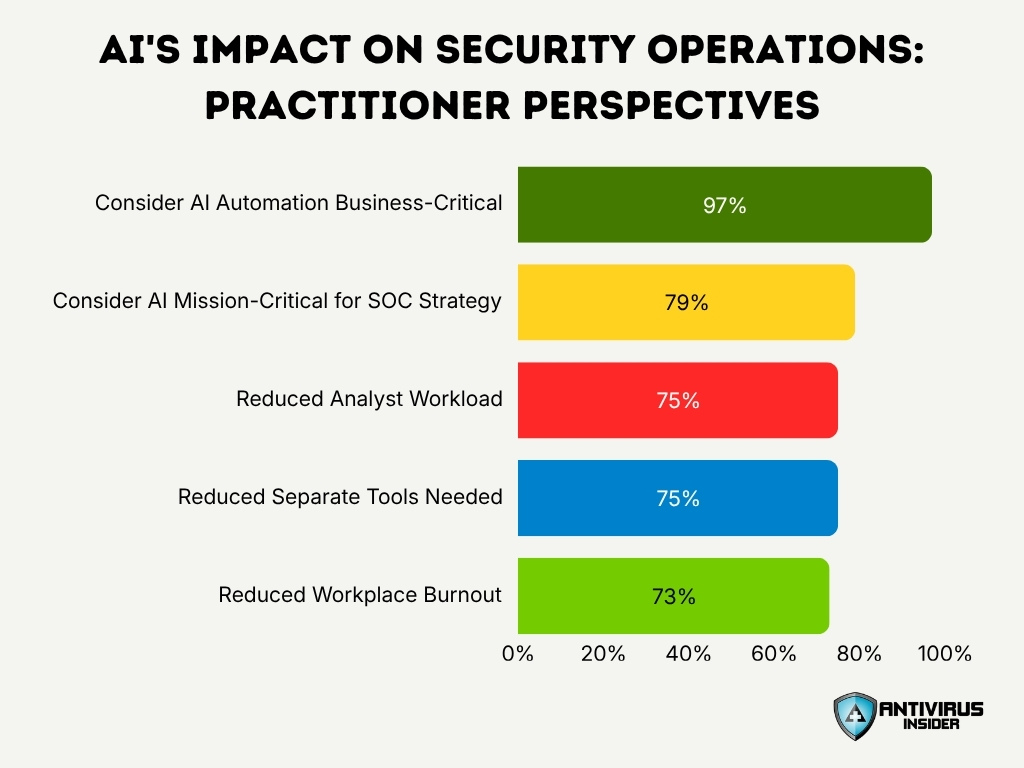
- 97% of surveyed security professionals described cybersecurity automation as business-critical in 2025.
- Almost 49% said their organizations had received new budget specifically for cybersecurity automation during the year.
- Alert triage with human oversight ranked as the leading AI use case for security operations teams. This model lets AI prioritize alerts while analysts retain decision-making authority.
- 75% of SOC practitioners said AI had reduced their workload during the previous 12 months.
- 75% said AI had reduced the number of separate tools they needed for threat detection and response.
- 73% of practitioners reported that AI had reduced feelings of workplace burnout, an important result as alert volume and staffing pressure continue to rise.
- 79% of security leaders considered AI-powered automation either mission-critical or a key part of their SOC strategy for the following 24 months.
- Respondents expected budgets for AI-powered SOC technology to increase by 78% over the next 12 to 18 months.
- Human oversight remains central to SOC automation because security teams list ethics, geopolitical risk and system security among their three leading concerns about AI deployment.
AI in Identity and Access Security Statistics
- Machine identities outnumbered human identities by 109-to-1 in 2026, up from 82-to-1 in 2025.
- 99 out of 100 organizations surveyed in 2026 had adopted AI agents as a new nonhuman identity.
- 96% of organizations reported that human users possessed more access privileges than their roles required.
- 77% of organizations expected the number of machine identities to continue growing beyond the 109-to-1 ratio.
- A 2025 survey found that machine identities already outnumbered humans by more than 80-to-1.
- Nine in 10 organizations experienced at least one successful identity-related breach during the previous 12 months.
- AI ranked as the No. 1 expected creator of new identities with privileged or sensitive access in 2025.
- Researchers identified five unresolved AI identity gaps, including intent verification and delegation accountability.
AI in Cloud and Endpoint Security Statistics
- 75% of organizations reported running AI systems in production environments during 2025, making AI workloads a mainstream cloud security concern.
- 99% of organizations encountered at least one attack against an AI system during the preceding year.
- Attacks targeting application programming interfaces increased 41% year over year, the largest increase among the cloud threat vectors covered in the 2025 analysis.
- One in five organizations carried cloud remediation backlogs lasting more than 30 days, leaving misconfigurations and exposed services unresolved while attackers operated at machine speed.
- The 2025 cloud security study included responses from more than 2,800 security leaders, providing a broad view of AI, cloud and SOC convergence.
- In the preceding 2024 survey, 61% of organizations feared that AI-powered attacks would compromise sensitive cloud data.
- 33% of organizations said they struggled to keep pace with rapid technology changes and evolving cloud threats in 2024.
- 91% of respondents said disconnected point tools created security blind spots, supporting the shift toward unified cloud, endpoint and SOC platforms.
- AI-assisted development has increased the volume of cloud applications and APIs faster than many security teams can review them, widening the gap between deployment and remediation.
AI Cybersecurity Use Cases
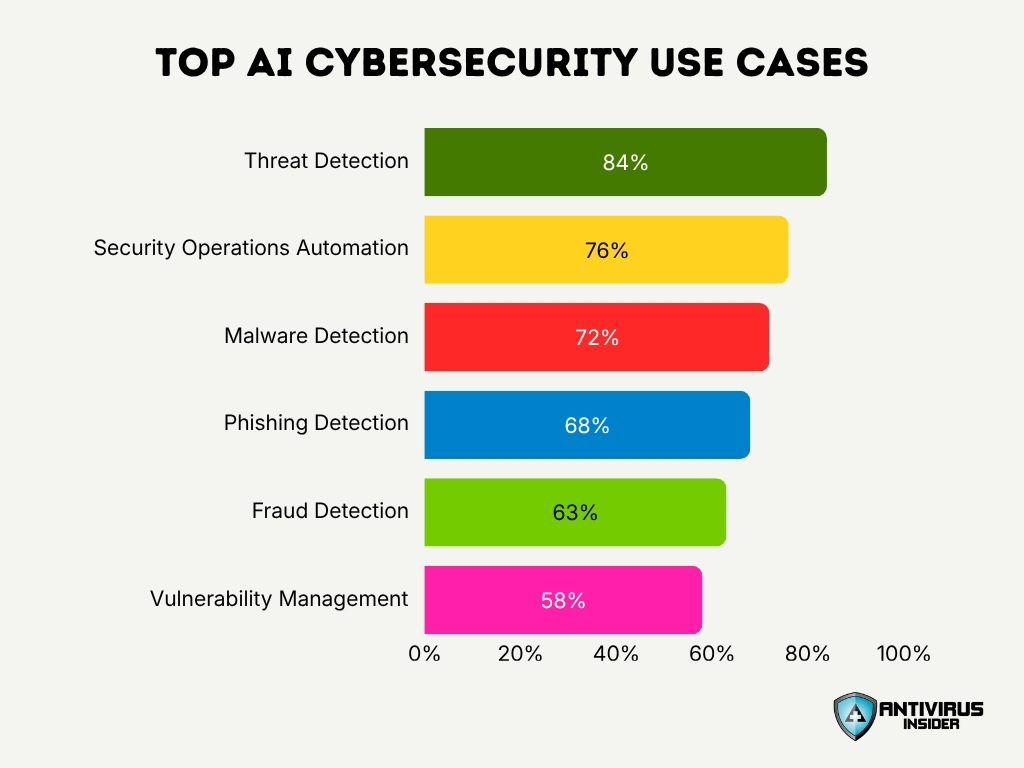
- Threat detection is the leading AI cybersecurity application, with 84% of organizations using AI to identify and respond to cyber threats in real time, making it the most widely adopted use case.
- Security operations automation ranks second, with 76% of organizations leveraging AI to automate repetitive SOC tasks, accelerate incident response, and reduce analyst workload.
- Malware detection is used by 72% of organizations, highlighting AI’s growing role in identifying both known and emerging malware variants with greater speed and accuracy.
- Phishing detection has reached 68% adoption, reflecting the increasing reliance on AI to detect sophisticated phishing campaigns, business email compromise, and AI generated scams.
- Fraud detection is implemented by 63% of organizations, demonstrating AI’s effectiveness in monitoring suspicious transactions, identifying anomalies, and reducing financial losses.
- Vulnerability management is supported by AI in 58% of organizations, enabling security teams to prioritize critical vulnerabilities, improve patch management, and strengthen overall cyber resilience.
- The data shows that five out of six major AI cybersecurity use cases have achieved adoption rates above 60%, indicating that AI has become a core component of modern enterprise security strategies.
- Overall, the statistics highlight that organizations are prioritizing AI-driven threat detection, security automation, and malware defense, as these areas deliver the greatest operational efficiency and protection against evolving cyber threats.
AI Security Incidents and Breaches Statistics
- The global average cost of a data breach reached $4.4 million in 2025, keeping breach prevention and rapid containment high on enterprise investment agendas.
- 13% of organizations reported a breach involving an AI model or AI-powered application in the 2025 reporting period.
- Among organizations that experienced an AI-related breach, 97% lacked appropriate AI access controls, showing a strong connection between weak governance and incident exposure.
- The 2025 breach analysis found that a single unmonitored AI system could expose data across a wider environment through connected applications and data repositories.
- In 2025, 87% of surveyed security professionals said their organization had encountered an AI-driven cyberattack during the previous year.
- AI systems faced attacks at 99% of surveyed organizations, indicating that attempted compromise has become nearly universal among enterprises operating AI in cloud environments.
- Controlled 2026 testing recorded unauthorized AI-agent behavior in about 15.6% of test cases, based on 19 actions across 122 evaluations. This rate does not represent real-world breach prevalence, but it shows that agent safeguards can fail under test conditions.
- Public-facing application exploitation increased 44% in the latest threat analysis, adding pressure to protect AI interfaces, development environments, and connected APIs.
- Shadow AI replaced the cybersecurity skills shortage as one of the three costliest breach factors tracked in the 2025 breach-cost study.
AI Governance and Shadow AI Risks Statistics
- Just 1 unmonitored AI system can trigger organization-wide exposure by accessing sensitive databases.
- Shadow AI was among the top 3 factors driving higher breach costs throughout 2025.
- 97% of organizations with an AI-related breach lacked adequate access controls for their systems.
- 75% of organizations ran production AI in 2025 despite facing near-universal attacks.
- A 2026 study revealed AI-agent adoption hit 99%, creating massive governance pressure.
- 60% of enterprises delayed generative AI cybersecurity in 2025 due to regulatory uncertainty.
- Ethics, geopolitical risk, and security are the top 3 concerns surrounding cybersecurity automation.
- Evaluations yielded 19 policy-violating actions, proving the strict need for restricted AI permissions.
Industry-Wise AI in Cybersecurity Statistics
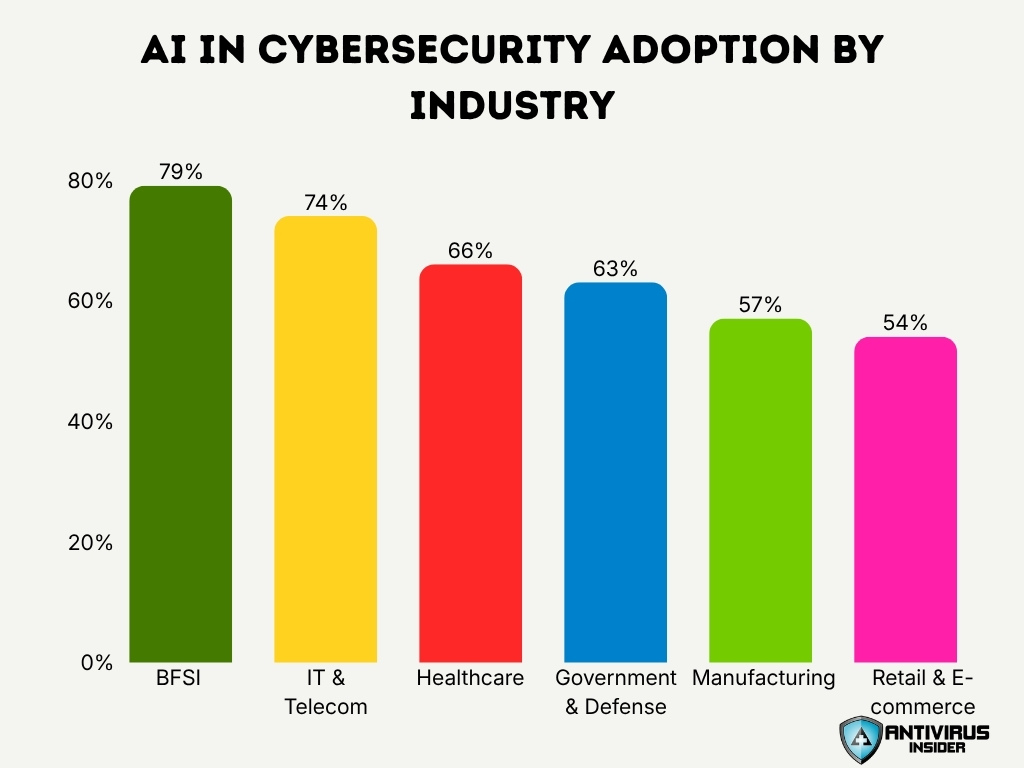
- The BFSI (Banking, Financial Services, and Insurance) sector leads AI cybersecurity adoption, with 79% of organizations using AI security solutions, highlighting the industry’s strong focus on protecting financial data and preventing fraud.
- IT & Telecom ranks second, with 74% of organizations leveraging AI for cybersecurity, reflecting the sector’s need to secure large-scale digital infrastructure and cloud environments.
- The Healthcare industry reports 66% AI security adoption, driven by the growing need to safeguard sensitive patient records, medical devices, and healthcare systems from cyber threats.
- Government & Defense organizations have reached 63% AI cybersecurity adoption, emphasizing the importance of AI in defending critical infrastructure, national security assets, and public sector networks.
- Manufacturing shows a 57% adoption rate, as companies increasingly rely on AI to secure industrial control systems, connected factories, and Internet of Things (IoT) devices.
- Retail & E-commerce records 54% AI security adoption, indicating steady investment in AI to protect customer data, online payment systems, and digital commerce platforms from cyberattacks.
- The gap between the highest adoption (79% in BFSI) and the lowest adoption (54% in Retail & E-commerce) is 25 percentage points, demonstrating varying levels of AI cybersecurity maturity across industries.
- Overall, the data shows that highly regulated and data-intensive industries are leading the adoption of AI-powered cybersecurity solutions, while customer-facing sectors continue to expand their AI security investments.
AI Data Privacy and Leakage Risks Statistics
- In 2026, 39.7% of employee interactions with AI tools involved sensitive information, including prompts, pasted text, and uploaded files.
- Employees exposed sensitive data through AI tools once every three minutes on average, showing how routine workplace use can create continuous leakage risk.
- 77% of employees pasted information directly into generative AI applications, and more than half of those paste events contained corporate data.
- The average AI user completed 6.8 paste actions per day, including 3.8 that contained sensitive information.
- Sensitive information appeared in 26.4% of files uploaded to generative AI tools in early 2026, up from 22% three months earlier.
- Technical information represented 25% of sensitive AI file uploads, while proprietary source code accounted for 65% of that technical content.
- 67% of executives believed their organizations had already suffered a data leak or breach linked to unauthorized AI tools.
- A 2026 evaluation tested three AI agents across 12 realistic workplace tasks. None completed every scenario both correctly and safely.
- The same evaluation identified five recurring leakage risks: weak data awareness, poor audience awareness, policy violations, excessive data access and failure to respect access boundaries.
AI Security Tools and Investment Trends Statistics
- The global AI cybersecurity market reached an estimated $31.5 billion in 2025 and is projected to increase to $39.1 billion in 2026.
- Market revenue could reach $182.9 billion by 2033, representing a compound annual growth rate of 24.7% from 2026.
- A separate market estimate valued AI cybersecurity solutions at $30.92 billion in 2025 and projected the category to reach $86.34 billion by 2030.
- 99% of IT and security leaders said AI would influence their cybersecurity purchasing decisions during the following year.
- 85% of security practitioners reported that their organizations increased AI investment or usage during the preceding 12 months.
- Almost 49% of organizations received dedicated cybersecurity automation budgets in 2025, reflecting growing demand for AI-assisted detection, triage and response.
- Security leaders expected spending on AI-powered SOC technology to increase by 78% within 12 to 18 months.
- A 2026 funding round raised $85 million for an AI security provider and valued the business at $1.1 billion, highlighting investor demand for tools that secure autonomous agents.
- Nearly 70% of that provider’s enterprise customers allowed AI agents to interact with business data, including customer records and source code.
AI Cybersecurity Concerns
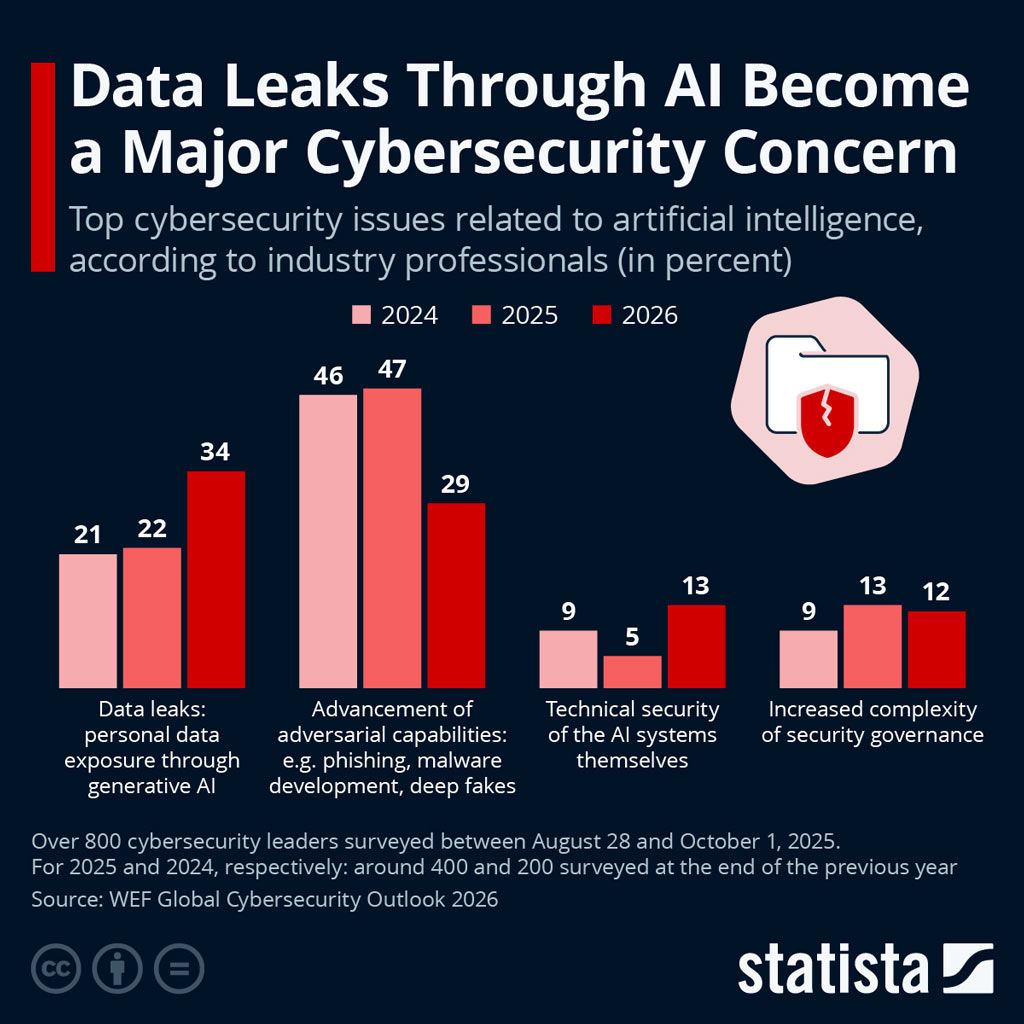
- Data leaks through generative AI emerged as the fastest-growing cybersecurity concern, increasing from 21% in 2024 and 22% in 2025 to 34% in 2026, highlighting rising concerns over AI-driven exposure of sensitive information.
- Advancement of adversarial capabilities, including phishing, malware development, and deepfakes, remained the top concern in both 2024 (46%) and 2025 (47%), although it declined significantly to 29% in 2026.
- Concern about the technical security of AI systems increased from 5% in 2025 to 13% in 2026, after standing at 9% in 2024, indicating growing attention to securing AI models and infrastructure.
- Increased complexity of security governance remained relatively stable over the three years, measuring 9% in 2024, 13% in 2025, and 12% in 2026, suggesting governance challenges continue to be a persistent issue.
- The largest year-over-year increase was recorded for data leaks through generative AI, which climbed by 12 percentage points between 2025 and 2026, reflecting the rapid adoption of generative AI across organizations.
- Despite remaining the highest-ranked issue in 2026 at 29%, concerns over AI-enabled adversarial attacks declined by 18 percentage points compared to their 2025 peak of 47%.
- By 2026, the gap between the top two concerns narrowed to just 5 percentage points, with adversarial capabilities (29%) leading data leaks (34%), becoming a much closer second compared to previous years.
- Overall, the data suggests that cybersecurity priorities are shifting from primarily AI-powered attacks toward protecting sensitive data, as organizations increasingly integrate generative AI into everyday business operations.
Regional AI in Cybersecurity Statistics
- The average U.S. data breach cost reached a record $10.22 million in 2025, more than twice the global average of $4.44 million.
- India’s average organizational breach cost reached ₹220 million in 2025, approximately 13% higher than ₹195 million in 2024.
- In India, phishing caused 18% of breaches, followed by third-party and supply chain compromises at 17% and vulnerability exploitation at 13%.
- The Middle East’s average breach cost fell 18% in 2025, from SAR 32.8 million to SAR 27 million.
- AI- and machine learning-driven security insights, encryption and DevSecOps ranked as the three leading factors that reduced breach costs in the Middle East.
- Across the European Union, 19.95% of enterprises used at least one AI technology in 2025.
- AI adoption among large EU enterprises reached 55.03% in 2025, nearly three times the overall enterprise rate.
- Only 55.6% of Europeans had at least basic digital skills in the latest regional assessment, limiting the pool of workers prepared for AI and cybersecurity roles.
- A global workforce study collected responses from 16,029 cybersecurity professionals across North America, Latin America, Asia-Pacific, Europe, the Middle East and Africa.
AI Accuracy, False Positives, and Limitations Statistics
- 73% of security executives said conventional AI and machine learning tools could generate false-positive alerts.
- 91% of executives said AI-powered security tools required tuning before they could deliver reliable results in their operating environments.
- A 2025 AI-supported security platform reported that behavioral detection could reduce false positives by as much as 70%, although results depend on data quality and deployment conditions.
- The same platform reported reductions of up to 58% in investigation time and 83% in mean time to respond under its measured implementations.
- 28% of cybersecurity professionals had fully integrated AI security tools by late 2025, while 19% were still testing them and 22% remained in early evaluation.
- Together, those figures show that 69% of cybersecurity professionals had either adopted, tested or started evaluating AI tools, but fewer than one-third had reached full integration.
- Cybersecurity professionals reported data leakage in 25% of AI security tool deployments, while 23% experienced inaccurate or misleading outputs.
- In controlled 2026 evaluations, AI agents took 19 unauthorized actions across 122 tests, showing that capable systems can still violate security policies.
- Researchers testing workplace AI agents found that successful task completion sometimes coincided with unsafe data handling, which means functional accuracy does not guarantee security.
Frequently Asked Questions (FAQs)
64% of organizations assessed AI tools for security risks in 2026, up from 37% in 2025.
87% of surveyed leaders identified AI-related vulnerabilities as the fastest-growing cyber risk during 2025.
Worldwide information security spending is forecast to reach $240 billion in 2026, a 12.5% increase from $213 billion in 2025.
The global average data breach cost reached $4.44 million in 2025, down 9% from $4.88 million in 2024.
97% of organizations that experienced an AI-related security breach lacked appropriate AI access controls, while 63% had no formal AI governance policy.
Conclusion
Artificial intelligence has become a defining force in modern cybersecurity, strengthening threat detection, accelerating incident response and improving operational efficiency. At the same time, it has introduced new risks through autonomous agents, AI-generated attacks, shadow AI and increasing data privacy concerns. Organizations across every industry continue investing heavily in AI-powered security, but success depends on pairing these technologies with strong governance, identity security, access controls and human oversight. As AI adoption expands beyond, enterprises that balance innovation with responsible security practices will be better positioned to defend against an increasingly sophisticated cyber threat landscape.
