



Artificial intelligence is reshaping how organizations detect, investigate, and respond to cyber threats. Agentic AI takes this further by enabling autonomous systems to analyze events, make decisions, and execute security actions with minimal human intervention. These capabilities now support real-world use cases such as Security Operations Center automation and cloud threat detection, helping organizations reduce response times while managing growing cyber risks. As investment and adoption continue to accelerate across the US and globally, the statistics below provide a detailed look at the market’s current position and future direction.
Editor’s Choice
- The global AI cybersecurity market is projected to reach $51.35 billion in 2026, up from $25.92 billion in 2025, representing nearly 98% year-over-year growth.
- Worldwide AI spending is forecast to total $2.59 trillion in 2026, increasing 47% from approximately $1.76 trillion in 2025, with agentic AI emerging as a major growth driver.
- Global end-user spending on information security is expected to increase from $213 billion in 2025 to nearly $240 billion in 2026.
- AI models are projected to experience 110% growth in 2026, driven by increasing enterprise demand for autonomous workflows and agentic automation.
- By 2028, enterprise adoption of AI-amplified cybersecurity products is expected to rise from fewer than 25% of organizations in 2025 to more than 75%.
- A typical Fortune 500 company could operate more than 150,000 AI agents by 2028, compared with fewer than 15 agents in 2025.
- Only 13% of organizations believe they currently have adequate governance for AI agents despite rapidly expanding deployments.
Recent Developments
- In 2026, leading technology vendors significantly expanded investments in AI-native cybersecurity as enterprises demanded stronger protection for autonomous AI systems.
- A major cloud security acquisition strengthened AI security capabilities for cloud workloads and autonomous applications.
- One major technology provider reported generating more than $20 billion annually from its cybersecurity business while accelerating AI-driven security innovation.
- A leading cybersecurity vendor raised its annual financial outlook during 2026 after reporting stronger-than-expected demand for AI-powered platforms.
- Cybersecurity mergers and acquisitions reached 219 deals during the first half of 2026, putting the industry on pace for a record year.
- AI-focused cybersecurity transactions increased to 29 deals in the first half of 2026, compared with 10 deals throughout all of 2025.
- Enterprise software vendors increasingly launched platforms focused on AI application governance, identity security, and agent monitoring instead of traditional endpoint protection alone.
- AI agent governance and agent sprawl emerged as major cybersecurity priorities entering 2026.
Global Market Overview for Agentic AI in Cybersecurity
- The rapid expansion of autonomous AI agents is creating one of the fastest-growing segments within the broader cybersecurity software industry.
- AI cybersecurity spending is forecast to nearly double from $25.92 billion in 2025 to $51.35 billion in 2026.
- AI cybersecurity spending is expected to exceed $85.99 billion by 2027, indicating sustained enterprise investment beyond 2026.
- Organizations increasingly prioritize securing machine identities, autonomous agents, and AI workflows, rather than focusing only on user accounts.
- Financial services, health care, manufacturing, and government agencies remain among the fastest adopters of AI-assisted cyber defense technologies.
- Cloud-native deployments continue to accelerate demand for AI-powered threat detection, automated investigation, and autonomous response platforms.
- Security software remains the fastest-growing segment within information security spending because organizations continue migrating workloads to cloud environments.
- Rising regulatory requirements and increasingly sophisticated AI-enabled attacks continue pushing organizations toward autonomous security operations.
Cybersecurity Agentic AI Market Size Statistics
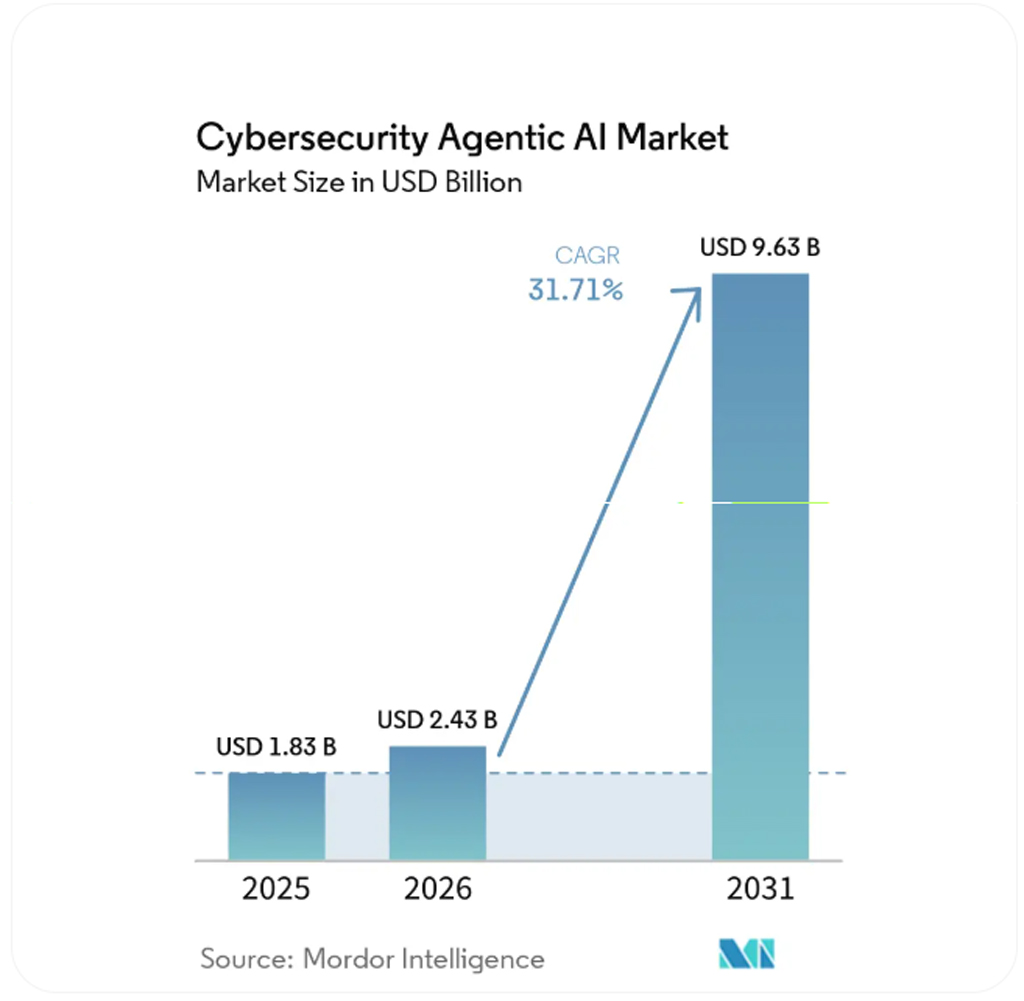
- The Cybersecurity Agentic AI market was valued at $1.83 billion in 2025, highlighting the early commercial adoption of autonomous AI-driven cybersecurity solutions.
- The market is expected to grow to $2.43 billion in 2026, representing a strong year-over-year increase of nearly 33%.
- By 2031, the market is projected to reach $9.63 billion, reflecting substantial long-term expansion across the cybersecurity industry.
- The market is forecast to register a robust CAGR of 31.71% during the 2026–2031 period, making it one of the fastest-growing AI segments.
- Between 2026 and 2031, the market size is expected to increase by approximately $7.2 billion, driven by rising enterprise investments in AI-powered security.
- The projected growth from $2.43 billion in 2026 to $9.63 billion in 2031 means the market is expected to grow nearly 4 times within five years.
- The strong growth outlook reflects increasing demand for autonomous threat detection, incident response, and AI-driven security operations across enterprises.
- The consistently rising market value indicates that Agentic AI is becoming a key technology for organizations seeking faster, scalable, and more intelligent cybersecurity solutions.
Definition and Scope of the Agentic AI in Cybersecurity Market
- Agentic AI refers to AI systems capable of planning, reasoning, executing tasks, and adapting with limited human intervention in cybersecurity environments.
- The market includes software, platforms, security services, AI models, orchestration tools, and governance solutions designed for autonomous cyber defense.
- Common enterprise applications include autonomous threat detection, SOC automation, vulnerability management, identity governance, and incident response.
- Agentic AI extends beyond traditional generative AI by enabling systems to complete multi-step workflows instead of simply generating content.
- Organizations increasingly deploy multiple specialized AI agents that collaborate across security operations, cloud infrastructure, and identity management.
- The market serves industries including banking, health care, manufacturing, government, telecommunications, retail, and critical infrastructure.
- Security controls increasingly focus on protecting machine identities, AI decision-making processes, and privileged access used by autonomous agents.
- Enterprise adoption of AI agents is expected to expand rapidly as organizations integrate autonomous workflows into broader digital transformation initiatives.
Drivers Shaping the Agentic AI in Cybersecurity Market
- Global spending on information security is projected to rise from $213 billion in 2025 to nearly $240 billion in 2026, reflecting stronger enterprise investment in AI-powered cyber defense.
- The global agentic AI in cybersecurity market is expected to grow from $22.6 billion in 2024 to $30.3 billion in 2026, driven by increasing demand for autonomous threat detection and response.
- Organizations continue adopting cloud-native environments, creating greater demand for AI agents capable of monitoring distributed workloads around the clock.
- 87% of cybersecurity leaders identified AI-related vulnerabilities as the fastest-growing cyber risk during 2025, accelerating investment in autonomous security solutions.
- Security teams increasingly use AI to improve phishing detection (52%), intrusion and anomaly response (46%), and user behavior analytics (40%).
- Growing shortages of cybersecurity professionals continue encouraging organizations to automate repetitive SOC tasks with AI agents.
- Increasing regulatory pressure around AI governance is pushing enterprises to implement security controls specifically designed for autonomous systems.
- Rising ransomware, supply chain attacks, and AI-assisted phishing campaigns are accelerating enterprise demand for continuous autonomous monitoring.
Agentic AI Applications in Cybersecurity
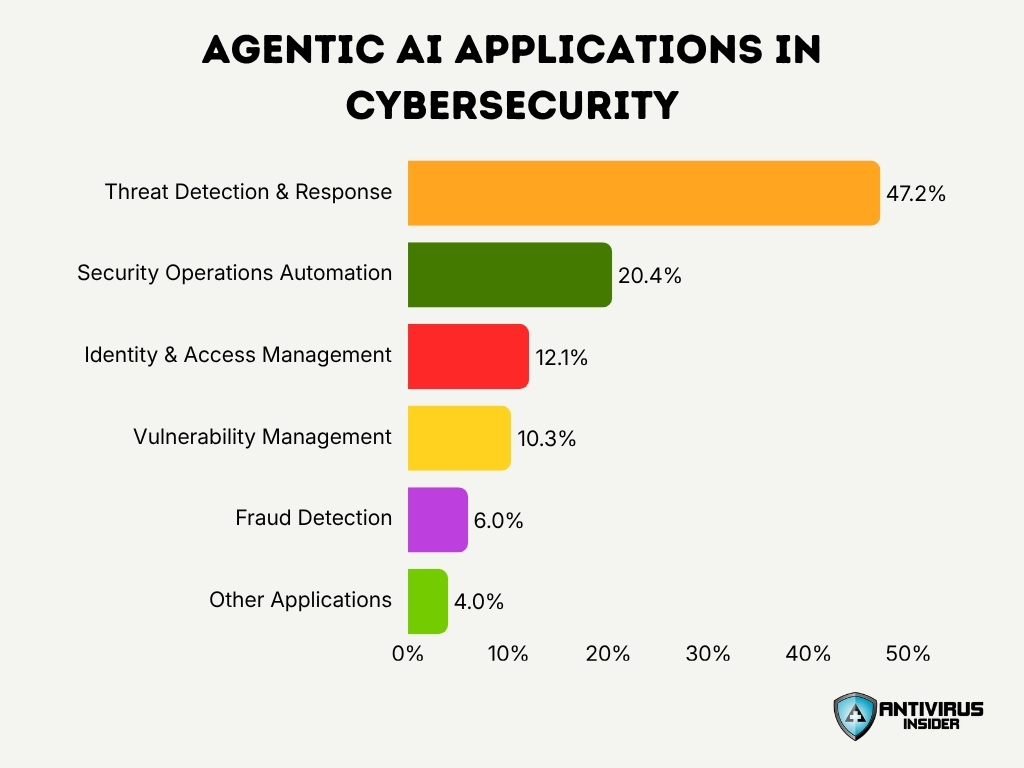
- Threat Detection & Response dominates the market with a 47.2% share, making it the most widely adopted application of agentic AI in cybersecurity due to its ability to identify and respond to threats in real time.
- Security Operations Automation accounts for 20.4% of the market, reflecting the growing use of AI agents to automate repetitive SOC tasks, reduce alert fatigue, and improve operational efficiency.
- Identity & Access Management (IAM) represents 12.1% of the market, highlighting increased enterprise investment in AI-driven identity verification, access control, and privileged account protection.
- Vulnerability Management holds a 10.3% market share, as organizations increasingly rely on autonomous AI systems to identify, prioritize, and remediate security weaknesses faster.
- Fraud Detection contributes 6.0% of the market, demonstrating the use of agentic AI to detect suspicious transactions, prevent account takeovers, and reduce financial cybercrime.
- Other Applications collectively make up 4.0% of the market, covering emerging use cases such as compliance monitoring, security policy enforcement, insider threat detection, and cyber risk assessment.
- Together, Threat Detection & Response and Security Operations Automation account for 67.6% of the market, showing that organizations primarily deploy agentic AI to strengthen real-time defense and automate security operations.
- The distribution of market share indicates that enterprises are prioritizing proactive threat prevention, continuous monitoring, and autonomous incident response as the core benefits of agentic AI in modern cybersecurity strategies.
Restraints Impacting the Agentic AI in Cybersecurity Market
- 54% of organizations cite insufficient AI knowledge and cybersecurity skills as the leading barrier to implementing AI-powered security solutions.
- 41% of respondents believe continuous human oversight remains necessary even when AI automates security operations.
- 39% of organizations remain uncertain about AI-related security risks, slowing broader enterprise deployment.
- Unmanaged AI agents create new attack surfaces, compliance risks, and governance challenges across enterprise environments.
- Many organizations still struggle to establish accountability for AI-generated decisions during incident response and automated remediation.
- Legacy security infrastructure often lacks visibility into autonomous AI workflows, limiting interoperability with existing security tools.
- Regulatory requirements differ across regions, making global deployment of agentic AI security platforms more complex.
- Enterprises remain cautious about allowing AI agents to execute high-impact security actions without validation because incorrect decisions could disrupt business operations.
Opportunities in the Agentic AI in Cybersecurity Market
- The global agentic AI cybersecurity market is projected to reach $269.8 billion by 2034 with a 34.4% CAGR.
- The broader AI in cybersecurity market is expected to expand to $182.9 billion by 2033 at a 24.7% CAGR.
- Autonomous agents can compress breach containment timelines from an average of 258 days down to under 4 hours.
- Enterprise adoption of multi-agent AI in threat detection will surge from just 5% to 70% by 2028.
- AI-driven automation platforms can reduce manual SOC alert volumes by a staggering 99.8%.
- The non-human identity security segment is forecasted to grow rapidly at a 41.3% CAGR through 2034.
- Advanced AI models are projected to automate over 50% of routine Tier 1 SOC analyst tasks by the year 2028.
- Implementing agentic AI in standard workflows can reduce operational costs by 54% and task duration by 59%.
- Autonomous AI systems can increase security task accuracy by 30% while boosting overall productivity by 82%.
Top Challenges Facing the Agentic AI in Cybersecurity Market
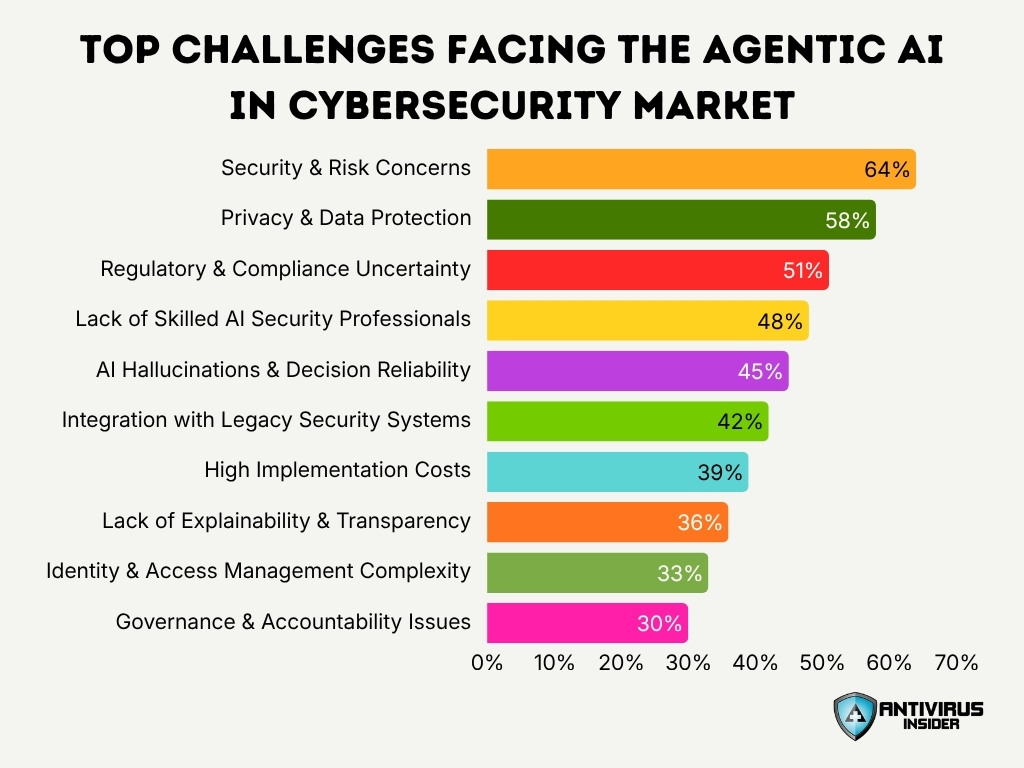
- Security & Risk Concerns are the biggest obstacle, with 64% of organizations identifying them as the primary challenge to adopting agentic AI in cybersecurity.
- Privacy & Data Protection remain a major issue, as 58% of organizations are concerned about securing sensitive data when deploying autonomous AI systems.
- Regulatory & Compliance Uncertainty affects 51% of organizations, highlighting the need for clearer AI governance and legal frameworks.
- Nearly 48% of organizations report a lack of skilled AI security professionals, making it difficult to deploy and manage advanced AI-driven security solutions.
- AI Hallucinations & Decision Reliability concern 45% of respondents, reflecting the importance of ensuring accurate and trustworthy autonomous security decisions.
- Around 42% of organizations struggle with integration with legacy security systems, slowing the adoption of agentic AI technologies.
- High implementation costs are cited by 39% of organizations, indicating that budget constraints remain a significant barrier for many businesses.
- Lack of Explainability & Transparency is reported by 36% of organizations, emphasizing the need for AI systems that provide clear and auditable decision-making.
- Identity & Access Management Complexity challenges 33% of organizations, especially as AI agents require secure authentication and permission controls.
- Governance & Accountability Issues are reported by 30% of organizations, demonstrating the ongoing need for defined ownership and oversight of AI-powered cybersecurity systems.
Technology Trends in the Agentic AI in Cybersecurity Market
- The global cybersecurity agentic AI market is projected to hit $9.63 billion by 2031 at a 31.71% CAGR.
- An alarming 99% of enterprises utilizing AI in production report experiencing at least one attack on their AI systems.
- The AI-powered SOC automation segment currently commands a 28.1% market share and is growing at a 34.1% CAGR.
- Modern security architectures now manage an average of 109 machine identities for every single human identity.
- Enterprises globally are forecasting a massive 85% growth in the deployment of AI agents over the next 12 months.
- Driven by autonomous systems, non-human identity security solutions are projected to expand rapidly with a 41.3% CAGR.
- Cloud-native AI deployments overwhelmingly dominated the agentic security landscape by capturing a 61.54% market share.
- The overarching global AI Security Operations Center market is expected to surge to $47.07 billion by 2031.
Threat Landscape for Agentic AI in Cybersecurity
- Agentic AI traffic experienced a massive 7,851% year-over-year growth across the internet.
- AI-generated phishing now achieves a 54% click-through rate, matching human expert success.
- Approximately 80% of all social engineering attacks are now powered by artificial intelligence.
- Agentic phishing attacks are projected to exceed 42% of all global security breaches in 2026.
- Generative AI-related security breaches have already impacted 97% of surveyed organizations.
- Unregulated shadow AI breaches cost enterprises an average of $4.63 million per incident.
- 53% of security leaders cite AI-powered attacks as their single biggest challenge in 2026.
- Despite escalating threats, 63% of organizations currently lack formal AI governance policies.
- Only 22% of organizations conduct adversarial AI testing to identify critical system vulnerabilities.
Agentic AI Adoption by Company Size Statistics
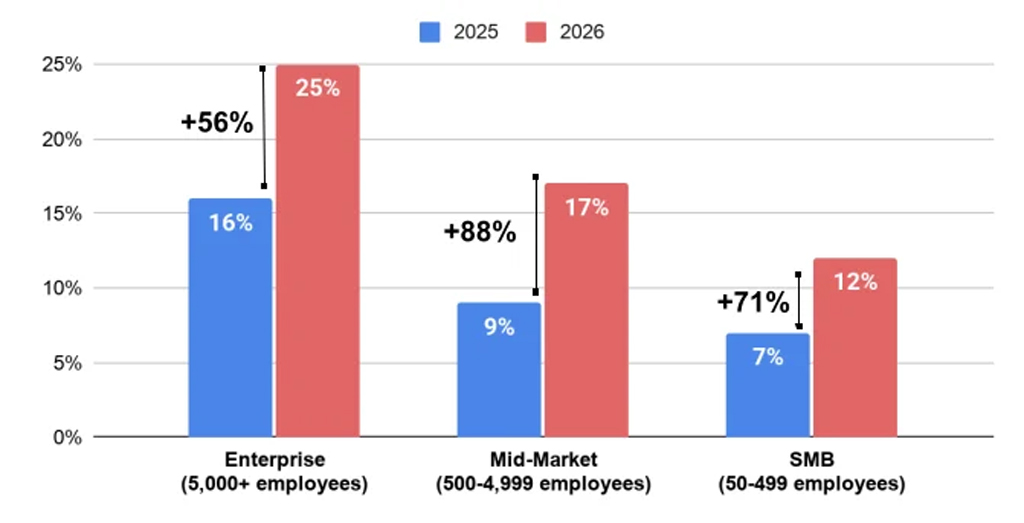
- Enterprise organizations (5,000+ employees) increased Agentic AI adoption from 16% in 2025 to 25% in 2026, representing a 56% year-over-year growth, making them the fastest adopters in absolute adoption rate.
- Mid-market companies (500–4,999 employees) raised adoption from 9% to 17% between 2025 and 2026, achieving the highest growth rate of 88% among all business segments.
- Small and medium-sized businesses (50–499 employees) expanded Agentic AI adoption from 7% in 2025 to 12% in 2026, reflecting a solid 71% annual increase.
- By 2026, 25% of enterprise businesses had adopted Agentic AI, compared to 17% of mid-market firms and 12% of SMBs, highlighting a clear adoption gap based on company size.
- Enterprise adoption exceeded SMB adoption by 13 percentage points in 2026 (25% vs. 12%), indicating larger organizations continue to lead AI implementation.
- The mid-market segment nearly doubled its adoption rate in just one year, increasing by 8 percentage points from 9% to 17%.
- SMBs posted the lowest adoption levels in both years but still recorded a significant 5 percentage point increase, rising from 7% in 2025 to 12% in 2026.
- Across all company sizes, Agentic AI adoption increased substantially between 2025 and 2026, demonstrating that organizations of every size are accelerating investments in autonomous AI technologies.
Autonomous Response and SOC Automation in Agentic AI for Cybersecurity
- 87% of security teams report that adopting agentic AI is a strategic priority.
- 79% of enterprises report active AI agent adoption to automate core workflows.
- 96% of organizations plan to expand their agentic AI usage across operations.
- 85% reduction in manual alert investigation time is achievable with AI SOC automation.
- 90% faster processing of escalated investigations is documented using SOC AI agents.
- 70% of routine SOC tasks can be automated using AI-driven security platforms.
- 60% of total SOC workloads are projected to be handled by AI within three years.
- 5x improvement in mean time to respond (MTTR) occurs with autonomous triage deployment.
- 77% of security leaders are comfortable allowing AI to act autonomously without human review.
Identity and Access Governance in the Agentic AI in Cybersecurity Market
- Automated agents, service accounts, API tokens, and other machine identities can outnumber human identities in enterprise environments by ratios exceeding 80-to-1, making nonhuman identity governance a central market requirement.
- 78% of organizations lack a documented policy for creating or removing AI identities, which can leave abandoned agents and credentials active after projects end.
- More than 16% of organizations do not track the creation of new AI-related identities, limiting their ability to maintain an accurate inventory of autonomous systems.
- Only 8% of respondents express high confidence that their existing identity and access management tools can handle AI-agent and nonhuman-identity risks.
- Identity-based cyberattacks increased 32% in the first half of 2025, raising the importance of applying strong authentication and least-privilege rules to both people and AI agents.
- More than 97% of identity attacks relied on large-scale password techniques, showing that basic credential weaknesses remain exploitable even as security operations adopt agentic AI.
- Modern multifactor authentication can reduce identity compromise risk by more than 99%, supporting its use for human administrators and the control planes that authorize agent activity.
- Among breached organizations studied in 2025, 63% lacked AI governance policies, while only 37% had approval or oversight processes for AI use.
- Current identity standards do not fully address autonomous agents that delegate tasks, cross organizational boundaries, or change behavior during execution, creating demand for agent-specific identity assurance.
AI Agent Runtime Security in the Agentic AI in Cybersecurity Market
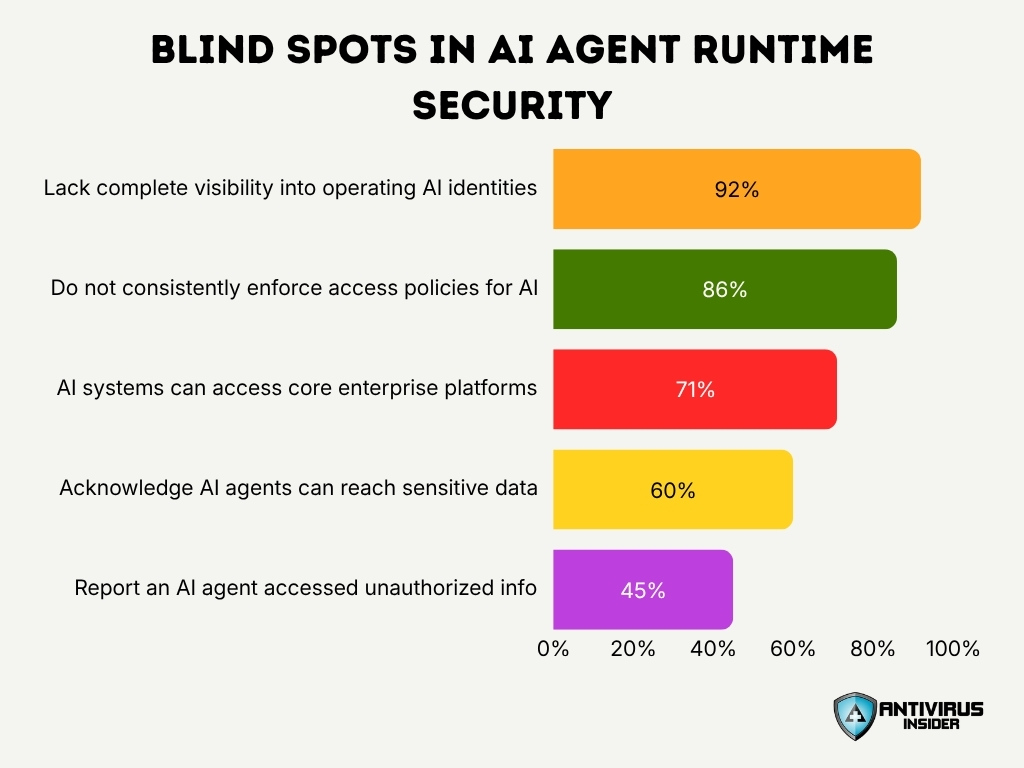
- 92% of security leaders lack complete visibility into the AI identities operating across their organizations, which makes runtime discovery a foundational control for agentic systems.
- 86% of large enterprises do not consistently enforce access policies for AI identities, leaving agents free to reach tools or data beyond their intended roles.
- Although 71% of AI systems can access core platforms such as enterprise resource planning, customer relationship management, and financial applications, only 16% of organizations govern that access effectively.
- 70% of surveyed organizations already use AI agents, while 60% acknowledge that those agents can reach sensitive data.
- 45% of organizations report that an AI agent has accessed information it should not have reached, showing why static predeployment testing cannot replace live behavioral monitoring.
- Organizations spent an average of more than $1 million on AI agent identity and security problems during the previous year, creating a measurable business case for runtime safeguards.
- 92% of security professionals express concern about employees’ use of AI agents and the resulting expansion of the organizational attack surface.
- 13% of organizations experienced a breach involving an AI model or application in 2025, and 97% of those affected organizations lacked adequate AI access controls.
- Runtime protection must monitor agent memory, tool calls, delegated tasks, and execution paths because agentic systems can face memory poisoning, prompt injection, agent collusion, and cascading failures.
Deployment Mode Analysis of the Agentic AI in Cybersecurity Market
- Cloud-native deployment accounted for a 61.54% share of the cybersecurity agentic AI market in 2025.
- Hybrid deployment is expected to record a 32.31% CAGR through 2031 to secure regulated workloads.
- 40% of data breaches spanned multiple environments, increasing demand for cross-environment agentic platforms.
- High shadow AI use added an average of $670,000 to breach costs due to lacking cloud governance.
- One in five organizations reported a breach from shadow AI, with only 37% having capable policies.
- Organizations assessing AI tool security for deployment reviews rose from 37% in 2025 to 64% in 2026.
- 34% of leaders cited generative AI data leakage as a top concern in 2026, up from 22% in 2025.
- 97% of AI-related breaches occurred in organizations lacking proper AI access controls.
Component Analysis of the Agentic AI in Cybersecurity Market
- Software represents the core market component, covering agent orchestration, automated investigation, threat detection, identity governance, runtime monitoring, and response execution.
- The wider AI cybersecurity market is estimated at $25.53 billion in 2026 and could reach $50.83 billion by 2031, reflecting a projected 14.8% compound annual growth rate.
- Another market assessment valued AI in cybersecurity at $28.51 billion in 2025, up from $23.12 billion in 2024, and projected a rise to $136.18 billion by 2032.
- Services will remain important because enterprises need implementation support, integration, model testing, governance design, and incident-response expertise before granting agents operational authority.
- 77% of security technology stacks now use generative AI, indicating that AI functionality is becoming an embedded software capability rather than a stand-alone experiment.
- 28% of organizations had integrated AI tools into security operations by 2025, providing a base for broader agentic deployments in investigation, triage, and remediation.
- Among cybersecurity professionals, 42% ranked AI use in threat detection and response as the most important AI-specific skill, signaling demand for both technical platforms and related training services.
- Organizations using extensive security AI and automation have demonstrated lower breach costs and faster containment than organizations using little or no security AI.
- Component demand increasingly centers on interoperable software that can combine models, memory, tools, identity controls, policy enforcement, audit records, and human approval within one governed workflow.
Regional Agentic AI in Cybersecurity Market Share Insights
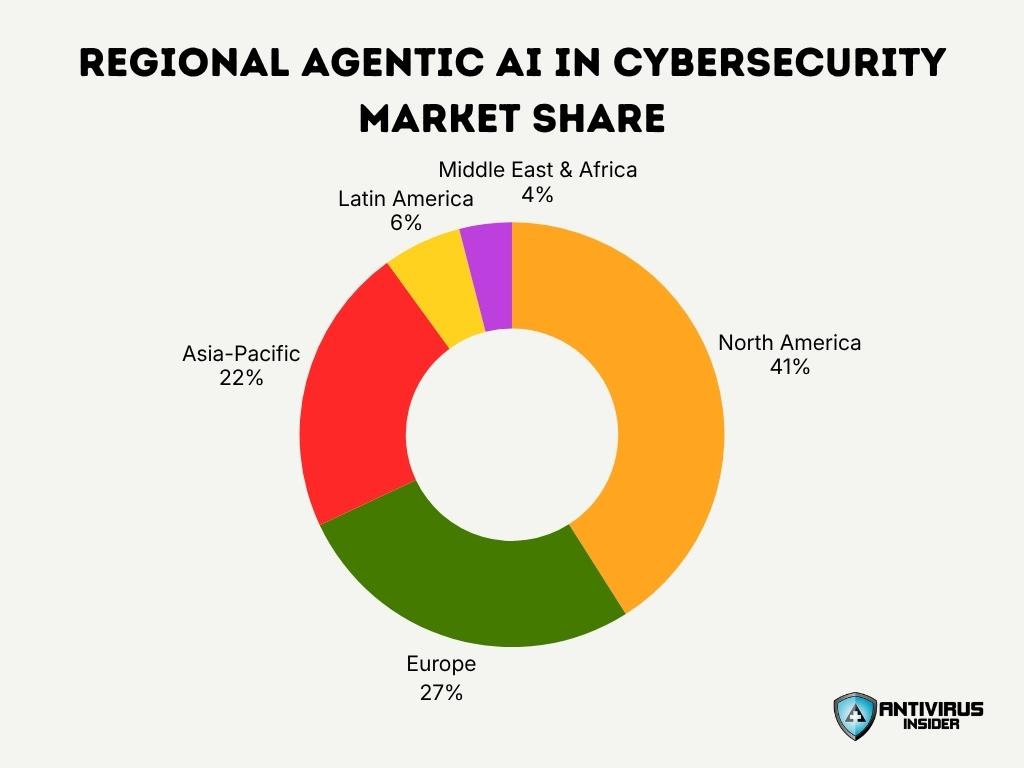
- North America dominates the regional market with a 41% share, reflecting its strong cybersecurity infrastructure, high enterprise AI adoption, and significant investments in autonomous security technologies.
- Europe accounts for 27% of the market, driven by growing regulatory compliance requirements, expanding AI security initiatives, and increased spending on digital resilience.
- Asia-Pacific holds a 22% market share, supported by rapid digital transformation, rising cyber threats, and accelerating adoption of AI-powered security solutions across enterprises.
- Latin America represents 6% of the global market, showing steady growth as organizations continue investing in modern cybersecurity platforms and intelligent threat detection.
- The Middle East & Africa contributes 4% of the market, with governments and businesses increasingly adopting Agentic AI to strengthen critical infrastructure and combat evolving cyber risks.
- Together, North America, Europe, and Asia-Pacific account for 90% of the global Agentic AI in Cybersecurity market, highlighting their leadership in innovation, investment, and enterprise deployment.
- Emerging regions such as Latin America and the Middle East & Africa, which together hold 10% of the market, are expected to present future growth opportunities as AI-driven cybersecurity adoption continues to expand.
Frequently Asked Questions (FAQs)
The market is projected to reach $322.4 billion by 2033, growing from $22.6 billion in 2024.
The market is forecast to grow at a 34.4% CAGR between 2025 and 2033.
How large is the Agentic AI in Cybersecurity market expected to be in 2026?
The threat detection and response segment is expected to account for 23.1% of the global market in 2026.
Enterprise adoption is expected to increase from fewer than 25% of organizations in 2025 to more than 75% by 2028.
Conclusion
Agentic AI is moving cybersecurity from assisted analysis toward systems that can plan investigations, operate tools, and execute response actions with limited supervision. With 87% of cybersecurity leaders identifying AI-related vulnerabilities as the fastest-growing cyber risk and 94% of leaders expecting AI to become the most consequential force shaping cybersecurity, organizations face pressure to secure agents as quickly as they deploy them. Identity governance, runtime monitoring, cloud controls, human approval, and auditable decision-making will determine whether autonomous security improves resilience or creates additional exposure.
