



Facial recognition has evolved from a specialized security technology into a widely used form of digital identity verification. Airports and border agencies use facial comparison to verify travelers, banks apply facial authentication to protect accounts and approve digital services, and smartphones increasingly rely on facial biometrics for secure device access. Healthcare providers, retailers and law enforcement agencies are also adopting the technology for applications ranging from attendance and identity verification to loss prevention and criminal investigations.
The facial recognition market continues to expand as advances in artificial intelligence, 3D imaging, cloud infrastructure and edge processing improve the speed and scalability of biometric systems. At the same time, concerns about false matches, demographic performance differences, biometric data security and personal privacy are pushing organizations toward stronger safeguards and regulatory compliance. The following facial recognition statistics examine the market’s growth, adoption, accuracy, applications, public attitudes, and regulatory landscape.
Editor’s Choice
- The global facial recognition market could rise from $8.5 billion in 2026 to $19.6 billion by 2033, representing a 12.8% compound annual growth rate.
- A second forecast projects expansion from $10.02 billion in 2026 to $20.68 billion in 2031, equivalent to a 15.6% CAGR.
- North America represented 38.5% of global revenue in 2025 in another market assessment, generating about $3.4 billion.
- Asia Pacific generated approximately $1.98 billion in 2025 under the same methodology and could increase to $2.32 billion in 2026.
- 3D facial recognition captured about 38% of global market revenue by technology in 2025 under one estimate, making it the largest technology segment in that dataset.
- Access control generated approximately 36% of 2025 facial recognition revenue by application under the same market methodology.
- U.S. federal oversight research found that 18 of 24 surveyed federal agencies reported using facial recognition for at least one purpose, showing how deeply the technology had already entered federal operations.
Recent Developments
- The European Union’s restrictions on specified prohibited AI practices became applicable on Feb. 2, 2025, directly affecting some biometric and facial recognition uses.
- European rules prohibit AI systems that build or expand facial recognition databases through untargeted scraping of facial images from the internet or CCTV footage.
- Real-time remote biometric identification in publicly accessible spaces for law enforcement also faces a general EU prohibition, although the law provides narrow exceptions, including searches for certain victims or missing people and responses to specified serious threats.
- The EU framework does not prohibit ordinary biometric verification that confirms whether a person is who they claim to be, an important distinction for banking and authentication systems.
- In the U.S., a federal oversight review examined seven federal law enforcement agencies that reported using facial recognition to support criminal investigations. All seven initially used facial recognition services without requiring related staff training, while two required training by April 2023.
- By September 2025, biometric facial comparison had processed more than 807 million travelers through U.S. border operations, demonstrating deployment at national scale.
- Facial recognition market revenue grew from an estimated $8.83 billion in 2025 to $10.13 billion in 2026 under one 2026 industry forecast, an increase of roughly 14.7%.
- Cloud deployment is forecast to record a 16.8% CAGR during the 2026-2031 forecast period, reflecting the shift toward remotely managed and scalable facial recognition infrastructure.
Global Facial Recognition Market Size and Growth
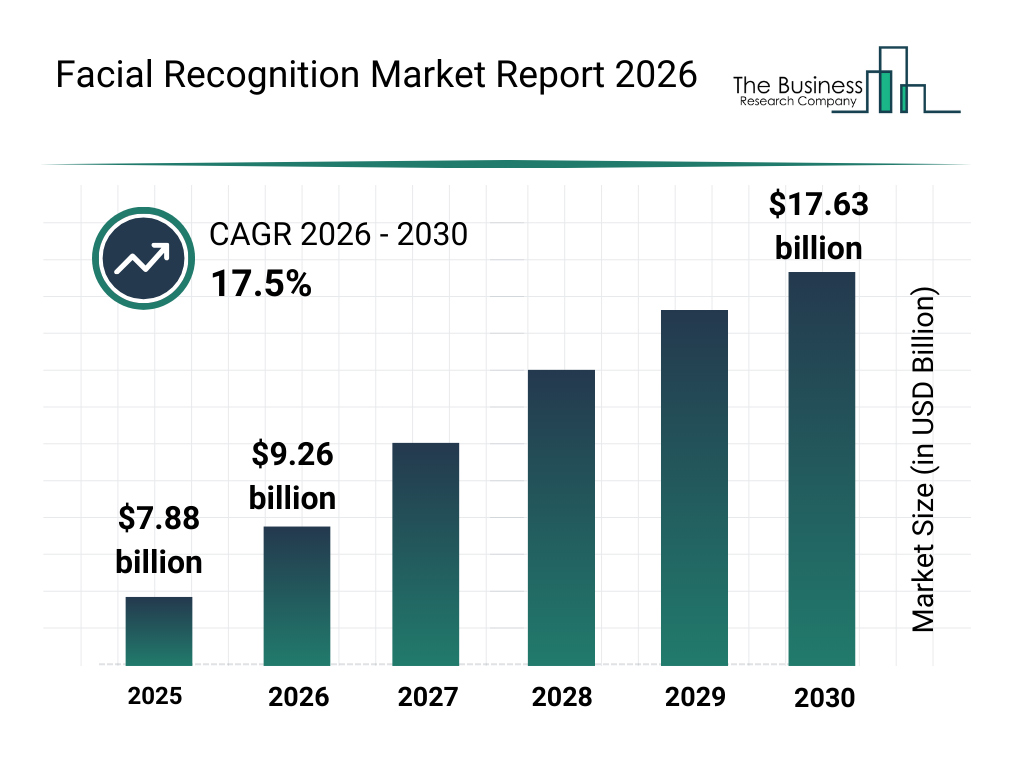
- The global facial recognition market is projected to grow from $7.88 billion in 2025 to $17.63 billion by 2030.
- In 2026, the facial recognition market is expected to reach $9.26 billion, up from $7.88 billion in 2025.
- The market is forecast to expand at a strong 17.5% CAGR between 2026 and 2030.
- Based on the reported growth rate, the market could reach approximately $10.88 billion in 2027 and $12.79 billion in 2028.
- By 2029, the facial recognition market is estimated to surpass $15 billion, before reaching $17.63 billion in 2030.
- Overall, the market is expected to more than double in size between 2025 and 2030, reflecting rapid adoption of facial recognition technologies worldwide.
Facial Recognition Market Revenue and Valuation Trends
- Under one 2026 market model, global revenue increased from $7.4 billion in 2025 to an estimated $8.5 billion in 2026, a gain of roughly $1.1 billion in one year.
- A second dataset shows revenue moving from $8.62 billion in 2025 to $10.02 billion in 2026, which implies an increase of about $1.4 billion.
- Another estimate places the 2025 market at $8.83 billion and the 2026 market at $10.13 billion, a year-over-year increase of approximately $1.3 billion.
- A separate 2026 analysis estimates that global facial recognition revenue reached $9.9 billion in 2025, illustrating the sizable differences between market measurement methodologies.
- The U.S. market alone is estimated to expand from $1.75 billion in 2025 to $2.05 billion in 2026 under one country-specific forecast.
- That U.S. forecast reaches $4.51 billion by 2031, translating into a 17.12% CAGR between 2026 and 2031.
- North American facial recognition revenue reached approximately $3.4 billion in 2025 in another dataset and is projected to reach $3.88 billion in 2026.
- Europe generated an estimated $1.96 billion in 2025 under the same methodology, with revenue projected to increase to $2.21 billion in 2026.
- Asia Pacific’s corresponding market value could rise from approximately $1.98 billion in 2025 to $2.32 billion in 2026, indicating faster year-over-year expansion than Europe in this dataset.
Facial Recognition Adoption Rates by Region
- North America captured 38.5% of worldwide facial recognition revenue in 2025 under one market model, making it the largest regional market in that analysis.
- Another 2026 study also ranks North America first but calculates its 2025 share at 36%, showing how market definitions affect regional estimates.
- A separate forecast estimates North America will account for 34.2% of the global market in 2026.
- The U.S. market could reach $2.05 billion in 2026 and $4.51 billion in 2031, corresponding to a 17.12% CAGR.
- Europe represented about 22.2% of worldwide revenue in 2025 under one current market estimate, with $1.96 billion in regional revenue.
- Asia Pacific represented approximately 22.4% of global revenue in 2025 in the same dataset and is projected to increase from $1.98 billion to $2.32 billion in 2026.
- Another market methodology ranks Asia Pacific as the largest market in 2026, highlighting the lack of a single standardized definition for the facial recognition industry.
- India provides a notable regional growth example, its facial recognition market is projected to expand at a 21.4% CAGR from 2023 to 2028, with market revenue forecast to increase from $107.6 million to $284.2 million.
- Within India, security and access control revenue is projected to rise from $91.8 million in 2025 to $110.5 million in 2026, while finance and payments could increase from $42.8 million to $52.8 million.
Facial Recognition Market Share by Application
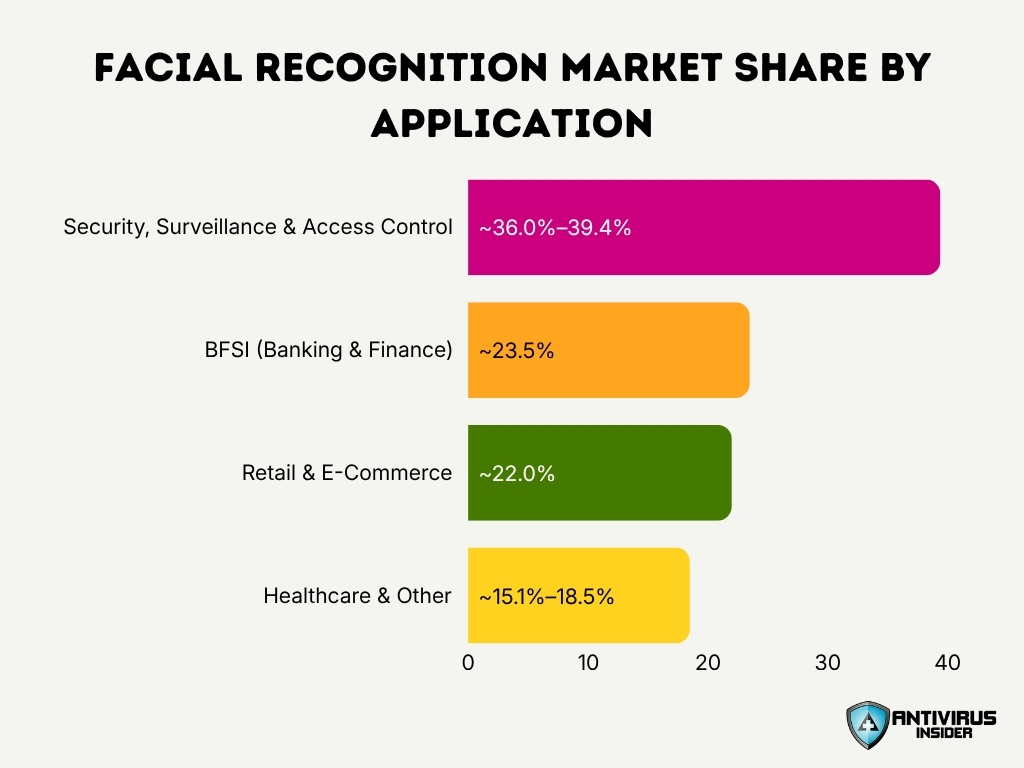
- Security, surveillance and access control leads the facial recognition market in 2026, accounting for an estimated 36.0% to 39.4% share.
- BFSI represents around 23.5% of the market, driven largely by KYC, identity verification, and fraud prevention use cases.
- Retail and e-commerce holds an estimated 22.0% share, with adoption focused on VIP identification, heat mapping and frictionless checkout.
- Healthcare and other applications contribute roughly 15.1% to 18.5%, including patient data security and staff attendance tracking.
- Combined, security and BFSI applications account for roughly 59.5% to 62.9% of the market, highlighting the strong role of facial recognition in identity and access-related functions.
Facial Recognition Market Share by Component and Technology
- Software accounted for 57.2% of global facial recognition revenue in 2025 under one current market analysis, making it the largest component category in that dataset.
- Edge hardware is forecast to grow at an 18.76% CAGR through 2031, reflecting demand for facial recognition that processes biometric information closer to the camera or device.
- By technology, 2D facial recognition generated 43.1% of market revenue in 2025 in the same analysis.
- Facial analytics and emotion-related AI represent a faster-growing category in that forecast, with an expected 18.11% CAGR through 2031.
- A different market assessment identifies 3D facial recognition as the largest technology segment, accounting for approximately 38% of revenue in 2025.
- Another 2026 industry forecast expects software solutions to dominate the offering category in 2026, while cloud deployment is projected to grow at a 16.8% CAGR during the forecast period.
- Security and access control is projected to represent 46.9% of the market by application in 2026 under that forecast, underscoring the industry’s continuing dependence on identity and physical-security use cases.
- On-premise systems represented 61.45% of the market in 2025, while edge and on-device deployments are forecast to grow at a 16.98% CAGR through 2031.
- Fixed cameras accounted for 55.05% of facial recognition device revenue in 2025, while mobile and wearable deployments are projected to grow at a 17.72% CAGR through 2031.
Facial Recognition in Law Enforcement and Security Statistics
- In a survey of 42 U.S. federal agencies employing law enforcement officers, 14 agencies reported using facial recognition to support criminal investigations.
- Of those 14 agencies, 13 did not track employees’ use of nonfederal facial recognition systems at the time of the review, creating gaps in oversight of commercial, state, and local searches.
- A later review focused on seven federal law enforcement agencies that used facial recognition services to support criminal investigations.
- Those seven agencies collectively used four nongovernment facial recognition services between October 2019 and March 2022.
- Six agencies with available usage data conducted approximately 60,000 facial recognition searches before they had training requirements in place.
- All seven agencies initially allowed facial recognition use without mandatory staff training. By April 2023, only two had introduced training requirements; two of the other five continued using the services, while three had stopped.
- At the broader federal level, six of 24 major agencies reported using facial recognition to generate leads in domestic criminal investigations in fiscal 2020.
- As of Sept. 27, 2024, 2,093 credential authentication systems operated across 231 airports and training or testing facilities, including 1,727 newer systems with expanded capabilities such as facial identity verification.
- Testing of a touchless airport identity system involving 634 volunteers recorded a 93% first-attempt face-capture success rate, a facial matching success rate above 99%, and an average transaction time of 8 seconds.
Facial Recognition in Retail and Ecommerce Usage Data
- UK retail facial recognition systems generated 516,739 real-time alerts in 2025, more than double the 252,943 recorded in 2024.
- That works out to an average of 1,415 alerts per day in 2025, compared with 693 per day during 2024.
- In December 2025 alone, retail facial recognition generated 54,312 alerts, setting a monthly record in the cited deployment data.
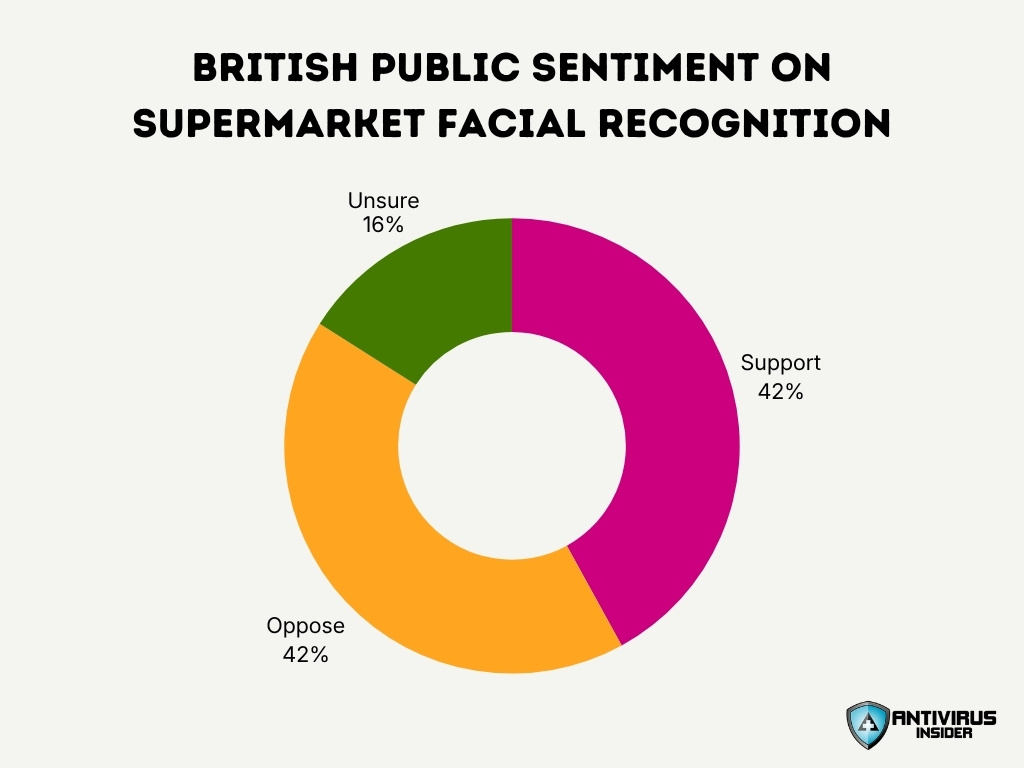
- A February 2026 survey of 6,741 British adults found 42% supported supermarkets using facial recognition, including 12% who strongly supported it and 30% who somewhat supported it. Another 42% opposed the practice, while 16% were unsure.
- A separate 2025 poll of 2,133 adults found 65.6% supported allowing retailers to use facial recognition to prevent theft and antisocial behavior.
- The same research found 61% said they would feel safer working in a store equipped with such a facial recognition system.
- In contrast, another survey reported in January 2026 found 59% of shoppers felt uncomfortable with facial recognition and other AI technology tracking their presence and activity inside stores.
- For ecommerce, 32% of surveyed UAE consumers used biometric authentication, such as facial or fingerprint recognition, for their most recent online retail purchase in 2025. The corresponding global average was 17%.
- A 2025 Japanese payments survey found 34.8% of respondents expressed interest in trying in-store facial recognition payments, rising to 54.3% among consumers in their 20s.
- U.S. regulatory experience illustrates the downside of poorly controlled retail deployments: one major pharmacy chain used facial recognition in hundreds of stores from 2012 to 2020, and regulators said the system produced thousands of false-positive matches.
Facial Recognition in Healthcare and Medical Applications
- The global healthcare biometrics market, which includes facial, fingerprint, iris, and other biometric technologies, reached approximately $14.73 billion in 2025.
- That broader healthcare biometrics market is projected to reach $18.3 billion in 2026, a year-over-year increase of about 24%.
- Current forecasts put healthcare biometrics revenue at $103.76 billion by 2034, corresponding to a 24.22% CAGR during 2026-2034. Facial recognition forms one segment of this wider market.
- Beginning May 1, 2025, all medical colleges and institutions covered by India’s national medical regulator were instructed to move attendance from fingerprint devices to face-based Aadhaar authentication.
- By August 2025, face authentication had reached 850 medical colleges and institutions within that system.
- A large U.S. study on facial technology in healthcare and research collected responses from 4,048 adults, split across two complementary surveys of 2,038 and 2,010 participants.
- In that study, 55.5% of respondents said they were equally concerned about the privacy of medical records, DNA and facial images collected for precision-health research.
- Only 48.4% considered facial recognition acceptable for healthcare providers monitoring patients’ emotions or symptoms, while 46.5% accepted its use for linking diverse data sources in health research.
- When asked about participating in a hypothetical precision-health study, 39.6% were willing, 30.1% were unwilling and 30.3% were unsure. Additionally, 22% preferred to opt out of both DNA and facial-imaging components.
Facial Recognition in Banking and Financial Services Statistics
- A 2026 U.S. digital-banking survey found 25.3% of respondents use facial recognition to access online or mobile bank accounts. Respondents could report more than one authentication method.
- Fingerprints remained more common in the same survey, used by 48.5%, while 41.2% reported using passwords to access digital banking.
- The same research found 70.5% of respondents had encountered fraud or attempted fraud while using online banking, including phishing, identity theft, and payment fraud.
- A 2025 global consumer study found 51% said biometric authentication, including facial and fingerprint recognition, would increase their trust in a brand.
- A 2025 holiday-shopping study found 71% of Gen Z respondents used biometric authentication, a higher rate than other generations surveyed.
- In India, Aadhaar Face Authentication reached 193.6 million transactions in July 2025, and financial institutions were among more than 150 entities using the technology for service delivery.
- A study of 610 bank customers found that attitudes toward biometric banking significantly influenced perceived ease of use and security, while those perceptions affected usefulness and future adoption intentions.
- Consumer acceptance can be high when biometrics replace passwords. One U.S. survey of 1,000 adults found 86% were interested in biometrics for identity verification or payments, while 70% considered biometric methods easier than passwords or PINs.
- However, privacy remains a constraint. A 2025 U.S. identity-verification survey reported that 91% had agreed to provide biometric data, even though 63% expressed serious privacy concerns.
Facial Recognition Acceptance by Location
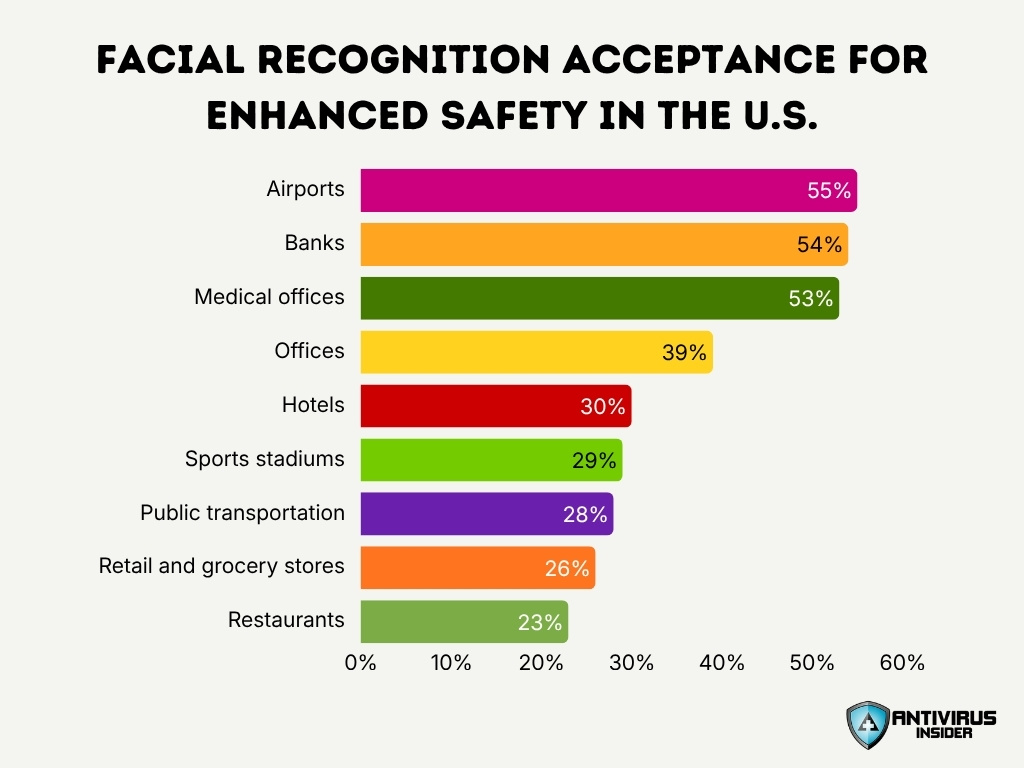
- Airports lead facial recognition acceptance at 55%, making them the most supported setting for FRT when linked to enhanced safety.
- Banks follow closely at 54%, showing strong public acceptance of facial recognition for security in financial environments.
- Medical offices rank third at 53%, with more than half of Americans open to using FRT for improved safety.
- Acceptance drops to 39% in offices, creating a noticeable gap compared with airports, banks, and medical facilities.
- Only 30% of Americans support facial recognition use in hotels for enhanced safety.
- Sports stadiums and public transportation record similar acceptance levels at 29% and 28%, respectively.
- Support is lower in everyday commercial settings, with 26% accepting FRT in retail and grocery stores.
- Restaurants rank lowest at 23%, indicating the weakest acceptance of facial recognition among the locations surveyed.
Smartphone and Consumer Device Facial Recognition Penetration
- Independent laboratory testing covering 208 smartphones released or tested since October 2022 found that 133, or 64%, had face-unlock implementations that researchers could fool with a 2D printed photograph.
- In 2023, 53% of tested phones failed that photo-spoofing check. The share increased substantially the following year.
- During 2024, the proportion of tested smartphones whose face unlock could be fooled reached 72%.
- Results improved in 2025, when the failure rate fell to 63%, representing a 13% year-over-year improvement in the cited testing program.
- For devices using Face ID, the probability that a random person could unlock a device with one enrolled appearance is stated as less than 1 in 1 million.
- That system permits five unsuccessful facial match attempts before requiring the user’s passcode.
- Depth information forms part of Face ID authentication and is not present in ordinary 2D photographs, helping distinguish this implementation from camera-only face unlock systems.
- In a consumer attitudes survey, 61% of British respondents identified faster device unlocking as a benefit of facial recognition on phones and personal devices.
- Facial authentication also increasingly links smartphones to public digital identity. India’s face-authentication service works on both Android and iOS, and July 2025 alone produced 193.6 million authentication transactions across supported services.
Facial Recognition Accuracy and Error Rate Statistics
- Current standardized testing covers facial recognition technology from nearly 100 developers, using more than 18 million images representing more than 8 million people for demographic analysis.
- In demographic results updated in March 2025, one evaluated algorithm recorded an overall false non-match rate of 0.13% under the specified test condition.
- For that algorithm, false non-match rates across geographic groups ranged from approximately 0.10% to 0.16%, showing that even strong aggregate performance can contain measurable subgroup differences.
- Another algorithm in the same table recorded an overall false non-match rate of 0.17%, with subgroup results ranging from about 0.15% to 0.20%.
- False-match disparities can be substantially larger than overall error rates suggest. For one January 2025 submission, the reported false-match rate ranged from 0.006% to 2.15% across demographic groups under the specified test configuration.
- In that example, the highest demographic false-match rate was 345 times the lowest rate, demonstrating why aggregate accuracy alone cannot describe demographic performance.
- Airport identity testing offers a real-world comparison: a 634-person test of a touchless identity solution produced a greater than 99% facial matching success rate.
- The same airport test achieved a 93% first-attempt face-capture success rate, meaning image acquisition itself can introduce friction even when matching performance exceeds 99%.
- Retail experience shows why deployment conditions matter. Regulators found that one retailer’s facial recognition deployment produced thousands of false positives, while the company had not adequately tested accuracy before deployment or consistently tracked false-positive rates afterward.
Global Facial Recognition Market Company Share
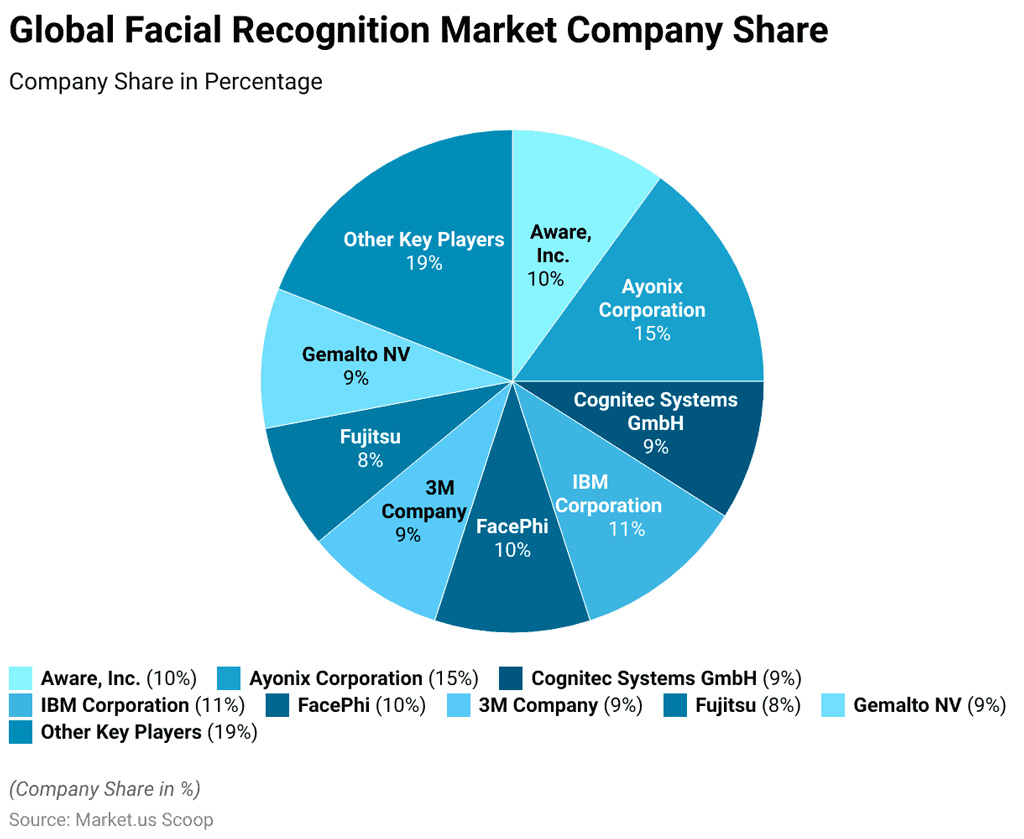
- Other key players collectively hold the largest share at 19%, showing that the global facial recognition market remains relatively fragmented beyond the leading vendors.
- Ayonix Corporation leads among named companies with a 15% market share, giving it the strongest individual position in the chart.
- IBM Corporation accounts for 11% of the market, making it the second-largest named company by share.
- Aware, Inc. and FacePhi each hold 10%, indicating closely matched competitive positions in the facial recognition market.
- Cognitec Systems GmbH, 3M Company, and Gemalto NV each capture 9% of the market, forming a sizable middle tier of competitors.
- Fujitsu has the smallest listed individual share at 8%, although its position remains relatively close to several other major vendors.
- The top two named companies, Ayonix Corporation and IBM Corporation, combine for 26% of the global facial recognition market.
- The eight named companies together represent 81% of the market, while 19% is distributed among other key players.
Facial Recognition Regulation and Legal Compliance Statistics
- European rules prohibit AI systems that create or expand facial recognition databases through untargeted scraping of facial images from the internet or CCTV footage.
- Violating prohibited AI-practice rules can trigger administrative fines of up to €35 million or 7% of worldwide annual turnover, whichever is higher for an undertaking.
- Other specified operator and provider violations can attract penalties of up to €15 million or 3% of worldwide annual turnover, whichever is higher.
- Illinois law treats a scan of face geometry as a biometric identifier and allows an aggrieved person to bring an action over covered violations.
- Illinois law provides liquidated damages of $1,000 for negligent violations or actual damages, whichever is greater.
- For intentional or reckless violations, Illinois law provides liquidated damages of $5,000 or actual damages, whichever is greater, in addition to specified legal costs and potential other relief.
- Texas biometric rules require covered businesses to provide notice and obtain consent before capturing biometric identifiers for commercial purposes. Enforcement can include civil penalties of up to $25,000 per violation.
- Texas’ broader AI law took effect on Jan. 1, 2026, and includes provisions covering biometric data, government use of AI, constitutional rights, and unlawful discrimination.
- Washington’s government facial recognition framework took effect July 1, 2021, and established requirements involving accountability, testing, training, human review and records.
- Federal oversight found that seven selected U.S. law enforcement agencies initially used facial recognition services without mandatory related training. By April 2023, two of seven had implemented training requirements, prompting recommendations for stronger safeguards.
Facial Recognition Privacy Concerns and Public Opinion Statistics
- A representative January 2025 survey of 3,920 people in England and Wales found 64% supported police use of facial recognition to some degree, while 11% opposed it.
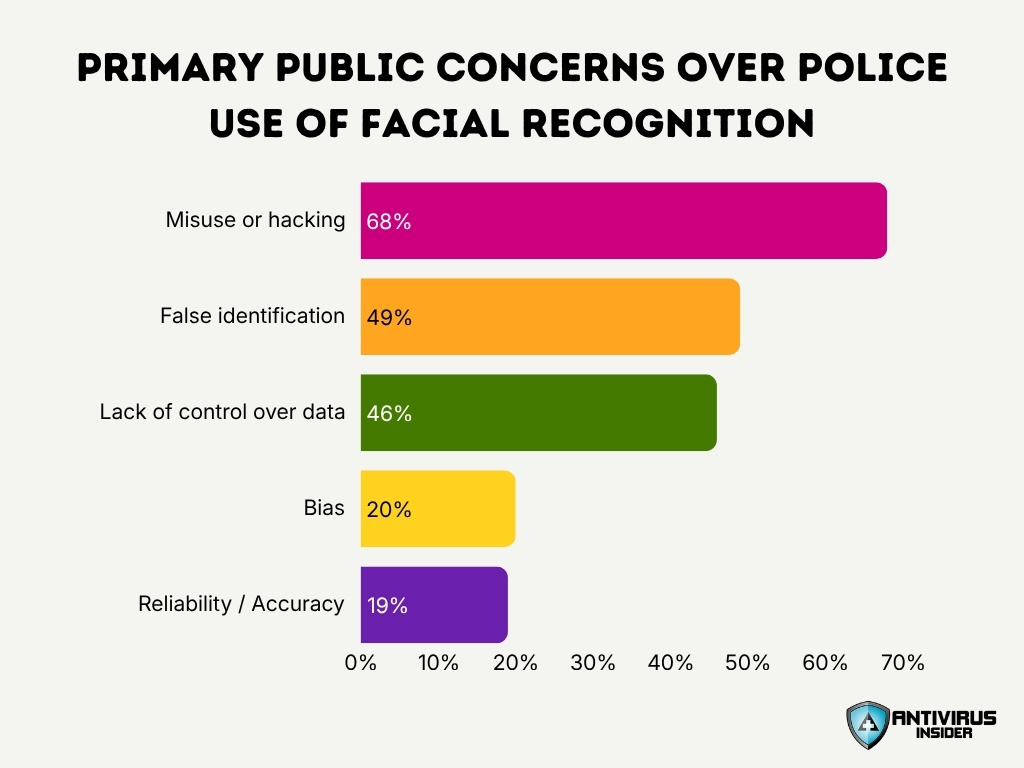
- However, 68% identified misuse or hacking as a concern, making it the most frequently selected concern about police facial recognition in that survey.
- Another 49% worried about false identification of suspects, while 46% expressed concern about a lack of control over the data police can collect.
- Bias ranked lower but remained notable: 20% expressed concern that facial recognition could be biased, while 19% worried that the technology might not be reliable or accurate.
- Only 6% said facial recognition made them feel less safe, while 7% selected none of the listed concerns.
- Acceptance varied significantly by application. Retrospective facial recognition received 97% at-least-sometimes acceptance, compared with 91% for live facial recognition used to find vulnerable people and 88% for live systems used to locate criminal suspects.
- Operator-initiated facial recognition, where an officer photographs someone and checks the image against a database, received 84% at-least-sometimes acceptance, the lowest of the four policing scenarios tested.
- Trust in institutions strongly affected attitudes. Support for police facial recognition reached 81% among people who completely trusted police, compared with 30% among respondents who did not trust police at all.
- In U.S. health research, 71.1% of respondents reported being very or somewhat concerned about privacy when video images were used and shared, while 47.4% expressed those levels of concern about imaging-derived data.
- In the same U.S. research, 55.5% were equally worried about the privacy of medical records, DNA and facial images in precision-health research, while 22% said they would prefer to opt out of both DNA and facial-imaging components.
Facial Recognition Data Breach and Security Incident Statistics
- An Australian data breach investigation disclosed in 2024 involved a technology supplier whose compromised dataset reportedly included biometric facial recognition information, along with contact information, birth dates, driver’s license information and gaming activity.
- A major facial recognition database contained more than 30 billion photos collected from publicly accessible internet sources, including social media, websites, news articles and public databases, according to a European regulatory decision.
- Dutch regulators imposed a €30.5 million fine in 2024 over unlawful processing of personal and biometric data associated with that database.
- Regulators also issued enforcement orders that could add more than €5 million in penalties for noncompliance.
- UK enforcement action had previously imposed a £7.5 million penalty over the scraping of images and creation of a global facial recognition database. The related litigation remained active into 2026.
- Australian regulators previously found that the same facial recognition operation had collected a database of more than 3 billion images at the time of their investigation, illustrating how rapidly large facial-image repositories expanded afterward.
- A separate Australian investigation found that facial recognition captured the faces of hundreds of thousands of people across 63 stores between November 2018 and November 2021. The regulator concluded that the collection breached privacy requirements.
- Another retail investigation found facial recognition operated across 28 stores from June 2020 to July 2022, capturing people entering stores and individuals at returns counters. Regulators found that shoppers had not received adequate notice or provided consent.
- A 2024 New Zealand supermarket trial illustrates how short retention can reduce exposure; it scanned 225,972,004 faces, including repeated scans, but deleted 99.999% of them within one minute.
- U.S. regulators said one pharmacy retailer’s facial recognition system generated thousands of false-positive matches after collecting tens of thousands of images. The resulting order prohibited facial recognition for security or surveillance purposes for five years.
Facial Recognition Investment, Funding, and Market Competition Statistics
- The global facial recognition market is estimated at $8.5 billion in 2026, up from $7.4 billion in 2025, with revenue projected to reach $19.6 billion by 2033.
- That forecast represents a 12.8% CAGR from 2026 through 2033, leaving substantial room for investment in software, cameras, identity platforms, and supporting infrastructure.
- North America accounted for 36% of 2025 facial recognition revenue, while Asia Pacific is projected as the fastest-growing regional market through 2033.
- Retail and ecommerce generated 22% of facial recognition revenue in 2025, while access control represented 36% of revenue by application and 3D technology held roughly 38% by technology.
- One major identity-verification company announced a $200 million Series D in April 2025, giving the business a $2 billion valuation and highlighting investor interest in identity infrastructure that includes biometric verification.
- A smaller biometric identity-verification startup closed a $1 million seed round in 2026 to support U.S. expansion and tools including biometric matching, liveness detection, facial age estimation and deepfake detection.
- A facial recognition company that had raised $352 million was acquired in early 2025 for approximately $125 million, illustrating that substantial funding does not guarantee equivalent exit valuations in a competitive biometric market.
- A July 2026 rights issue by a biometrics provider targeted approximately SEK 110 million, with SEK 100 million covered by guarantee commitments. The company linked demand to identity fraud, AI, deepfakes and stricter security requirements.
- Current competitive analysis identifies at least 20 notable vendors across the global facial recognition landscape, spanning long-established biometric suppliers, AI specialists and identity-verification providers.
- Market competition is also shifting toward edge computing. One 2026 forecast puts the market at $9.95 billion in 2026 and $20.88 billion by 2031, representing a 15.97% CAGR as on-device and privacy-preserving architectures expand.
Frequently Asked Questions (FAQs)
The global facial recognition market is estimated at $8.5 billion in 2026, up from $7.4 billion in 2025.
The market is projected to grow at a 12.8% CAGR from 2026 to 2033, reaching approximately $19.6 billion by 2033.
North America held the largest regional position with 36% of global facial recognition revenue in 2025.
A January 2025 survey of 3,920 adults in England and Wales found that 64% supported police use of facial recognition to some degree, while 11% opposed it.
The 3D facial recognition segment held approximately 38% of the global market in 2025, making it the largest technology segment in that market analysis.
Conclusion
Facial recognition statistics show a technology becoming increasingly embedded in security, travel, banking, healthcare, retail, and consumer devices. Global market estimates place the industry at roughly $8.5 billion to $10 billion, while large-scale deployments already process hundreds of millions of travelers, authentication requests, and facial scans. Continued investment in cloud platforms, edge processing, liveness detection and identity verification could further expand the range of commercial and government applications.
However, wider adoption also increases the importance of accuracy, privacy and biometric data protection. False matches can carry serious consequences in law enforcement and security settings, while consumers continue to express concerns about surveillance, unauthorized data collection and breaches involving biometric information. Regulations are also becoming more consequential, with organizations facing stricter requirements for consent, data retention, transparency and responsible deployment.
The direction of the market therefore depends on more than technical performance or revenue growth. Successful facial recognition deployments will increasingly need to combine high accuracy, strong cybersecurity, human oversight and regulatory compliance with clear limits on how biometric information is collected, stored and used.
