



Endpoint security has evolved far beyond traditional antivirus as organizations now protect laptops, smartphones, servers, virtual machines, cloud-connected devices, and other systems employees use to access corporate data. Hospitals must secure clinical workstations and connected medical environments, financial institutions need to protect devices accessing payment and customer information, and distributed businesses must monitor endpoints operating across offices, homes, and public networks.
The challenge is becoming more complex as attackers combine credential theft, vulnerability exploitation, ransomware, social engineering, and AI-assisted techniques to compromise devices and move deeper into corporate environments. At the same time, remote work, BYOD, cloud applications, and shadow IT continue to expand the number of endpoints security teams must identify and manage. As a result, organizations are increasingly investing in endpoint detection and response, behavioral analytics, automated containment, identity-first controls and zero trust security models. The statistics in this article examine endpoint security market growth, spending patterns, deployment trends, attack activity, EDR adoption and the technologies shaping enterprise endpoint protection.
Editor’s Choice
- One current forecast values the global endpoint security market at $17.79 billion in 2026, up from $16.25 billion in 2025.
- Under a broader definition, the market is expected to rise from $37.2 billion in 2025 to $41.6 billion in 2026 and reach $95.9 billion by 2033.
- North America accounted for 39.3% of global endpoint security revenue in 2025 in one recent market estimate.
- Another segmentation model found that cloud-based endpoint security represented 57.88% of the market in 2025, with cloud deployments forecast to grow 15.01% annually through 2031.
- Large enterprises accounted for 62.54% of endpoint security revenue in 2025, while SMEs are projected to expand at a 13.56% CAGR.
- The fastest recorded eCrime breakout time reached just 27 seconds in 2025, illustrating how little time security teams can have to contain an intrusion.
- Malware-free activity represented 82% of detections in 2025, reinforcing the shift toward behavioral monitoring, identity protection, and EDR.
- AI-enabled adversary operations increased 89% in 2025, while more than 90 organizations encountered abuse of legitimate AI tools to generate malicious commands and steal sensitive information.
- 97% of organizations reporting an AI-related security incident lacked adequate AI access controls, highlighting the connection between endpoint, identity, and AI governance.
Recent Developments
- AI-enabled adversary activity surged 89% year over year in 2025, with attackers using AI across reconnaissance, credential theft, and evasion.
- Attackers abused legitimate generative AI tools at more than 90 organizations by injecting malicious prompts that generated commands used for credential and cryptocurrency theft.
- The average eCrime breakout time declined to 29 minutes in 2025, representing a 65% increase in attacker speed compared with 2024.
- The fastest observed eCrime breakout dropped from 51 seconds in 2024 to 27 seconds in 2025, nearly halving the previous record.
- Exploitation of zero-day vulnerabilities before public disclosure increased 42% in 2025, increasing the value of behavioral detection when signatures or patches are unavailable.
- Cloud-conscious intrusions conducted by state-linked actors increased 266% in 2025, reflecting attackers’ growing ability to move across endpoint, identity, and cloud environments.
- In 2025, 40% of vulnerabilities exploited by China-linked adversaries targeted edge devices, illustrating how attackers increasingly look beyond well-monitored employee endpoints.
- Password spraying accounted for 97% of identity attacks observed in the latest reporting period, demonstrating that attackers still exploit basic credential weaknesses alongside advanced techniques.
- Authorities seized or blocked more than 2,300 malicious domains associated with a major infostealer disruption in mid-2025, limiting infrastructure used to steal information from browsers, applications, and infected devices.
- Business email compromise accounted for 21% of observed attack outcomes, compared with 16% for ransomware, underscoring the importance of protecting endpoint sessions, identities, and authentication workflows together.
Global Endpoint Security Market Overview
- One August 2026 assessment estimates that the global endpoint security market grew from $16.25 billion in 2025 to $17.79 billion in 2026.
- That forecast expects the market to reach $34.40 billion by 2034, representing an 8.6% CAGR over the 2026-2034 period.
- A separate August 2026 assessment estimates the market at $23.74 billion in 2025 and $25.95 billion in 2026, with revenue projected to reach $44.86 billion in 2032.
- Another 2026 analysis values the market at $21.24 billion in 2025, increasing to $22.82 billion in 2026 and $40.55 billion by 2034.
- A broader definition estimates $37.2 billion in 2025 and $41.6 billion in 2026, demonstrating the substantial effect of including different services and security categories in the market total.
- North America held 34.4% of global revenue in 2025 under that broader methodology, while the U.S. represented the region’s largest national market.
- Another market model assigns North America a 33.12% share in 2025 and projects Asia-Pacific to grow at a 12.22% CAGR through 2031.
- Solutions represented 65% of 2025 endpoint security revenue in one current segmentation, exceeding the services segment.
- BFSI held 20.42% of endpoint security revenue in 2025 in one market analysis, while health care and life sciences are forecast to expand at a 12.98% CAGR through 2031.
Endpoint Security Market Growth Statistics
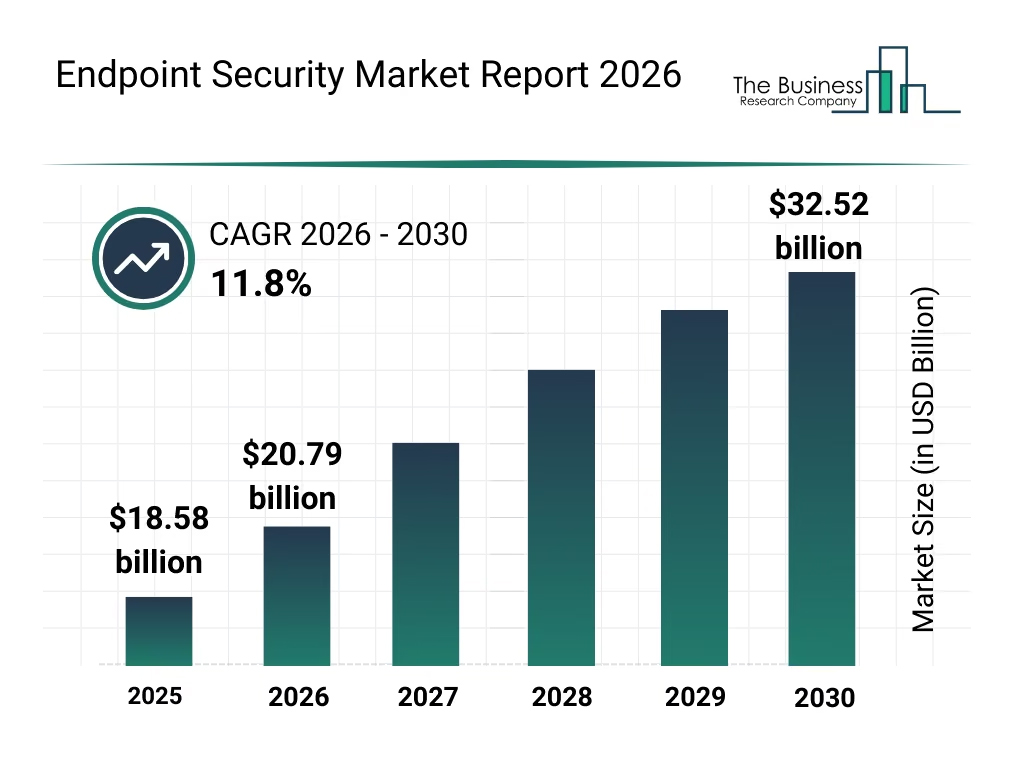
- The global endpoint security market is valued at $20.79 billion in 2026, up from $18.58 billion in 2025.
- Between 2025 and 2026, the endpoint security market expands by approximately $2.21 billion, representing nearly 11.9% year-over-year growth.
- The endpoint security market is projected to reach $32.52 billion by 2030, highlighting strong demand for endpoint protection solutions.
- From 2026 to 2030, the market is expected to add approximately $11.73 billion in value.
- Endpoint security is forecast to record a robust 11.8% CAGR from 2026 to 2030, indicating sustained double-digit market expansion.
- By 2030, the endpoint security market is projected to be approximately 56% larger than its 2026 level.
Endpoint Security Market Share by Solution Type
- Under one 2025 market segmentation, firewall and UTM solutions held 19.58% of endpoint security revenue, making this category the largest individual solution type in that methodology.
- EDR represents one of the fastest-growing endpoint categories and is projected to expand at a 15.52% CAGR through 2031.
- A business-focused endpoint security analysis estimated that EDR generated $8.86 billion in 2025, equal to 44.97% of its defined market.
- Under the same segmentation, endpoint protection platforms generated $6.94 billion, or 35.23% of 2025 revenue.
- Extended detection and response accounted for the remaining 19.8%, representing approximately $3.90 billion in 2025 revenue under that methodology.
- A separate endpoint protection analysis places EDR even higher, at 52.02% of 2025 revenue, or approximately $11.89 billion.
- Endpoint protection platforms represented 34.15% of that market, generating approximately $7.80 billion in 2025.
- Managed detection and response accounted for 13.84%, or roughly $3.16 billion, under the same endpoint protection segmentation.
- Within the cloud endpoint protection market, traditional antivirus and anti-malware technologies still generated 33.15% of 2025 revenue, showing that preventive controls remain commercially important despite the shift toward behavioral detection.
- Cloud EDR is forecast to expand at a 20.95% CAGR through 2031, significantly faster than many mature endpoint protection categories.
Endpoint Security Adoption by Deployment Mode
- Cloud-based solutions represented 57.88% of the endpoint security market in 2025 under one current global segmentation.
- Cloud endpoint security is projected to grow at a 15.01% CAGR through 2031, supported by centralized administration and distributed workforces.
- Another business endpoint security analysis estimates that cloud deployments generated $14.77 billion in 2025, representing 74.97% of its defined market.
- On-premises products represented 25.03%, or approximately $4.93 billion, under the same business-focused segmentation.
- A separate endpoint protection model puts cloud deployment even higher at 76.68% of 2025 revenue, versus 23.32% for on-premises deployment.
- Within EDR specifically, cloud-delivered agents accounted for 68.12% of installations in 2025, while on-premises and air-gapped deployments retained a 31.88% share.
- Cloud-delivered EDR deployments are projected to expand at a 24.93% CAGR, reflecting demand for SaaS administration, rapid policy changes, and protection of distributed endpoints.
- Within cloud endpoint protection, public cloud held 48.86% of 2025 revenue, making it the largest cloud deployment model in that segment.
- Hybrid cloud endpoint protection is projected to grow at a 17.35% CAGR through 2031, as organizations balance cloud scalability with local control and regulatory requirements.
- On-premises endpoint protection still accounts for approximately 39% of the one endpoint protection platform market estimate, particularly where organizations face data residency, regulatory, or sovereignty requirements.
Endpoint Security Market Share by Component
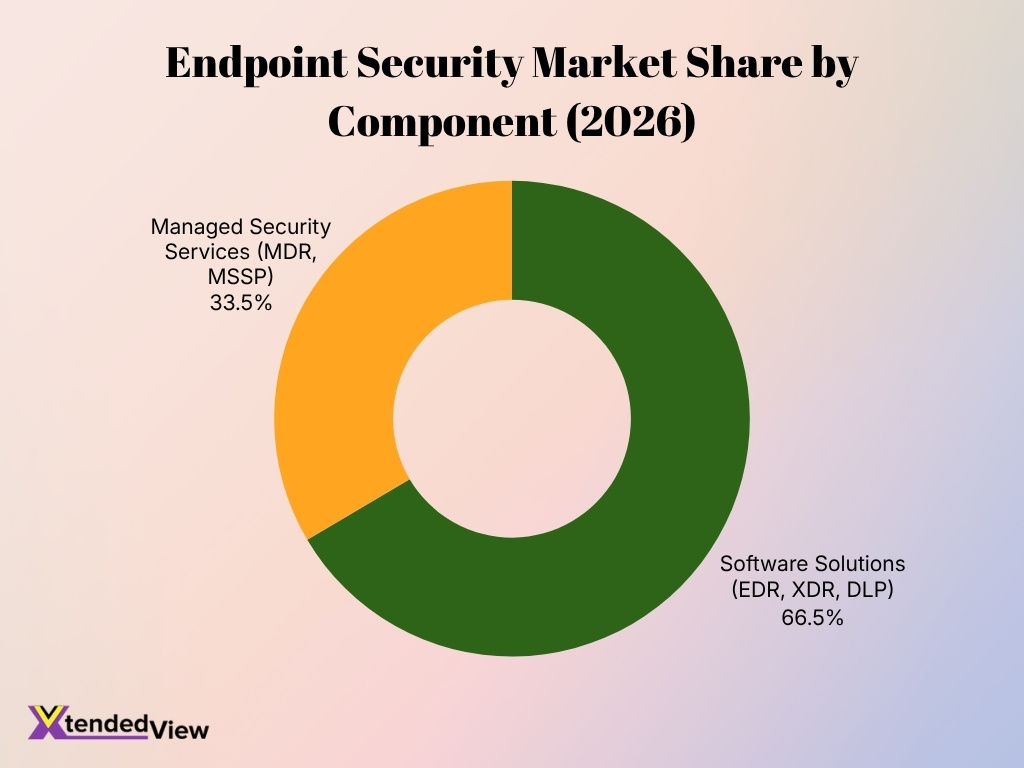
- Software solutions dominate the endpoint security market with a 66.5% share in 2026, driven by organizations shifting from traditional antivirus tools toward advanced EDR, XDR, and DLP solutions.
- The transition from legacy antivirus to behavioral analytics highlights growing demand for endpoint security platforms capable of detecting sophisticated and evolving cyber threats.
- Managed security services account for 33.5% of the market, giving MDR and MSSP providers roughly one-third of total endpoint security market share.
- Demand for managed security services is growing rapidly as organizations struggle with severe security operations center (SOC) skill shortages and limited in-house cybersecurity expertise.
- Together, software solutions and managed security services represent 100% of the component market, with software holding nearly twice the share of managed services.
Endpoint Security Spend by Organization Size
- Large enterprises accounted for 62.54% of global endpoint security revenue in 2025, maintaining the largest share by organization size.
- Small and midsize businesses are forecast to increase endpoint security spending at a 13.56% CAGR through 2031, faster than the broader large-enterprise segment.
- In the cloud endpoint protection segment, large enterprises represented 57.45% of 2025 revenue, showing that larger businesses remain the primary buyers of centrally managed endpoint tools.
- Small and midsize businesses in the cloud endpoint protection market are projected to grow at a 16.65% CAGR through 2031, indicating faster adoption among smaller organizations.
- Another endpoint security segmentation estimated that large enterprises controlled 64.3% of the market in 2025, compared with 35.7% for SMEs.
- Under that same model, SME endpoint security revenue is expected to grow 13.2% annually, compared with 8.6% for large enterprises.
- The broader information security market shows a similar pattern: large enterprises held 69.4% of 2025 spending, while SMEs represented the smaller but faster-changing portion of demand.
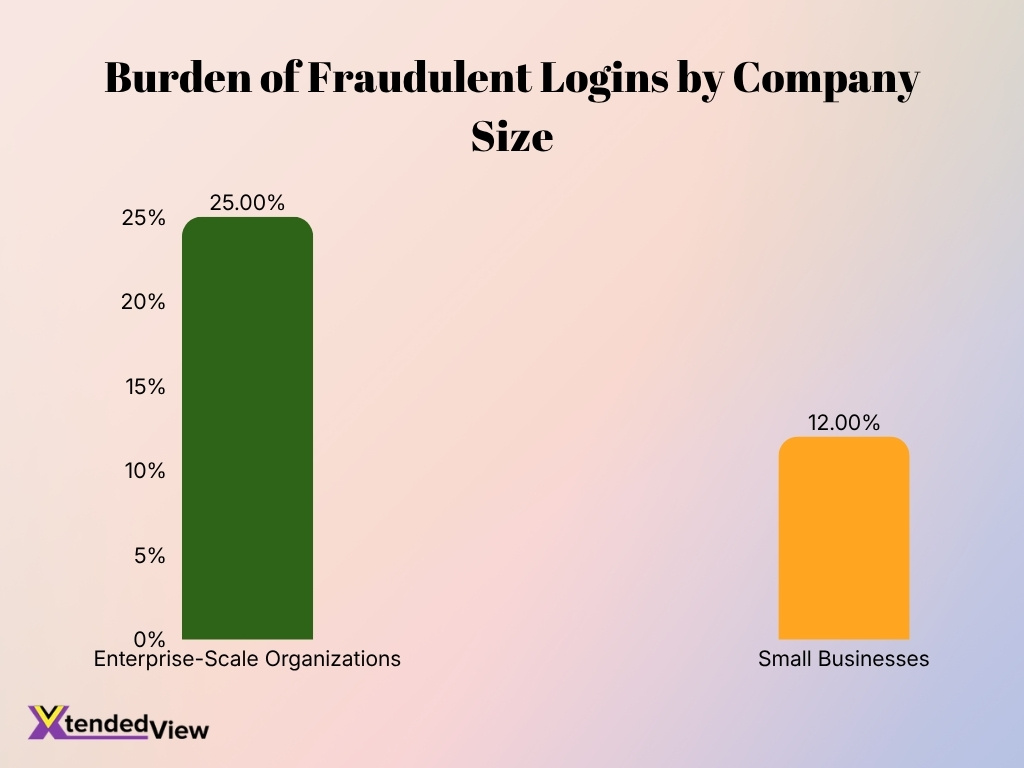
- Credential-stuffing traffic creates a different burden by company size: fraudulent login attempts represented a median 25% of authentication attempts at enterprise-scale organizations, versus 12% at small businesses in one analysis.
- Ransomware also places disproportionate financial pressure on smaller companies. In 2025 breach data, ransomware appeared in 88% of SMB breaches, compared with 39% among larger organizations.
Regional Endpoint Security Market Breakdown
- North America generated approximately $6.46 billion in endpoint security revenue in 2025, equal to 39.3% of the global market under one current estimate.
- North American endpoint security revenue is projected to reach approximately $7 billion in 2026, maintaining the region’s global leadership.
- The U.S. endpoint security market alone is projected to reach about $5.28 billion in 2026 under the same methodology.
- Europe generated about $4.3 billion in 2025, equal to 26.4% of worldwide endpoint security revenue, and is forecast to reach $4.69 billion in 2026.
- A separate global analysis assigns North America a 33.12% market share in 2025, confirming its leadership even under a narrower methodology.
- Asia-Pacific is projected to record the fastest regional expansion, with endpoint security revenue growing at a 12.22% CAGR through 2031.
- In hosted endpoint protection software, North America generated $3.45 billion in 2025, equal to approximately 38.9% of worldwide revenue.
- Asia-Pacific represented 26.9% of hosted endpoint protection revenue in 2025, or roughly $2.38 billion, making it the second-largest regional market under that product definition.
- Europe represented another 25.3% of hosted endpoint protection spending, or approximately $2.24 billion in 2025.
- North America also accounted for 38% of global EDR revenue in 2025, while the worldwide EDR market is projected to expand from $5.74 billion in 2025 to $7.23 billion in 2026.
Endpoint Security Investment by Industry Vertical
- Banking, financial services and insurance accounted for 20.42% of endpoint security revenue in 2025, the largest industry share in one global market assessment.
- Within cloud endpoint protection specifically, financial services represented an even larger 24.95% share in 2025.
- Health care and life sciences represent the fastest-growing major endpoint security vertical, with revenue projected to rise at a 12.98% CAGR through 2031.
- Cloud endpoint protection spending in health care is projected to increase at a 17.55% CAGR through 2031, reflecting heightened concern over patient records, connected medical systems, and ransomware.
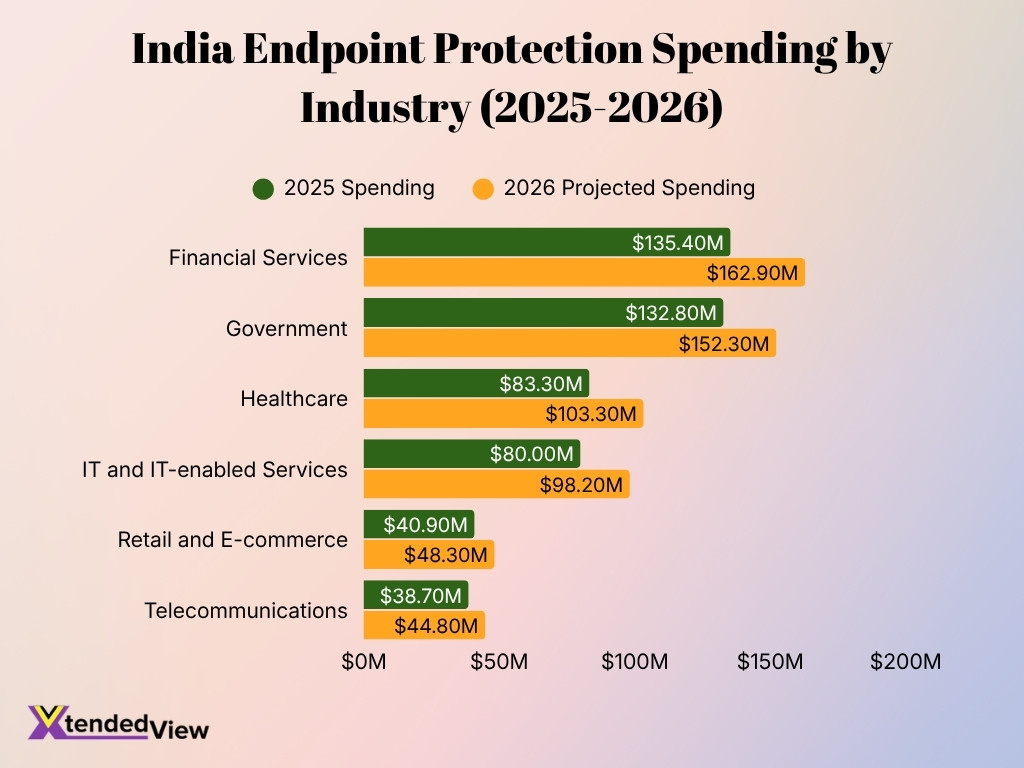
- India’s financial-services endpoint protection platform market is projected to rise from $135.4 million in 2025 to $162.9 million in 2026, an increase of about 20% in one year.
- India’s health care endpoint protection platform segment is projected to jump from $83.3 million in 2025 to $103.3 million in 2026, representing roughly 24% annual growth.
- The Indian government endpoint protection platform segment is forecast to increase from $132.8 million in 2025 to $152.3 million in 2026.
- IT and IT-enabled services endpoint protection spending in India is expected to rise from $80 million in 2025 to $98.2 million in 2026, reflecting growth of nearly 23%.
- Telecommunications endpoint protection spending in the same market is projected to increase from $38.7 million in 2025 to $44.8 million in 2026, while retail and e-commerce spending is forecast to rise from $40.9 million to $48.3 million.
- Energy companies face increasing endpoint and connected-device exposure as digital infrastructure expands, with smaller utilities particularly constrained by limited security budgets and older technology.
Endpoint-Related Cyberattacks and Breach Origins
- Endpoints were involved in 61% of investigated intrusions in 2025, making them the second-most frequently affected attack surface after identity.
- Identity systems appeared in 89% of 2025 intrusion investigations, illustrating how endpoint and identity security increasingly overlap.
- Network infrastructure appeared in 50% of investigated intrusions, while human-driven activity contributed to 45%.
- Email systems appeared in 27% of investigated incidents, compared with 26% for applications and 20% for cloud environments.
- About 87% of incidents crossed at least two attack surfaces in 2025, showing why endpoint-only monitoring can miss important parts of an intrusion.
- 67% of incidents involved three or more attack surfaces, reinforcing demand for EDR, identity telemetry, and cross-platform detection.
- Endpoint incidents accounted for 29% of all security incidents in 2025 in another current threat dataset, with malware remaining the leading endpoint threat.
- In Q2 2026, malware represented 52.7% of endpoint incidents, while targeted attacks accounted for 23.6%.
- Opportunistic attacks represented another 15.5% of Q2 2026 endpoint incidents, while red-team activity accounted for 7.2% and server-side vulnerabilities for 1%.
- Compared with 2024, endpoint involvement in incident-response investigations declined from 72% to 61% in 2025, while identity-related activity became even more prominent.
Ransomware and Extortion Attacks Targeting Endpoints
- Ransomware appeared in 48% of breaches in the latest 2026 breach dataset, up from 44% in the preceding annual report.
- In the 2025 dataset, ransomware was present in 44% of analyzed breaches, compared with approximately 32% in the prior reporting period.
- That increase represented a 37% year-over-year rise in ransomware presence across breaches.
- System intrusion accounted for 60% of breaches in the 2026 dataset, with ransomware serving as a major driver of that attack pattern.
- Ransomware appeared in 77% of system intrusion breaches, demonstrating how often complex compromises end in ransomware-based monetization.
- A 2026 survey found that ransomware attackers successfully encrypted data in 56% of attacks during the preceding 12 months.
- Only about one-third of smaller organizations stopped ransomware before attackers encrypted their data, indicating weaker containment capability among smaller companies.
- The median ransomware payment reached $769,000 in the 2026 survey, despite a growing number of companies trying to improve recovery and resilience.
- Average ransomware recovery costs reached approximately $1.7 million, excluding the ransom itself in the cited survey measurement.
- In the previous breach dataset, 64% of ransomware victims did not pay, while the median payment among paying organizations declined to $115,000 from $150,000.
Phishing and Credential Theft via Endpoints
- Vulnerability exploitation became the leading initial breach vector in the 2026 dataset at 31%, overtaking stolen credentials as the most common entry path.
- In the preceding annual dataset, compromised credentials represented 22% of known initial access vectors, making credential abuse the most common starting point at that time.
- Phishing accounted for 16% of known initial access vectors in the 2025 dataset, trailing credential abuse and vulnerability exploitation.
- Approximately 60% of analyzed breaches involved a human element in 2025, including social engineering, mistakes, and misuse.
- Stolen credentials appeared in 32% of breaches in one 2025 analysis, demonstrating that credentials remain useful even when they are not the initial compromise vector.
- Among identity incidents observed in 2025, attackers successfully obtained account access through stolen credentials in 47.7% of cases.
- Credential-stuffing traffic represented a median of 19% of daily authentication attempts in analyzed single sign-on logs.
- At large enterprises, credential stuffing reached a median of 25% of authentication attempts, compared with 12% at smaller companies.
- Infostealer data showed that the median user maintained unique passwords for only 49% of services, indicating substantial password reuse across accounts.
- Mobile phishing and social-engineering attacks generated 40% higher click rates than traditional approaches in the latest breach analysis, making phones an increasingly attractive target.
BYOD and Remote Work Endpoint Risks
- 95% of IT leaders in one recent enterprise study expressed concern about security risks when employees work outside the office, with data leakage standing out as a key issue.
- Mobile users demonstrate 40% higher click rates on phishing and social-engineering attacks than users receiving comparable traditional email approaches, increasing exposure on BYOD smartphones.
- The U.S. endpoint security market is projected to reach $5.28 billion in 2026, with growing BYOD usage identified as one factor supporting demand.
- Cloud-based endpoint security represented 57.88% of global market revenue in 2025, partly reflecting demand for centrally managed protection across distributed workforces.
- Cloud endpoint security revenue is forecast to increase at a 15.01% CAGR through 2031, outpacing several traditional endpoint deployment categories.
- Cloud-delivered EDR accounted for a substantial majority of modern deployments, while North America alone represented 38% of EDR revenue in 2025 as organizations expanded monitoring across distributed device fleets.
- Endpoint attacks represented 29% of all security incidents in 2025, demonstrating that devices remain a major attack surface even as more work moves into cloud applications.
- Endpoints appeared in 61% of incident-response investigations in 2025, while identity appeared in 89%, showing why remote access requires both device and identity controls.
- About 87% of investigated intrusions involved multiple attack surfaces, meaning a compromised remote device can become one stage in a larger identity, network, or cloud intrusion.
- Password reuse further increases remote-work exposure: infostealer analysis found that only 49% of passwords were unique for the median affected user, allowing one compromised endpoint to expose credentials for multiple services.
Shadow IT and Unmanaged Endpoint Exposure
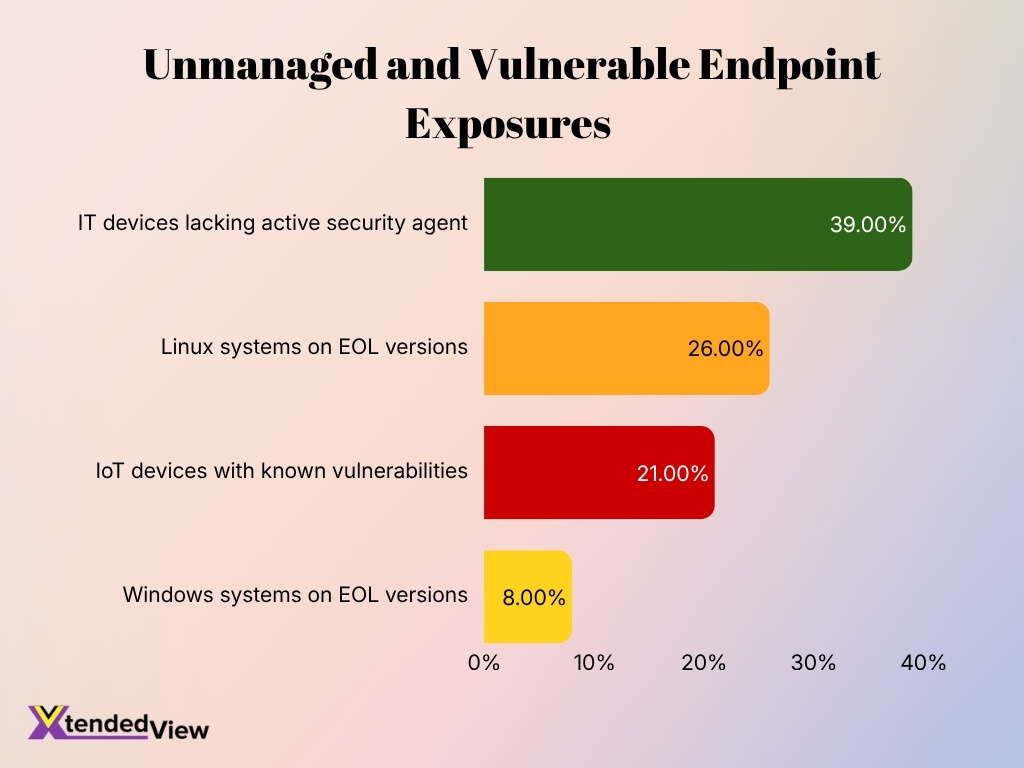
- Nearly 39% of IT devices registered in enterprise directory environments lacked an active endpoint security agent in a 2025 analysis of more than 27 million devices.
- About 26% of Linux systems in the same device dataset ran end-of-life operating system versions, leaving organizations dependent on software that may no longer receive standard security fixes.
- Another 8% of Windows systems were running end-of-life operating systems, creating persistent exposure even in environments with formal device inventories.
- High-risk IoT devices generated 48.2% of observed network connections, showing how nontraditional endpoints can account for a large portion of enterprise network activity.
- Approximately 21% of IoT devices had at least one known vulnerability, creating potential footholds outside conventional laptop and workstation security controls.
- One 2025 discovery dataset found that 97% of SaaS applications in use qualified as shadow SaaS rather than centrally sanctioned software.
- Organizations in another 2025 analysis managed an average of 490 SaaS applications, but only 47% of those applications were authorized.
- At companies with 11 to 50 employees, 27% of workers used unsanctioned AI applications, making smaller businesses particularly exposed to shadow AI.
- Those small organizations averaged 269 shadow AI tools per 1,000 employees, illustrating how quickly unmanaged applications can multiply across a workforce.
- Only 12% of sales-related SaaS applications were centrally managed in one 2025 dataset, leaving 88% outside centralized management.
AI-Driven and Automated Endpoint Threats
- The 2026 breach dataset found generative AI augmenting 15% of attack techniques, showing that AI has moved from experimentation into operational cybercrime.
- Employee use of unauthorized shadow AI tripled to 45% in the latest breach analysis, expanding the number of uncontrolled paths through which sensitive information can leave an organization.
- Automated AI bot traffic was growing at 21% month over month, illustrating how automation can scale malicious probing and other online activity far faster than manual operations.
- 13% of organizations in a 2025 breach study reported compromises involving AI models or AI applications.
- Among organizations that experienced an AI-related security incident, 60% suffered compromised data.
- Another 31% of AI-related security incidents caused operational disruption, showing that AI security failures can affect business availability as well as confidentiality.
- One in five breached organizations reported an incident linked to shadow AI, connecting unsanctioned AI use directly with measurable breach exposure.
- Organizations with high levels of shadow AI experienced approximately $670,000 more in average breach costs than organizations with little or no shadow AI.
- Only 34% of organizations with AI governance policies regularly audited their environments for unsanctioned AI use.
- Shadow AI incidents exposed personally identifiable information in 65% of cases and intellectual property in 40%, compared with global averages of 53% and 33%, respectively.
Zero Trust and Identity-First Endpoint Controls
- Only 29% of organizations in a 2025 survey used identity-based access as their primary access-control model.
- Another 48% used a mix of IP-based and identity-based access, showing that many businesses remain midway through their transition from network-centric security.
- 22% still relied primarily on IP-based access, which places greater trust in network location than identity-centric zero trust models do.
- Zero trust network access technology was in use at 34% of surveyed organizations in 2025.
- Only 24% used device posture management, indicating a significant gap in checking endpoint health as part of access decisions.
- Identity and access management technology had reached 45% adoption, making identity infrastructure the most widely used secure-access technology in that survey.
- 99% of surveyed organizations said they wanted to redesign some aspect of their access and connectivity environment, with security the leading priority.
- 42% believed their existing security and access setup would no longer meet organizational needs within two years, including 8% that said it was already outdated or would become outdated within a year.
- Workforce MFA adoption reached 70% in 2025, while phishing-resistant passwordless authentication rose from 8.6% to 14% in one year.
- Adoption of phishing-resistant authenticators increased 63% year over year, while password usage declined from 95.1% to 93% of workforce users.
Endpoint Detection and Response (EDR) Adoption Trends
- 89% of surveyed security teams used EDR for threat response in 2025, up from 82% in the previous year.
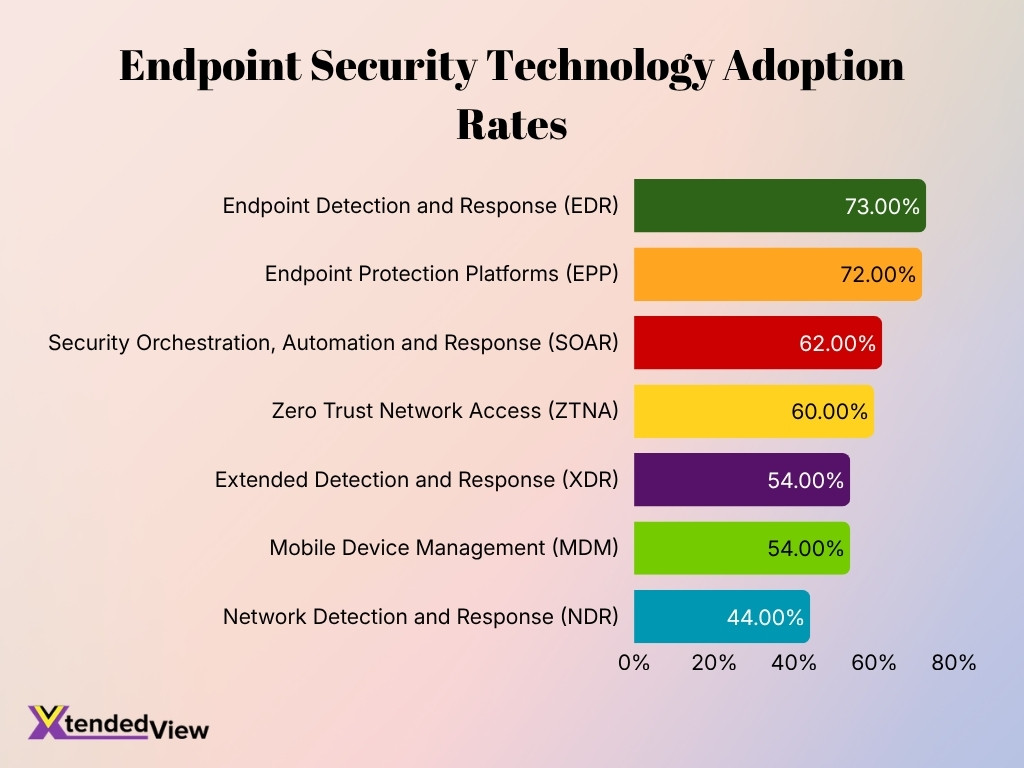
- A separate 2025 global survey of large organizations found 73% were using EDR, placing it among the most widely adopted endpoint protection technologies.
- Endpoint protection platforms were used by 72% of organizations in that same global survey, indicating substantial overlap between preventive and detection-focused endpoint technologies.
- Zero trust network access specifically for endpoints reached 60% adoption among surveyed large organizations.
- Extended detection and response reached 54% adoption, showing that more than half of surveyed large organizations had begun correlating endpoint signals with data from other security layers.
- Mobile device management also reached 54% adoption, reflecting the need to manage smartphones, tablets and other mobile endpoints alongside conventional PCs.
- Security orchestration, automation and response tools supported 62% of threat-response teams in 2025, compared with 61% in the previous survey.
- Network detection and response use stood at 44% in 2025, down from 47% a year earlier, while endpoint response adoption continued to rise.
- Only 3% of surveyed organizations said they could respond to confirmed threats within seconds in 2025, down from 8% the previous year.
- Another 40% could respond within minutes, while 38% needed hours to move from detection to scoping or containment.
Top Endpoint Security Vendors and Market Concentration
- More than 40 vendors competed in the endpoint security market in a 2025 competitive assessment, confirming that the sector remains crowded despite consolidation among market leaders.
- The five largest endpoint security vendors controlled a combined 52% of the market in 2024, up from 46.8% in 2023.
- Microsoft held 28.6% of the worldwide modern endpoint security market in 2024, compared with 25.8% the previous year.
- That represented a 28.2% annual growth rate for Microsoft’s modern endpoint security business under the referenced market methodology.
- CrowdStrike ranked second with 16.8% of the modern endpoint security market in the latest publicly disclosed vendor-share dataset.
- Broadcom accounted for approximately 6% of market revenue, placing it third under that modern endpoint security methodology.
- Trellix followed with a 5.9% market share, only 0.1 percentage point behind Broadcom.
- Sophos represented approximately 5% of the market, putting the five named leaders at roughly 62% under this separate modern endpoint methodology.
- A narrower 2025 cloud-based endpoint security model found the top 10 vendors controlled 17.23% of revenue, illustrating how market concentration changes substantially depending on product definition.
- Within that cloud-focused model, CrowdStrike held 2.11%, followed by Palo Alto Networks at 1.84%, SentinelOne at 1.81% and Trend Micro at 1.80%.
Frequently Asked Questions (FAQs)
The global endpoint security market is estimated at $17.79 billion in 2026, up from $16.25 billion in 2025 under one current market definition.
The market is projected to grow at a 9.6% CAGR from 2026 to 2031, reaching $28.06 billion by 2031.
North America accounted for 39.3% of global endpoint security revenue in 2025, making it the largest regional market under that estimate.
The endpoint detection and response market is projected at $7.23 billion in 2026, rising from $5.74 billion in 2025.
In a 2025 detection and response survey, 89% of respondents used EDR for threat response, up from 82% in 2024.
Conclusion
Endpoint security sits at the intersection of device protection, identity security, cloud defense, AI governance, and incident response. The latest global dataset analyzed 31,861 security incidents, including 22,625 confirmed data breaches, while third-party supply-chain involvement reached 48% of breaches. These figures demonstrate that protecting individual devices is no longer enough when attackers can move between endpoints, credentials, applications, networks, and external services during the same intrusion.
Organizations, particularly those operating large or distributed U.S. workforces, increasingly need accurate asset inventories, managed endpoint agents, EDR, strong identity controls, phishing-resistant authentication, timely patching, and clear governance for AI, SaaS, and BYOD use. Cloud-managed endpoint security and automated response are also becoming more important as attack speeds increase and security teams have less time to investigate suspicious activity manually.
The broader trend is toward integrated endpoint security rather than isolated defensive tools. Companies that connect endpoint telemetry with identity, cloud, and network signals can improve visibility, detect malicious behavior earlier, and contain compromised devices before attackers expand access. As endpoint numbers and attack techniques continue to grow, effective endpoint security will remain a central part of enterprise cybersecurity investment and risk management.
