



VPN use reflects a broader shift in how consumers and businesses think about online privacy, security, and access. Individuals use VPNs to reduce tracking, protect traffic on public Wi-Fi, access region-restricted content, and maintain privacy when browsing or shopping online. Businesses, meanwhile, continue to rely on VPNs for remote access, although many are now combining them with zero-trust, SASE, and identity-based security tools. Government restrictions, age-verification rules, and temporary platform bans have also triggered sharp spikes in VPN demand in several countries. As a result, VPN adoption now spans consumer privacy, remote work, streaming, censorship circumvention, and enterprise security, making it an important part of the global digital landscape.
Editor’s Choice
- 23% of global internet users aged 16 and older used a VPN for at least some online activities in Q2 2025.
- In the U.S., 32% of adults said they currently used a VPN in a June 2025 survey, down from 46% in the prior reported comparison.
- Worldwide VPN app downloads totaled approximately 412.5 million in 2025, down 11.1% from about 464.0 million in 2024.
- Russia recorded the highest survey-based usage rate among the countries reported in the Q2 2025 global dataset, at 50.3% of internet users.
- The U.S. TikTok shutdown on Jan. 19, 2025, triggered an 827% increase in VPN demand compared with the established baseline.
- UK VPN demand surged as much as 1,987% after age-verification requirements took effect in July 2025.
- Uganda produced one of 2026’s largest documented demand spikes, reaching 2,557% above baseline after internet access returned following a government-imposed shutdown.
- In May 2026, Iranian VPN demand climbed 934% when connectivity returned after an 88-day nationwide internet blackout.
- Among U.S. adults in 2025, VPN usage was highest among people ages 18 to 29, with nearly 40% reporting regular use.
- Men in the same U.S. research used VPNs at a 39% rate, compared with 30% among women.
Recent Developments
- In May 2026, VPN demand in Iran surged 934% above its previous baseline when internet connectivity returned after an 88-day nationwide blackout.
- Earlier in January 2026, Iranian VPN demand had already climbed as much as 579% as intermittent internet access returned following another nationwide shutdown.
- Uganda recorded a 2,557% VPN demand increase in January 2026 after authorities restored internet access following an election-related shutdown while major social platforms remained restricted.
- Australia recorded a 330% increase in VPN demand in March 2026 as new age-verification requirements for adult websites took effect.
- In July 2025, UK VPN demand initially jumped 1,327% on the day new age-verification requirements took effect and reached 1,987% above baseline two days later.
- Daily UK VPN users increased from about 650,000 before July 25, 2025, to more than 1.4 million at the mid-August peak. Usage later eased to roughly 980,000 by the end of 2025.
- France experienced a 570% peak increase in VPN demand on June 5, 2025, after new age-verification requirements affected access to adult websites.
- U.S. VPN demand jumped 827% on Jan. 19, 2025, when TikTok temporarily shut down its U.S. servers in response to the federal ban.
- India saw VPN demand rise 72% on May 8, 2025, amid restrictions on streaming content originating from Pakistan and broader cross-border online censorship.
- Turkey experienced a 188% increase in VPN demand on March 19, 2025, after restrictions affected X, YouTube, Instagram, and TikTok.
Global VPN Market Revenue Statistics
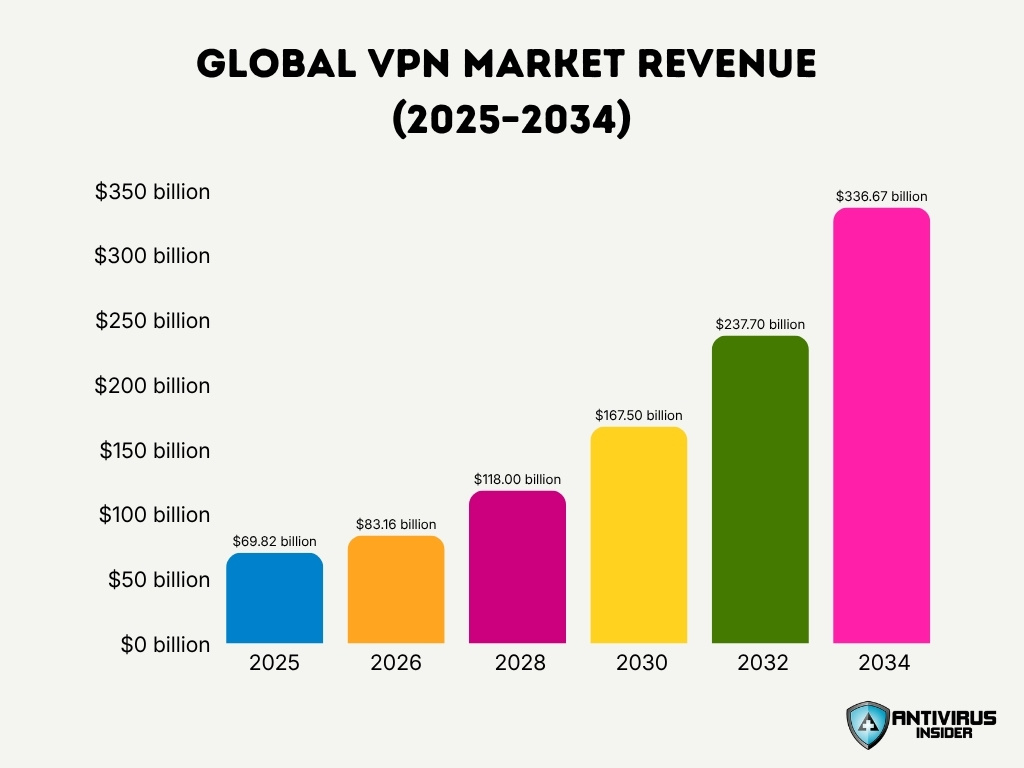
- The global VPN market is estimated to generate $69.82 billion in revenue in 2025, establishing a strong base for continued industry expansion.
- In 2026, global VPN market revenue is expected to reach $83.16 billion, an increase of about 19.1% from 2025.
- By 2028, the VPN market is projected to grow to approximately $118 billion, representing nearly 69% growth compared with 2025.
- Global VPN revenue could climb to $167.50 billion by 2030, making the market roughly 2.4 times larger than its 2025 level.
- By 2032, VPN market revenue is forecast to reach $237.70 billion, adding more than $167 billion compared with 2025.
- The market is projected to hit $336.67 billion by 2034, nearly 4.8 times its estimated 2025 market size.
- Between 2025 and 2034, the VPN industry is expected to add approximately $266.85 billion in annual market revenue, highlighting substantial long-term growth potential.
VPN Adoption Statistics by Country and Region
- Russia led the Q2 2025 survey-based country ranking at 50.3% of internet users, compared with the worldwide average of 23%.
- The United Arab Emirates ranked second in the same dataset at 38.9%, while Turkey reached 35.3%.
- Southeast Asia remained a strong VPN region: Indonesia recorded 31.4%, Vietnam 28.8%, Malaysia 27.8%, and Singapore 25.9%.
- Canada reached 28% VPN usage in Q2 2025, placing it ahead of the U.S. rate of 25.4% in the same global survey framework.
- India recorded 24.2% survey-based usage, slightly above the worldwide rate of 23%.
- In Western Europe, the Netherlands reached 26.3%, the UK 25.6%, Germany 24.2%, and France 21% in the Q2 2025 survey.
- Australia recorded a 26.2% VPN usage rate, putting it 3.2 percentage points above the global survey benchmark.
- Japan remained a comparatively low-usage market at 15.7%, while South Korea stood at 17.7% in the same Q2 2025 dataset.
- Download-based data tells a different story in the United Arab Emirates, where 2025 adoption reached 85.5%. This figure reflects VPN app downloads relative to population rather than the share of surveyed internet users who say they use a VPN.
- Download-based U.S. adoption reached 16.2% in 2025, with approximately 54.1 million downloads, down from 63.4 million downloads in 2024.
VPN Usage Demographics
- Nearly 40% of U.S. adults ages 18 to 29 reported regular VPN use in 2025, making them the most active age group in the survey.
- Usage declined with age and fell to just under 30% among Americans ages 60 and older.
- U.S. men reported a 39% VPN usage rate in 2025.
- U.S. women reported a 30% usage rate, producing a 9-percentage-point gender gap.
- Put another way, the reported usage rate among men was about 30% higher than the rate among women when comparing 39% with 30%.
- Globally, Q2 2025 research also found that VPN usage was higher among male internet users than female users across the measured age groups.
- Among U.S. adults overall, 32% currently used a VPN in the 2025 survey, giving context to the nearly 40% rate among the youngest adults.
- About 75% of Americans recognized what VPNs are in the 2025 survey, even though less than half of that overall population reported actually using one.
- Among U.S. non-users, 15% said they did not know enough about VPNs, suggesting that familiarity remains an adoption barrier alongside age and other demographic differences.
- Meanwhile, 18% of U.S. non-users said they did not see the benefit of a VPN, while 30% simply believed they did not need one.
VPN Usage by Device and Operating System
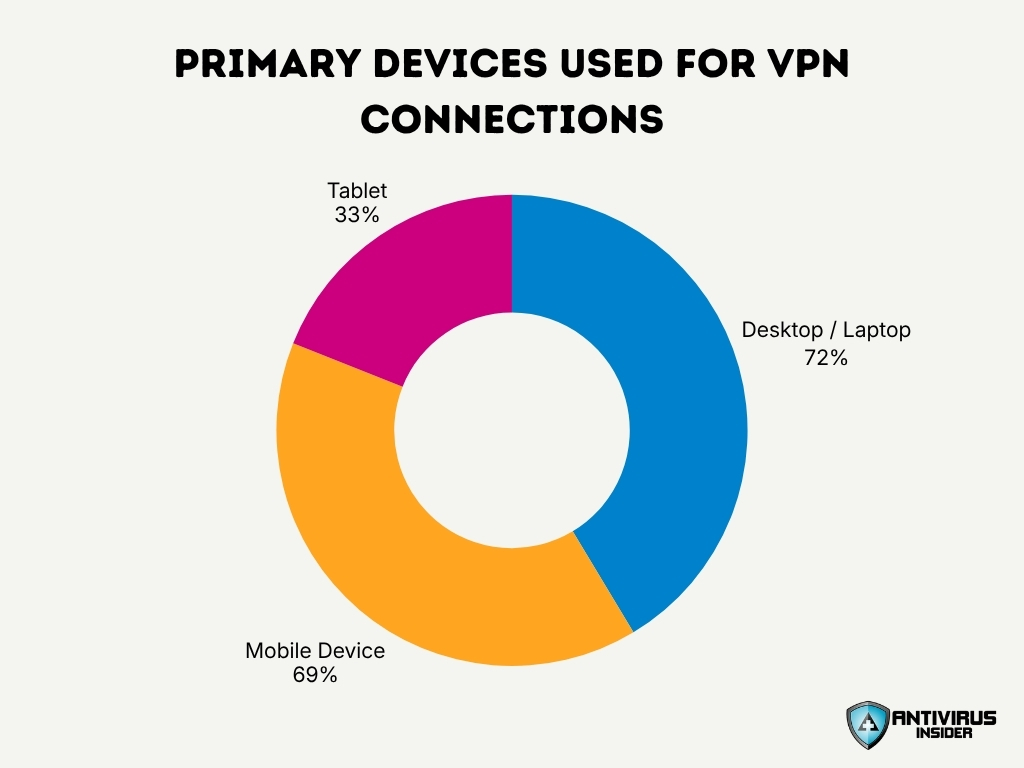
- Survey research found that 72% of desktop and laptop VPN users used VPNs on those computers, making PCs one of the most common device categories for VPN connections.
- 69% of surveyed VPN users reported using a VPN on a mobile device, only 3 percentage points behind desktops and laptops.
- 33% of users reported VPN use on tablets, substantially below both computer and smartphone usage.
- Operating-system-specific survey figures found VPN use among 52% of surveyed iOS users, compared with 37% among Android users.
- The 15-percentage-point difference between reported iOS and Android VPN use highlights how adoption can vary across mobile ecosystems.
- A UK consumer survey found VPNs installed on 63% of VPN users’ laptops, compared with 40% on smartphones, 33% on desktop computers, and 21% on tablets.
- Among those UK respondents, 21% used a desktop or laptop VPN more than once per day, while another 31% used one daily.
- Mobile VPN connections can be even more frequent for some users: 25% of UK respondents said they used a mobile VPN more than once per day.
- Recent research into younger users found that 66% of children who had ever used a VPN used one on a smartphone, compared with 40% on laptops and 31% on tablets.
- The same research found 19% used VPNs on game consoles and 15% on smart TVs, illustrating how VPN connections now extend beyond traditional computers and phones.
VPN Usage Among Remote Workers
- In a 2025 secure-access study of businesses with 20 to 500 employees, 71% of organizations reported using VPN solutions for secure remote access.
- Among U.S. consumers surveyed in 2025, 25% of VPN users said a job requirement was one reason they used a VPN, down from 39% in 2023.
- Only 8% of U.S. adults in the 2025 survey said they used a VPN exclusively for work, compared with 13% in 2023.
- A 2025 hybrid-work survey found that 38.2% of organizations used a traditional VPN as one of their remote-access solutions.
- Traditional VPNs served as the primary remote-access method for 19.1% of surveyed organizations, placing them behind SASE at 33.5%.
- SASE appeared somewhere in the remote-access stack at 62.5% of organizations, while virtual desktop infrastructure reached 42.6% and zero-trust network access reached 23.5%.
- Smaller companies with fewer than 1,000 employees recorded the highest primary VPN usage in that hybrid-work study, at 27.7%.
- In the 2025/2026 UK cybersecurity survey, 36% of businesses had a VPN rule or control for staff connecting remotely, up from 31% in 2024/2025.
- A broader organizational study found that 81% of businesses with a VPN required employees to use it when accessing company systems from outside the workplace.
- Across EU enterprises in 2024, 60.24% provided employees remote access to email, documents, and business applications, illustrating the scale of corporate demand for secure off-site connectivity even when organizations use technologies other than VPNs.
Business and Enterprise VPN Adoption Statistics
- 41% of organizations in a 2025 enterprise survey still used traditional VPNs to manage secure network access and connectivity.
- By comparison, 45% used identity and access management, 37% used SASE, and 34% used zero-trust network access.
- Peer-to-peer mesh VPN technology reached 27% of surveyed companies, highlighting the shift toward more distributed network architectures.
- Among small and midsize organizations surveyed in 2025, 71% used VPNs for secure remote access.
- Organizations in that study were 61% more likely to use VPNs than all other solutions when securing internet access.
- Nearly two-thirds of organizations not currently using a VPN expected to adopt one within 12 to 24 months, indicating that VPN adoption remains active even as zero-trust deployments expand.
- At the same time, 65% of organizations in another 2025 survey said they planned to replace VPN services within a year, showing that different business segments are moving in opposite directions.
- 81% of organizations in that security survey planned to implement zero-trust strategies within the following 12 months.
- An even larger 96% favored a zero-trust approach, suggesting that enterprises increasingly expect identity-based access controls to supplement or replace traditional VPN architecture.
- Among organizations that moved from VPN technology toward zero trust, 76% cited improved security and compliance as the primary advantage.
Global Enterprise VPN Market Share by Industry
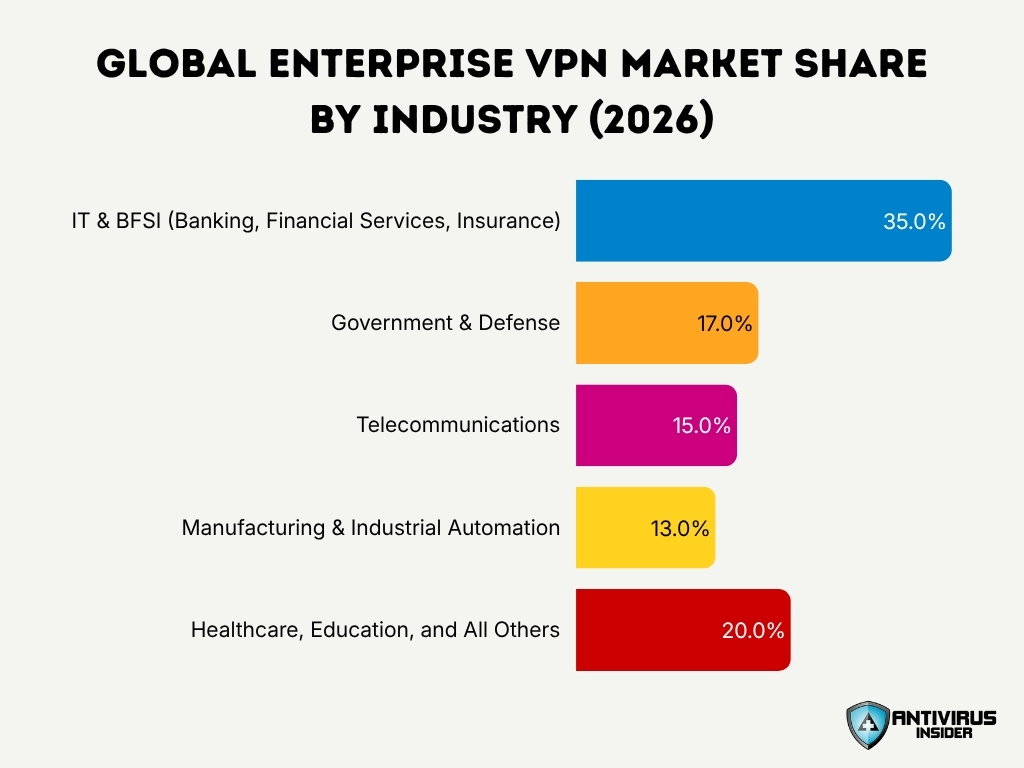
- IT & BFSI dominates the enterprise VPN market with a 35.0% share, making it the largest industry segment in 2026.
- Healthcare, education, and other industries collectively account for 20.0% of the enterprise VPN market.
- Government & defense represents 17.0% of the market, reflecting substantial enterprise VPN adoption across public-sector organizations.
- Telecommunications holds a 15.0% share, positioning it as another major contributor to enterprise VPN demand.
- Manufacturing & industrial automation accounts for 13.0% of the enterprise VPN market, the smallest share among the individually listed industry groups.
- Combined, IT & BFSI, government & defense, and telecommunications represent 67.0% of the enterprise VPN market in 2026.
VPN Usage for Streaming, Gaming, and Torrenting
- 23% of U.S. VPN users in 2025 said they used VPNs to access media unavailable in their country.
- The corresponding streaming and international-media figure reached 28% in 2023, meaning the 2025 rate was 5 percentage points lower.
- In 2022, 22% of users cited unavailable international media as a reason for VPN use, compared with 19% in 2021.
- Torrenting motivated 13% of U.S. VPN users in 2025, returning to the same level recorded in 2021.
- Torrent-related VPN usage had climbed to 21% in 2023, 8 percentage points above the 2025 result.
- Earlier device-level research found that 57% of mobile VPN users cited access to better TV, movies, and games, versus 54% of PC and laptop VPN users. Because this study predates the 2025 consumer survey, it works best as a historical device-use benchmark rather than a current market estimate.
- The same data showed only a 3-percentage-point gap between mobile and computer users in entertainment-related VPN use, suggesting entertainment has historically mattered across both device categories.
- International content access remained more common than torrenting in the 2025 U.S. survey, at 23% versus 13%, a 10-percentage-point difference.
- Compared with 2023, VPN use for international media declined about 18% on a relative basis, while the torrenting share fell approximately 38%.
- Taken together, the current consumer data shows that access to geographically limited streaming content remains a materially larger VPN use case than torrenting among U.S. users in 2025.
VPN Usage for Privacy, Public Wi-Fi, and Censorship
- 60% of U.S. VPN users cited general privacy in 2025, making it the largest individual motivation measured in the consumer survey.
- General security followed at 57%, only 3 percentage points behind privacy.
- Public Wi-Fi protection motivated 37% of VPN users, up from 34% in 2021.
- Preventing tracking by search engines and social networks accounted for 32% of users, versus 18% in 2021.
- Hiding browsing activity from an internet service provider motivated 21% of users in 2025.
- Privacy-related VPN demand can rise sharply when access restrictions change. In July 2025, UK VPN demand jumped 1,327% on the day new online age-verification rules came into effect and later peaked 1,987% above baseline.
- U.S. VPN demand rose 827% on Jan. 19, 2025, as users sought alternate access routes during TikTok’s temporary U.S. shutdown.
- Turkey experienced a 188% increase in VPN demand in March 2025 when access restrictions affected several major social and video platforms.
- In January 2026, VPN demand in Uganda surged 2,557% above baseline after internet access returned following an election-related shutdown while major online services remained restricted.
- Iran recorded a 934% VPN demand increase in May 2026 when connectivity returned following an 88-day nationwide internet blackout, illustrating how VPN demand can respond directly to censorship and connectivity controls.
Why People Use VPNs
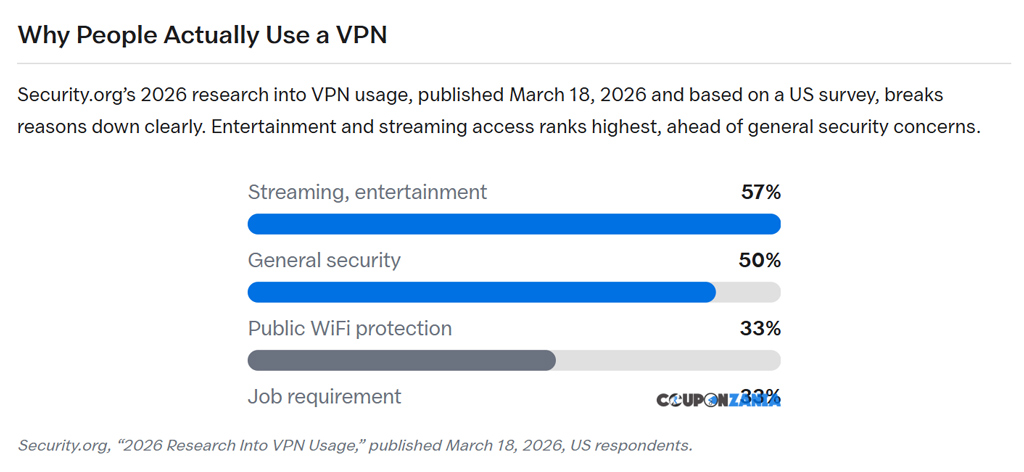
- Streaming and entertainment is the leading reason people use a VPN, cited by 57% of U.S. respondents.
- General security ranks second at 50%, showing that 1 in 2 respondents use VPNs to strengthen their online security.
- Public Wi-Fi protection motivates 33% of respondents, highlighting continued concern about security when using public networks.
- Job requirements account for 23% of VPN usage, meaning nearly 1 in 4 respondents use a VPN because their work requires it.
- Streaming and entertainment leads general security by 7 percentage points, suggesting that content access now slightly outweighs security as a VPN use case.
- Overall, the findings show that VPN adoption serves a mix of entertainment, cybersecurity, public Wi-Fi protection, and workplace needs.
Free vs. Paid VPN Usage Statistics
- 28% of U.S. VPN users relied on free VPN services in the 2025 consumer survey.
- That means roughly 72% used something other than a free-only service, although this group can include employer-funded and otherwise bundled VPN access.
- Earlier survey research found 64% of VPN users had paid access through their own subscription, their organization, or a combination of both.
- Within that earlier payment breakdown, 26% personally paid for their VPN subscription.
- Another 25% received VPN access through their organization, showing the role employers play in funding secure connectivity.
- 13% shared the cost through a combination of personal and organizational payments in that study.
- Approximately 30% used a free VPN in the earlier research, close to the 28% recorded in the more recent 2025 U.S. survey.
- Among U.S. consumers who paid for VPN service in 2025, the median monthly cost was $10, with most subscriptions ranging from roughly $2 to $15 per month depending on plan length and features.
- More than half of VPN users reported slow internet speeds, with free VPN users disproportionately affected by performance limitations.
- Cost still limits adoption: among U.S. adults who did not use VPNs in 2025, 14% said VPNs were too expensive, while 30% said they did not need one and 18% saw no benefit.
VPN Subscription and Pricing Statistics
- Across a broad 2026 pricing comparison, the average rolling VPN subscription costs $11.79 per month.
- The average one-year VPN plan costs about $4.82 per month, or $57.84 over a year, based on the same comparison.
- Two-year plans average $3.81 per month, with an average total commitment of approximately $91.44.
- Three-year VPN subscriptions average about $3.32 per month, reducing the effective monthly price further for users willing to make a longer commitment.
- A separate January 2026 analysis of more than 30 paid VPN services calculated an average $11.15 monthly price for rolling subscriptions.
- In that study, longer-term plans averaged $3.87 per month, or $46.44 per year when expressed as an annual equivalent.
- Signing up for a longer-term plan produced an average 65% saving relative to the rolling monthly price in the same 2026 analysis.
- Most rolling monthly VPN subscriptions in that dataset fell between $9 and $15 per month, showing how tightly many mainstream services cluster at the monthly level.
- The lowest long-term introductory pricing observed in that analysis reached approximately $1.11 per month, although the full subscription period normally requires payment upfront.
- Another 2026 comparison placed average one-year VPN pricing at about $51.85 annually and average two-year pricing at roughly $81.85 for the full two-year term.
VPN Market Size and Growth Statistics
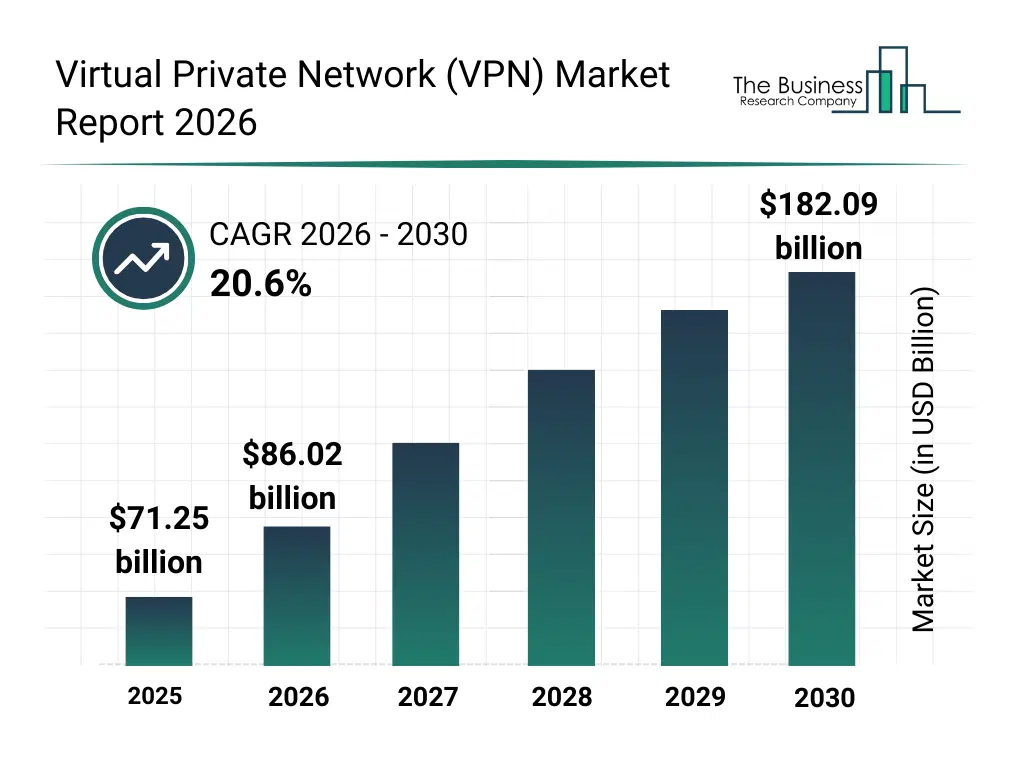
- The global Virtual Private Network (VPN) market was valued at $71.25 billion in 2025.
- The VPN market is projected to reach $86.02 billion in 2026, representing strong year-over-year expansion.
- Between 2026 and 2030, the VPN market is expected to grow at a robust 20.6% CAGR.
- Based on the stated growth rate, the market could increase to approximately $103.74 billion in 2027 and $125.11 billion in 2028.
- By 2029, the global VPN market is estimated to surpass $150 billion, reaching approximately $150.89 billion.
- The VPN market is forecast to hit $182.09 billion by 2030, more than 2.5 times its 2025 market size.
- Overall, the market is projected to add roughly $110.84 billion in value between 2025 and 2030.
VPN Security, Privacy, and Data Breach Statistics
- 56% of organizations surveyed in 2025 reported at least one cyberattack in the previous year that exploited security vulnerabilities in VPN servers.
- Within the same sample, 27% experienced two or three VPN-related attacks during the previous 12 months.
- Another 6% experienced four or five attacks, showing that repeated exploitation affected a meaningful subset of organizations.
- 8% reported more than five VPN-related incidents in a single year.
- Analysis of VPN vulnerabilities found that reported VPN CVEs increased 82.5% between 2020 and 2024.
- Roughly 60% of VPN vulnerabilities identified in the latest full-year portion of that analysis carried high or critical severity scores.
- 93% of surveyed organizations expressed concern that third-party VPN connections could introduce backdoor vulnerabilities.
- 71% of respondents ranked attacker lateral movement among their top VPN-related concerns once unauthorized access reaches an internal environment.
- A 2026 cyberinsurance analysis found VPN access accounted for 73% of ransomware initial-entry vectors in 2025, up from 66% in 2024 and 38% in 2023 within its claims dataset.
- The same 2026 claims analysis found that one in three ransomware claims began through SonicWall infrastructure, highlighting the concentration risk created when attackers focus on widely deployed remote-access technology.
VPN Performance and Speed Statistics
- A July 2026 test of 59 VPNs found that paid services produced an average 7% download-speed loss on nearby servers.
- The same testing recorded an average 16% download-speed loss on long-distance connections, more than twice the nearby-server penalty.
- WireGuard generated approximately 4.53% protocol overhead, the lowest among the major protocols included in one 2026 comparison.
- IKEv2/IPSec produced approximately 7.88% overhead in the same controlled testing.
- OpenVPN UDP increased data overhead by about 17.23%, substantially above WireGuard.
- OpenVPN TCP produced approximately 19.96% overhead, making it the heaviest of the major protocols compared in the test.
- A February 2026 laboratory comparison found that all 12 VPNs tested kept download-speed losses below 10%, compared with roughly 40% average losses when similar testing began in 2018.
- The fastest download result in that test showed only a 3.17% reduction, falling from a 94.46 Mbps baseline to 91.47 Mbps.
- The best upload result produced only a 4.08% decrease, maintaining 90.66 Mbps from a 94.52 Mbps baseline.
- Mobile testing published in July 2026 found that VPN encryption can increase cellular data consumption by up to 20%, making protocol efficiency relevant for users with capped mobile plans.
VPN Provider Market Share and Popular Services
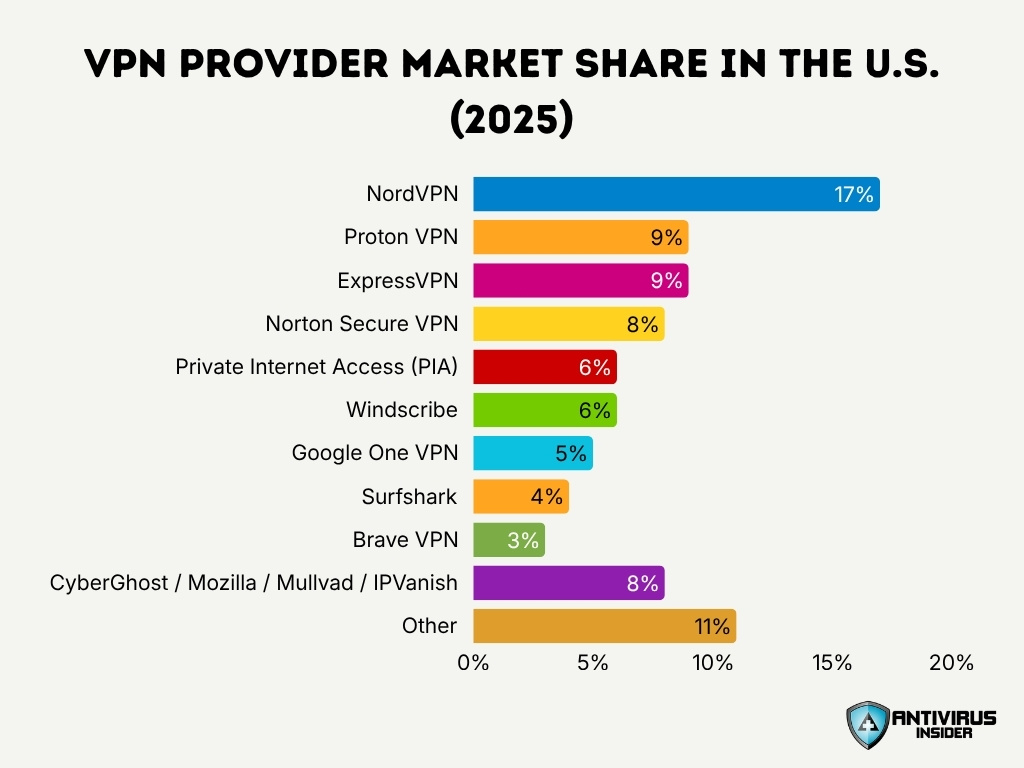
- 17% of surveyed U.S. VPN users reported using NordVPN in 2025, the largest individual share recorded in the survey.
- Proton VPN accounted for 9% of users, down from 13% in the comparable 2023 survey.
- ExpressVPN also reached 9% in 2025, up from 8% two years earlier.
- Norton Secure VPN reached 8% of surveyed users, compared with 6% in 2023.
- Private Internet Access represented 6% of users in 2025, one percentage point below its 2023 result.
- Windscribe doubled its recorded share from 3% in 2023 to 6% in 2025.
- Google One VPN accounted for 5% of responses in 2025, compared with 9% in 2023.
- Surfshark captured approximately 4% of surveyed U.S. VPN users, compared with 5% in the previous comparison period.
- Brave VPN represented 3% of users, while Mozilla VPN, CyberGhost, Mullvad VPN, and IPVanish each held 2% in the 2025 survey.
- Another 11% selected VPN services outside the individually listed brands, reinforcing how fragmented the consumer market remains.
VPN Adoption Trends and Future Outlook
- A 2026 market forecast expects the global VPN industry to add approximately $75.07 billion in market value between 2025 and 2030.
- That forecast places expected industry growth at an 18.4% CAGR through 2030, driven partly by hybrid work and secure remote connectivity.
- North America is projected to account for 31.3% of forecast market growth in that 2026-2030 assessment.
- The MPLS VPN segment alone was valued at $22.03 billion in 2024, showing the continuing scale of enterprise networking alongside consumer VPN services.
- Among organizations assessed in 2025, 90% reported at least one limitation with their existing VPN or network-access setup.
- 35% identified latency or speed problems as a significant limitation of their existing VPN infrastructure.
- High operational overhead affected 34% of organizations, creating another incentive to move remote-access management toward cloud-delivered platforms.
- Integration challenges affected 28% of respondents, while 25% said their current access environment struggled to scale.
- 24% reported throughput limitations, illustrating that enterprise VPN modernization depends on performance as well as security.
- Another 19% said existing VPN or network-access technology was incompatible with cloud or hybrid environments, reinforcing the shift toward architectures designed around distributed applications and workers.
Frequently Asked Questions (FAQs)
The global VPN market is estimated at $86.02 billion in 2026, up from $71.25 billion in 2025.
The global VPN market is projected to grow at a 20.6% CAGR from 2026 to 2030, reaching about $182.09 billion.
VPN demand in Uganda peaked at 2,557% above baseline in January 2026 after internet access returned following a government-imposed shutdown.
Downloads of major VPN apps in India rose 49%, from about 139,000 to 208,000 per day, when Telegram access was restricted in June 2026.
The site-to-site VPN market is forecast to reach $27.46 billion by 2030, up from $16.83 billion in 2026, at a 13% CAGR.
Conclusion
VPN statistics show a market that remains widely used but is changing in both purpose and technology. Consumers continue to rely on VPNs for privacy, safer public Wi-Fi connections, streaming access, and reduced online tracking, while businesses are reassessing how traditional VPNs fit into modern security strategies. At the same time, faster protocols such as WireGuard are reducing performance losses, and growing concerns around VPN vulnerabilities are pushing organizations toward tighter identity controls and zero-trust architectures.
Market forecasts also point to continued revenue growth through the end of the decade, even as enterprise buyers shift toward more integrated security platforms. Overall, VPNs are unlikely to disappear, but their role is evolving from a stand-alone privacy or remote-access tool into one layer within a broader security and access framework.
