



Digital wallets have become a core part of how consumers pay for groceries, shop online, transfer money, and manage financial accounts. At the same time, fraudsters have shifted their attention toward mobile payment ecosystems, using phishing, account takeover, synthetic identities, and AI-powered scams to exploit users and merchants. These trends affect industries ranging from retail and banking to fintech and e-commerce, making fraud prevention a top priority. Explore the statistics below to understand how digital wallet fraud is evolving.
Editor’s Choice
- More than 116 billion online transactions were analyzed in the latest global cybercrime study covering 2025, revealing an 8% increase in global fraud attacks compared with the previous year.
- First-party fraud accounted for 38.3% of all reported fraud globally in 2025, making it the largest fraud category for the second consecutive year.
- Account takeover (ATO) represented 27.2% of reported fraud cases worldwide during 2025, remaining one of the biggest threats to digital wallets.
- Synthetic identity fraud increased to 11% of reported fraud cases in 2025, overtaking true identity theft in many digital financial environments.
- 26% of consumers reported losing money to digital fraud during the previous year, highlighting the growing financial impact on individuals.
- 37% growth in suspected account takeover fraud was recorded between 2024 and 2025, reflecting increasingly sophisticated credential-based attacks.
- Digital wallets represented 13% of total fraud losses in North America during 2025, while cards and wallets together accounted for 41% of regional payment fraud losses.
- AI-generated deepfake attacks increased by 180% year over year, creating new risks for digital identity verification and wallet onboarding in 2026.
Recent Developments
- The latest cybercrime analysis found that fraudsters increasingly target e-commerce and digital payment ecosystems, contributing to an 8% rise in global fraud rates during 2025.
- AI-generated identities have become a major concern, with organizations reporting rapid growth in synthetic identity fraud across digital financial services.
- Identity verification providers observed a 180% annual increase in deepfake-related attacks entering digital onboarding processes during 2026.
- Researchers estimate that organizations worldwide will perform 100.4 billion digital identity verification checks in 2026, increasing the importance of automated fraud screening.
- Approximately 1 in every 100 failed identity verification attempts now contains a deepfake document, image, or liveness video.
- Password reset workflows have become a prime attack surface, with 11% of reset attempts in 2024 identified as fraudulent, rising to 27% on desktop devices.
- Financial institutions increasingly report first-party fraud replacing traditional scams as the most common fraud category, driven partly by economic pressures and changing consumer behavior.
- A 2026 assessment identified mobile banking and digital wallet fraud among the most significant financial fraud categories by both victim volume and monetary losses across reporting jurisdictions.
Digital Wallet Fraud Overview
- Digital wallet fraud commonly involves account takeover, phishing, synthetic identities, friendly fraud, and payment scams, according to global fraud monitoring reports.
- First-party fraud increased from 36% in 2024 to 38.3% in 2025, making it the leading fraud category worldwide.
- Third-party account takeover remained the second-largest reported fraud category, accounting for more than 27% of reported fraud incidents in 2025.
- Synthetic identity fraud more than doubled its share over recent years and now exceeds the proportion of true identity theft in many digital financial systems.
- Fraudsters increasingly combine stolen credentials with AI-generated identities to bypass traditional verification systems used by wallet providers.
- Consumer confidence depends heavily on security, with 77% of consumers saying protection of personal data is the most important factor when choosing where to transact online.
- Fraud attacks increasingly target the identity lifecycle rather than payment processing alone, shifting investments toward identity intelligence and behavioral analytics.
- Mobile wallets now rank among the leading financial fraud categories identified by regulators monitoring consumer financial risks globally.
Most Common Digital Wallet Fraud Types
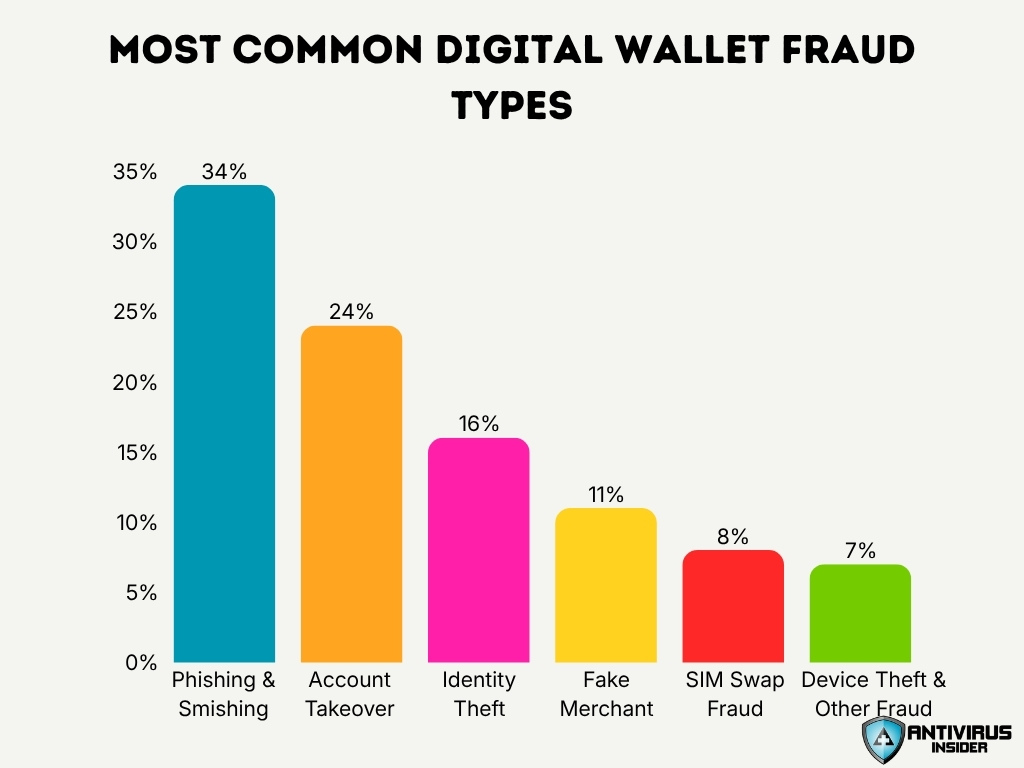
- Phishing and smishing are the most common digital wallet fraud types, accounting for an estimated 34% of reported cases.
- Account takeover fraud represents 24% of incidents, making it the second-largest threat to digital wallet users.
- Together, phishing, smishing, and account takeover contribute 58% of all estimated digital wallet fraud cases.
- Identity theft accounts for 16%, showing that stolen personal information remains a major risk in digital payments.
- Fake merchant and payment scams represent 11% of fraud, often targeting users through deceptive sellers, websites, or payment requests.
- SIM swap fraud makes up 8% of cases, allowing criminals to intercept verification codes and access digital wallet accounts.
- Device theft and other fraud types account for the remaining 7%, the smallest share among the listed categories.
- The top three fraud categories; phishing and smishing, account takeover, and identity theft, collectively represent 74% of estimated digital wallet fraud.
Digital Wallet Fraud Trends
- Fraud organizations increasingly deploy AI-generated identities and automated bots to attack digital payment platforms at scale.
- Identity-focused fraud has overtaken many traditional payment fraud methods as criminals exploit weaknesses during account creation and authentication.
- 8.3% of digital account creation attempts were suspected of fraud during 2025, representing the highest-risk stage in the customer lifecycle.
- Suspected account takeover fraud increased by 37% between 2024 and 2025.
- 33% of consumers targeted by digital fraud during the previous three months reported phishing as the attack method.
- U.S. data breach volume increased 47% from 2024 to 2025, creating additional opportunities for credential-based wallet attacks.
- Fraud detection increasingly relies on behavioral analytics, device intelligence, and AI rather than passwords alone because credential theft continues to grow.
- Economic uncertainty continues to increase opportunistic fraud, particularly first-party fraud targeting digital payment and wallet providers.
Mobile Wallet Fraud Statistics
- Mobile transactions involving digital wallets and P2P payments now account for 33% of total ecommerce fraud costs in the US.
- In Canada, the financial impact is even higher, with digital wallets representing 41% of all ecommerce fraud costs.
- Global digital payment fraud losses reached $48 billion in 2025 and are projected to skyrocket to $107 billion by 2029.
- Mobile fraud sessions spiked by 67% between late 2025 and mid-2026, reflecting a massive shift toward mobile attack channels.
- This recent surge in mobile wallet attacks includes an 86% increase on iOS devices and a 35% rise on Android platforms.
- Despite a general decrease in mobile retail sales, global mobile fraud losses continue to rise by 19% year-over-year.
- Quishing, or the use of fraudulent QR codes to bypass mobile wallet security, experienced a rapid growth of 51% in 2025.
- Businesses adopting advanced biometric mobile wallet technology report a 34% drop in payment fraud compared to traditional security measures.
Most Targeted Fraud Frontiers
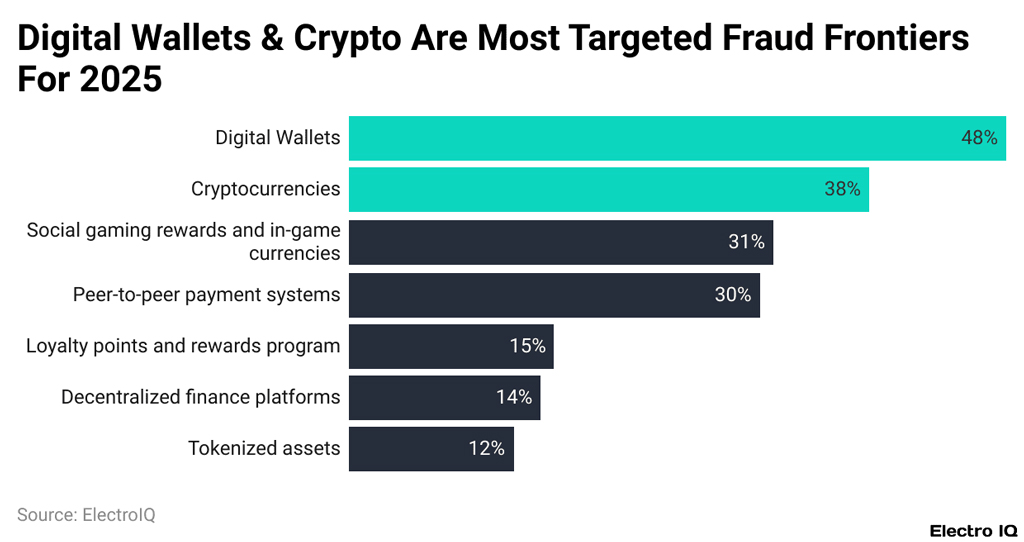
- Digital wallets rank as the most targeted fraud frontier, cited by 48% of respondents, highlighting growing security risks as wallet adoption increases.
- Cryptocurrencies follow in second place at 38%, showing that crypto transactions and accounts remain major targets for fraudsters.
- Social gaming rewards and in-game currencies account for 31%, indicating that virtual economies are becoming increasingly attractive to cybercriminals.
- Peer-to-peer payment systems are targeted by 30%, placing them only 1 percentage point behind gaming rewards and currencies.
- The targeting rate for digital wallets is 10 percentage points higher than cryptocurrencies, emphasizing their position as the leading fraud concern.
- Loyalty points and rewards programs register 15%, suggesting that stored rewards and redeemable balances are also vulnerable to fraudulent activity.
- Decentralized finance platforms account for 14%, reflecting persistent security concerns surrounding smart contracts, wallets, and decentralized transactions.
- Tokenized assets rank lowest at 12%, although their inclusion shows that fraud risks are spreading across emerging digital asset categories.
- The combined findings show that payment and currency-related platforms dominate the fraud landscape, with the top four categories recording targeting rates of 30% or more.
- The gap between the highest and lowest-ranked categories is 36 percentage points, with digital wallets at 48% compared with tokenized assets at 12%.
Digital Payment Fraud Losses
- Global businesses estimate fraud costs at 7.7% of annual revenue, highlighting the financial burden that digital payment fraud places on merchants and financial institutions.
- Scams and authorized payment fraud accounted for 24% of reported fraud losses worldwide in 2025, making them the largest fraud category for businesses.
- Synthetic identity fraud represented 20% of global fraud losses reported by organizations during the same period.
- Account takeover (ATO) generated 20% of global business fraud losses, underscoring the importance of securing digital wallet credentials.
- In the U.S., account takeover caused 31% of all reported fraud losses among businesses, making it the most expensive fraud type.
- U.S. consumers who lost money to digital fraud most frequently reported stolen credit card or fraudulent charges (33%), followed by identity theft (29%) and account takeover (27%).
- Digital fraud affected 26% of consumers globally during the previous year, demonstrating that payment fraud continues to impact millions of wallet users.
- Nearly 30% of scam victims in the U.S. said their fraud incident started on social media, resulting in $2.1 billion in reported losses during 2025.
Digital Wallet Account Takeover Statistics
- The suspected account takeover fraud rate increased 37% between 2024 and 2025 across digital platforms.
- Account takeover represented 20% of global fraud losses reported by organizations during 2025.
- In the U.S., businesses identified account takeover as the source of 31% of fraud losses, the highest share among all fraud categories.
- Financial institutions reported that account takeover incidents affecting payment channels increased 7% year over year.
- 23% of surveyed financial institutions experienced growing account takeover activity targeting payment accounts.
- Account takeover through phishing, smishing, and vishing ranks as one of the primary mechanisms behind mobile banking and digital wallet fraud.
- Fraud intelligence indicates attackers increasingly combine credential stuffing, phishing, and AI-assisted impersonation to compromise digital wallet accounts.
- Identity-based attacks now occur throughout the customer lifecycle rather than only during login, increasing long-term account takeover risks.
Leading Causes of Digital Wallet Fraud
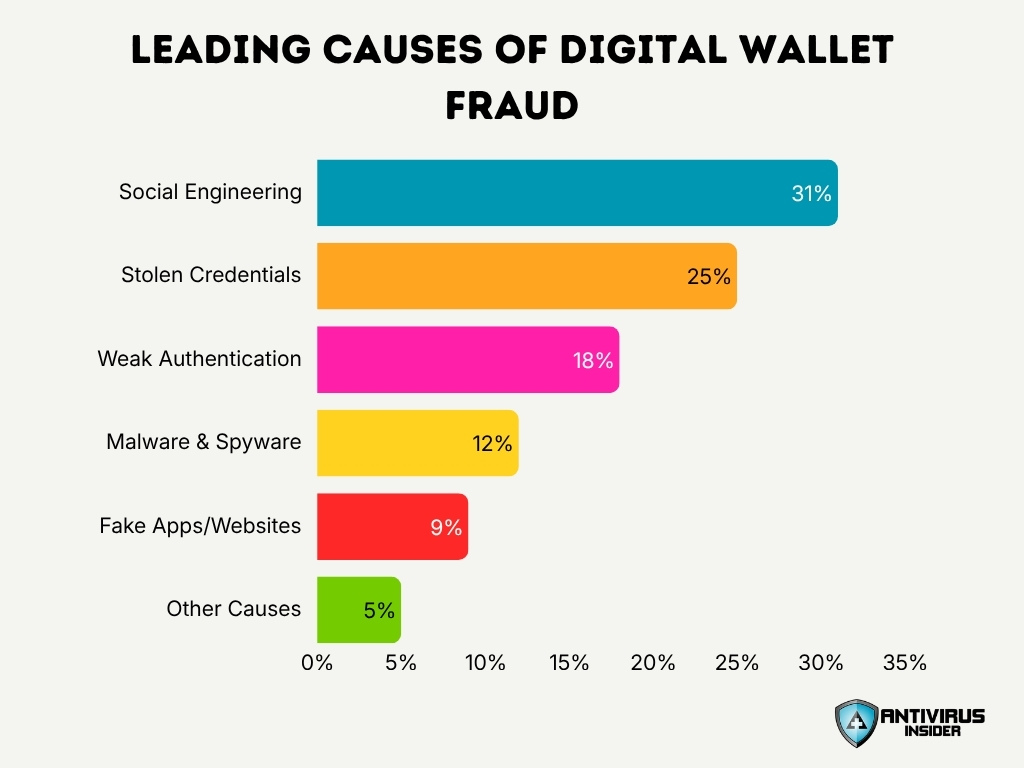
- Social engineering is the leading cause of digital wallet fraud, accounting for 31% of reported cases.
- Stolen credentials represent 25% of incidents, showing how compromised passwords and login details remain a major security risk.
- Weak authentication contributes 18% of digital wallet fraud, highlighting the need for stronger login and verification methods.
- Malware and spyware are responsible for 12% of cases, often allowing criminals to capture sensitive payment and account information.
- Fake apps and websites account for 9% of fraud, commonly tricking users into entering wallet credentials on fraudulent platforms.
- Other causes make up the remaining 5%, indicating that smaller and emerging fraud methods still pose a measurable threat.
- Together, social engineering and stolen credentials account for 56% of digital wallet fraud, making user manipulation and credential theft the dominant risk factors.
Phishing and Smishing Fraud Statistics
- 33% of consumers targeted by digital fraud in the last three months reported experiencing a phishing attack, making it the most common attack method.
- Phishing, smishing, and vishing rank among the most significant financial fraud categories by both victim count and financial losses.
- Among U.S. consumers who lost money to digital fraud, 17% attributed their losses to phishing emails.
- 15% of U.S. digital fraud victims reported financial losses from smishing, or fraudulent SMS messages.
- 13% of U.S. victims reported losing money after vishing, or voice phishing, attacks.
- Globally, 20% of consumers who lost money to digital fraud cited phishing as the attack method.
- Globally, 23% of victims reported financial losses from vishing scams.
- Fake payment requests delivered through email, SMS, and messaging apps continue to drive account takeover and digital wallet fraud across financial services.
Credential Theft and Credential Stuffing Statistics
- 47% year-over-year growth in credential stuffing attacks was observed in 2025, expanding the pool of compromised accounts.
- Stolen credentials served as the initial access vector in 22% of confirmed corporate data breaches globally.
- Over 1.95 billion malware combo-list credential exposures were indexed globally throughout the calendar year of 2025.
- Account takeover attacks surged by 250% in 2024, heavily fueled by automated credential stuffing and seasonal traffic.
- Approximately 31% of all malware-sourced credentials now contain active session cookies to bypass multi-factor authentication.
- A staggering 97% of identity attacks operate as password spray attempts, averaging over 7,000 attacks per second.
- Phishing-resistant authentication deployments have been linked to a 99% reduction in credential-related account takeovers.
- Credential stuffing volume against consumer login endpoints spiked by 148% year-over-year by the end of 2025.
- The average compromised device yielded 87 stolen credentials that spanned corporate applications and personal cloud services.
- Nearly 65% of bot requests and 64% of authorization requests utilize leaked credentials to infiltrate digital networks.
Social Engineering Fraud Statistics
- Scams and authorized fraud represented 24% of reported business fraud losses worldwide during 2025.
- Nearly 30% of scam victims in 2025 stated their losses began through social media platforms.
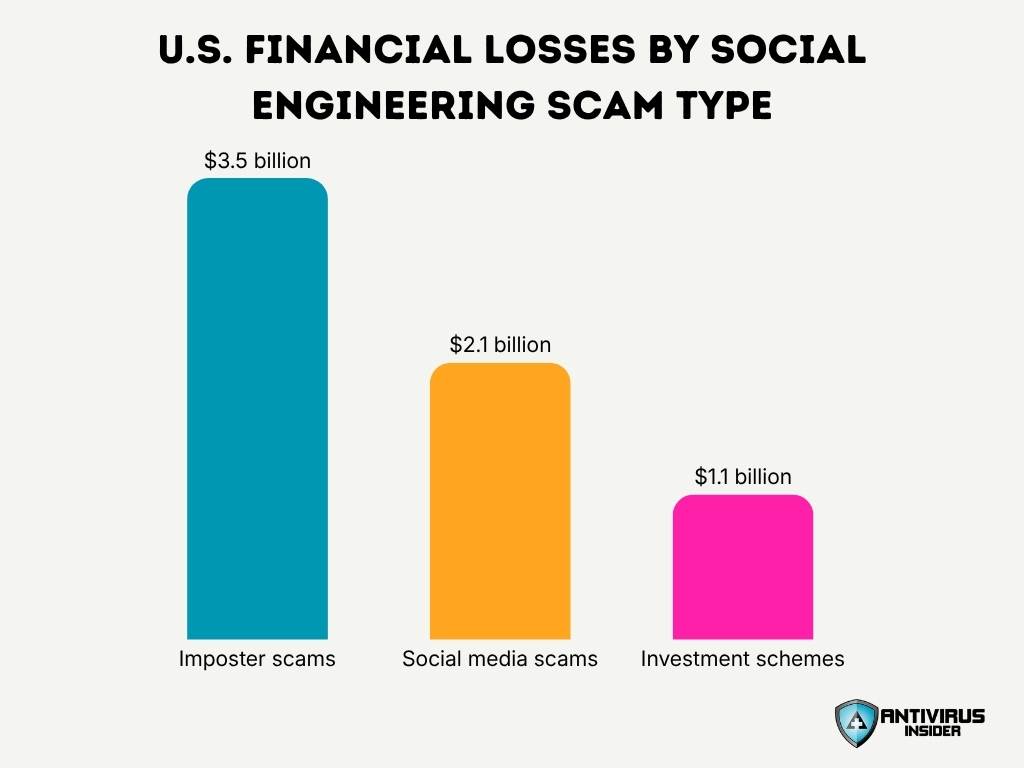
- Reported U.S. losses from scams originating on social media reached $2.1 billion in 2025.
- Total financial losses from social media scams have seen an eightfold increase since 2020.
- Consumers reported losing a staggering $3.5 billion directly to imposter scams throughout 2025.
- A significant 36% of all cybersecurity incident response cases in 2025 began with a social engineering tactic.
- The average financial cost of a data breach initiated by a phishing attack reached $4.8 million.
- Approximately 60% of all confirmed network breaches involve a human element such as psychological manipulation.
- Fraudulent investment schemes promoted on social platforms accounted for $1.1 billion in total financial losses.
Identity Theft in Digital Wallets
- Identity theft accounted for 29% of financial losses reported by U.S. consumers affected by digital fraud.
- Globally, 21% of consumers who lost money to digital fraud reported identity theft as the cause.
- Synthetic identity fraud represented 20% of global business fraud losses during 2025.
- Synthetic identities currently drive over 80% of new account fraud cases involving digital onboarding.
- AI-generated deepfakes now account for 40% of all biometric fraud attempts against verification systems.
- Digital document forgeries linked to identity theft surged by an alarming 244% year-over-year.
- Approximately 71% of banks prioritize digital ID verification to actively combat digital wallet fraud.
- Existing account takeovers constitute 61% of reported identity misuse preceding unauthorized digital transfers.
Peer-to-Peer Payment Fraud Statistics
- $12.5 billion was lost to fraud in 2024, representing a 25% increase over the prior year.
- Scams affecting ACH and instant payment channels reported a 176% increase in financial losses.
- Wire fraud operations enabled the Recovery Asset Team to freeze over $561.6 million in 2024.
- Fraudulent transfers often rely on urgency and fear, exploiting predictable human behavior to execute scams.
- Consumers 19 and younger were more than twice as likely to report a loss to a scam as those 80 and older.
- Nearly two-thirds of consumers who disputed a Zelle payment as fraud at major banks were not reimbursed.
- Business email compromise (BEC) generated $3.04 billion in reported losses in 2025 alone.
- Experts urge institutions to enhance monitoring via AI, machine learning, and behavioral biometrics to identify fraud in real-time.
Fraud Across Digital Payment Channels
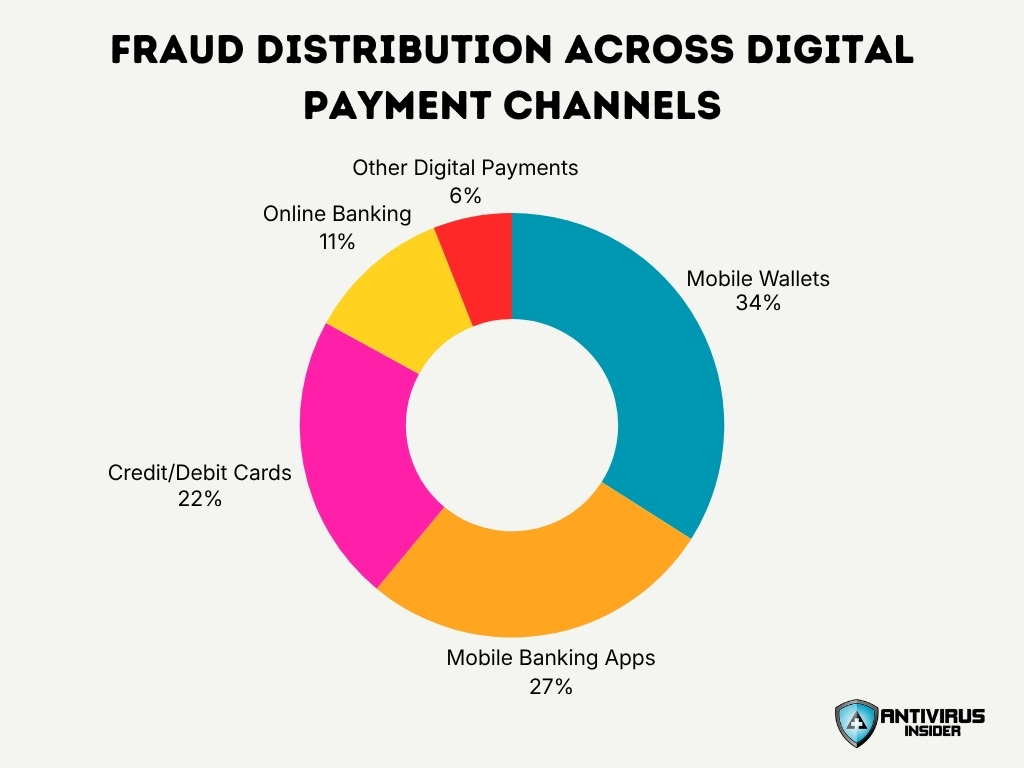
- Mobile wallets are the most targeted digital payment channel, accounting for 34% of the total fraud risk distribution.
- Mobile banking apps rank second at 27%, showing that app-based financial services remain a major target for cybercriminals.
- Together, mobile wallets and mobile banking apps represent 61% of fraud risk, highlighting the growing security challenges across mobile payment platforms.
- Credit and debit cards account for 22% of fraud risk, making traditional card payments the third most targeted channel.
- Online banking represents 11% of the fraud distribution, which is less than half the risk level reported for mobile banking apps.
- Other digital payment methods contribute the remaining 6%, indicating a comparatively lower but still notable fraud exposure.
- The data shows that fraud is increasingly concentrated in mobile-first payment channels, where convenience, high transaction volumes, and weak user security practices can create additional vulnerabilities.
Fake Merchant Scam Statistics
- In 2025, more than 40% of people who lost money through a social media scam said the incident involved a shopping offer. Many ads directed buyers to unfamiliar websites or pages impersonating established brands.
- Nearly 30% of reported scam victims in 2025 said the fraud started on social media, where fake merchants can reach consumers through targeted advertisements and marketplace listings.
- Social media scams generated $2.1 billion in reported consumer losses during 2025, eight times the amount reported in 2020.
- U.S. consumers reported approximately $16 billion in total fraud losses in 2025, up about 25% from the $12.5 billion reported for 2024.
- Business and government impersonation scams caused $3.5 billion in reported losses in 2025, nearly triple the 2020 total. Fake sellers often use similar impersonation methods to establish trust.
- Consumers reported losing nearly $1 billion to business impersonators in 2025, with financial institution impersonation producing the highest losses within the category.
- In 2024, scams that began through websites, apps, social media, or online advertisements generated more than $3 billion in reported losses, compared with about $1.9 billion for scams initiated through calls, emails, and text messages.
- Between January and September 2025, more than 44,000 consumers received £2 million through chargebacks linked to scams, fake websites, imitation products, and unauthorized subscriptions.
- One financial institution’s detection data showed that monthly fake-merchant discoveries increased from approximately 45 in early 2025 to 90 by the third quarter, before reaching 102 in October.
Chargeback Fraud Statistics
- Global chargeback volume was projected to reach 261 million cases in 2025, reflecting the growth of digital purchases, subscription billing, and card-not-present transactions.
- Worldwide chargeback volume could rise to 324 million cases by 2028, an increase of roughly 24% from the 2025 projection.
- European chargeback volume could increase by 27% between 2025 and 2028, creating additional dispute-management costs for merchants and payment providers.
- The worldwide cost of chargebacks to merchants could reach $42 billion by 2028, with almost half of those disputes expected to involve fraudulent activity.
- Digital purchases now account for 63% of merchant transaction volume, increasing merchants’ exposure to remote-payment disputes and first-party misuse.
- 72% of e-commerce merchants reported that friendly fraud increased during 2024, while estimates placed its contribution at 40% to 80% of total fraud losses.
- Between 40% and 50% of friendly fraud offenders may submit another illegitimate dispute within 60 days, making repeat behavior a major chargeback risk.
- A 2024 consumer survey found that 43% of respondents admitted committing first-party fraud, including disputing transactions they had authorized.
- Among consumers who acknowledged first-party fraud, 60% cited financial hardship as a factor behind their actions.
- The average global merchant chargeback and dispute win rate stood at 17.1% in 2025, compared with 17.4% in 2024.
Digital Wallet Fraud Prevention Technologies
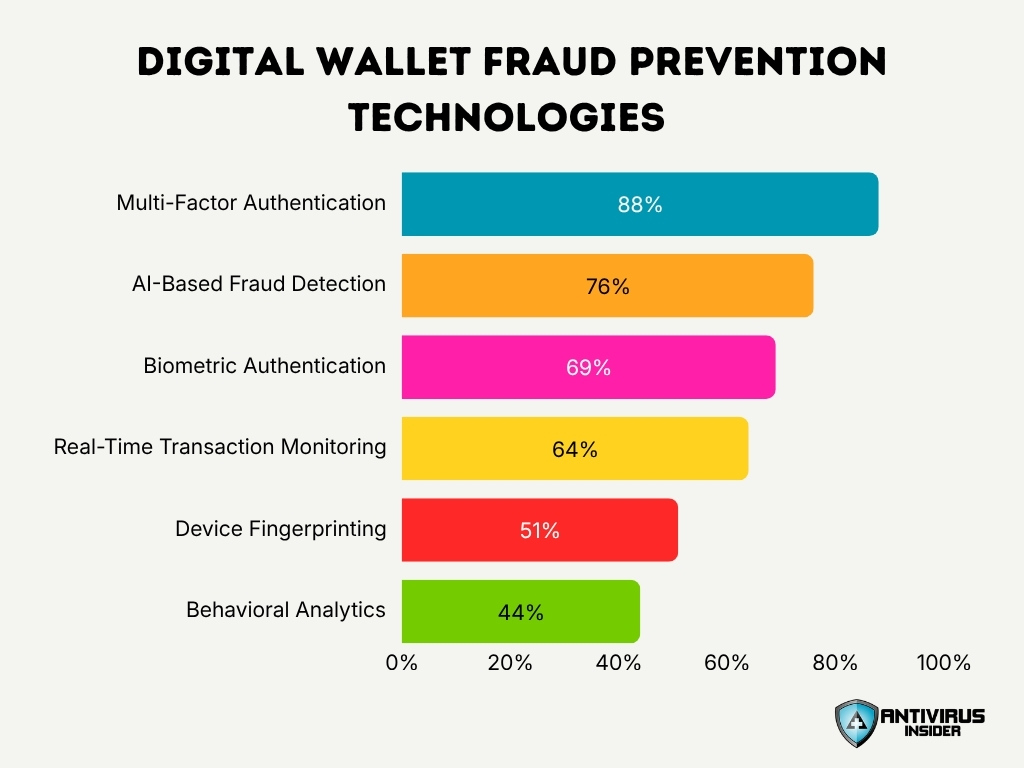
- Multi-factor authentication is the most widely adopted security measure, used by 88% of organizations to prevent unauthorized wallet access.
- AI-based fraud detection ranks second at 76%, highlighting the growing use of automated systems to identify suspicious transactions and fraud patterns.
- Biometric authentication is used by 69% of organizations, making fingerprint, facial, and voice recognition important tools for verifying users.
- Real-time transaction monitoring has a 64% adoption rate, helping organizations detect and respond to unusual payment activity immediately.
- Device fingerprinting is implemented by 51% of organizations to recognize trusted devices and flag potentially risky login attempts.
- Behavioral analytics records the lowest adoption rate at 44%, despite its ability to detect fraud through changes in user behavior and transaction habits.
- The 44-percentage-point gap between multi-factor authentication and behavioral analytics indicates that organizations still favor established security controls over advanced behavioral technologies.
Cross-Border Payment Fraud Statistics
- Card payment fraud in 2024 occurred at a rate 17 times higher when the recipient operated outside the European Economic Area, where strong customer authentication does not always apply.
- Approximately 30% of fraudulent card payment value in the region during 2024 involved cross-border transactions directed outside the economic area.
- Total reported payment fraud across the region reached €4.2 billion in 2024, up from €3.5 billion in 2023 and €3.4 billion in 2022.
- Card fraud losses involving cards issued within the region reached €1.329 billion in 2024, a 29% year-over-year increase.
- Fraudulent credit transfers generated €2.2 billion in losses during 2024, representing a 16% increase from 2023.
- Payment service users absorbed approximately 85% of credit-transfer fraud losses in 2024, largely because criminals persuaded customers to authorize the transfers themselves.
- Historical payment data show the continuing cross-border risk: transactions within the regional payment area represented 9% of card transaction value but 51% of fraud value in 2019.
- Transactions acquired outside that regional payment area represented only 2% of card payment value but 14% of fraud value in 2019.
- Transnational scam centers linked to East and Southeast Asia generate an estimated nearly $40 billion annually, while their operations have expanded into Africa, Latin America, South Asia, the Middle East, and Pacific markets.
Regional Digital Wallet Fraud Statistics
- U.S. consumers reported approximately $16 billion in fraud losses during 2025, marking an increase of about 25% from the previous year.
- In the United Kingdom, authorized push payment fraud losses reached £257.5 million in the first half of 2025, up 12% from the same period in 2024.
- The number of British authorized push payment cases fell 8% to 110,747 in the first half of 2025, indicating that average losses rose even as incident volume declined.
- British payment providers returned £159.2 million to victims during the first half of 2025, equal to 62% of reported authorized-payment losses.
- India recorded 2.8 million reported digital payment frauds in 2025, more than 10 times the level recorded in 2021.
- The reported value of Indian digital payment fraud increased nearly 40-fold between 2021 and 2025, reaching 230 billion rupees, or approximately $2.49 billion.
- Australian consumers lost $2.18 billion to scams in 2025, a 7.8% increase from 2024.
- Australian payment-redirection scams produced $166.8 million in losses during 2025, up 9.3% year over year.
- Regional merchant data showed an average of 4.8 fraud attack types affecting Asia-Pacific merchants in 2025, compared with 4.3 in North America, 3.4 in Europe, and 3.0 in Latin America.
- E-commerce fraud consumed 4.1% of merchant revenue in Latin America during 2025, compared with 3.6% in North America, 2.8% in Europe, and 2.6% in Asia-Pacific.
Frequently Asked Questions (FAQs)
26% of consumers globally reported losing money to digital fraud in the previous year.
U.S. consumers reported approximately $16 billion in fraud losses during 2025, a 25% increase from 2024.
The suspected account takeover (ATO) fraud rate increased by 37% between 2024 and 2025.
8.3% of digital account creation attempts worldwide were suspected of fraud in 2025, making it the highest-risk stage in the customer lifecycle.
Visa identified nearly $1 billion in scam-related payment activity between July and December 2025, with scams becoming the fastest-growing source of consumer payment fraud.
Conclusion
Digital wallet fraud now spans fake merchants, account takeovers, identity theft, chargeback abuse, and authorized-payment scams. U.S. fraud losses increased from $12.5 billion in 2024 to about $16 billion in 2025, while global chargebacks and cross-border payment risks continued to rise. Although merchants improved fraud detection and reduced fraudulent-order rates, gaps remain before checkout, during fulfillment, and across real-time payment channels. Wallet providers, banks, and merchants need connected identity, device, behavioral, and transaction controls to limit future losses.
