



Cybersecurity has become one of the fastest-growing career fields as organizations strengthen their defenses against ransomware, AI-powered attacks, and data breaches. Banks, healthcare providers, government agencies, cloud platforms, and manufacturers all compete for skilled professionals who can protect critical systems and sensitive information. As hiring evolves alongside new technologies, salary expectations, workforce shortages, and emerging job roles continue to reshape the employment landscape. Explore the latest cybersecurity job statistics to understand where the market is heading and what opportunities lie ahead.
Editor’s Choice
- The U.S. recorded approximately 514,359 cybersecurity job listings over the previous 12 months, representing a 12% increase from the prior reporting period.
- Employers added nearly 57,000 additional cybersecurity job postings compared with the previous year, signaling renewed hiring momentum during 2025.
- There were only 74 qualified cybersecurity workers for every 100 open cybersecurity positions in the U.S., highlighting a persistent talent shortage.
- Skills shortages have overtaken headcount shortages as the leading workforce concern among cybersecurity leaders in the latest global workforce research.
- A record 16,029 cybersecurity professionals and decision-makers participated in the latest global workforce study, making it one of the industry’s largest talent surveys.
- Around 36% of organizations reported cybersecurity budget cuts during 2025, only slightly below the previous year’s level, indicating spending has stabilized rather than rebounded.
- Information Security Analyst employment in the U.S. is projected to grow 33% between 2023 and 2033, far faster than the average occupation.
Recent Developments
- CyberSeek expanded its workforce database in 2025, providing broader labor market insights across cybersecurity occupations.
- Cybersecurity job demand increased by 12% year over year in the latest CyberSeek reporting cycle.
- Organizations increasingly prioritize AI security, cloud security, and identity protection skills during recruitment as threat landscapes evolve.
- The latest workforce research no longer estimates a global workforce gap because employers increasingly emphasize specialized skills over simply hiring more staff.
- 39% of organizations reported cybersecurity hiring freezes during 2025, remaining largely unchanged from the previous year.
- About 24% of organizations experienced cybersecurity layoffs during 2025, a slight improvement compared with 2024.
- AI adoption has increased employer demand for professionals with both technical expertise and business strategy capabilities.
- Only 17% of cybersecurity job postings targeted candidates with fewer than four years of experience, reflecting growing demand for experienced professionals.
- Senior cybersecurity hiring has increased by nearly 24%, while employers continue raising expectations for entry-level candidates.
Cybersecurity Job Market Overview
- Cybersecurity remains among the fastest-growing technology employment sectors in the U.S., driven by increasing cyber threats and regulatory requirements.
- U.S. employers advertised more than half a million cybersecurity positions during the latest annual reporting period.
- Cloud computing, AI adoption, ransomware activity, and stricter compliance rules continue expanding cybersecurity hiring needs.
- Large enterprises report greater hiring pressure, with organizations employing over 10,000 people experiencing higher cybersecurity staffing challenges than smaller firms.
- 33% of organizations say they lack sufficient resources to fully staff cybersecurity teams.
- 29% of employers report they cannot afford to recruit professionals with the cybersecurity skills they require.
- Nearly 32% of cybersecurity professionals report feeling overworked because of staffing shortages.
- 28% of professionals say workload pressures prevent them from keeping current with emerging cybersecurity threats.
- Organizations increasingly recruit candidates with transferable skills from adjacent IT and technology disciplines instead of relying solely on traditional cybersecurity backgrounds.
Cybersecurity Job Openings Statistics
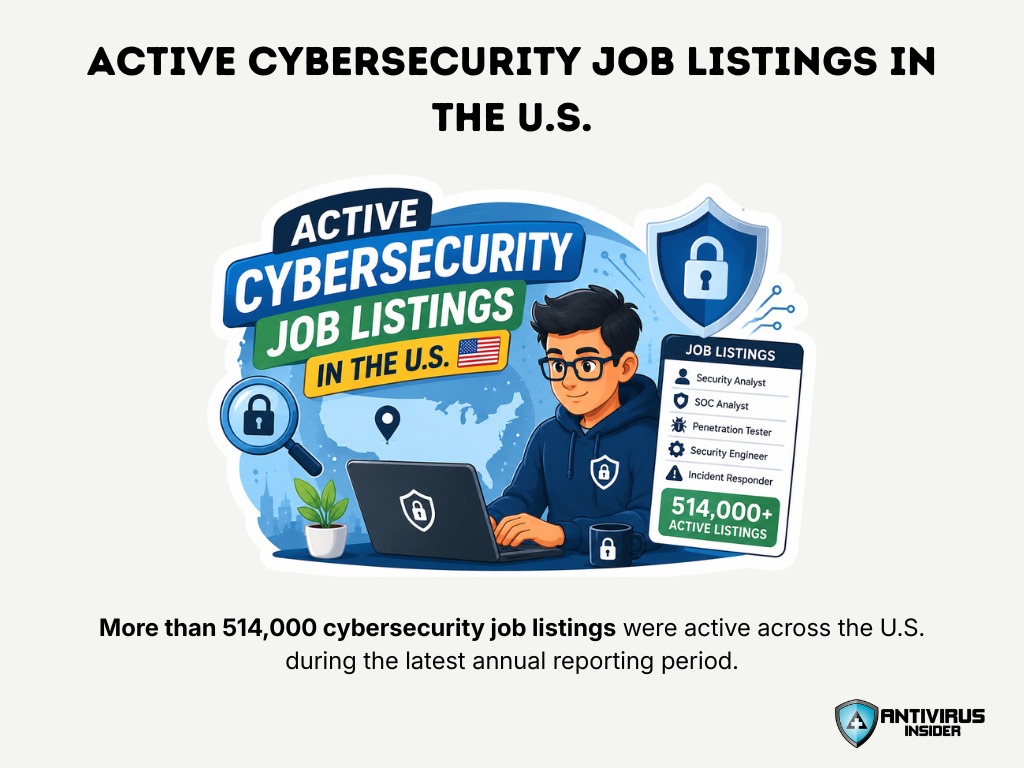
- More than 514,000 cybersecurity job listings were active across the U.S. during the latest annual reporting period.
- Cybersecurity vacancies increased by approximately 12% year over year during 2025.
- The market currently supplies only 74 qualified workers per 100 open cybersecurity jobs, leaving thousands of vacancies unfilled.
- Entry-level opportunities are highly competitive, with only 17% of postings targeting professionals with under four years of experience.
- The global cybersecurity workforce gap reached a record 4.8 million unfilled positions in 2025.
- Information security analyst roles are projected to experience a massive 33% employment growth from 2024 to 2034.
- The worldwide cybersecurity workforce must increase by 87% to properly meet current global security demands.
- Approximately 10% of all cybersecurity job listings in 2025 specifically referenced AI skills as a core requirement.
- Around 67% of organizations globally report being significantly short on cybersecurity staff.
- Four core industries, financial services, materials, consumer goods, and technology, make up 64% of the total talent shortage.
Cybersecurity Job Growth Statistics
- Employment for Information Security Analysts is projected to grow 33% from 2023 to 2033, substantially outpacing average U.S. job growth.
- The U.S. cybersecurity labor market added approximately 57,000 more job openings compared with the previous reporting period.
- Employers posted 514,359 cybersecurity vacancies during the latest 12-month reporting period.
- Demand continues expanding across cloud security, identity management, application security, AI governance, and security operations roles.
- Organizations increasingly invest in entry-level talent development to address long-term workforce shortages despite challenging economic conditions.
- 75% of hiring managers report having budgets available to develop junior cybersecurity professionals.
- 73% of cybersecurity hiring managers believe they have adequate staffing budgets despite ongoing recruitment challenges.
- Around 55% of hiring managers use internships as a primary pathway for identifying early-career cybersecurity talent.
- 46% of employers also leverage apprenticeship programs to recruit cybersecurity professionals.
Cybersecurity Workforce Gap Statistics
- The U.S. labor market currently has 74 cybersecurity professionals available for every 100 job openings, leaving a significant workforce shortage.
- The latest workforce research concludes that critical skills shortages now pose a greater challenge than simple staffing shortages.
- 33% of organizations report insufficient staffing resources for cybersecurity teams.
- 29% of organizations cannot afford to hire professionals with the cybersecurity expertise they need.
- Nearly 32% of cybersecurity professionals say staff shortages have increased their workload.
- 20% of professionals report working longer hours because teams remain understaffed.
- 23% of cybersecurity workers say they lack sufficient training opportunities to keep pace with evolving threats.
- 22% of respondents report being assigned cybersecurity responsibilities outside their core expertise due to staffing shortages.
- Organizations increasingly address workforce shortages through internal upskilling, multiskilling initiatives, apprenticeships, and certification-based career pathways.
Cybersecurity Salary Statistics
- The U.S. median annual wage for Information Security Analysts reached $124,910 in the latest federal salary data, making cybersecurity one of the highest-paying technology careers.
- Professionals holding advanced cybersecurity certifications reported global median salaries exceeding $140,000, depending on experience and role.
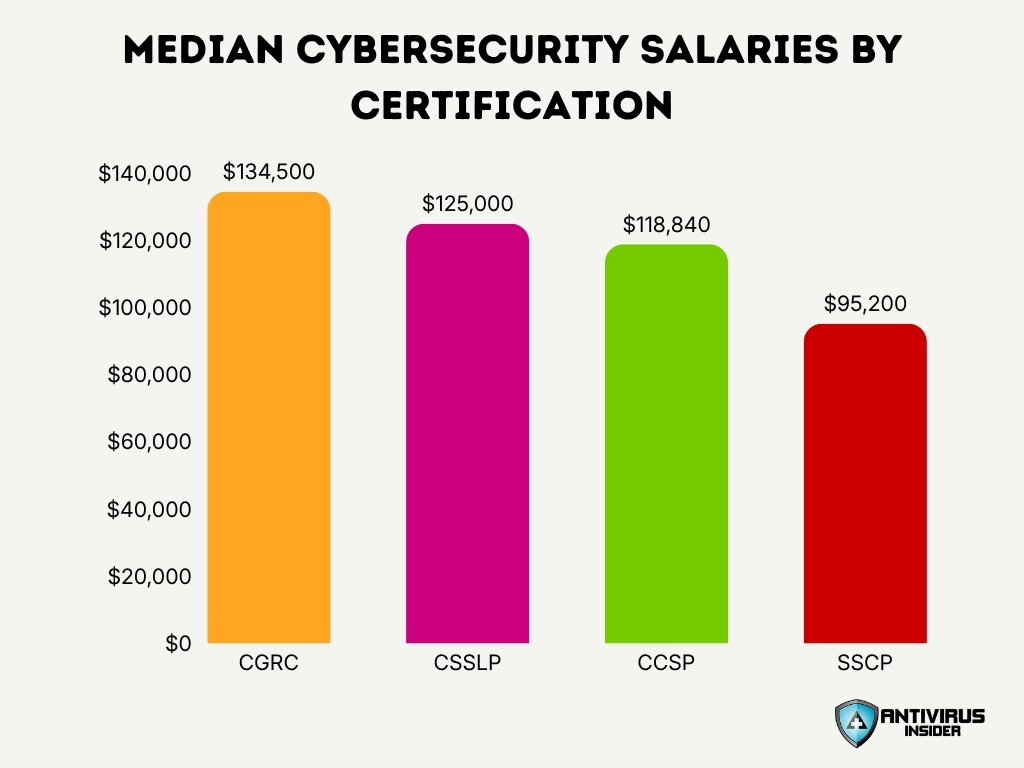
- Professionals with the CGRC certification reported a median salary of $134,500.
- The median salary for professionals with the CSSLP certification reached $125,000.
- Professionals holding the CCSP certification earned a global median salary of $118,840.
- The SSCP certification was associated with a median salary of $95,200, reflecting strong earning potential for early-career professionals.
- Salary growth continues to favor professionals specializing in cloud security, AI security, and governance, where employer demand remains strong.
- Organizations increasingly offer larger compensation packages to experienced cybersecurity professionals because hiring experienced talent remains challenging.
- Leadership positions such as Chief Information Security Officer (CISO) frequently exceed $200,000 annually at large enterprises, depending on organization size and industry.
In-Demand Cybersecurity Job Roles
- Security Engineers face a massive 33% projected job growth over the next decade.
- Employment for Security Analysts is expected to increase by 29% with 16,000 new openings annually.
- The global cybersecurity workforce gap leaves over 4.8 million unfilled positions for Security Consultants and advisors.
- Over 1.5 million open jobs globally require the specialized expertise of Security Architects.
- IT Security Managers currently rank among the top five fastest-growing career roles worldwide through 2030.
- The market driving Cloud Security Specialists is projected to reach an estimated $62.9 billion by 2029.
- Nearly 10% of modern cybersecurity job listings specifically demand AI security and governance skills.
- Around 87% of industry leaders rank AI-related vulnerabilities as their fastest-growing risk assessment priority.
- Approximately 79% of Identity and Access Management (IAM) specialists plan to integrate automation into their stacks.
Cybersecurity Jobs by Experience Level
- Only 17% of cybersecurity job postings targeted professionals with fewer than four years of experience, highlighting limited entry-level opportunities.
- 90% of hiring managers would consider candidates who possess previous IT experience, even without formal cybersecurity experience.
- 89% of hiring managers would also consider candidates holding an entry-level cybersecurity certification alone.
- Employers increasingly expect hands-on practical experience before hiring junior cybersecurity professionals.
- 84% of organizations use skills-based assessments or technical testing during recruitment for entry-level cybersecurity roles.
- Senior cybersecurity hiring continued growing faster than entry-level hiring throughout 2025 as organizations prioritized experienced talent.
- Professionals with five or more years of cybersecurity experience continue to receive significantly higher interview response rates than junior applicants.
- Many organizations now encourage internal career progression from IT support, networking, and systems administration into cybersecurity positions.
- Career changers remain an important talent source as employers broaden recruitment beyond traditional cybersecurity backgrounds.
Highest-Paying Cybersecurity Jobs
- Chief Information Security Officers command base salaries ranging from $220,000 to $420,000, with total packages often exceeding $500,000.
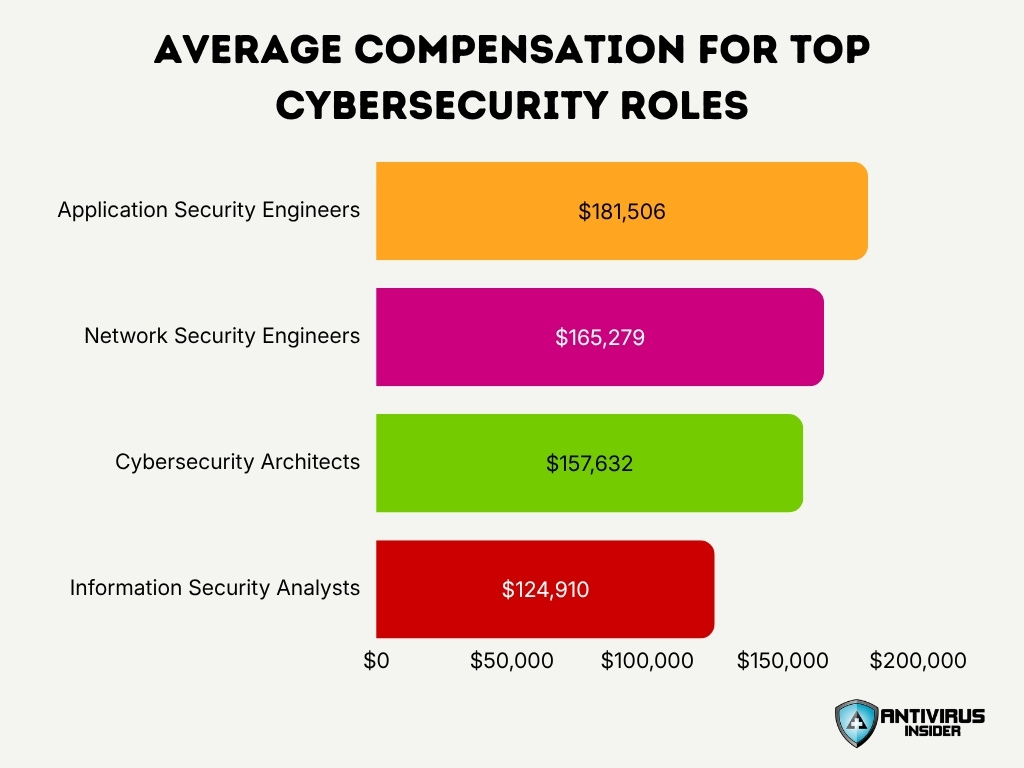
- Cybersecurity Architects earn an average salary of $157,632, while senior practitioners can make up to $180,000 annually.
- Mid-to-senior level Cloud Security Engineers typically see compensation between $130,000 and $175,000 due to rapid cloud migration.
- Application Security Engineers earn an average of $181,506, with the top 10 percent commanding up to $263,077.
- Incident Response Specialists consistently earn between $90,000 and $140,000, with heavy premiums for handling high-pressure breaches.
- The median annual wage for general Information Security Analysts sits at $124,910, while the top 10 percent earn over $186,420.
- Achieving an OSCP certification can boost salaries by 30% to 45%, significantly elevating earning potential for mid-level professionals.
- Network Security Engineers receive an average compensation of $165,279, with top earners bringing in upwards of $280,361.
- The cybersecurity industry anticipates a 33% job growth rate through 2033, continually driving up overall executive compensation.
Cybersecurity Certification Statistics
- 47% of hiring managers rank cybersecurity certifications as a critical hiring factor, ahead of IT experience and formal education.
- 89% of employers would consider candidates who possess only an entry-level cybersecurity certification.
- Certified in Cybersecurity (CC), CompTIA Security+, and CompTIA CASP+ remain the most frequently requested foundational certifications.
- Approximately 34% of hiring managers expect entry-level applicants to hold the CISSP, despite its five-year experience requirement.
- Around 38% of hiring managers require the CISA certification for some entry-level positions, creating unrealistic expectations for new candidates.
- Professionals entering cybersecurity through certifications reported one of the highest satisfaction levels with their career pathway, with 67% recommending it to others.
- The number of active CISSP certification holders exceeded 191,000 worldwide by the end of 2025.
- Active CCSP certification holders surpassed 23,800 globally by the end of 2025.
- Certification holders consistently report stronger salary growth and broader career advancement opportunities than professionals without industry-recognized credentials.
Cybersecurity Education Statistics
- Only 43% of hiring managers consider formal cybersecurity education a critical hiring requirement for entry-level positions.
- 90% of employers value previous IT experience over education alone when evaluating entry-level candidates.
- 56% of cybersecurity professionals entered the field through previous IT careers.
- Only 10% of professionals reported entering cybersecurity directly through cybersecurity education programs.
- Among professionals aged 21 to 29, approximately 23% entered cybersecurity after completing a cybersecurity degree.
- 61% of professionals who entered through cybersecurity education would recommend that pathway to others.
- Employers increasingly complement academic qualifications with practical labs, internships, and technical assessments during hiring.
- Educational institutions continue expanding cloud security, AI security, and digital forensics programs to meet evolving employer demand.
- Degree holders who combine education with certifications and real-world experience remain the most competitive applicants.
Cybersecurity Employment Qualification Statistics
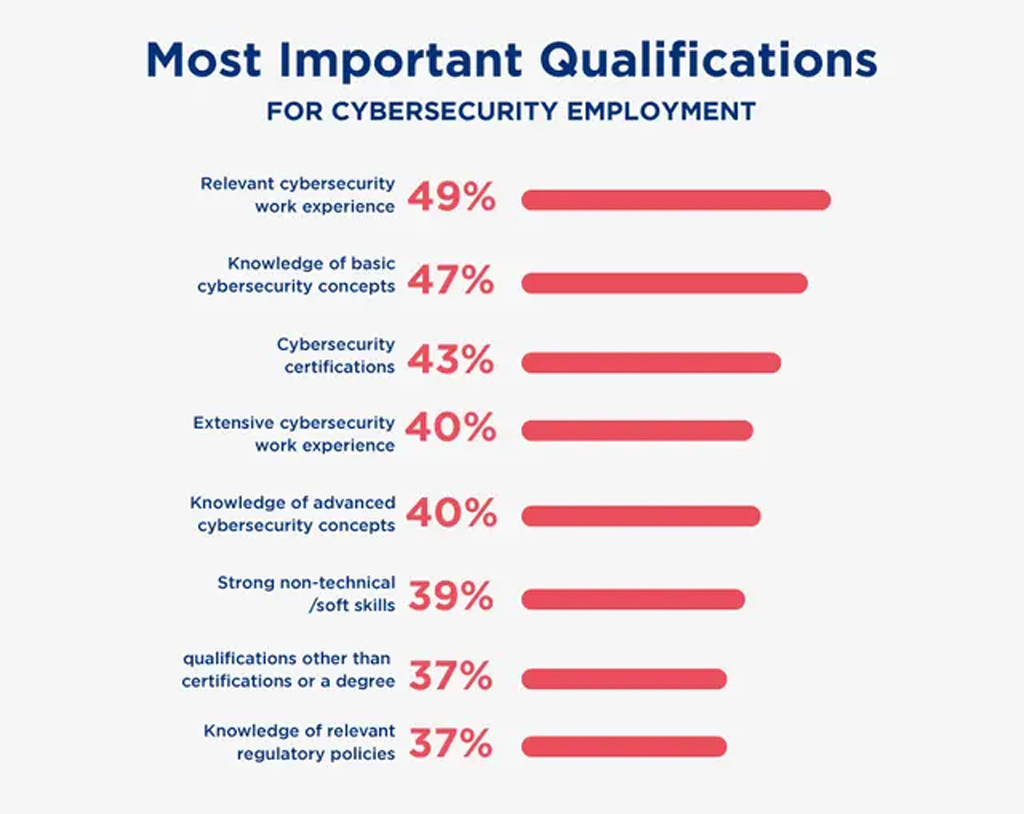
- Relevant cybersecurity work experience is the top hiring criterion, cited by 49% of employers.
- 47% of employers value knowledge of basic cybersecurity concepts when evaluating candidates.
- Cybersecurity certifications are considered important by 43% of hiring decision-makers.
- 40% of employers prioritize extensive cybersecurity work experience for cybersecurity roles.
- Knowledge of advanced cybersecurity concepts is valued by 40% of organizations.
- Strong non-technical and soft skills are important for 39% of cybersecurity employers.
- 37% of respondents value qualifications beyond certifications or a degree, highlighting practical expertise.
- Knowledge of relevant regulatory policies is considered an important qualification by 37% of employers.
Cybersecurity Skills in Demand
- Cloud security ranked as the top technical skill prioritized by 29% of hiring managers.
- AI security ranked second, with 27% of hiring managers actively seeking related expertise.
- Security engineering ranked among the leading technical skills, prioritized by 24% of hiring managers.
- Security analysis remained a key hiring priority for 23% of employers.
- Risk assessment also ranked highly, with 23% of hiring managers identifying it as a critical technical capability.
- Problem-solving, teamwork, and communication remain the three most valuable nontechnical skills sought by employers.
- Cybersecurity professionals identified communication skills (59%) as the most valuable nontechnical capability for long-term career success.
- AI, cloud computing, governance, and zero-trust implementation continue gaining importance as organizations modernize their security operations.
- Employers increasingly seek professionals who combine technical expertise, analytical thinking, adaptability, and business communication rather than technical knowledge alone.
Cybersecurity Hiring Trends
- Approximately 39% of organizations reported cybersecurity hiring freezes during 2025, reflecting continued caution despite persistent talent shortages.
- Around 24% of organizations experienced cybersecurity-related layoffs in 2025, a slight improvement compared with the previous year.
- 75% of hiring managers reported having budget available to hire or develop entry-level cybersecurity professionals.
- About 90% of employers would consider candidates with prior IT experience even without direct cybersecurity experience.
- 89% of hiring managers would interview applicants who possess only an entry-level cybersecurity certification.
- More employers now prioritize skills-based hiring over degree-only requirements, especially for technical security positions.
- AI security, cloud security, governance, and risk management remain among the fastest-growing hiring priorities entering 2026.
- Organizations increasingly recruit candidates through internships, apprenticeships, internal upskilling, and career-transition programs instead of relying solely on external hiring.
- Employers continue expanding hybrid and remote hiring to reach cybersecurity professionals outside traditional technology hubs.
Cybersecurity Jobs by Location
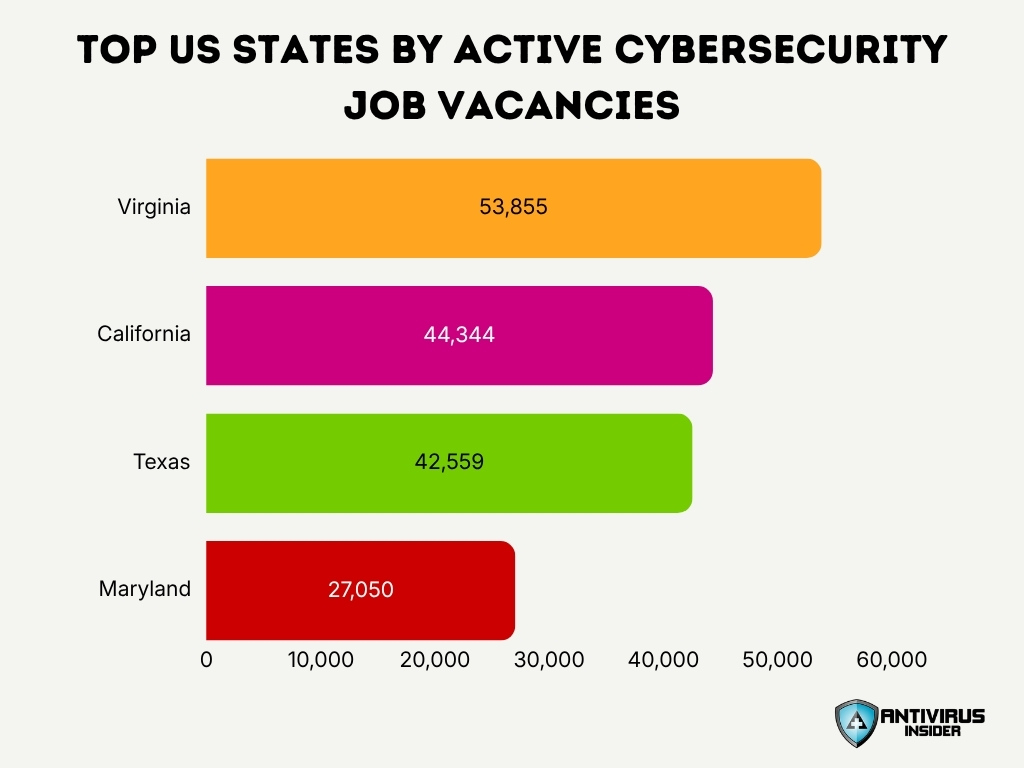
- Virginia leads the nation with an impressive 53,855 available cybersecurity job openings.
- Texas remains a massive hiring market, currently posting 42,559 cybersecurity vacancies.
- California ranks second overall, generating demand with 44,344 open cybersecurity roles.
- Maryland maintains a high job concentration, recording 27,050 active cybersecurity job openings.
- Florida continues its hiring expansion, currently employing over 10,830 Information Security Analysts.
- New York rewards its cybersecurity professionals with a high annual mean wage of $138,730.
- North Carolina demonstrates concentrated tech growth with a 2.41 location quotient for security analysts in the Durham-Chapel Hill area.
- The Washington, DC metropolitan area stands as a major employment hub with 17,150 employed cybersecurity analysts.
- The global cybersecurity workforce currently faces an estimated shortage of 4.8 million unfilled jobs, driving remote hiring initiatives.
Cybersecurity Jobs by Industry
- Financial services employ roughly 16% of all information security analysts to protect against digital banking threats.
- Healthcare organizations are rapidly expanding security hiring as the average cost of a data breach reaches $12.6 million.
- Government agencies are major employers responding to over 1,661 cyberattacks per week targeting national infrastructure.
- Technology companies specializing in computer systems design account for 22% of all cybersecurity analyst roles.
- Manufacturing organizations increased hiring after 61% of smart factories experienced disruptive cybersecurity incidents.
- Energy and utility companies are expanding operations to combat an 87% surge in ransomware attacks on industrial systems.
- Defense and aerospace remain top employers as the global defense cybersecurity market reaches $26.36 billion in 2026.
- Professional services firms are hiring advisory specialists to support a global services market expected to hit $38.1 billion.
- Retail and e-commerce companies are investing in talent after 44% of confirmed breaches in the sector involved ransomware.
Remote Cybersecurity Job Statistics
- Only 8% of Fortune 100 cybersecurity roles currently offer fully remote work options.
- About 10% of cybersecurity job listings now explicitly require AI and remote skills.
- Nearly 90% of IT professionals feel confident managing remote cybersecurity protocols.
- Approximately 41% of the workforce operates in hybrid setups, driving cloud security demand.
- Over 61% of organizations factored remote worker security into return-to-office policies.
- Misconfigured VPNs accounted for 14% of data leaks among remote employees globally.
- Remote workers are 3 times more likely to accidentally expose data than in-office staff.
- More than 55% of recent insider threat incidents are tied to remote work environments.
Worldwide Cyber Security Professional Salaries
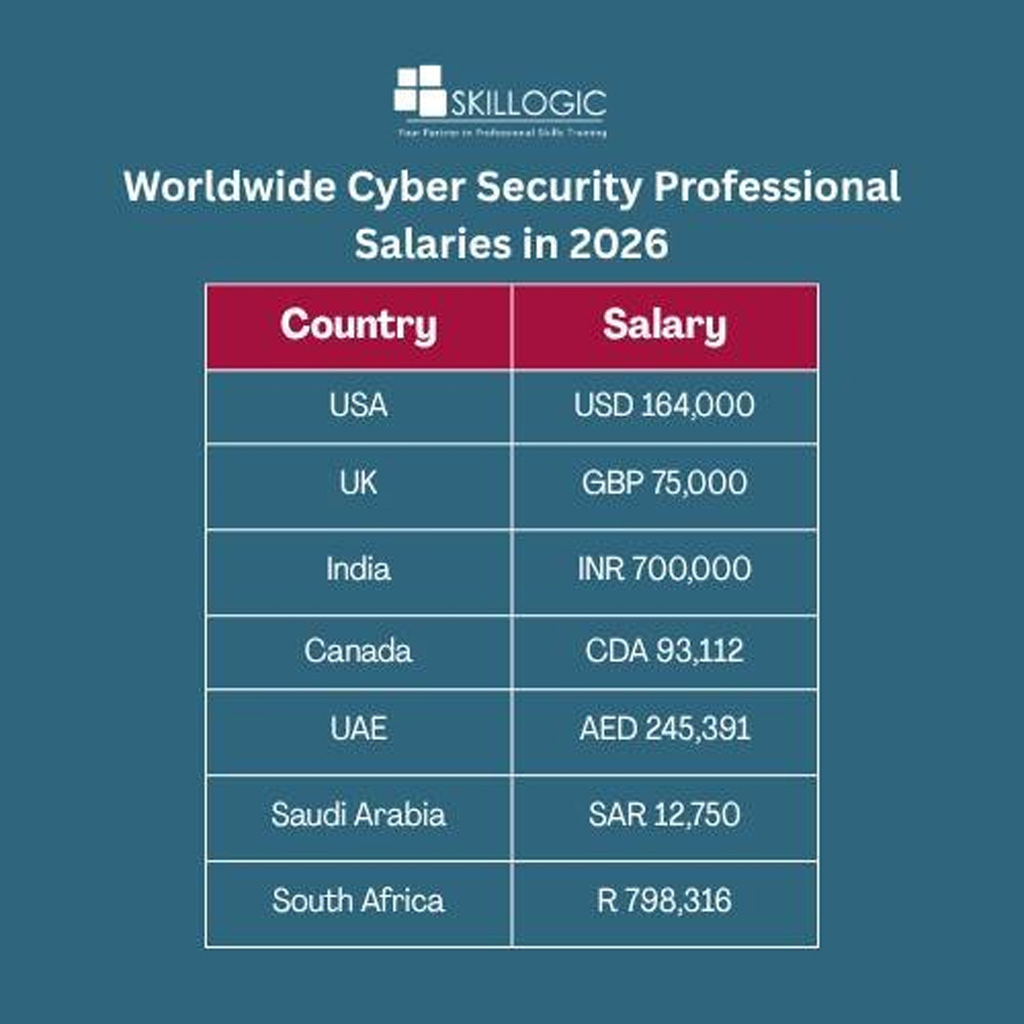
- The USA offers the highest cybersecurity salary in this comparison at USD 164,000.
- Canada provides an average annual cybersecurity salary of CAD 93,112, making it one of the top-paying markets.
- Cybersecurity professionals in the UK earn around GBP 75,000 per year.
- In the UAE, the average cybersecurity salary reaches AED 245,391 annually.
- India reports an average cybersecurity salary of INR 700,000 per year.
- South Africa offers an average annual cybersecurity salary of R 798,316.
- Saudi Arabia lists an average cybersecurity salary of SAR 12,750 according to the data.
- The salary comparison highlights significant regional differences in cybersecurity compensation across seven countries.
Cybersecurity Job Outlook
- Information security analyst jobs are projected to grow 29% to 33% over the next decade.
- The global cybersecurity workforce gap currently stands at 4.8 million unfilled positions.
- The active global cybersecurity workforce recently reached a record high of 5.5 million professionals.
- The median annual wage for US information security analysts is $124,910.
- The industry projects an average of 16,000 new job openings for security analysts each year.
- Approximately 67% of organizations report dealing with staffing shortages on their security teams.
- Roughly 10% of cybersecurity job listings now specifically reference a need for AI skills.
- The global cybersecurity market is projected to grow to $723.8 billion by 2033.
- The worldwide cybersecurity workforce gap grew by 19% in just one year.
Frequently Asked Questions (FAQs)
There were approximately 514,359 cybersecurity job listings in the U.S. during the latest 12-month reporting period (May 2024 to April 2025).
Employment for Information Security Analysts is projected to grow by 33% between 2023 and 2033, much faster than the average for all occupations.
The estimated global cybersecurity workforce stands at approximately 4.97 million professionals, with an estimated range of 4.4 million to 5.5 million.
Approximately 10% of U.S. cybersecurity job postings specifically list artificial intelligence (AI) skills as a job requirement.
Only 17% of U.S. cybersecurity job postings target candidates with fewer than four years of experience, reflecting a growing preference for experienced professionals.
Conclusion
Cybersecurity continues to offer one of the strongest career outlooks in the technology sector, supported by rising cyber threats, expanding regulatory requirements, and rapid adoption of cloud computing and artificial intelligence. While employers still face workforce shortages, the hiring landscape increasingly favors candidates with practical skills, certifications, and experience over traditional qualifications alone. Salary growth remains competitive across technical and leadership roles, and industries ranging from healthcare and finance to government and manufacturing continue expanding their cybersecurity teams.
Looking ahead, organizations are expected to invest further in AI security, cloud protection, identity management, and workforce development initiatives. As remote work, skills-based hiring, and continuous learning reshape the profession, cybersecurity is likely to remain one of the most stable and rewarding career paths throughout the coming decade.
