


Cyber warfare now sits at the center of national security, economic stability, and digital resilience. Governments, defense agencies, financial institutions, and critical infrastructure operators face a growing number of sophisticated attacks that blend espionage, sabotage, ransomware, and information warfare. At the same time, organizations across the US continue to strengthen cyber defenses as geopolitical tensions reshape the threat landscape. Explore the statistics below to understand how cyber warfare has evolved and what the latest data reveals about emerging risks and global trends.
Editor’s Choice
- 44% of all analyzed data breaches involved ransomware or extortion in the latest investigation dataset, highlighting ransomware as one of the defining features of modern cyber conflict.
- The global average cost of a data breach reached $4.4 million in 2025, although faster detection and containment reduced costs compared with the previous year.
- Organizations in the United States recorded an average breach cost of $10.22 million, the highest among all measured regions.
- Third-party involvement appeared in 30% of investigated breaches, nearly doubling from the previous reporting cycle and emphasizing supply chain risk.
- ENISA analyzed 4,875 cybersecurity incidents across Europe between July 2024 and June 2025, illustrating the sustained pace of cyber operations affecting governments and critical sectors.
- Verizon’s latest investigation reviewed 22,000+ security incidents and more than 12,000 confirmed breaches, making it one of the largest cyber datasets available.
- Human involvement, including phishing, credential theft, and social engineering, remains one of the leading contributors to successful cyber intrusions in 2025 and 2026.
Recent Developments
- Throughout 2025, governments increased public warnings about cyber campaigns linked to geopolitical conflicts involving Russia, China, Iran, and North Korea.
- Security analysts reported that third-party compromises doubled year over year, making trusted vendors an increasingly common attack path.
- AI-assisted phishing campaigns accelerated during 2025, allowing attackers to generate more convincing emails and impersonation attempts at scale.
- Manufacturing remained the most targeted industry for the fourth consecutive year, reflecting attackers’ interest in operational disruption and intellectual property theft.
- Analysts observed a sharp increase in attacks that relied on credential theft and hands-on-keyboard techniques instead of traditional malware deployment.
- Several high-profile ransomware campaigns disrupted transportation, aviation, healthcare, and government services during 2025, demonstrating the growing operational impact of cyberattacks.
- Threat intelligence reports documented 124 active ransomware groups during 2025, including 73 newly identified groups, marking a record level of criminal activity.
- Nation-state and hacktivist groups increasingly coordinated disruptive campaigns using DDoS attacks alongside influence operations and espionage.
Global Overview of Cyber Warfare
- Cyber warfare has expanded beyond military targets to include healthcare, transportation, finance, manufacturing, telecommunications, and public administration.
- Public administration represented 38.2% of recorded cyber incidents in the latest threat landscape, making it the most frequently targeted sector.
- DDoS attacks accounted for approximately 77% of observed disruptive incidents across the European threat landscape during the reporting period.
- Israel accounted for approximately 12.2% of ideologically motivated cyberattacks worldwide during 2025, according to global threat monitoring.
- Network-layer DDoS activity increased by 168% in Israel during 2025 amid heightened geopolitical tensions.
- Analysts increasingly classify cyber operations as part of hybrid warfare, combining cyberattacks with military pressure, disinformation, and psychological operations.
- Cyber operations continue to favor persistent espionage and infrastructure disruption over immediate destruction, allowing threat actors to maintain long-term strategic access.
- Governments worldwide expanded investment in cyber resilience, national CERTs, and public-private intelligence sharing following the continued rise in state-backed cyber activity.
Weekly Cyber Attacks by Industry
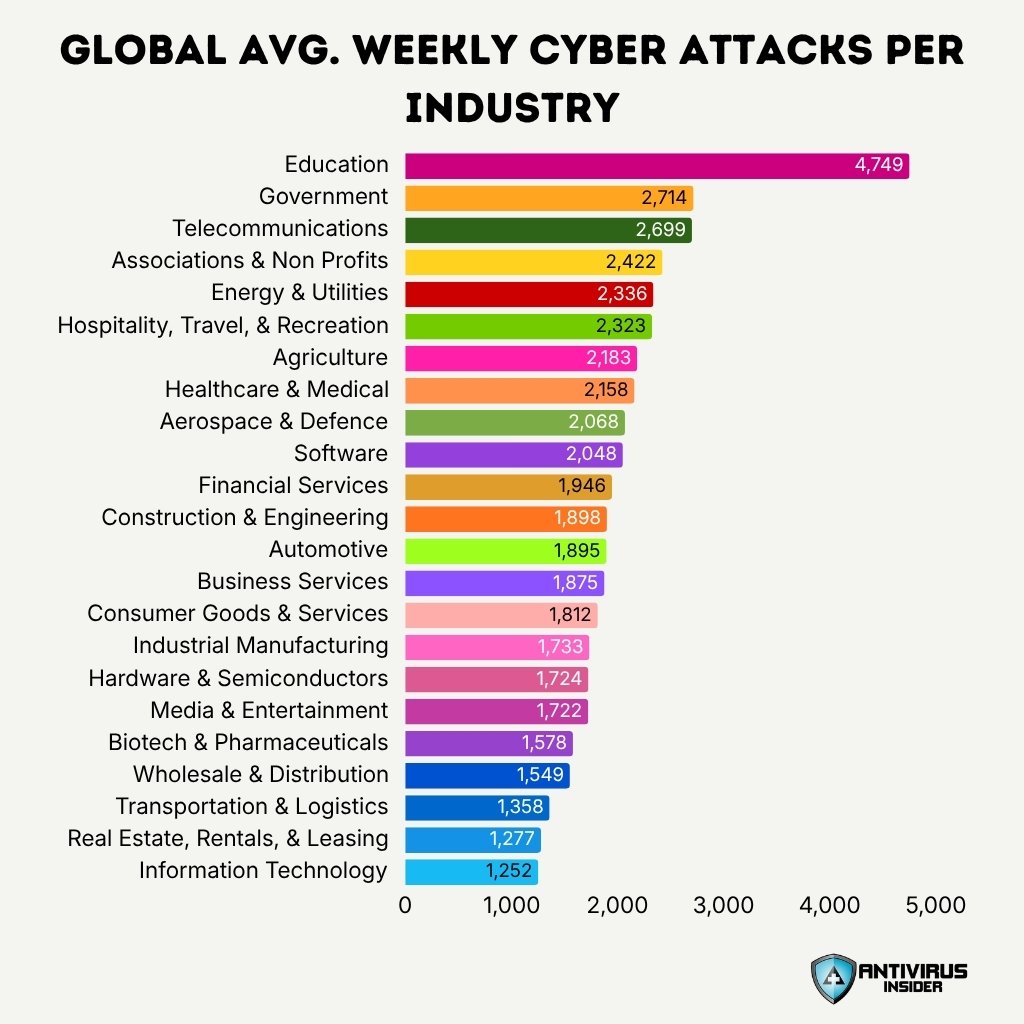
- Education faced the highest pressure, with 4,749 weekly cyber attacks, up 7% year over year.
- Government ranked second with 2,714 weekly attacks, showing a modest 2% increase.
- Telecommunications recorded 2,699 attacks per week, rising 6% from Feb-25.
- Associations & Nonprofits saw 2,422 weekly attacks, with a sharp 27% increase.
- Energy & Utilities reported 2,336 weekly attacks, growing 19% year over year.
- Hospitality, Travel, & Recreation had one of the fastest increases, up 56% to 2,323 attacks.
- Agriculture saw the biggest surge, jumping 96% to 2,183 weekly cyber attacks.
- Healthcare & Medical remained highly targeted with 2,158 attacks, despite a 9% decline.
- Aerospace & Defence recorded 2,068 weekly attacks, increasing 26%.
- Software companies faced 2,048 weekly attacks, up 24% compared to Feb-25.
- Construction & Engineering saw a major rise of 36%, reaching 1,898 weekly attacks.
- Hardware & Semiconductors had the steepest decline, down 19% to 1,724 attacks.
- Information Technology had the lowest attack volume at 1,252 weekly attacks, but still rose 27%.
Cyber Warfare Incidents by Region
- North America faces severe financial impacts from cyberattacks, with US organizations averaging $10.22 million per data breach.
- Europe recorded 4,875 analyzed cybersecurity incidents across multiple sectors between July 2024 and June 2025.
- Public administration was Europe’s most targeted sector, accounting for 38.2% of all analyzed cyber incidents.
- The transportation sector represented approximately 7.5% of analyzed European cyber incidents during the reporting period.
- The Middle East experiences intensified cyber warfare activity with average data breach costs reaching $7.29 million per incident.
- Ukraine recorded over 4,867 cyber incidents in early 2025, marking a 13% increase linked to ongoing military conflict.
- Asia-Pacific governments face advanced persistent threats, with Taiwan alone experiencing 173 targeted cyberattacks recently.
- Global incident reporting indicates the worldwide average cost of a data breach reached $4.44 million across public and private sectors.
Nation-State Threat Actors and Campaigns
- Nation-state threat actors remain undetected in compromised networks for an average dwell time of 277 days.
- There has been an 89% increase in targeted cyber campaigns facilitated by AI-enabled adversaries.
- Government and critical infrastructure sectors experienced a 110% surge in state-sponsored intrusions over the past year.
- State-aligned operators were responsible for nearly $1.46 billion in record-breaking cryptocurrency heists.
- Advanced nation-state attackers drove a 42% increase in the exploitation of zero-day vulnerabilities.
- Approximately 65% of external cyber threats are directly tied to organized crime and state-sponsored activities.
- The deployment of AI-generated phishing lures by state operatives has increased click-through rates by up to 54%.
- Over 84% of cloud-conscious intrusions leveraged compromised third-party software and managed service providers.
Military Cybersecurity Market Growth
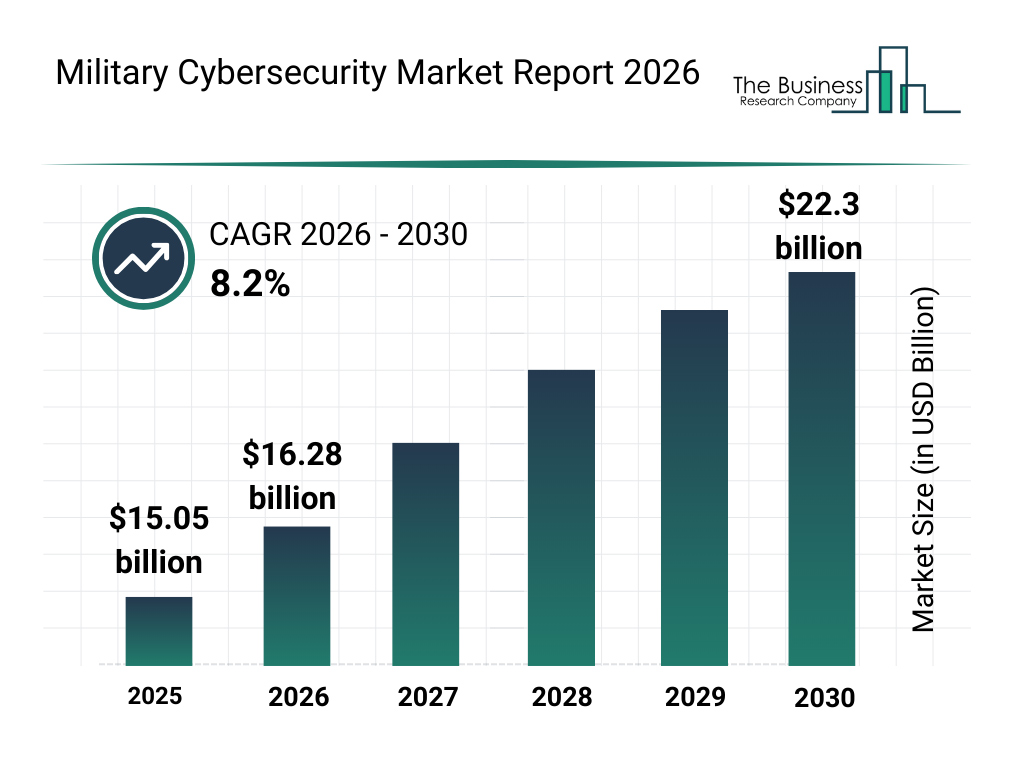
- The military cybersecurity market is projected to grow from $15.05 billion in 2025 to $22.3 billion by 2030.
- The market is expected to add around $7.25 billion in value between 2025 and 2030.
- In 2026, the market size is estimated at $16.28 billion, showing steady year-over-year growth.
- The sector is forecast to grow at a CAGR of 8.2% from 2026 to 2030.
- By 2028, the market is expected to reach around $19.06 billion, moving close to the $20 billion mark.
- The market could cross $20 billion in 2029, reaching an estimated $20.62 billion.
- The rising trend highlights growing demand for military cyber defense, secure networks, and threat protection systems.
- The data shows consistent annual growth, reflecting stronger investment in defense cybersecurity infrastructure.
Military and Defense Sector Cyber Attack Statistics
- The global military cybersecurity market is projected to exceed $40 billion by 2030, driven by increased investment in cyber defense platforms, secure communications, and AI-enabled threat detection.
- The US Department of Defense requested more than $14 billion for cyber-related capabilities and information technology in its FY2025 budget, reflecting continued modernization efforts.
- More than 70% of nation-state cyber campaigns investigated in 2025 targeted defense contractors, military suppliers, or government-linked organizations at some stage of the attack chain.
- NATO members continue expanding cyber investments, with cyber defense recognized as an operational domain alongside land, air, sea, and space.
- Over 90% of advanced military organizations now integrate cyber operations into joint military exercises and strategic planning.
- Defense agencies increasingly rely on Zero Trust architecture, with identity protection becoming a primary investment area for military networks.
- Multiple Western intelligence agencies reported persistent cyber espionage campaigns targeting weapons research, satellite systems, and military logistics throughout 2025.
- The US Cyber Command continues conducting “defend forward” operations to identify and disrupt malicious cyber activity before it reaches domestic networks.
Government Agency Cyber Breach Statistics
- Government organizations accounted for 38.2% of analyzed cyber incidents across Europe between July 2024 and June 2025.
- Approximately 60% of cyber incidents involving public institutions included phishing or stolen credentials.
- Third-party compromises contributed to 30% of investigated breaches for government agencies.
- Public agencies experienced a 65% year-over-year jump in ransomware attacks during the first half of 2025.
- Federal government networks reported 32,211 security incidents in a single year, marking a 10% overall increase.
- Phishing and imposter attacks remained a primary threat vector, accounting for 20% of all federal breaches.
- Roughly 23% of public-sector organizations reported having insufficient cyber-resilience capabilities going into 2026.
- Unpatched software vulnerabilities were directly exploited in 31% of initial breach entry points targeting government data.
- The global average cost of a data breach affecting public sector organizations climbed to $4.88 million by 2026.
Critical Infrastructure Attacks and Disruptions
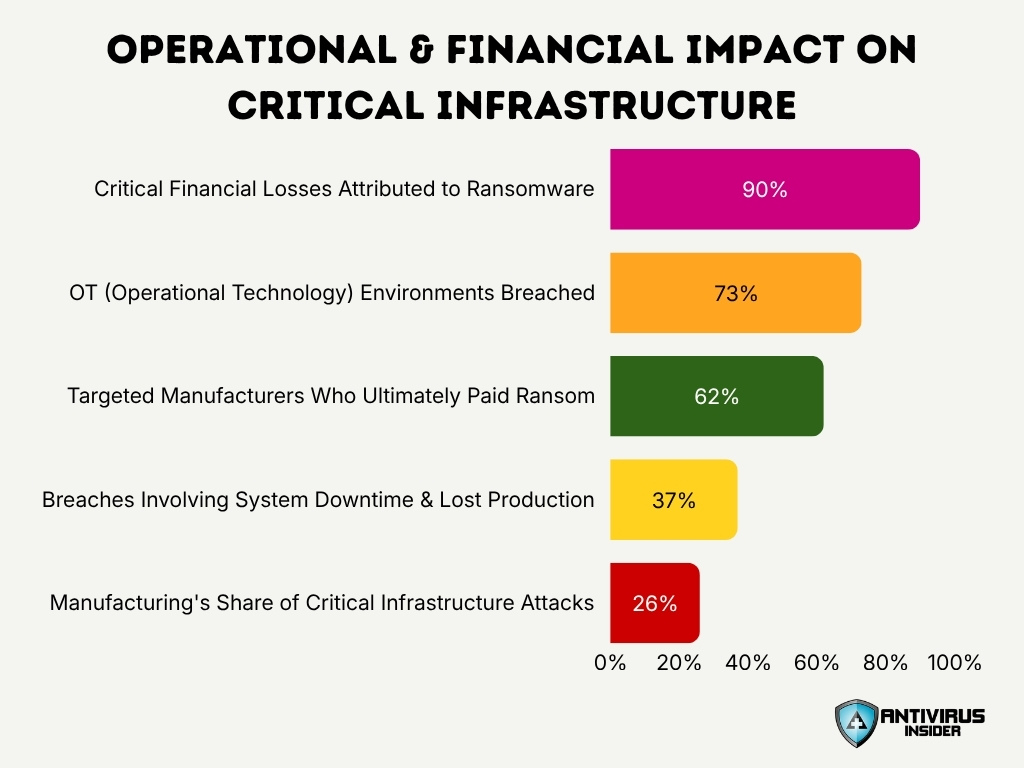
- The manufacturing industry accounted for 26% of all cyberattacks across critical infrastructure sectors.
- Threat actor activity targeting the manufacturing sector experienced a massive 71% year-over-year surge.
- Ransomware attacks are responsible for 90% of total financial losses incurred by critical manufacturing facilities.
- Despite having system backups, 62% of targeted manufacturers ultimately paid ransom demands to restore operations.
- Operational Technology (OT) environments experienced a breach in 73% of industrial organizations globally.
- The transportation sector represented approximately 7.5% of recorded cyber incidents across regional threat landscapes.
- Network-based DDoS attacks accounted for nearly 77% of disruptive incidents targeting essential service providers.
- System downtime and lost production constitute 37% of breach costs, averaging $3.2 million per incident.
- Annual global damages from ransomware extortion attacks against critical infrastructure are forecasted to reach $74 billion.
Cyber Attacks on Financial Institutions
- The average cost of a data breach in the financial sector reached $5.56 million in 2025.
- Approximately 65% of financial services organizations experienced a ransomware attack over the past year.
- The median ransomware demand against financial institutions has surged to a record $3 million.
- Banks and payment platforms absorb 34% of all observed DDoS attacks, making them the most targeted sector.
- In 31% of financial cyberattacks involving ransomware, attackers also successfully stole sensitive data.
- Almost 68% of data breaches involve a human element, primarily driven by phishing and stolen credentials.
- Financial institutions successfully recovered their data in 97% of ransomware encryption incidents.
- The global financial sector has suffered $12 billion in direct losses from cyber incidents over the past two decades.
Economic Impact and Cost of Cyber Warfare
- The global average cost of a data breach is currently $4.44 million, with the United States averaging $10.22 million.
- Global cybercrime damages are projected to reach between $10.5 trillion and $11.88 trillion annually by 2026.
- Healthcare data breaches remain the most expensive across all industries, averaging $11.2 million per incident.
- Supply chain compromises and third-party breaches now account for nearly 48% of all data breaches globally.
- Organizations utilizing extensive security AI and automation save an average of $1.9 million per data breach.
- Ransomware attacks and extortion schemes were present in 44% of confirmed global data breaches this past year.
- Breaches that take over 200 days to identify and contain cost organizations an average of $5.01 million.
- Global cybersecurity spending is forecasted to increase by 12.5% to reach a total of $240 billion in 2026.
Top U.S. National Security Threats
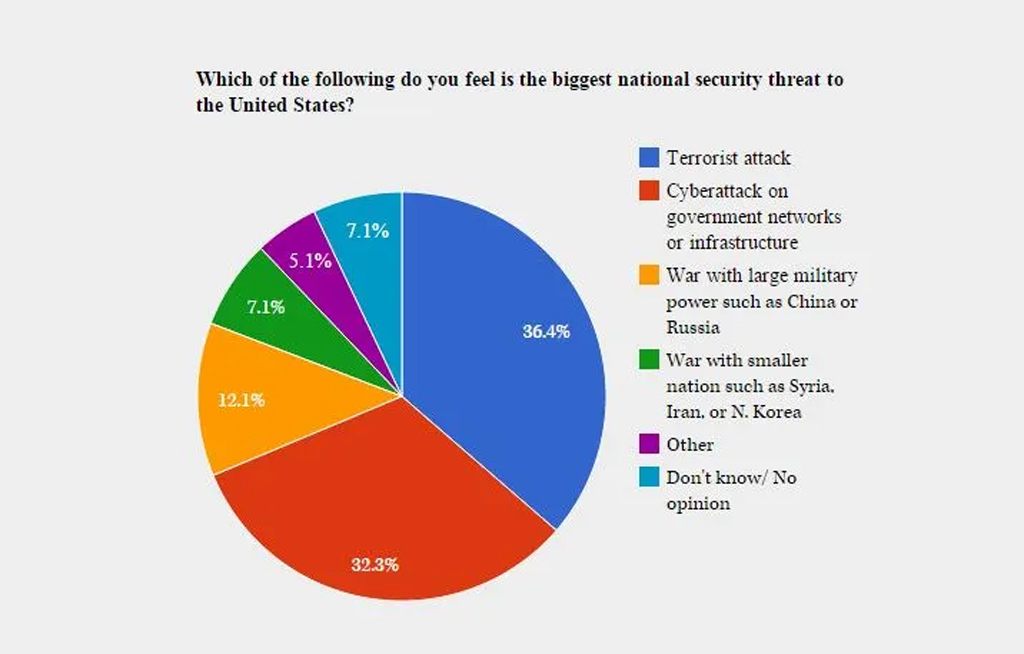
- Terrorist attacks are seen as the biggest threat, with 36.4% of respondents choosing this option.
- Cyberattacks on government networks or infrastructure rank second at 32.3%, showing strong concern over digital security.
- Together, terrorist attacks and cyberattacks account for 68.7% of total responses.
- War with China or Russia is viewed as a major threat by 12.1% of respondents.
- War with smaller nations such as Syria, Iran, or North Korea received 7.1% of responses.
- Don’t know or no opinion also stood at 7.1%, matching concern over smaller-nation conflicts.
- Other threats were the least selected category, with only 5.1% of responses.
Ransomware in Cyber Warfare Operations
- Ransomware attacks increased 32% globally at the start of 2026, with Q1 alone recording a 126% surge over the previous year.
- Manufacturing remained the most targeted sector, accounting for 28% of total global attacks with 1,553 incidents over the past year.
- 44% of all data breaches now involve ransomware, which marks a significant and dangerous increase from 32% in the prior year.
- The global average cost to recover from a ransomware attack dropped by 44% to reach $1.53 million in 2025.
- 64% of ransomware victims completely refused to pay the ransom demands in 2024, reflecting improved offline backup and recovery strategies.
- The median ransom demand reached $1.32 million, while the largest single organizational payout ever recorded was a staggering $75 million.
- 80% of modern attacks now leverage AI-assisted tools for automated credential harvesting and drastically shorten breach timelines.
- Nation-state-aligned operations consistently demonstrate an 87% success rate, with substantially higher demands reflecting advanced capabilities.
- 97% of organizations that had data encrypted were eventually able to recover it safely using isolated backups or decryption tools.
- The average operational downtime a company experiences after suffering a major ransomware attack is currently 24 days.
Espionage, Data Theft, and Intelligence Gathering
- A recent survey revealed that 64% of organizations are now actively accounting for geopolitically motivated cyberattacks like espionage.
- Estimated total financial losses stemming from intellectual property theft are projected to reach $750 billion globally.
- The global median attacker dwell time increased to 14 days in 2025, driven largely by long-term espionage campaigns.
- Compromised credentials and trusted access paths were utilized in 82% of all investigated malware-free network intrusions.
- Breaches involving third-party supply chain compromises doubled year-over-year to account for 30% of all cyber incidents.
- A staggering 75 zero-day vulnerabilities were exploited in the wild, with 44% specifically targeting enterprise networking products.
- Nation-state threat actors targeting government agencies and NGOs accounted for 79% of all documented state-sponsored attacks.
- Artificial intelligence was leveraged by threat actors in 16% of all recorded data breaches to automate reconnaissance and accelerate attacks.
- Organizations are facing an average of 1,876 cyberattacks per quarter, reflecting a 75% year-over-year increase in security breaches.
Cyber Warfare Attack Vectors
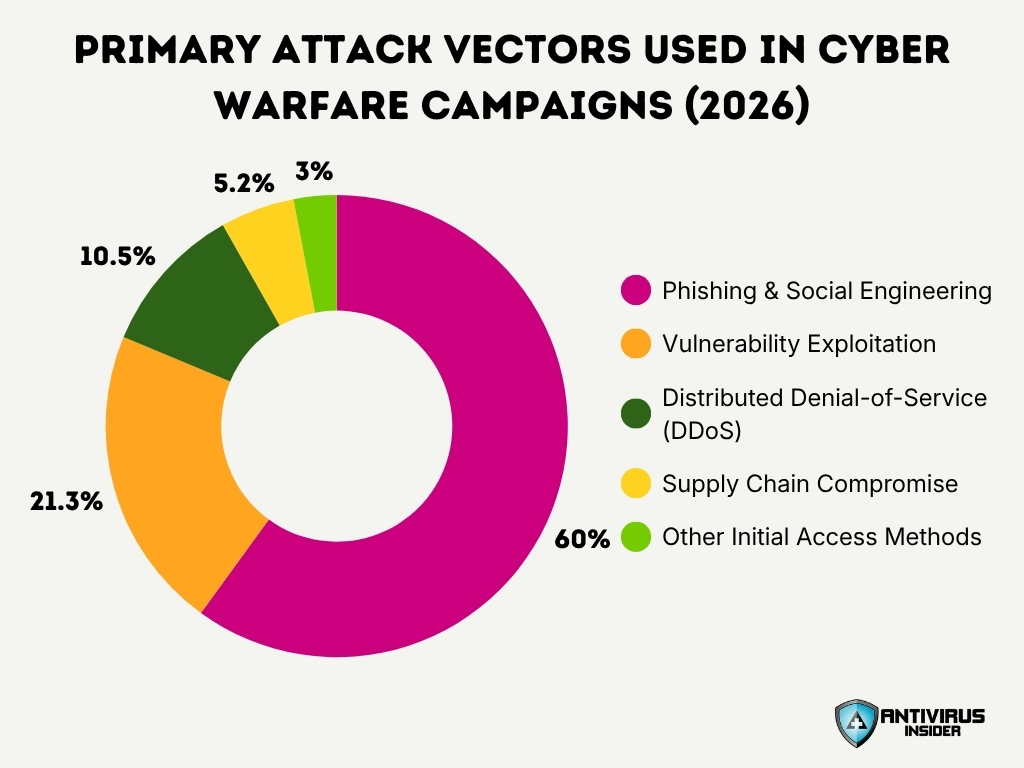
- Phishing & Social Engineering is the leading attack vector, accounting for 60.0% of cyber warfare campaigns.
- Vulnerability Exploitation ranks second with 21.3%, showing attackers still rely heavily on unpatched systems.
- DDoS attacks represent 10.5% of campaign methods, making them a key disruption tactic.
- Supply Chain Compromise accounts for 5.2%, highlighting risks from third-party vendors and software dependencies.
- Other Initial Access Methods make up only 3.0%, the smallest share among listed attack vectors.
- The data shows that human-targeted attacks, especially phishing, remain the dominant entry point in cyber warfare.
Use of Artificial Intelligence in Cyber Warfare
- AI-assisted cyberattacks have seen a 72% year-over-year increase, fundamentally changing the global threat landscape.
- Security teams report a staggering 1,265% surge in phishing attacks linked directly to generative AI capabilities.
- Organizations fully deploying AI-powered security and automation reduce their average data breach cost by $1.90 million to $2.2 million.
- Threat actors using AI are able to compose malicious emails 40% faster, leading to higher attack volumes.
- AI-generated phishing emails achieve a 78% open rate and a 21% click-through rate due to flawless grammar and hyper-personalization.
- The global AI cybersecurity market reached $31 billion and is projected to skyrocket to $134.6 billion by 2030.
- 92% of polymorphic attacks now utilize AI to dynamically modify malicious code and evade traditional signature-based detection.
- Defensive AI systems detect threats 60% faster, leading to a 45% reduction in containment costs per record.
Supply Chain Attacks Linked to Nation-States
- Software supply chain attacks experienced a massive 742% increase over a three-year period.
- Approximately 60% of all nation-state cyber operations actively target IT and software supply chains.
- Nearly 80% of organizations have suffered a data breach originating from a third-party vendor.
- Around 29% of nation-state attacks successfully infiltrate their primary targets via downstream suppliers.
- The global average financial impact of a supply chain breach currently sits at roughly $4.35 million per incident.
- An estimated 45% of organizations worldwide will have faced a direct software supply chain attack by the end of 2025.
- More than 90% of modern enterprise applications utilize open-source components susceptible to supply chain infiltration.
- Exploiting unpatched vulnerabilities in vendor software accounts for over 70% of successful supply chain compromises.
Cyber Warfare Concerns Among Business Leaders
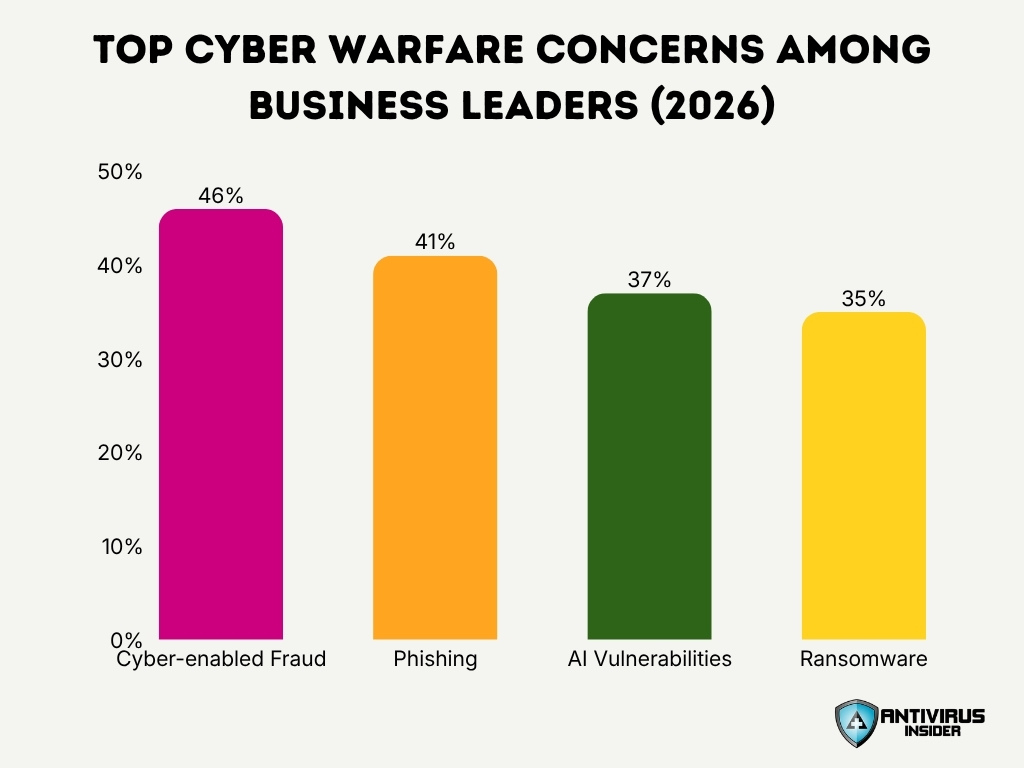
- Cyber-enabled fraud is the top concern, with 46% of CEOs worried about its impact.
- Phishing ranks second, concerning 41% of business leaders in 2026.
- AI vulnerabilities are a major emerging risk, worrying 37% of CEOs.
- Ransomware remains a serious cyber warfare concern for 35% of CEOs.
- The data shows CEOs are most focused on fraud, phishing, AI risks, and ransomware.
- All listed threats concern at least 35% of CEOs, showing broad anxiety around cyber warfare.
Cyber Defense Capabilities of Nation-States
- The global defense cybersecurity market was valued at $22.41 billion in 2025 and is projected to reach $56.57 billion by 2034.
- Over 78% of government agencies globally operated hybrid digital environments requiring continuous cyber monitoring in 2025.
- The U.S. Department of Defense allocated more than $13.5 billion for cyber-related activities in its FY2025 budget.
- North America retained a dominant 42.18% share of the global Cyber Warfare Market in 2025.
- Approximately 71% of government entities globally increased investments in real-time monitoring capabilities during 2025.
- The global government cybersecurity market size was estimated to be around $28.88 billion in 2026.
- More than 82% of government organizations experienced at least one attempted intrusion event within a yearly reporting period.
- Nearly 63% of public-sector agencies have integrated Artificial Intelligence for threat analysis and behavioral anomaly detection.
Emerging Trends and Future Projections in Cyber Warfare
- The global cybersecurity market is projected to reach $501.60 billion by 2030 with a CAGR of 11.6%.
- AI-generated phishing lures are expected to increase malicious click-through rates by up to 54% globally.
- The global AI in cybersecurity market is forecast to reach $50.83 billion by 2031 to counter automated threats.
- Government agencies worldwide are expanding oversight, with India’s CERT-In handling over 2.94 million cyber incidents in 2025.
- Compromised routers and unpatched endpoints will serve as the gateway for 75% of IoT-related critical infrastructure attacks.
- Human error and misconfigurations are projected to account for 95% of cloud security failures through 2026.
- The global average cost of a single data breach has reached $4.88 million, driving stricter cyber insurance requirements.
- Escalating geopolitical tensions are expected to drive global annual cybercrime costs past $10.5 trillion in 2026.
Frequently Asked Questions (FAQs)
The global average cost of a data breach reached $4.4 million in 2025, a 9% decrease from the previous year due to faster detection and containment.
Ransomware or extortion was involved in 44% of all analyzed data breaches, up significantly from 32% in the previous reporting period.
The latest threat landscape report analyzed 4,875 cybersecurity incidents that occurred between July 1, 2024, and June 30, 2025.
Organizations in the United States recorded an average data breach cost of $10.22 million in 2025, the highest among all measured regions.
Third-party involvement accounted for 30% of investigated breaches, nearly doubling year over year and highlighting the growing impact of software supply chain attacks.
Conclusion
Cyber warfare has evolved into one of the defining security challenges of the digital era. The latest statistics show that nation-state operations, ransomware, supply chain compromises, and AI-enabled attacks continue to increase in both sophistication and scale. Governments, defense organizations, financial institutions, and critical infrastructure operators remain primary targets, while private enterprises increasingly find themselves caught in the crossfire of geopolitical conflicts.
Looking ahead, investment in cyber resilience, Zero Trust architectures, AI-assisted threat detection, and international intelligence sharing will play a central role in reducing cyber risk. Organizations that combine proactive security strategies with continuous monitoring, employee awareness, and rapid incident response will be better positioned to withstand the evolving cyber warfare landscape.
