



Cyberattacks continue to grow in volume and sophistication, pushing consumers and businesses to invest in stronger digital protection. Avast remains one of the world’s most widely used antivirus platforms, protecting hundreds of millions of devices across PCs, Macs, and smartphones. Its technology also powers threat intelligence that helps block phishing campaigns and ransomware attacks in real time. Whether you’re a home user securing personal data or a small business managing endpoint security, Avast’s footprint offers valuable insights into today’s cybersecurity landscape. Let’s explore the latest Avast Antivirus statistics and trends.
Editor’s Choice
- Avast protects more than 435 million monthly active users worldwide, making it one of the largest consumer cybersecurity platforms globally.
- The company now serves hundreds of millions of users across PC, Mac, and mobile devices, according to its parent company, Gen Digital.
- Approximately 3% of Avast’s global users subscribe to paid plans, while the remaining users rely on free products.
- Avast’s premium products recorded a 99.8% zero-day malware detection rate during AV-TEST evaluations conducted in late 2025.
- Avast received a Top-Rated Product 2025 distinction from independent testing organizations for overall protection performance.
- Gen Digital projected fiscal 2026 revenue between $4.7 billion and $4.8 billion, reflecting strong demand for cybersecurity solutions including Avast products.
- The global antivirus software market reached approximately $4.45 billion in 2025 and is expected to continue expanding through the next decade.
Recent Developments
- In May 2026, Avast introduced a more flexible Avast One subscription model, allowing users to add premium features individually.
- Avast expanded its AI-powered scam detection tools to identify suspicious messages and fraudulent websites automatically.
- The company continued strengthening its anti-phishing capabilities as AI-generated scams became increasingly common in 2025 and 2026.
- Avast remained a member of global initiatives including No More Ransom and the Coalition Against Stalkerware.
- In December 2025, regulators distributed nearly $15.3 million in compensation to affected consumers following Avast’s privacy settlement.
- Avast maintained certifications from major testing organizations, including AV-Test, AV-Comparatives, SE Labs, and VB100 in 2025 and 2026.
- The parent company, Gen Digital, reported quarterly revenue of approximately $1.01 billion, surpassing market expectations.
- Demand for cybersecurity products increased because of the growing use of artificial intelligence in cyberattacks, benefiting brands such as Avast.
- Avast continued integrating antivirus, VPN, identity monitoring, and privacy tools into its unified Avast One platform.
Global User Base of Avast Statistics
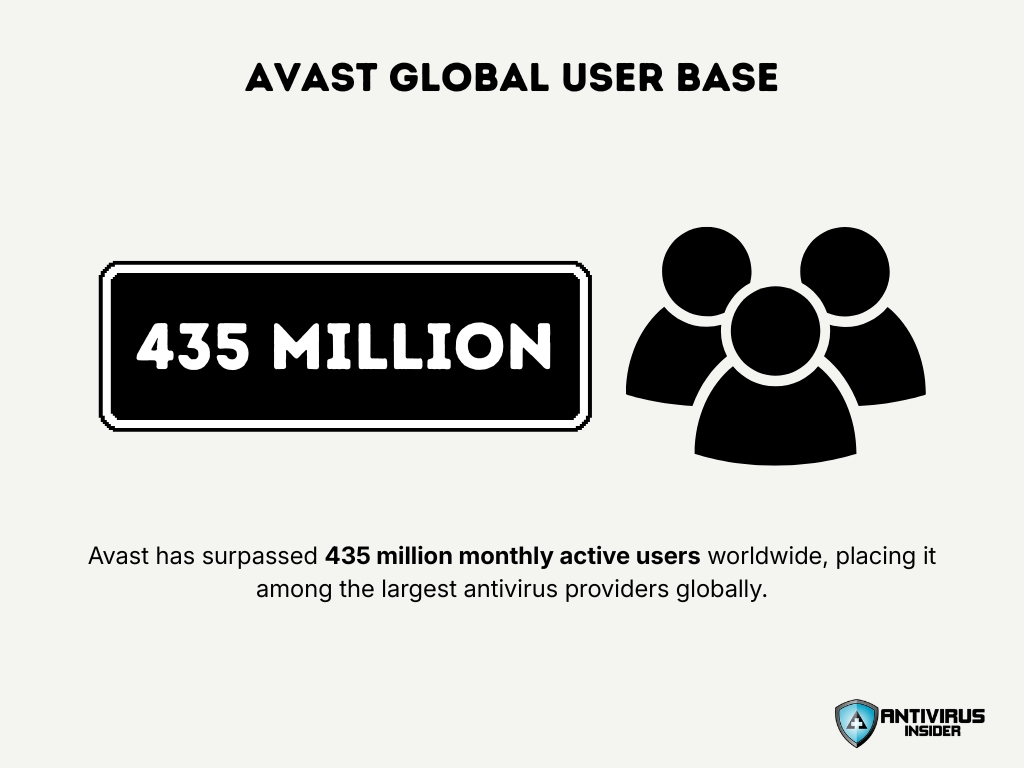
- Avast has surpassed 435 million monthly active users worldwide, placing it among the largest antivirus providers globally.
- Earlier company reports indicated a user base of around 440 million users, demonstrating sustained global reach.
- More than 100 million devices were previously associated with Avast’s data analytics platform, highlighting the scale of its ecosystem.
- Avast products are available in dozens of languages and support Windows, macOS, Android, and iOS users worldwide.
- The platform protects consumers in over 180 countries and territories, according to company materials.
- Avast remains one of the largest free antivirus communities in the cybersecurity industry.
- North America and Europe continue to represent two of Avast’s biggest markets due to high cybersecurity spending and internet penetration.
- The growth of mobile internet usage has expanded Avast’s reach among Android users in emerging markets.
- Rising cybercrime activity continues to support demand for antivirus software among consumers and small businesses worldwide.
User Growth of Avast Over Time
- Avast began operations in 1988, making it one of the oldest cybersecurity software companies still operating today.
- The company reached approximately 200 million users during the early 2010s as free antivirus adoption accelerated globally.
- By 2019, Avast’s user base had grown to around 440 million users worldwide.
- Avast reported 435 million monthly active users in 2020, even after industry consolidation and privacy challenges.
- The acquisition of AVG in 2016 significantly boosted Avast’s scale and expanded its global footprint.
- Consumer demand for cybersecurity tools increased sharply during and after the pandemic, supporting continued usage growth across antivirus platforms.
- In 2025, Gen Digital forecast stronger revenue growth because of increasing demand for cybersecurity products across consumer markets.
- Avast continues to benefit from rising concerns over phishing, identity theft, and ransomware attacks.
- The global antivirus software market is projected to exceed $8.45 billion by 2035, creating long-term growth opportunities for leading vendors such as Avast.
Worldwide Market Share of Avast Statistics
- Avast held the second-largest market share among anti-malware vendors worldwide according to industry rankings.
- The company remains one of the most widely downloaded free antivirus solutions globally because of its freemium model.
- North America accounted for approximately 48% of the global antivirus software market in 2025, making it a critical region for Avast and its competitors.
- The global antivirus market reached approximately $4.72 billion in 2025 and could exceed $8 billion by 2035.
- Another industry estimate placed the antivirus software market at $5.05 billion in 2024, with continued expansion expected through 2033.
- Increasing cyberattacks and digital fraud continue to support demand for antivirus products worldwide.
- Free antivirus products remain a major growth driver in emerging markets where consumers seek low-cost security solutions.
- Avast competes directly with major brands including Norton, Bitdefender, McAfee, Kaspersky, and Microsoft Defender.
- The company maintains a strong position in the consumer cybersecurity market because of its large user community and broad device support.
Avast Website Traffic Demographics Statistics
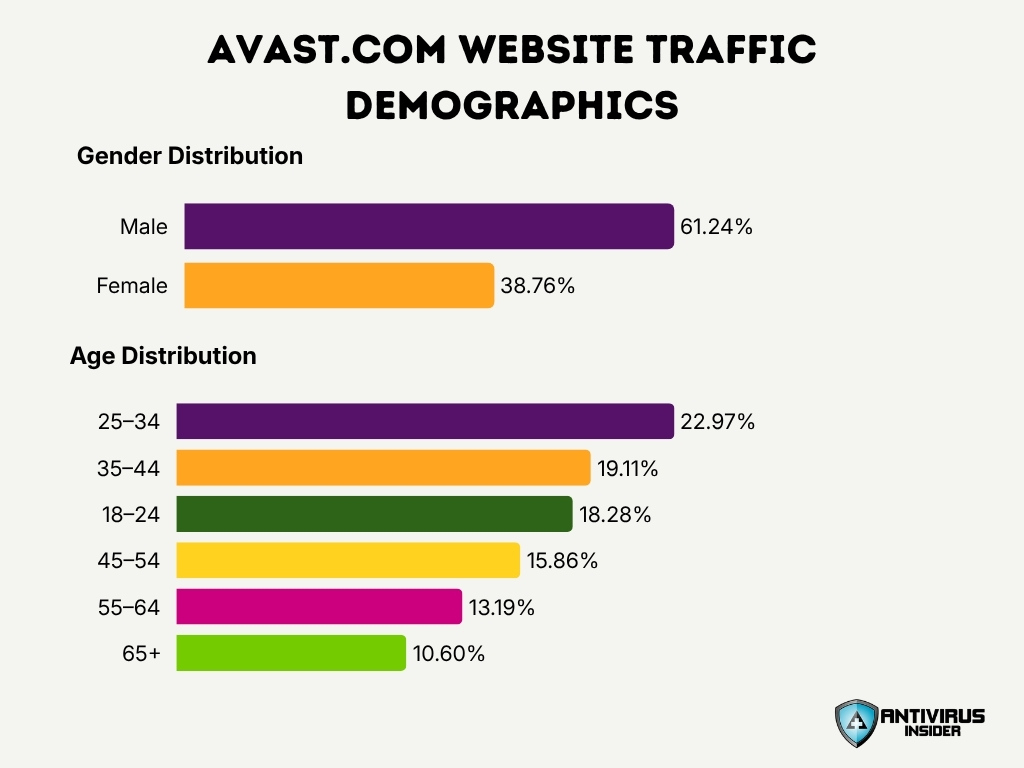
- Male visitors account for the majority of Avast’s website audience, representing 61.24% of total traffic.
- Female users make up 38.76% of Avast’s website visitors, indicating a smaller but significant audience.
- The 25–34 age group is the largest visitor segment, contributing 22.97% of total website traffic.
- Users aged 35–44 represent the second-largest audience, accounting for 19.11% of visitors.
- The 18–24 age group contributes 18.28%, highlighting strong engagement among younger adults.
- Visitors aged 45–54 make up 15.86% of Avast’s website traffic.
- The 55–64 age group accounts for 13.19% of the website’s total audience.
- Users aged 65+ represent the smallest demographic, contributing 10.60% of Avast’s website visitors.
Market Share of Avast By Country
- The United States currently accounts for 85.60% of the entire North American antivirus software market.
- India’s antivirus market is projected to expand by $124.1 million with a 9.6% CAGR by 2029.
- Avast protects an enormous global network of over 435 million monthly active users.
- Approximately 50% of all Avast users are located across Europe, the Middle East, and Africa.
- Customers in the Americas make up roughly 35% of Avast’s total global user base.
- The Asia-Pacific region represents about 17% of Avast’s rapidly growing international market presence.
- Avast maintains a significant footprint with at least 1 million users in 73 different countries.
- North America dominates the global antivirus security sector with a 48.0% overall market share.
Market Share of Avast By Device Type
- Desktop devices continue to account for the majority of Avast users, with Windows PCs representing an estimated 60% to 65% of the company’s active device base.
- Android remains Avast’s largest mobile platform due to its strong presence in emerging markets and the popularity of free mobile security apps.
- The global endpoint security market reported that more than 58% of cybersecurity incidents in 2025 targeted desktop and laptop devices, reinforcing demand for antivirus solutions on PCs.
- Smartphones generated nearly 60% of global web traffic in 2025, increasing demand for mobile antivirus applications such as Avast Mobile Security.
- The number of active Android devices surpassed 3.9 billion worldwide in 2025, creating a large addressable market for mobile security vendors.
- PC shipments reached approximately 262 million units globally in 2025, providing continued opportunities for antivirus software installations.
- Tablets represented around 6% of global internet traffic in 2025, making them a smaller but still important market for security applications.
- Consumer demand for cross-platform protection continues to rise, with more users seeking antivirus coverage across desktops, smartphones, and tablets through a single subscription.
- Multi-device subscriptions remain one of the fastest-growing segments in consumer cybersecurity because households now use an average of more than 20 connected devices.
Market Share of Avast By Operating System
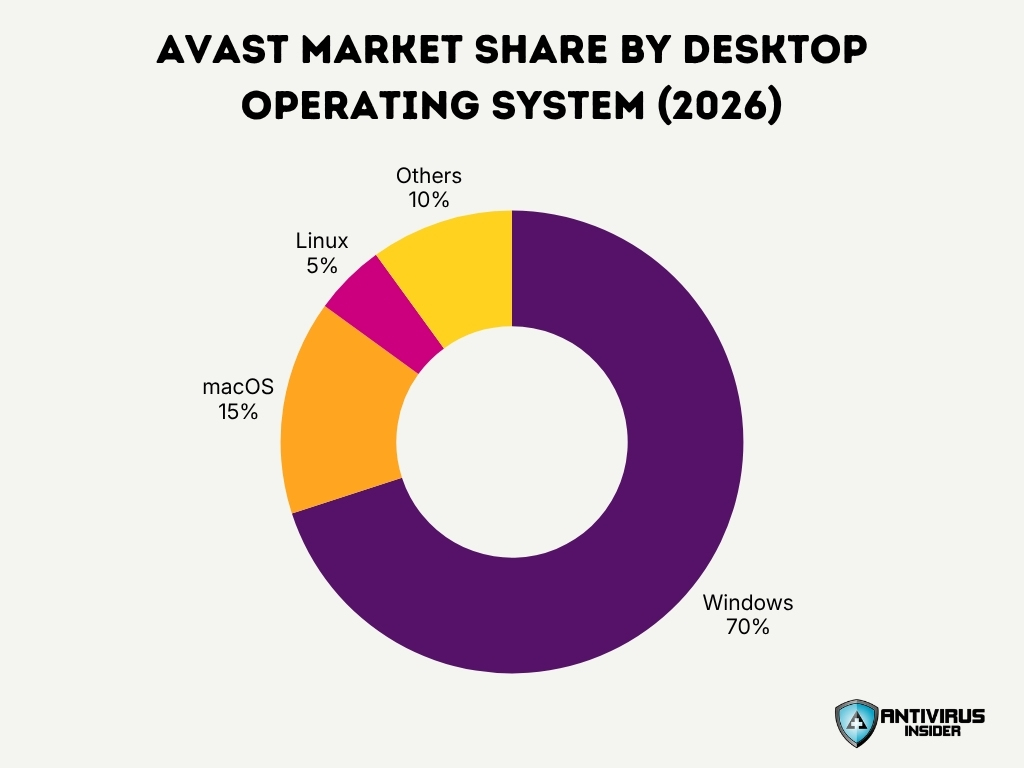
- Windows remains Avast’s largest operating system, accounting for the majority of its installed base because Windows still powers around 70% of desktop computers worldwide in 2026.
- macOS represented approximately 15% of the desktop operating system market in early 2026, giving Avast a significant opportunity among Mac users.
- Android continues to dominate the mobile market with a global share of roughly 71%, supporting strong adoption of Avast Mobile Security.
- iOS held approximately 28% of the global smartphone operating system market in 2026.
- Windows 11 crossed 400 million active devices in 2025, expanding the potential user base for antivirus software providers.
- More than 1.4 billion Windows devices remain active globally, making Windows security a core market for Avast and its competitors.
- Linux devices account for less than 5% of the desktop operating system market, limiting demand for consumer antivirus products on the platform.
- Hybrid work environments continue to increase demand for security products that function seamlessly across multiple operating systems and device types.
- The growing use of smartphones and tablets has shifted antivirus development toward cloud-based and cross-platform security services.
Free vs Paid Users of Avast Statistics
- Avast’s user base exceeds 435 million monthly active users globally.
- Approximately 3% of Avast users currently pay for premium subscriptions.
- There are roughly 13 million paid Avast users actively subscribed worldwide.
- Avast holds an estimated 60% market share within the free antivirus segment.
- Avast Premium Security achieved a 99.8% detection rate against zero-day attacks.
- The free Avast version scored a 99.99% online protection rate in independent tests.
- General free antivirus usage among consumers surged to 61% in 2025.
- General paid antivirus usage among consumers dropped to 36% in 2025.
Download and Installation Statistics of Avast
- Avast Antivirus has recorded over 435 million active users worldwide.
- The Avast Mobile Security app has surpassed 100 million downloads on Android alone.
- Avast Cleanup has exceeded 100 million Android downloads for device optimization.
- Avast Secure Browser has been downloaded by more than 50 million Android users.
- Global PC shipments exceeded 260 million units in 2025 for new antivirus installations.
- More than 5.5 billion internet users worldwide require some form of cybersecurity protection.
- Avast software successfully prevents approximately 1.5 billion cyberattacks every single month.
- The United States accounts for the highest usage with 22.09% of all Avast users.
- Avast Free Antivirus is the primary choice for 87% of the platform’s user base.
Desktop vs Mobile Users of Avast Statistics
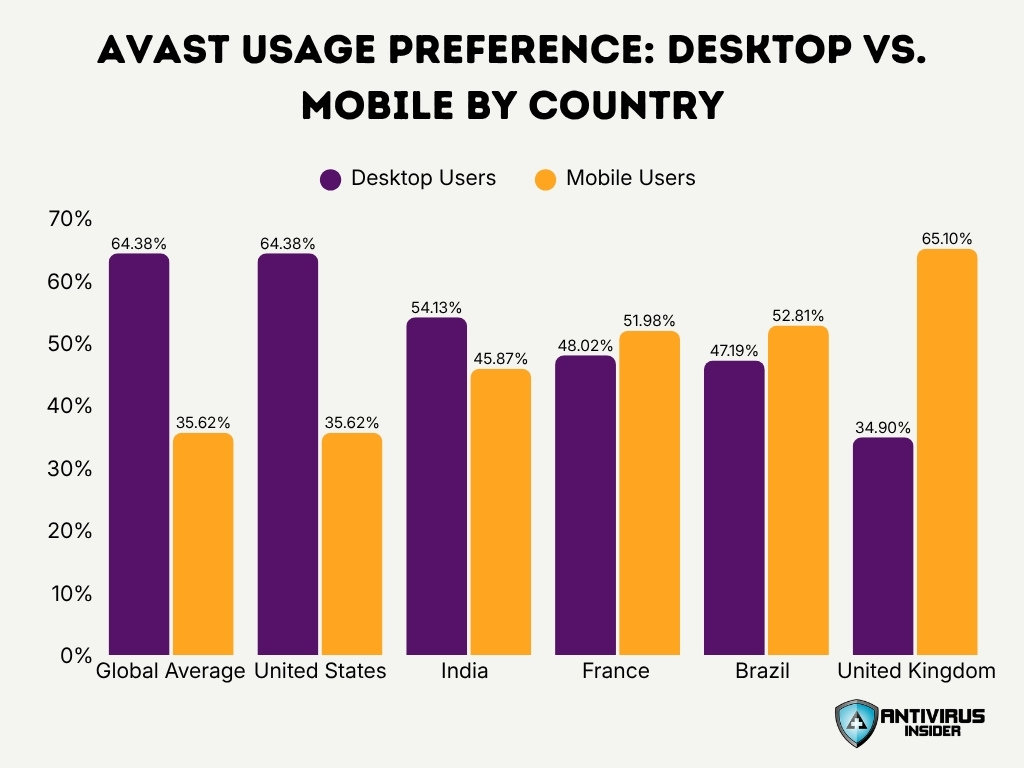
- Globally, 64.38% of Avast users prefer installing the security software on desktop computers, while 35.62% use it on mobile devices.
- Recent traffic analytics show platform visitors are closely divided into 51.9% desktop users and 48.1% mobile users.
- In the United States, 64.38% of the Avast user base operates on desktops, whereas 35.62% rely on mobile phones.
- Brazil displays a higher mobile reliance, with 52.81% mobile users compared to 47.19% desktop users for Avast products.
- In the United Kingdom, a significant 65.1% of Avast users run the software on mobile platforms, leaving 34.9% on desktops.
- India maintains a desktop majority for Avast security, with 54.13% on desktops compared to 45.87% on mobile devices.
- France leans slightly toward mobile security, recording 51.98% mobile users versus 48.02% desktop users.
- Across all desktop and mobile platforms, Avast currently protects a massive global user base of over 435 million individuals.
- Avast Free Antivirus remains the dominant product choice, utilized by 87% of the total user population across all supported devices.
- Engagement data reveals that 56% of users across both mobile and desktop environments interact with their Avast application daily.
Malware Detection Statistics of Avast
- Avast achieved a 99.8% protection score against zero-day malware attacks in independent testing during late 2025.
- Independent evaluations consistently rate Avast’s malware detection rate above 99% against widespread and prevalent malware samples.
- Avast earned multiple Advanced+ awards in malware protection assessments from independent testing organizations in 2025.
- The company uses machine learning and cloud-based analytics to identify new malware variants in real time.
- Global malware attacks exceeded 6 billion incidents in 2025, highlighting the need for antivirus protection.
- Ransomware represented one of the fastest-growing forms of malware, with attacks increasing significantly over the past year.
- The average cost of a malware-related data breach reached $4.88 million globally in 2025.
- Consumer malware increasingly targets credentials, payment information, and cryptocurrency wallets, increasing demand for advanced endpoint security.
- AI-generated malware campaigns have become more sophisticated, encouraging cybersecurity companies like Avast to invest heavily in automated threat detection systems.
Phishing Protection Statistics of Avast
- Avast ranked among the top three products globally in 2026 anti-phishing tests.
- Independent product testing in January 2026 utilized 250 live phishing URLs.
- Avast successfully achieved one of the highest blocking rates during the independent study.
- Phishing attacks account for more than one-third of all global data breaches.
- Large-scale phishing research involved a significant sample size of 12,511 participants.
- The click rate for simple phishing lures was recorded at 7% during the study.
- Successful click rates more than doubled to 15% for sophisticated phishing attacks.
- Overall consumer awareness of online scams has increased significantly since 2024.
Ransomware Protection Statistics of Avast
- Global ransomware damages are projected to exceed $275 billion annually by 2031.
- Avast successfully blocked over 10 billion unique cyberattacks globally in 2023 alone.
- Ransomware and extortion methods currently represent over 50% of all cyberattacks.
- Recent threat reports reveal a 100% increase in ransomware activity across the US, UK, and Canada.
- Ransomware attacks experienced a massive 379% surge in India and a 66% increase in Australia.
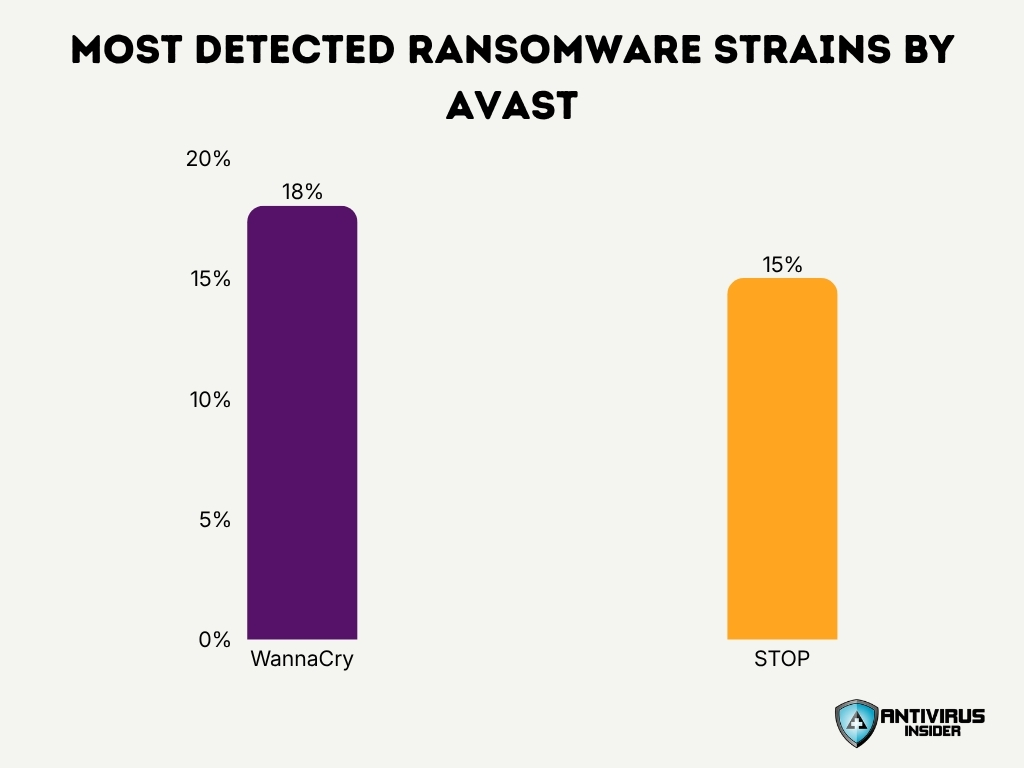
- WannaCry remains the most prevalent ransomware threat, holding an 18% market share.
- The STOP ransomware strain is the second most common, responsible for 15% of detected attacks.
- Avast observed a 24% global increase in ransomware attacks against businesses within a single quarter.
- Avast’s threat-detection network and anti-ransomware tools actively protect over 400 million users.
Real-Time Threat Blocking Statistics of Avast
- The software achieved a 100% protection rate against live malware samples in recent independent real-world tests.
- Avast demonstrated an impressive block rate of over 99% across more than 400 tested threats during security evaluations.
- The premium security version recorded a flawless 99.8% detection rate against zero-day attacks in industry benchmarks.
- The antivirus consistently scored a perfect 6 out of 6 for both protection and usability in continuous testing.
- Avast successfully reached the highest Advanced+ tier in six out of seven rigorous real-world protection evaluations.
- The global threat detection network actively protects hundreds of millions of users by analyzing tens of thousands of malicious URLs.
- Advanced cloud-based threat intelligence helps maintain a dominant 60% market share within the free antivirus software segment.
- Approximately 66% of adults use antivirus software, with free solutions like Avast surging to 61% adoption.
Performance Impact Statistics of Avast
- Avast earned perfect 6/6 scores for performance in multiple 2025 and 2026 independent evaluations.
- The product achieved a Gold Award and Advanced+ ratings in six of seven major independent tests.
- Evaluators recorded a low impact score of 2.1 for Avast during a comprehensive performance assessment.
- Testers classified the software as “very fast” across 100% of common computing activities like application launches.
- The antivirus demonstrated two times less system impact than native operating system security alternatives.
- The program delivered an 11% faster boot time on average compared to its previous software iterations.
- Avast achieved an impressive 99.8% zero-day threat detection rate while maintaining a minimal system footprint.
- The security solution scored a remarkable 97.4 out of 100 on industry-recognized performance benchmarking suites.
- Modern cloud processing architecture allows the product to reduce device resource consumption by nearly 50%.
Competitor Comparison of Avast Market Share
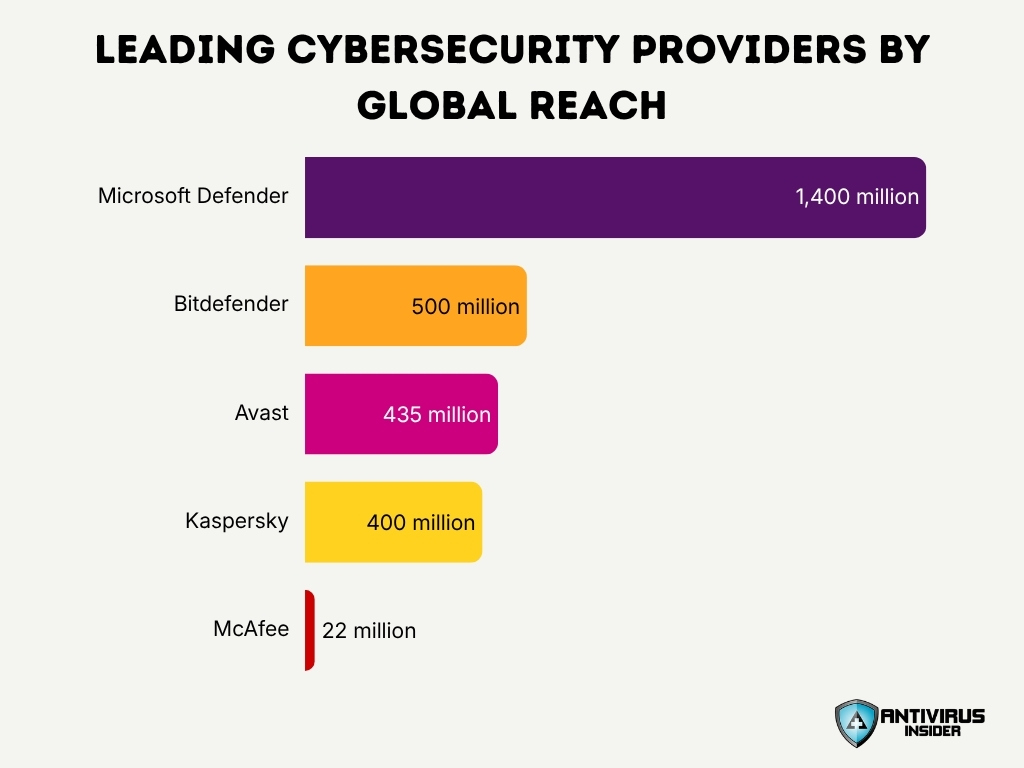
- Avast remains one of the world’s largest consumer cybersecurity providers, serving more than 435 million active users globally.
- Microsoft Defender benefits from the enormous Windows ecosystem, which exceeds 1.4 billion active devices worldwide.
- Norton, another brand under Gen Digital, maintains millions of paying customers and a strong presence in North America.
- McAfee reported approximately 22 million paying customers worldwide in its latest public disclosures.
- Bitdefender protects more than 500 million systems globally through direct and partner deployments.
- Kaspersky reported that its technologies protect over 400 million users and 240,000 corporate clients worldwide.
- AV-Comparatives and AV-Test consistently rank Avast among the leading antivirus vendors for malware detection and protection performance.
- The global consumer cybersecurity market continues to consolidate around a few major players, including Gen Digital, Microsoft, McAfee, Bitdefender, and Kaspersky.
- Freemium business models continue to give Avast a competitive advantage in emerging markets where consumers are less likely to purchase paid antivirus subscriptions.
Customer Satisfaction Statistics of Avast
- Avast maintains a strong 4.3 out of 5 overall rating from more than 44,000 customer reviews across major software review platforms.
- The software achieved an exceptional 99.97% malware protection rate during recent independent security laboratory tests.
- The antivirus consistently earns perfect 18-point scores for protection, performance, and usability in 2025 and 2026 assessments.
- Approximately 92% of business reviewers explicitly praise the software’s central management and remote deployment capabilities.
- The product secured an impressive 9.3 out of 10 score for ease of use and frictionless setup compared to technical alternatives.
- Avast earned prestigious Advanced+ certifications in 6 out of 7 consumer main-test series conducted throughout 2025.
- Evaluators recorded exactly 0 false alarms during recent intensive system usability and real-world threat assessments.
- Approximately 87% of critical reviewers cited persistent upgrade notifications as their primary issue with the free tier.
Frequently Asked Questions (FAQs)
Avast protects more than 435 million monthly active users globally, making it one of the largest consumer cybersecurity platforms in the world.
Only about 3% of Avast’s global user base subscribes to paid plans, while the remaining users rely on its free cybersecurity products.
Avast’s threat detection network blocks an average of more than 1.8 billion cyberattacks annually and over 89 million new malicious files every month.
Avast agreed to a $16.5 million settlement, and regulators later distributed nearly $15.3 million in refunds to more than 103,000 consumers.
In 2016, Avast held approximately 40% of the global antivirus market outside China, making it one of the most dominant antivirus providers worldwide.
Conclusion
Avast remains one of the largest and most recognized antivirus brands in the world, protecting more than 435 million users across desktops and mobile devices. The company’s strong malware detection scores, high rankings in independent testing, and expanding AI-powered security features have helped it maintain a leading position in consumer cybersecurity. As phishing attacks, ransomware incidents, and identity threats continue to evolve, demand for comprehensive security platforms like Avast is likely to remain strong. The statistics presented throughout this report show that Avast’s combination of free protection, premium features, and broad global reach continues to make it a major force in the antivirus industry.
