


Deepfake AI has moved from experimental media generation into a measurable fraud, identity, and cybersecurity risk. Criminals now use synthetic voices, AI-generated faces, manipulated documents, and fabricated executive videos to bypass identity checks, authorize fraudulent payments, and impersonate trusted people in business communications. At the same time, legitimate organizations use the underlying technology for entertainment, localization, advertising, education, and digital content production. The growing overlap between useful synthetic media and malicious impersonation has made verification more difficult for banks, enterprises, social platforms, regulators, and consumers. Deepfake risk is no longer limited to viral misinformation; it increasingly affects financial transactions, remote onboarding, elections, customer-service systems and personal privacy.
Editor’s Choice
- 1,567 unique verified deepfake incidents were documented during 2025, producing about 296.4 billion media impressions across the incident set.
- Documented deepfake-related fraud losses exceeded $1.28 billion in 2025, even though more than 80% of tracked incidents did not publicly disclose a financial loss.
- 62% of organizations represented in a 2025 cybersecurity-leader survey reported experiencing a deepfake attack during the preceding 12 months.
- Deepfakes made up approximately 20% of biometric fraud attempts measured in 2025, and deepfaked-selfie incidents grew 58% from the previous year.
- U.S. authorities recorded $893 million in losses across AI-involved cybercrime complaints in 2025, including schemes using voice cloning and realistic synthetic videos.
- Deepfake fraud in North American verification checks increased 1,100% in Q1 2025 compared with Q1 2024.
- Only 7% of anti-fraud professionals surveyed for a 2026 benchmarking study said their organizations were more than moderately prepared to detect or prevent AI-fueled fraud.
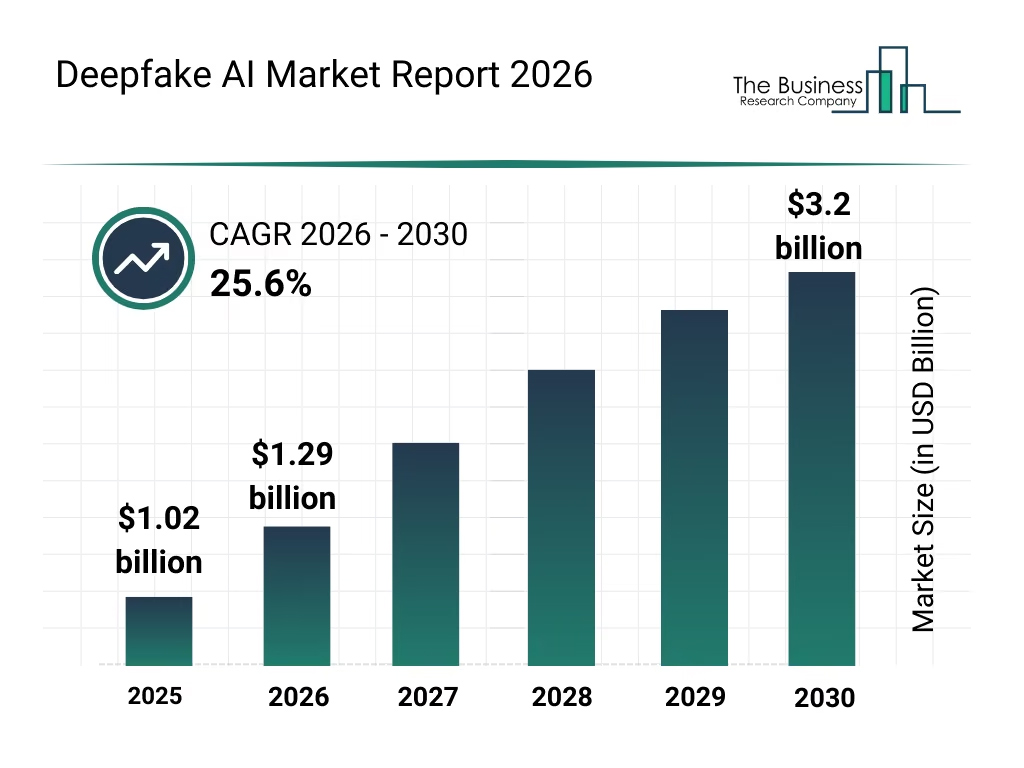
- The dedicated deepfake AI market is projected by one 2026 estimate to rise from $1.02 billion in 2025 to $1.29 billion in 2026, a 25.8% annual increase.
- Sophisticated, multi-step identity fraud increased 180% between 2024 and 2025, with its share rising from 10% to 28% of detected identity-fraud attempts. Deepfakes form part of this increasingly coordinated attack model.
Recent Developments
- A 2026 global survey found 77% of fraud professionals had observed an increase in deepfake social-engineering fraud during the previous two years, the highest increase among the AI-enabled fraud categories examined.
- In the same study, 72% reported increases in deepfake digital-injection attacks, where manipulated media enters an identity or verification process without relying on a physical camera capture.
- Only 7% of the 713 anti-fraud professionals surveyed said their organizations were more than moderately prepared for AI-powered fraud, exposing a substantial defense gap entering 2026.
- Injection attacks aimed at iOS devices increased 741% across 2025, including a 1,151% surge during the second half of the year in one global biometric-threat dataset.
- Southeast Asia recorded a 720% spike in biometric attack activity during Q3 2025 in the same threat dataset, showing that emerging attack methods can concentrate sharply in individual regions.
- Deepfaked selfies increased 58% during 2025, while deepfakes reached one-fifth of measured biometric fraud attempts.
- Sophisticated identity-fraud attacks grew 180% year over year in 2025, increasing from 10% to 28% of identity-fraud attempts examined in a dataset covering more than 4 million fraudulent attempts across 2024 and 2025.
- In 2025, 11% of first-party identity-fraud schemes in that dataset involved deepfakes, putting them among the five leading first-party fraud methods.
- Fraudsters also expanded beyond face manipulation. AI-assisted document forgery went from effectively 0% to 2% of detected fake-document cases in 2025, creating another route for synthetic identity attacks.
- The U.S. recorded 22,364 AI-linked cybercrime complaints in 2025, marking the first time the annual federal internet-crime report included a dedicated artificial-intelligence section.
Deepfake AI Market Growth Statistics
- The global deepfake AI market was valued at approximately $1.02 billion in 2025.
- The market is expected to increase to $1.29 billion in 2026, showing strong year-over-year expansion.
- By 2027, the deepfake AI market is projected to reach approximately $1.62 billion.
- The market could surpass $2 billion in 2028, reaching roughly $2.03 billion.
- Deepfake AI market revenue is projected to climb to approximately $2.55 billion by 2029.
- By 2030, the market is forecast to reach $3.2 billion, more than doubling its 2026 market size.
- Between 2026 and 2030, the deepfake AI market is projected to expand at a strong 25.6% CAGR.
- Overall, the market is expected to gain approximately $1.91 billion in value between 2026 and 2030, representing growth of roughly 148%.
Deepfake Volume and Growth Statistics
- Researchers documented 1,567 unique verified deepfake incidents in 2025 after reviewing roughly 3,253 reported incidents and eliminating duplicates.
- The verified incidents generated 296.4 billion combined media impressions, showing that repeated exposure can dramatically exceed the number of original deepfake events.
- 81% of verified deepfake incidents received coverage from only one reporting source, indicating that the public record captures a long tail of incidents that receive limited attention.
- Just 54 incidents that appeared in at least five sources averaged roughly 1.5 billion impressions each, illustrating how quickly a small number of prominent deepfakes can dominate overall reach.
- Brand- and reputation-focused deepfakes generated 156.3 billion impressions in 2025, more reach than all other incident categories combined in the same dataset.
- The top 5% of incidents categorized as critical achieved 350 times the reach of minimal-severity incidents and produced 68% of total measured media reach.
- North American deepfake fraud detected in identity-verification activity jumped 1,100% year over year during Q1 2025.
- In another biometric dataset, instances of deepfaked selfies increased 58% during 2025, while injection attacks climbed 40% from the previous year.
- Machine-generated voice fraud also accelerated sharply. During 2024, synthetic-voice attacks increased 149% at banks and financial institutions and 475% at insurance organizations measured in one voice-security dataset.
- More broadly, the share of advanced, multi-step identity-fraud attempts rose from 10% in 2024 to 28% in 2025, a 180% increase that reflects the movement toward coordinated attacks combining deepfakes with other techniques.
Deepfake Fraud Losses and Financial Impact Statistics
- Publicly documented deepfake-fraud incidents produced more than $1.28 billion in reported financial losses during 2025. More than 80% of tracked incidents had no publicly disclosed financial loss, so the documented total represents only a portion of potential exposure.
- Within that dataset, 289 documented consumer-fraud incidents were associated with approximately $1.34 billion in disclosed losses under the report’s consumer-fraud classification methodology.
- The largest documented consumer deepfake-fraud incident in the dataset reached approximately $700 million, demonstrating the outsized influence that individual high-value cases can have on annual loss totals.
- The same analysis identified 41 corporate deepfake-fraud incidents carrying about $74.9 million in documented losses.
- The largest single corporate deepfake-fraud case recorded in that dataset produced a loss of approximately $35 million.
- U.S. cybercrime complaints with a reported AI nexus produced nearly $893 million in losses during 2025. This broader category includes, but does not exclusively consist of, deepfake and voice-cloning fraud.
- AI-linked U.S. investment-scam complaints alone generated more than $632 million in reported losses in 2025, with offenders using AI-generated celebrity, executive, and trusted-person videos and voices to support fraudulent investment pitches.
- AI-associated employment scams produced almost $13 million in reported losses in 2025. Some schemes used voice spoofing or possible voice deepfakes during remote job interviews, although other employment attacks focused on obtaining network access rather than immediate payments.
- For context, U.S. consumers reported $3.5 billion in losses to all imposter scams in 2025, up nearly 20% from the prior year. This is a broader category and should not be interpreted as a deepfake-only loss figure.
- Total reported U.S. consumer fraud losses reached approximately $15.9 billion to $16 billion in 2025, about 25% higher than 2024. Deepfakes represent one growing mechanism within this much larger fraud environment rather than the sole cause of the increase.
Deepfake Attack Statistics by Industry and Sector
- In a 2025 survey, 45% of financial-services organizations said they experienced an AI-powered cyberattack during the previous 12 months, compared with 38% of organizations across other industries.
- Moreover, 55% of financial-services organizations reported an increase in deepfake attacks during the previous year, compared with 43% among organizations outside the sector.
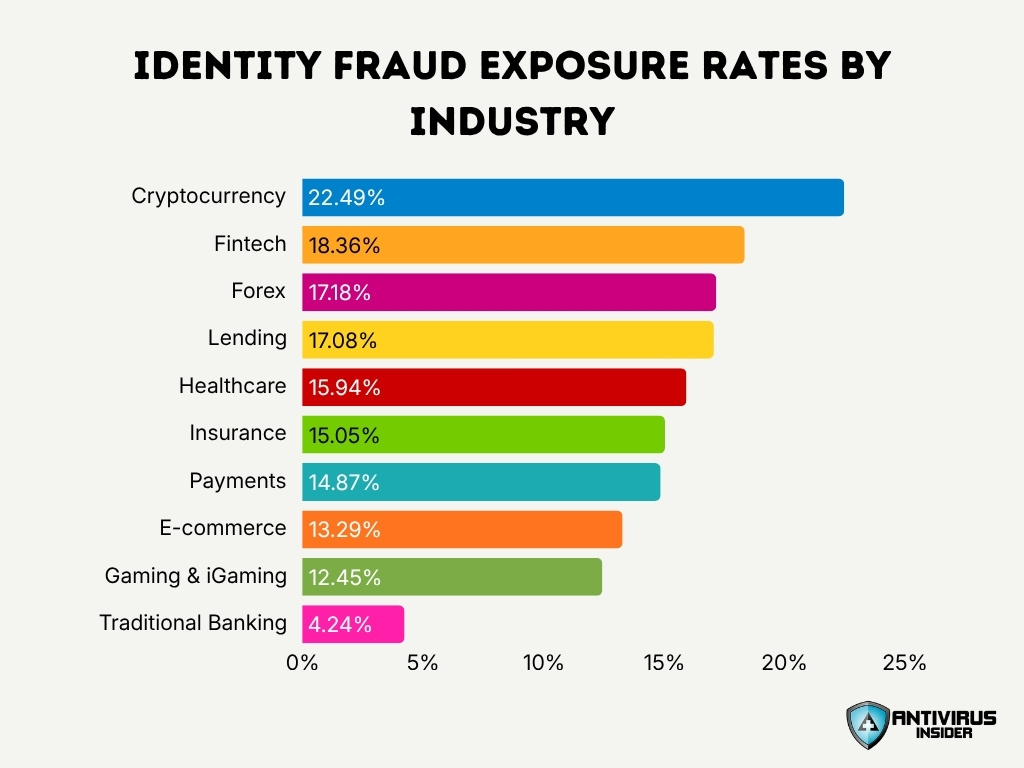
- A 2026 identity-verification dataset found that fraudulent verification attempts represented 22.49% of requests in cryptocurrency, the highest rate among the industries examined. This measures overall identity fraud rather than deepfakes alone.
- Fintech followed with an identity-fraud exposure rate of 18.36%, underscoring the pressure on digital-first financial onboarding systems.
- Forex platforms recorded a 17.18% identity-fraud rate, while lending and investment services recorded 17.08%. These categories include synthetic identities, face swaps, and other identity attacks.
- Healthcare verification traffic recorded a 15.94% fraud rate in the same 2026 analysis, showing that synthetic identity risks now extend beyond traditional financial targets.
- Insurance recorded a 15.05% identity-fraud exposure rate, reflecting criminals’ interest in account access, claims, and identity-linked transactions.
- Payments businesses recorded fraudulent activity across 14.87% of verification requests, while e-commerce and marketplace businesses recorded 13.29%.
- Gaming and iGaming recorded a 12.45% identity-fraud rate, while telecommunications recorded 8.07%.
- Traditional banking showed the lowest rate among the industries listed in that 2026 dataset at 4.24%, although the high transaction values involved can still make successful deepfake attacks financially significant.
Corporate and Business Deepfake Attack Statistics
- 42% of U.S. security practitioners surveyed in 2025 said executives or board members at their organizations had been targeted at least once with a fake image or video.
- Among organizations that experienced executive targeting, senior leaders faced an average of three fake-image or video attacks, showing that attacks often recur rather than end after one attempt.
- Another 18% of respondents were unsure whether their senior leadership had already experienced a deepfake attack, illustrating the visibility problem surrounding synthetic impersonation.
- 66% of respondents considered it highly likely that their executives would face a future deepfake attack.
- Detection remains difficult: 59% described identifying deepfake attacks against executives as very or highly difficult.
- Among reported targeting methods, 28% involved impersonating a trusted entity, such as another executive, colleague, family member or known organization.
- Urgent messages demanding immediate payment or responding to an alleged security breach accounted for another 21% of executive-targeting methods.
- Only 34% of organizations reported high visibility into suspicious activity that could help them prevent deepfake threats.
- Just 36% of respondents said their organizations measured the financial cost of deepfake attacks, meaning many companies still lack a clear estimate of their economic exposure.
- In 2026, one global breach analysis found that one in four malicious breaches involved AI enablement, mostly through deepfake impersonation and AI-assisted malware. Those AI-enabled breaches cost organizations about $6 million on average.
Video Deepfake and Face-Swap Attack Statistics
- Face-swap attacks increased 300% during 2024 compared with 2023, according to live biometric threat observations.
- Native virtual-camera attacks surged 2,665% during 2024, making synthetic camera feeds one of the fastest-growing identity-attack vectors measured that year.
- Digital-injection attacks increased 783% in 2024, allowing criminals to send manipulated content directly into verification workflows rather than presenting it to a physical camera.
- Deepfakes accounted for 40.8% of fraud attempts against video-based biometric checks in a 2025 identity-fraud dataset.
- Earlier measurements showed face-swap attacks climbing 704% between the first and second halves of 2023, illustrating how quickly this attack technique reached operational scale.
- During the same 2023 period, criminals’ use of emulators for video-injection attacks increased 353%.
- Digital-injection attacks targeting mobile web platforms rose 255% between H1 and H2 2023, another indicator of the move away from basic presentation attacks.
- Researchers identified more than 115,000 potential biometric-attack combinations that criminals could construct using only three commonly available attack tools.
- A 2025 enterprise survey found 37% of organizations had encountered deepfakes during video calls, compared with a higher incidence for synthetic or manipulated audio calls.
- The online ecosystem supporting advanced identity attacks had grown to nearly 24,000 users selling or exchanging attack technologies by the 2025 reporting period.
Voice Cloning and Audio Deepfake Statistics
- Analysis of more than 1.2 billion calls found that deepfake activity in contact centers increased 680% year over year during 2024, creating the base for continued expansion into 2025.
- Across confirmed fraud cases, machine-generated or replayed voices represented approximately 0.90% of total confirmed fraud.
- During Q4 2024, machine-generated voice fraud approached 1.95% of confirmed fraud, up sharply from about 0.21% in Q1.
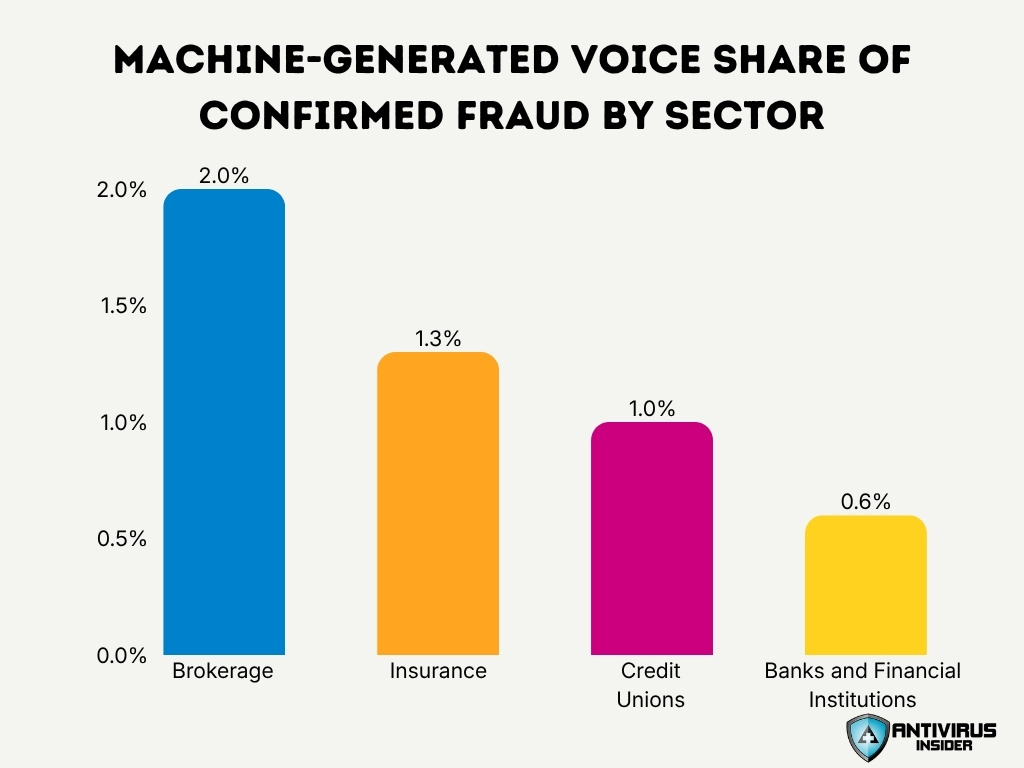
- Brokerage businesses recorded the highest measured proportion of synthetic or replayed voice fraud at 2% of total fraud cases.
- Insurance organizations followed at 1.3%, while credit unions recorded approximately 1% of fraud from machine-generated or replayed voices.
- Banks and other financial institutions recorded a lower 0.6% share of confirmed fraud involving synthetic or replayed voices, but their transaction volumes make even small percentages material.
- Deepfake attacks targeting contact centers increased 1,337% between 2023 and 2025, reflecting how rapidly fraudsters adopted synthetic speech in customer-service environments.
- The number of publicly listed text-to-speech models on one major model repository increased from roughly 300 in 2023 to 3,300 by 2025, an elevenfold expansion in two years.
- Modern zero-shot voice-cloning systems can reproduce a person’s voice from only a few seconds of reference audio, lowering the amount of source material criminals need to impersonate an individual.
- A 2026 audio-detection benchmark covering 2,000 balanced real and synthetic samples from 12 commercial voice generators produced 95.4% accuracy for its highest-performing detector, while several comparison models stayed near chance.
Identity Verification and Biometric Fraud Statistics
- Digital forgeries accounted for 57.46% of document fraud in the 2025 identity-fraud dataset, overtaking physical counterfeits for the first time.
- Digital document manipulation increased 244% year over year, highlighting how software-based forgery has become easier to produce at scale.
- Compared with 2021, digital document fraud had increased approximately 1,600% by 2024.
- National identity cards represented 40.8% of document attacks worldwide, making them the most frequently attacked document type in that analysis.
- Cryptocurrency platforms recorded fraudulent onboarding activity in 9.5% of verification attempts during the reporting period, almost twice the rate found in several other major financial segments.
- Lending and mortgage services recorded fraudulent onboarding attempts at 5.4%, making them the second-most-targeted financial category in that dataset.
- Traditional banks followed at 5.3% of onboarding attempts, showing that established institutions remain heavily exposed despite mature compliance programs.
- Fraudulent verification activity at cryptocurrency businesses rose 50% year over year, from 6.4% in 2023 to 9.5% in 2024.
- Traditional banks experienced a 13% annual increase in fraudulent onboarding attempts during the same period.
- Across another global identity dataset, deepfake detection increased fourfold from 2023 to 2024, and deepfakes reached 7% of detected fraud attempts, illustrating the growing role of synthetic media within identity fraud.
Deepfake Detection Accuracy and Human Perception Statistics
- A large meta-analysis combined 56 research papers, 137 effect sizes, and 86,155 participants, making it one of the broadest evaluations of human deepfake-detection performance available.
- Across the pooled studies, people correctly identified deepfake material only 55.54% of the time, with the confidence interval crossing the 50% chance level.
- Humans performed better when assessing genuine media, correctly identifying authentic material 68.08% of the time.
- Overall accuracy across both genuine and deepfake stimuli reached 60.6%, showing that people’s stronger recognition of real material raises the combined result.
- Audio deepfakes produced a pooled human-detection accuracy of 62.08%, although the wide confidence interval meant performance did not reliably exceed chance across studies.
- Human accuracy fell to 53.16% for deepfake images and 52% for synthetic text, placing both forms of media only slightly above a coin flip.
- For deepfake video, people correctly identified manipulated content 57.31% of the time across the pooled studies.
- Training, AI assistance, and other detection strategies increased pooled deepfake-detection performance to approximately 65.14%, indicating that intervention can improve human judgment even though results remain imperfect.
- A 2026 evaluation across 10 major datasets found that automated detectors typically lose 10% to 15% of their performance when tested on out-of-distribution deepfakes rather than familiar data.
- The same 2026 evaluation tested 6 approaches for adversarial robustness and found that white-box adversarial attacks exceeded an 80% success rate, demonstrating that high laboratory accuracy does not guarantee resilience against deliberately evasive deepfakes.
Social Media and Online Platform Deepfake Statistics
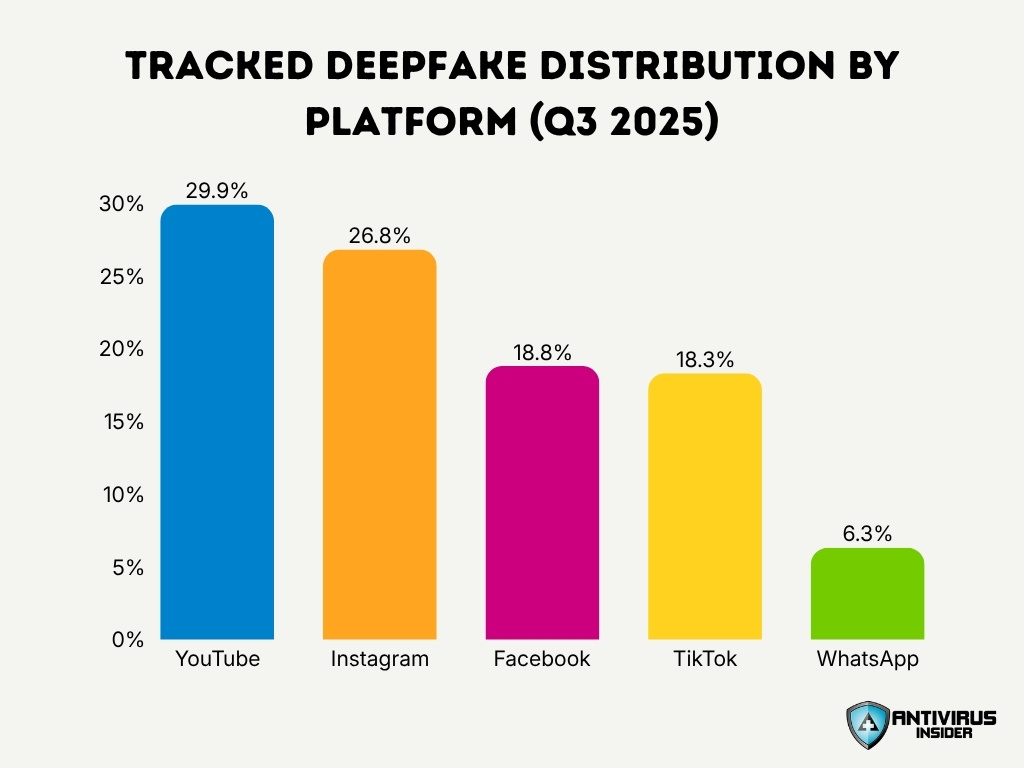
- During Q3 2025, 29.9% of tracked deepfake distribution occurred through YouTube, the largest share among the five major platforms measured in the incident dataset.
- Instagram accounted for 26.8% of Q3 2025 deepfake distribution, placing it second in that same analysis.
- Facebook represented 18.8% of tracked Q3 deepfake distribution, while TikTok accounted for another 18.3%.
- WhatsApp represented 6.3% of measured deepfake distribution during Q3 2025. Its private-message structure can make manipulated content harder for outside researchers and fact-checkers to observe.
- U.S. consumers reported $2.1 billion in losses from scams that started on social media in 2025. Nearly 30% of people who reported losing money to a scam said social media was the initial contact channel. This figure covers all social-media scams, not deepfakes alone.
- Reported social-media scam losses in 2025 were approximately eight times higher than in 2020, illustrating the financial scale of the distribution channels that deepfake scammers increasingly exploit.
- Investment schemes generated $1.1 billion in reported social-media scam losses in 2025, representing more than half the total money lost through scams that started on social platforms. Synthetic celebrity endorsements and manipulated identities can support this type of fraud, although the figure includes non-deepfake scams as well.
- A 2026 consumer study in India found that people who encountered synthetic content reported seeing it most frequently on Instagram at 65%, followed by Facebook at 59%, YouTube at 48%, Telegram at 44%, and WhatsApp at 41%.
- Another 2026 threat dataset found that YouTube accounted for 64.8% of AI scam-video blocks on supported Windows devices during Q4 2025, compared with 11.1% for Facebook. These figures reflect the monitored devices rather than the overall risk of each platform.
- Social platforms also provide enormous potential reach in the U.S.: in 2025, 84% of U.S. adults used YouTube, 71% used Facebook, 50% used Instagram, and 37% used TikTok. This audience scale helps explain why synthetic-media scams can spread quickly once published.
Deepfake Incidents by Region and Country Statistics
- North America accounted for 38% of reported deepfake incidents in a Q1 2025 global incident analysis, making it the largest regional share in that dataset.
- Asia represented 27% of reported incidents, while Europe accounted for 21%. Oceania represented 6%, Africa 5%, and South America 3%.
- Between Q1 2024 and Q1 2025, detected deepfake fraud increased 1,100% in North America, compared with a 900% increase in Europe and a 700% global regional average.
- Hong Kong recorded the sharpest national increase in that period at 1,900%, followed by Singapore at 1,500% and mainland China at 1,183%.
- Germany recorded a 1,100% increase in detected deepfake fraud, while the United Kingdom recorded a 900% increase between Q1 2024 and Q1 2025.
- A separate full-year 2025 analysis found the Maldives recorded a 2,100% year-over-year increase in deepfake attacks, the highest national increase in its APAC dataset.
- Malaysia recorded a 408% increase in deepfake activity during 2025, followed by Mongolia at 200%, Thailand at 199%, and Sri Lanka at 194% among the fastest-growing APAC jurisdictions measured.
- Singapore’s overall fraud growth declined 12% in 2025, yet detected deepfake incidents increased more than 158%, showing that synthetic impersonation can rise even where total fraud activity falls.
- Broader identity fraud moved in different directions by region during 2025: rates declined 14.6% in Europe and 5.5% in North America, while increasing 19.8% in the Middle East, 16.4% in APAC and 9.3% in Africa. These figures cover identity fraud generally, not deepfakes alone.
- Among individual regional fraud rates measured in 2025, Iraq reached 9.7%, Pakistan 5.9%, Tanzania 5%, Argentina 3.8%, Latvia 3.7%, and the U.S. 1.4%.
Non-Consensual Deepfake Pornography Statistics
- Non-consensual intimate imagery and child sexual abuse material accounted for 311 verified deepfake incidents in 2025, equal to about 20% of all verified incidents in one annual deepfake dataset.
- Analysts identified 8,029 realistic AI-generated child sexual abuse images and videos during 2025.
- Reports containing realistic AI-generated child sexual abuse material increased from 193 in 2024 to 491 in 2025, a 154% increase.
- Analysts recorded 3,443 AI-generated abuse videos in 2025, compared with only 13 in 2024, representing an increase of roughly 26,385%.
- 65% of AI-generated abuse videos identified in 2025 fell into Category A, the most severe classification used in the underlying analysis, compared with 43% of non-AI criminal videos.
- Another 30% of AI-generated abuse videos fell into Category B, meaning approximately 95% belonged to the two most severe categories combined.
- Analysts assessed 4,586 realistic AI-generated abuse images in 2025, representing about 1% of the 449,298 abuse images on which they took action that year.
- Girls appeared in 97% of AI-generated child sexual abuse images identified in 2025. Across the combined 2024-2025 dataset, 99% of AI-generated images depicted girls.
- Children estimated to be ages 7 to 10 accounted for 44% of AI-generated child sexual abuse images identified in 2025, while depictions of children ages 3 to 6 recorded the largest annual growth at 31%.
- A major 2026 international study estimated that approximately 1.1 million children across 21 surveyed countries had been affected by AI-generated sexual imagery during a one-year period, illustrating that synthetic sexual abuse has moved beyond isolated online incidents.
Election and Political Deepfake Statistics
- A 2025 global assessment identified 215 generative AI election incidents across 50 countries that held competitive national elections in 2024.
- 80% of countries holding competitive national elections in 2024 experienced at least one documented generative AI incident related to their election.
- Content creation accounted for 90% of election-related AI incidents, including synthetic audio, images, video, and social-media posts.
- Researchers classified 69% of documented election AI incidents as harmful, although the analysis did not conclude that AI changed the outcome of the elections examined.
- Attribution remained difficult: 46% of incidents had no known source, while 25% were associated with political candidates or parties and 20% with foreign actors.
- Another election-monitoring project documented 133 deepfakes across 30 countries and five continents, with significant deepfake campaigns appearing in 39% of the elections it tracked from fall 2023 onward.
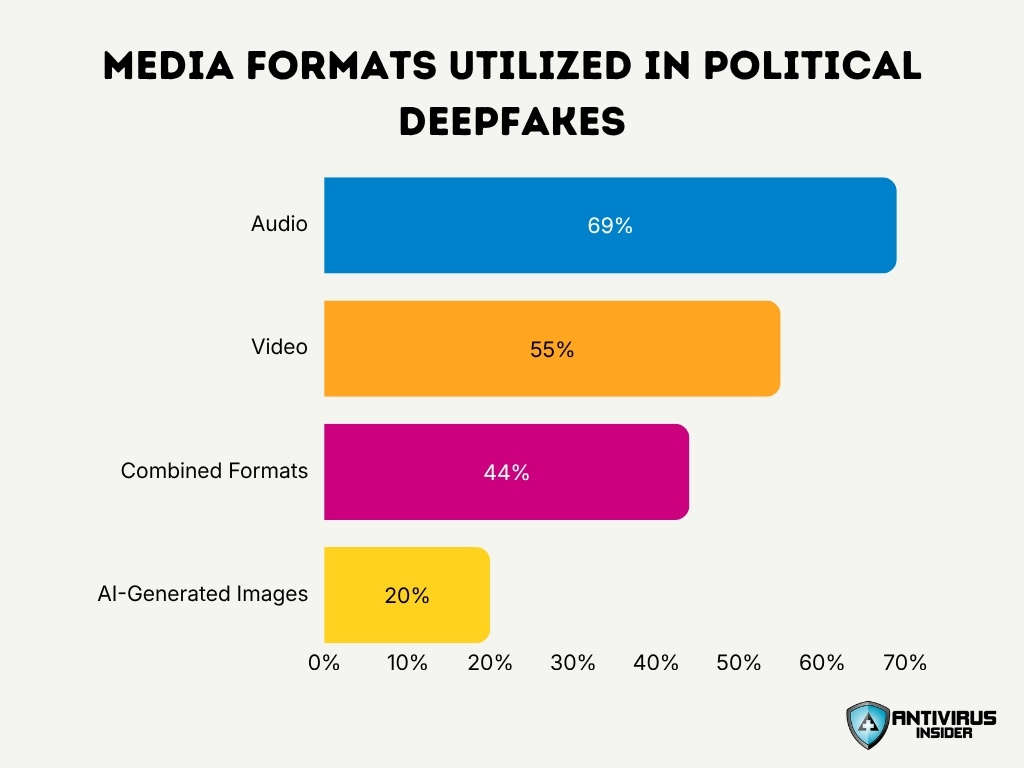
- Audio appeared in 69% of the political deepfake cases in that dataset, compared with video in 55% and AI-generated images in 20%; 44% combined more than one media format.
- The U.S. 2024 election generated 36 tracked deepfake cases in that analysis, nine times the four cases recorded for the U.K. election.
- A separate analysis covering the 2024 U.K., EU and French elections identified 16 confirmed viral AI-enabled disinformation cases in the U.K. and 11 across the EU and French elections combined. Researchers found no evidence that those incidents meaningfully altered the election results.
- Ahead of Brazil’s October 4, 2026 election, 75% of Brazilians reportedly interact regularly with AI, and nearly 63% said they would consider consulting AI about political candidates, increasing the relevance of rules governing synthetic political content.
Deepfake Laws and Regulations Statistics
- By July 2026, 49 U.S. states enacted deepfake laws, with 87% passed since 2024.
- State legislatures passed 58 deepfake-related bills by late July 2026, compared to 64 in 2025.
- By mid-2026, 31 states had laws regulating political deepfakes, mostly relying on disclosure requirements.
- Of the 31 state frameworks, 28 relied on disclosure requirements, while Minnesota, Texas, and Maryland used prohibitions.
- A July 2026 legislative tracker counted 33 states with political-deepfake laws, up from 28 the previous year.
- 48 states enacted laws addressing sexually explicit deepfakes by mid-2026, with 36 states covering both adult and child imagery.
- Platforms must remove AI-generated intimate digital forgeries within 48 hours under the federal TAKE IT DOWN Act.
- Regulators sent compliance reminders to 14 major technology companies and warned 12 businesses offering “nudify” tools.
- The EU implemented major AI transparency rules on August 2, 2026, requiring clear disclosures for deepfakes.
Future Deepfake Trends and Projections Statistics
- Based on fraud activity recorded from January through May, one 2026 projection estimates that overall deepfake identity fraud could increase 495% during 2026, or almost sixfold compared with 2025. The figure remains an annualized estimate rather than a completed full-year total.
- Synthetic identities represented 42.3% of measured deepfake identity fraud in 2025, making them the largest of four AI-enabled identity-attack categories in that analysis.
- Live-video deepfakes represented 28.1% of 2025 deepfake identity fraud, while face swaps accounted for 17.6% and document deepfakes for 11.9%.
- Document deepfakes are projected to increase approximately 3,892% in 2026, equivalent to roughly 40 times their 2025 level if the January-May 2026 run rate continues.
- By the first half of 2026, document deepfakes accounted for 80.1% of measured AI-enabled identity-fraud artifacts, while synthetic identities represented 12.31% and injected video 4.01%.
- Anti-fraud professionals remain concerned about further growth: 55% expect deepfake social engineering to increase significantly during the next 24 months. The same share expects significant growth in generative AI document fraud and forgery.
- Defense spending and adoption are also changing. 25% of organizations used AI or machine learning in their anti-fraud programs in 2026, up from 18% in 2024, while another 28% expected to adopt the technology by 2028.
- Governance has not kept pace with adoption: although 86% of organizations considered accuracy important or very important when adopting generative AI for anti-fraud use, only 18% reported testing AI models for bias or fairness.
- Consumer expectations point in the same direction. 68% of U.S. adults surveyed in 2025 said increased AI use would make online scams and attacks more common, while only 4% expected AI to make them less common.
- A 2026 global consumer study found 50% of adults had encountered an AI-driven scam during the prior year. Exposure reached 67% among Gen Z and 56% among U.S. respondents, suggesting that synthetic deception will increasingly become a routine consumer-security issue rather than an isolated technical threat.
Frequently Asked Questions (FAQs)
There were 1,567 unique verified deepfake incidents in 2025, generating a combined 296.4 billion media impressions.
Documented deepfake incidents resulted in more than $1.28 billion in reported losses, although more than 80% of incidents disclosed no financial damage.
Deepfake-powered identity fraud is projected to increase 495% in 2026, nearly 6x the 2025 level, based on annualized fraud-attempt data.
Current estimates vary by methodology: one forecast values the market at $694.06 million in 2026, while another places it at $1.29 billion.
One market forecast projects a 42.8% CAGR from 2025 to 2031, with the global market expanding from $850 million to $7.27 billion.
Conclusion
Deepfake AI entered the year as both a fast-growing technology market and an established fraud tool. Verified incidents, biometric attacks, corporate impersonation, synthetic voice scams, political manipulation, and non-consensual imagery show that deepfakes now operate across nearly every major digital environment. The threat is also becoming more complex as criminals combine generated faces, cloned voices, synthetic documents and stolen identity data within the same attack.
At the same time, governments and businesses are responding with new disclosure rules, takedown requirements, detection systems and stronger identity-verification controls. These defenses will need to keep evolving because deepfake tools are becoming cheaper, faster, and easier to deploy at scale. Organizations that rely on a single visual, voice, or document check will face increasing exposure, while layered verification, content authentication, employee awareness, and continuous fraud monitoring will become more important. The statistics throughout this article show that deepfake AI is no longer an emerging risk; it is now a persistent operational, financial, and societal challenge.
