


Spam is no longer limited to unwanted promotional emails. Criminals increasingly combine email, text messages, robocalls, social media messages, fake identities, malicious links, QR codes, and AI-assisted social engineering to reach consumers and businesses at scale. These campaigns often imitate familiar interactions, such as bank security alerts, package-delivery updates, job offers, government notices, and account-verification requests, making fraudulent communication harder to recognize at first glance.
The financial consequences have also become more serious. Reported internet crime losses reached nearly $21 billion in 2025, while billions of robocalls and enormous volumes of unwanted email continued to reach U.S. consumers. At the same time, generative AI is helping attackers produce more convincing messages, synthetic identities, cloned voices, and personalized phishing campaigns. The following spam statistics examine the scale of the problem, the channels attackers use, financial losses, industry targets, filtering effectiveness, and the emerging technologies shaping spam.
Editor’s Choice
- 44.99% of global email traffic was spam in 2025, down 2.28 percentage points from the previous year.
- Spam climbed sharply late in the year, reaching 52.87% of global email traffic in November 2025 and 51.80% in December.
- More than 5.6% of emails analyzed by one global email-security network in 2025 were classified as malicious, rather than merely unwanted.
- U.S. consumers received approximately 52.5 billion robocalls during 2025, only about 1% fewer than in 2024.
- Consumers filed more than 2.6 million Do Not Call complaints during fiscal 2025, although unwanted-call complaints remained about 48% below their 2021 level.
- Text-message scams produced $470 million in reported consumer losses in 2024, despite the number of text-scam reports declining compared with earlier periods.
- Internet crime losses reached nearly $21 billion in 2025, compared with $16.6 billion reported for 2024.
- AI-related internet crime became measurable at significant scale in 2025: more than 22,000 complaints referenced AI and produced over $893 million in reported losses.
- AI-automated phishing emails have achieved reported click-through rates of 54% versus 12% for standard phishing attempts, illustrating how automation can make malicious messaging more persuasive.
Recent Developments
- The 2025 Internet Crime Report recorded 1,008,597 complaints, up from 859,532 complaints in 2024. That represents an increase of roughly 17%.
- Reported internet crime losses increased from about $16.6 billion in 2024 to nearly $21 billion in 2025, continuing a sharp rise in the financial impact of online crime.
- More than 22,000 AI-related complaints in 2025 accounted for over $893 million in reported losses, providing a concrete measure of AI’s growing role in fraud.
- Businesses reported more than $30 million in losses from business email compromise scams involving AI during 2025.
- AI-linked confidence and romance scams generated more than $19 million in reported losses during 2025, while distress scams involving tactics such as voice cloning accounted for more than $5 million.
- Deceptive links appeared in 52% of malicious emails in 2025, up from 43% in 2024, making links the leading malicious email threat category in the analyzed traffic.
- Identity-based attacks increased 32% during the first half of 2025, while more than 97% of identity attacks involved password attacks.
- Email bombing became a notable social-engineering tactic in 2025. Attackers can subscribe one target to hundreds or thousands of services, burying legitimate security alerts beneath a flood of unwanted messages.
- Government impersonation complaints rose sharply into 2025. Reported losses associated with government impersonation reached approximately $798 million in 2025, compared with about $406 million in 2024.
Global Spam Overview
- Spam represented an average 44.99% of worldwide email traffic in 2025, down 2.28 percentage points year over year.
- Based on that decline, spam accounted for approximately 47.27% of global email traffic in 2024, providing a useful year-over-year benchmark.
- The global spam share averaged roughly 43.50% through much of 2025 before rising sharply during the fourth quarter.
- The fourth-quarter average reached 49.26%, making the final quarter of 2025 the year’s busiest period for spam email.
- November recorded the year’s global peak at 52.87%, while December followed at 51.80%.
- The leading source country accounted for 32.50% of outgoing spam in 2025, down from 36.18% in 2024.
- The second-largest source accounted for 19.10% of outgoing spam, while the third-largest represented 10.57%. Together, the top three therefore generated more than 62% of measured outgoing spam.
- The fourth-largest source generated 3.46% of outgoing spam, followed by another country at 2.89% and a major Asian commercial hub at 2.11%.
- Separate email-security measurements found 5.6% of analyzed emails were malicious in 2025, generally ranging from 4% to 6% through most of the year. This narrower category distinguishes harmful messages from the much larger pool of general spam.
Global Email Volume and Spam Trends
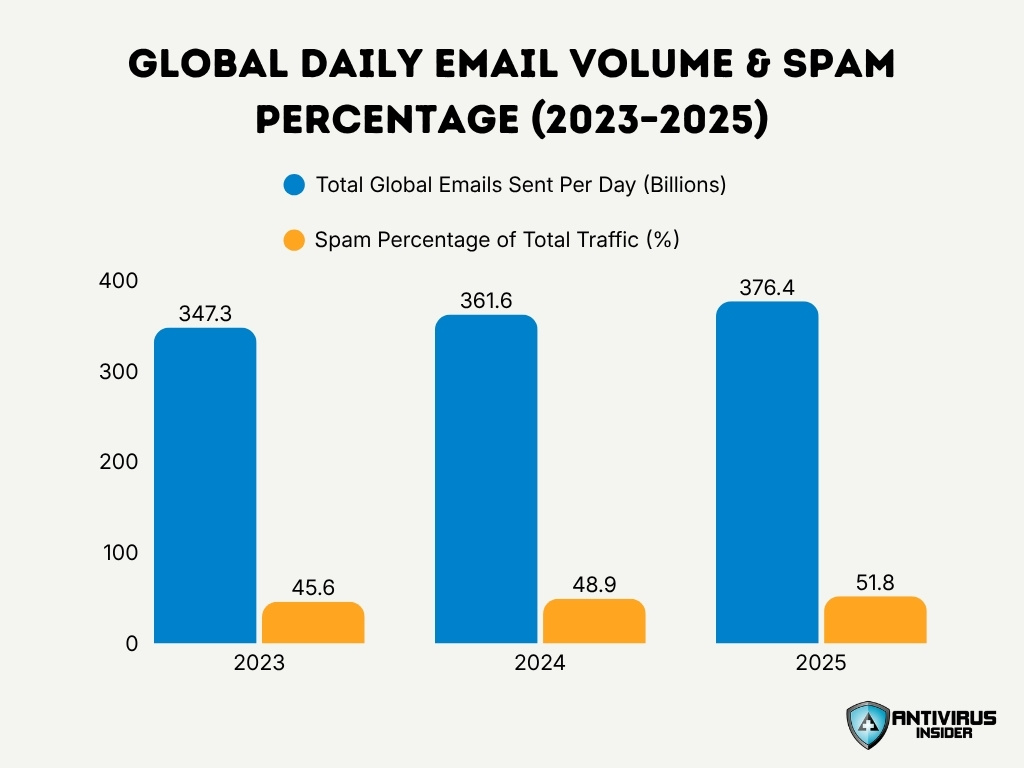
- Global daily email traffic increased from 347.3 billion emails in 2023 to 376.4 billion in 2025, reflecting continued growth in worldwide email activity.
- In 2024, approximately 361.6 billion emails were sent each day, up 4.1% from 2023.
- Daily email volume grew by roughly 29.1 billion emails between 2023 and 2025, representing an increase of about 8.4%.
- Spam accounted for 45.6% of total email traffic in 2023, meaning nearly 1 in every 2 emails was classified as spam.
- The share of spam climbed to 48.9% in 2024 before exceeding half of all email traffic at 51.8% in 2025.
- Between 2023 and 2025, the spam share increased by 6.2 percentage points, indicating that spam traffic grew faster than overall email volume.
- Based on these figures, roughly 195 billion spam emails per day were circulating globally in 2025, compared with about 158 billion per day in 2023.
Spam Text Message (SMS) Statistics
- Consumers reported $470 million in losses from fraud that started through text messages in 2024, more than five times the reported amount in 2020.
- There were 246,784 fraud reports identifying text messages as the initial contact method in 2024.
- Text messages represented 16% of fraud reports with a known contact method in 2024, placing SMS behind email and phone calls by report volume.
- Among 2024 fraud reports that began through text, 11% reported a monetary loss.
- The median loss for text-initiated fraud reached $1,000 per reported loss in 2024, higher than the $600 median associated with email.
- The five leading categories of text-message fraud accounted for approximately half of all reported text frauds in 2024.
- Fake package-delivery messages ranked as the most commonly reported text scam in 2024. These messages often direct recipients to lookalike delivery websites designed to capture personal or payment information.
- Other leading SMS schemes in 2024 included bogus job offers, fake bank fraud alerts, unpaid toll messages, and “wrong number” conversations that can develop into investment or romance fraud.
- By 2025, text messages had become one of the most frequently reported scam contact methods. Available 2025 consumer data shows 411,424 reports citing text messages, with a $1,000 median loss among reported losses.
- Government impersonation reports increased 40% in 2025, with fraudulent overdue-toll messages contributing to the rise and showing how SMS can turn routine payment notices into impersonation scams.
Spam Call and Robocall Statistics
- U.S. consumers received an estimated 52.5 billion robocalls in 2025, only about 1% fewer than in 2024.
- December 2025 alone generated almost 4.1 billion robocalls, illustrating the scale that automated dialing systems can reach in a single month.
- December averaged approximately 140.6 million robocalls per day, equivalent to about 1,627 calls every second.
- Consumers filed more than 2.6 million Do Not Call complaints during fiscal 2025, although total unwanted-call complaints remained about 48% below their 2021 level.
- Robocalls generated 1,601,611 complaints during fiscal 2025, compared with 802,144 complaints about live callers and 214,322 complaints where the call type was not specified.
- Debt-reduction calls produced 389,560 robocall complaints in fiscal 2025, making debt reduction the largest listed robocall topic.
- Imposter schemes generated 152,764 robocall complaints, while medical and prescription calls generated another 129,076.
- The National Do Not Call Registry contained approximately 258.5 million active registrations by Sept. 30, 2025, after more than 4.7 million additional numbers joined during the fiscal year.
- Arizona recorded 1,028 Do Not Call complaints per 100,000 people in fiscal 2025, the highest state rate reported, followed by Tennessee at 1,017 and Nevada at 960.
- Call-center fraud involving tech/customer support and government impersonation produced more than 80,000 complaints and $2.9 billion in losses in 2025, showing that unwanted calls can progress from nuisance traffic into high-value fraud.
Spam Call Statistics by Age and Gender
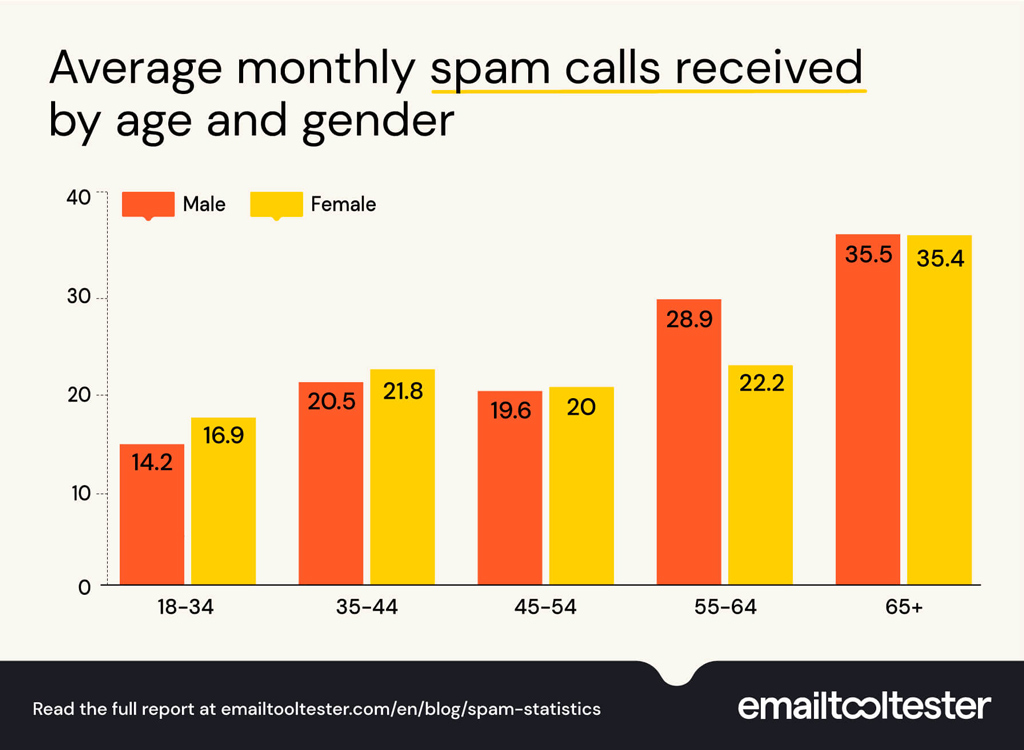
- Adults aged 65+ receive the most spam calls, averaging 35.5 calls per month for men and 35.4 for women.
- Men aged 55–64 receive 28.9 spam calls per month, compared with 22.2 calls among women, the largest gender gap across all age groups.
- Among adults aged 45–54, spam call exposure is nearly equal, at 19.6 calls for men and 20.0 for women per month.
- Women aged 35–44 average 21.8 spam calls per month, slightly higher than the 20.5 calls received by men.
- Younger adults aged 18–34 receive the fewest spam calls, averaging 14.2 per month for men and 16.9 for women.
- Overall, the data shows that spam call volume generally increases with age, with people aged 65+ receiving more than twice as many monthly spam calls as those aged 18–34.
Social Media Spam Statistics
- In 2025, 28% of fraud reports that involved a monetary loss and identified a contact method said the scam started on social media.
- Consumers reported $2.1 billion in losses from scams that originated on social media in 2025, up from $1.9 billion in 2024.
- Reported social media scam losses increased about eightfold from 2020 to 2025, rising from $261 million to $2.1 billion.
- Investment scams caused approximately $1.1 billion of social media-originated losses in 2025, accounting for more than half of the total dollars lost through this contact channel.
- Shopping scams were the most frequently reported social media scam type in 2025. More than 40% of people who lost money through a social media scam said the incident started after they ordered something advertised there.
- Nearly 60% of people who reported losing money to a romance scam in 2025 said the scam originated on social media.
- About one-third of reported job or business opportunity scam losses involving an identified contact method began on social media in 2025.
- Among people ages 18 to 29 who reported fraud losses with a known contact method, 40% said the scam began on social media. The shares were 32% for ages 30 to 59 and 29% for ages 60 to 69.
- Roughly half of reported rental scams during the 12 months ending June 2025 originated with fake rental advertisements posted on a major social platform.
- Since 2020, consumers have reported nearly 65,000 rental scams and about $65 million in losses, highlighting how fake listings can turn ordinary social media advertising into a costly fraud channel.
Phishing and Scam Statistics
- Researchers recorded approximately 3.8 million phishing attacks in 2025, slightly above the 3.76 million observed during 2024.
- The first quarter of 2025 produced 1,003,924 phishing attacks, the largest quarterly total recorded since late 2023 at that point.
- Phishing volume climbed further to 1,130,393 attacks in Q2 2025, making it the highest quarterly total since Q2 2023.
- Q3 2025 recorded 892,494 phishing attacks, followed by 853,244 in Q4, a quarter-over-quarter decline of about 4%.
- In December 2025 alone, researchers identified 295,691 unique phishing websites, compared with 269,558 in October and 287,995 in November.
- The number of brands targeted by phishing campaigns increased from 457 in October to 496 in December 2025, showing that attackers continued to diversify the organizations they impersonated.
- Online payment and financial-sector targets together accounted for 30.9% of phishing attacks in Q1 2025.
- Wire-transfer business email compromise attacks rose 33% quarter over quarter in Q1 2025, indicating stronger criminal focus on high-value payment fraud.
- One global protection system blocked more than 554 million attempts to open phishing links during 2025, illustrating the enormous volume of exposure behind reported attack counts.
- Phishing, spoofing, extortion, and investment schemes ranked among the most frequently reported internet crime categories in 2025, when total internet crime complaints passed 1 million.
Spam Delivery Channels
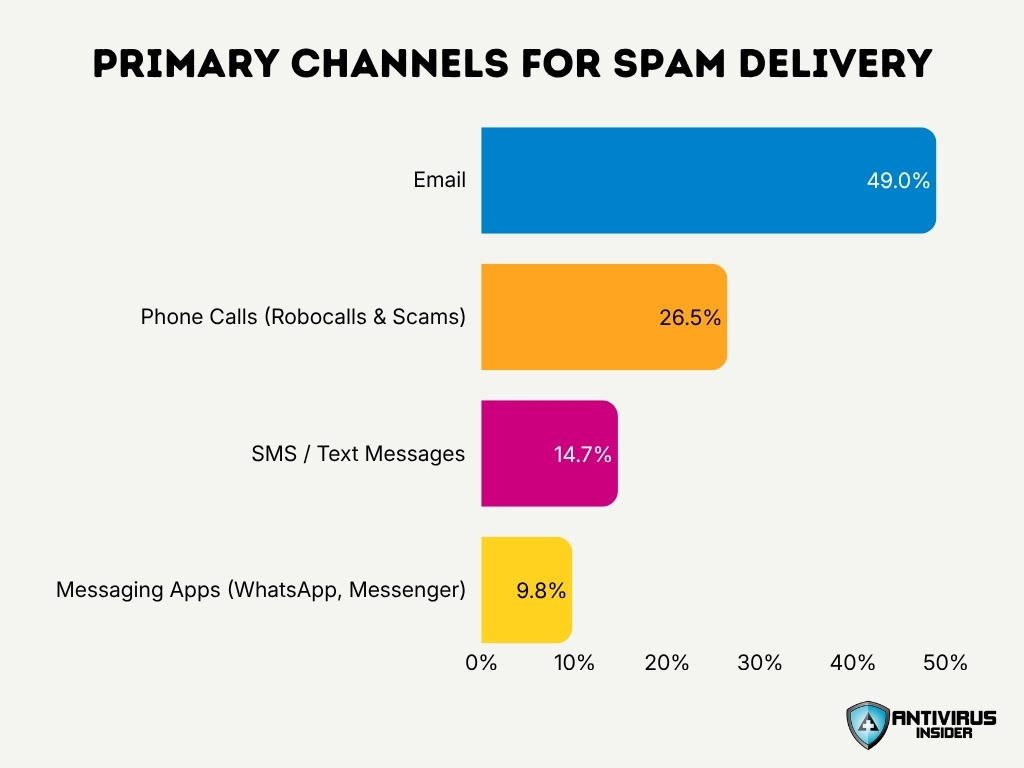
- Email remains the dominant spam delivery channel, accounting for 49.0% of total spam encounters in 2026.
- Phone calls, including robocalls and scams, rank second with a substantial 26.5% share of spam encounters.
- SMS and text message spam represents 14.7% of total encounters, making mobile messaging another significant spam vector.
- Messaging apps, including WhatsApp and Messenger, account for 9.8% of spam encounters, the smallest share among the four major channels.
- Combined, email and phone calls generate 75.5% of all spam encounters, showing that traditional communication channels remain the primary targets.
- Mobile-focused channels, SMS and messaging apps combined, contribute 24.5% of spam encounters, or nearly one-quarter of the total.
AI-Generated Spam Trends
- Authorities received 22,364 complaints involving AI-related cybercrime in 2025, with reported losses totaling more than $893 million.
- Businesses reported more than $30 million in losses from business email compromise schemes with an AI connection during 2025.
- AI-linked confidence and romance scams produced more than $19 million in reported losses in 2025.
- Distress scams involving techniques such as AI voice cloning caused more than $5 million in reported losses during 2025.
- AI-enhanced phishing campaigns achieved a reported 54% click-through rate, compared with roughly 12% for traditional phishing methods in the referenced testing data.
- That performance made AI-enhanced phishing about 4.5 times more effective by click-through rate and could increase attacker profitability by as much as 50 times under modeled conditions.
- Fraud defenses blocked approximately $4 billion in attempted scams and fraudulent transactions during the reporting period, showing the scale at which AI-assisted and conventional fraud now operates.
- AI-generated identity documents used to defeat verification controls increased 195% globally, indicating that synthetic identity abuse extends beyond spam messages into account creation and fraud infrastructure.
- A phishing campaign that used an AI website-building service sent hundreds of thousands of messages and affected more than 5,000 organizations in February 2025.
- Security researchers subsequently detected tens of thousands of malicious URLs per month created through the same AI-assisted website platform, showing how generative tools can speed up phishing-site production as well as message creation.
Spam Emails by Country
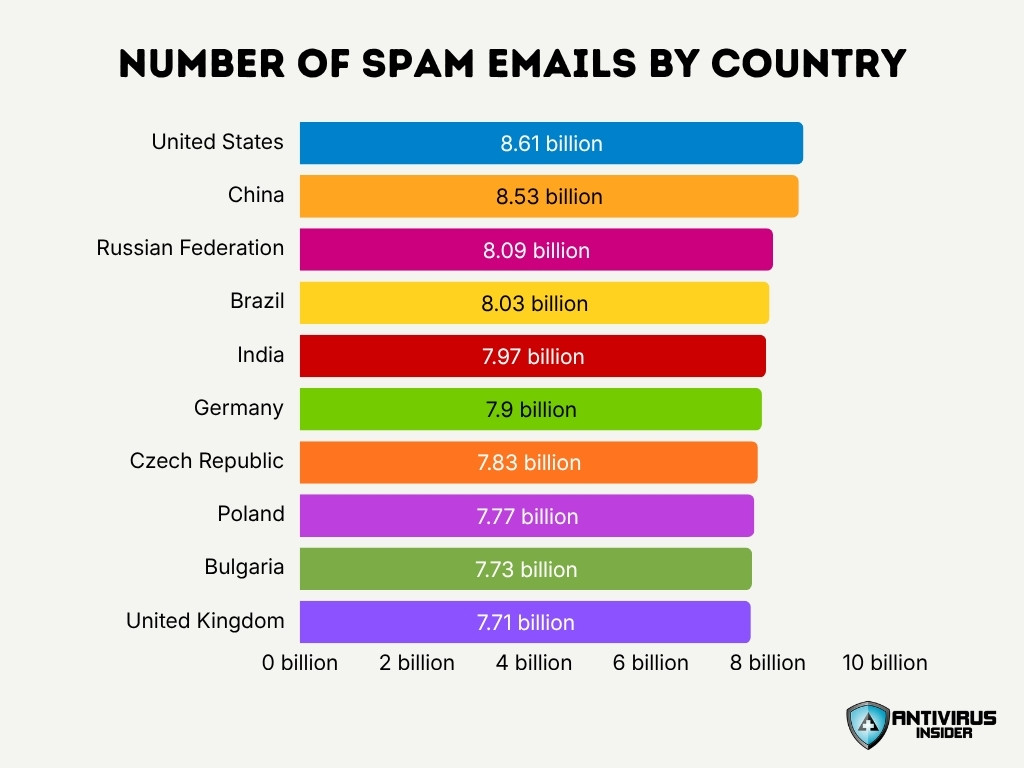
- The United States records the highest number of spam emails at 8.61 billion, placing it at the top of the ranking.
- China follows closely with 8.53 billion spam emails, only 80 million fewer than the United States.
- The Russian Federation ranks third with 8.09 billion spam emails, keeping its total above the 8 billion mark.
- Brazil reports 8.03 billion spam emails, making it the fourth country in the dataset to exceed 8 billion.
- India ranks fifth with 7.97 billion spam emails, just 60 million below the 8 billion threshold.
- Among European countries, Germany leads with 7.90 billion, followed by the Czech Republic at 7.83 billion and Poland at 7.77 billion.
- Bulgaria and the United Kingdom round out the ranking with 7.73 billion and 7.71 billion spam emails, respectively.
- The gap between the highest and lowest figures is only 900 million emails, showing that spam volumes are relatively concentrated across these leading countries.
Financial Losses from Spam and Scams
- U.S. internet crime complaints produced nearly $21 billion in reported losses during 2025, up from approximately $16.6 billion in 2024.
- Cyber-enabled fraud alone generated approximately $17.7 billion in losses, accounting for about 85% of all reported internet crime losses in 2025.
- Investment fraud generated about $8.65 billion in cyber-enabled losses in 2025, making it the largest fraud category by financial impact.
- Cryptocurrency investment scams alone caused approximately $7.2 billion in reported losses during 2025. These schemes often began through texts, social media messages, advertisements, or dating apps.
- Business email compromise produced roughly $3.05 billion in losses during 2025, maintaining its position as one of the costliest forms of message-driven fraud.
- Consumers reported about $3.5 billion in imposter scam losses in 2025, nearly three times the amount reported in 2020.
- Business impersonation scams caused nearly $1 billion in reported consumer losses in 2025, while government impersonation accounted for about $920 million.
- Social media-originated scams produced $2.1 billion in reported losses in 2025, compared with $1.9 billion in 2024 and $261 million in 2020.
- Americans ages 60 and older reported approximately $7.7 billion in internet crime losses in 2025, a 37% increase from 2024.
- Cryptocurrency-related complaints reached 181,565 in 2025 and generated more than $11 billion in reported losses across cryptocurrency-enabled crime categories.
Different Types of Spam Emails
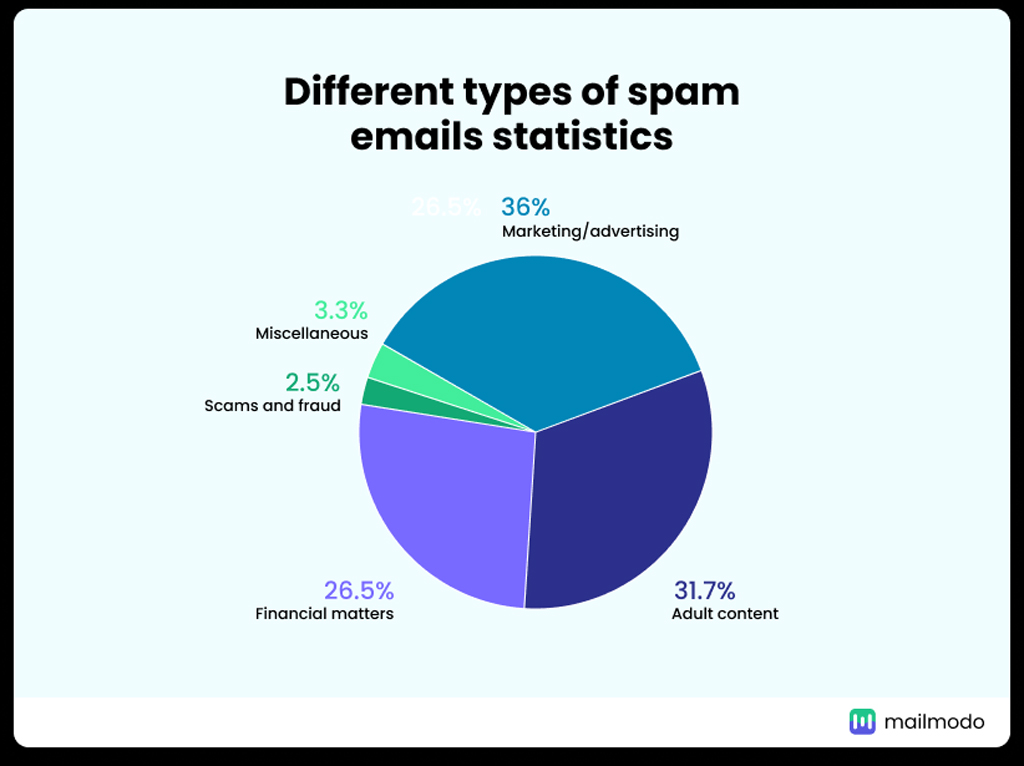
- Marketing and advertising emails are the largest spam category, accounting for 36% of all spam emails.
- Adult content ranks second, representing a substantial 31.7% of spam email activity.
- Financial matters make up 26.5% of spam emails, making them the third-largest category.
- Together, marketing/advertising, adult content, and financial matters account for 94.2% of all spam emails.
- Miscellaneous spam represents only 3.3% of the total, significantly below the three leading categories.
- Scams and fraud have the smallest share in the dataset at just 2.5% of spam emails.
- The gap between the largest category, marketing/advertising (36%), and the smallest, scams and fraud (2.5%), is 33.5 percentage points.
Industry Targets of Spam and Phishing
- Social media represented 20.3% of phishing attacks worldwide in Q4 2025, making it one of the two most-targeted sectors during the quarter.
- SaaS and webmail services also accounted for 20.3% of Q4 2025 phishing attacks, reflecting attackers’ interest in business credentials and cloud accounts.
- Telecom companies attracted 18.7% of phishing attacks in Q4 2025, placing the sector just behind social media and SaaS/webmail.
- Financial institutions accounted for 9.3% of worldwide phishing attacks during Q4 2025. Banking credentials remain valuable because compromised accounts can lead directly to payment fraud.
- E-commerce and retail businesses received 8.7% of phishing attacks in Q4 2025, as criminals imitated shopping platforms, order confirmations, and customer-service messages.
- Payment services represented another 7.6% of phishing attacks, demonstrating attackers’ continued focus on organizations that handle financial transactions.
- Cryptocurrency services accounted for 3.6% of phishing activity in Q4 2025. The smaller attack share can still generate large losses because successful compromises may expose digital assets directly.
- Shipping services attracted 2% of phishing attacks during Q4 2025, supporting the continued use of fake delivery and package-notification messages.
- Cloud storage services accounted for 1.4% of phishing attacks, while all other categorized sectors collectively represented 8.1%.
- Separate 2025 business research found that 69% of information and communications businesses identified a cyber breach or attack, compared with 55% of professional, scientific, and technical companies and 48% of finance or insurance businesses.
Environmental Impact of Spam
- The world processed an estimated 376 billion emails per day in 2025.
- Spam accounted for roughly 44.99% of global email traffic in 2025.
- Approximately 169 billion spam messages are transmitted globally every day.
- A single spam email generates an average footprint of 0.3 grams of CO₂e.
- Daily spam traffic produces an estimated 50,700 metric tons of CO₂e per day.
- Annual global spam volumes generate roughly 18.5 million metric tons of CO₂e.
- Global data centers consumed approximately 415 terawatt-hours of electricity in 2024.
- Data-center electricity consumption has surged by 12% per year since 2017.
- The United States accounted for 45% of global data-center electricity use in 2024.
- Global daily email traffic is projected to hit 424 billion messages in 2026.
How People Respond to Spam Emails
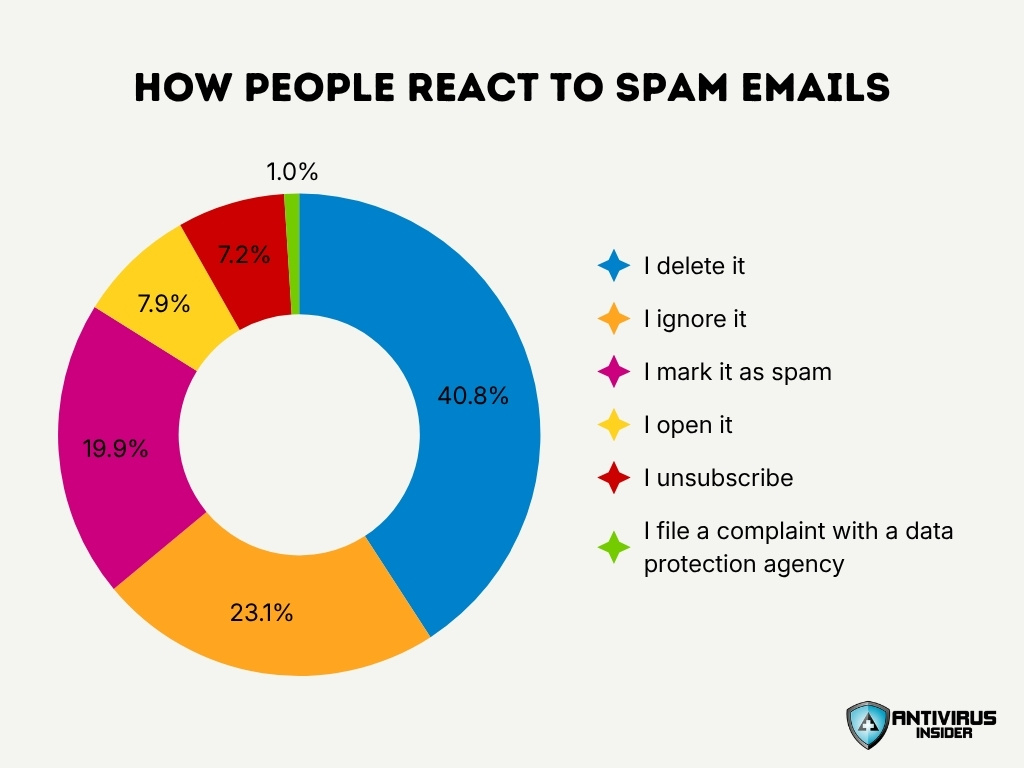
- Deleting spam emails is the most common response, with 40.8% of people choosing to remove them immediately.
- Around 23.1% of users simply ignore spam emails, making it the second-most common reaction.
- Nearly 1 in 5 people (19.9%) actively mark unwanted emails as spam, helping email providers identify similar messages.
- Only 7.9% of recipients open spam emails, indicating relatively low engagement with suspicious or unwanted messages.
- About 7.2% of people choose to unsubscribe from unwanted emails rather than delete or ignore them.
- Just 1% of respondents file a complaint with a data protection agency, making formal reporting the least common response.
- Combined, 83.8% of people either delete, ignore, or mark spam emails as spam, showing that most recipients take little or no direct engagement with the sender.
Spam Filter Effectiveness
- One major email platform reports automatically blocking more than 99.9% of spam, phishing attempts, and malware before they reach users’ inboxes.
- Its defenses block nearly 15 billion unwanted emails per day, demonstrating why inbox-level spam counts substantially understate the volume generated by attackers and bulk senders.
- Automated defenses also scan more than 300 billion email attachments each week for potentially harmful content.
- Machine-learning protections detect, on average, twice as much malware as standard third-party antivirus products alone in the measured email environment.
- Despite filtering advances, 5.6% of emails analyzed by another security network in 2025 were malicious, with the monthly share generally ranging from 4% to 6%.
- In February 2025 analysis, 24% of email messages were malicious or unwanted spam, illustrating how threat prevalence can vary sharply according to the traffic population and measurement system.
- Conventional defenses face challenges from attachments: 23% of analyzed HTML attachments were malicious, and more than three-quarters of detected malicious files were HTML.
- Nearly 47% of analyzed email domains lacked DMARC protection in 2025, leaving a large share without this domain-level control against unauthorized impersonation and spoofing.
- Layering additional email-security products over an existing cloud protection system improved spam filtering by an average 1.65% and malicious-message filtering by 0.5% in one 2025 benchmark, suggesting that gains depend strongly on what the base platform already blocks.
- Among malicious emails that did reach inboxes in the same benchmarking work, automated post-delivery remediation removed an average 45%, while additional integrated security products accounted for 55% of post-delivery filtering.
Future of Spam and Emerging Channels
- In January 2026 email telemetry, one in three messages was malicious or unwanted spam, up from approximately one in four in the comparable 2025 research.
- Phishing accounted for 48% of malicious email activity in the January 2026 dataset, confirming that credential theft remains central to emerging email attacks.
- Phishing-as-a-service tools powered 90% of high-volume phishing campaigns in 2025, compared with just 30% in 2024. This threefold rise shows how subscription attack kits are industrializing phishing.
- The number of active phishing-as-a-service kits doubled during 2025, expanding attackers’ access to ready-made templates, hosting, automation, and credential-stealing infrastructure.
- Among phishing-kit techniques observed in 2025, 48% used URL obfuscation and 48% incorporated MFA-bypass methods, while 43% used CAPTCHA techniques to make fraudulent pages appear legitimate or evade scanning.
- Malicious QR codes appeared in 19% of observed phishing-kit attacks during 2025. Separately, 70% of malicious PDF files analyzed in January 2026 contained QR codes leading to phishing websites.
- Vishing, or voice phishing, increased by a reported 449% in 2025, showing how attackers are shifting from written messages toward phone-based social engineering.
- Messaging services are another expanding battlefield. More than 6.8 million accounts linked to criminal scam centers were removed from one major messaging platform during the first half of 2025.
- Among APAC consumers targeted by financial scams in recent research, 49% encountered phishing and 42% encountered payment scams; Gen Z reported 23% exposure to deepfake scams and the same 23% exposure to QR-code phishing.
- AI is accelerating these emerging channels: U.S. authorities recorded 22,364 AI-related cybercrime complaints and $893.3 million in losses in 2025, including AI-assisted email compromise, synthetic identities, romance scams, and voice-cloning schemes.
Frequently Asked Questions (FAQs)
Spam accounted for 44.99% of global email traffic in 2025, down 2.28 percentage points from the previous year.
Researchers recorded approximately 3.8 million phishing attacks in 2025, slightly above 3.76 million in 2024.
U.S. consumers received approximately 52.5 billion robocalls in 2025, only about 1% fewer than in 2024.
Consumers reported $2.1 billion in losses from scams that started on social media in 2025, about eight times the 2020 figure.
Reported internet crime losses reached nearly $21 billion in 2025, based on more than 1 million complaints.
Conclusion
Spam statistics for show that unwanted communication has developed into a broader cybersecurity and consumer-fraud problem spanning email, text messages, robocalls, social networks, cloud services, QR codes, and AI-generated content. Global spam continues to represent a substantial share of email traffic, while reported internet crime losses reached nearly $21 billion in 2025. Social media scams, business email compromise, investment fraud, impersonation schemes, and AI-assisted attacks demonstrate that the consequences now extend well beyond cluttered inboxes.
Defensive technology remains effective, with leading email systems reporting that they block more than 99.9% of spam, phishing attempts, and malware before messages reach users. However, criminals continue to adapt through phishing-as-a-service, MFA-bypass techniques, malicious QR codes, voice phishing, account takeovers, and increasingly convincing AI-generated communications. For consumers and organizations, reducing spam-related risk therefore requires a combination of automated filtering, stronger identity and authentication controls, employee awareness, cautious handling of unsolicited messages, and independent verification before sharing information or sending money. As communication channels continue to evolve, spam prevention will increasingly depend on detecting not only suspicious messages but also the identities, infrastructure, and social-engineering techniques behind them.
