



Employee surveillance has become a standard part of modern workplace management as organizations balance productivity, cybersecurity, and regulatory compliance. Companies now rely on monitoring software to secure sensitive data, manage remote teams, and measure workforce performance across distributed workplaces. At the same time, employees continue to raise concerns about privacy, transparency, and trust. This article explores the latest employee surveillance statistics, helping readers understand how workplace monitoring is evolving across industries.
Editor’s Choice
- 74% of U.S. employers now use online monitoring tools to track employee work activities, including browsing history, screen activity, and application usage.
- Around 61% of organizations use AI-powered analytics to evaluate employee productivity and work patterns.
- 75% of employers monitor employees inside physical workplaces using technologies such as cameras, access controls, or other surveillance systems.
- 67% of surveyed employers collect biometric information, including fingerprint or facial recognition data, for workplace access or attendance management.
- 43% of employees report that their employer monitors their online activity during work hours.
- Only 22% of employees say they know their employer conducts online monitoring, highlighting a major transparency gap.
- One in six U.S. employees say they would consider leaving their job because of workplace surveillance practices.
Recent Developments
- During 2025, organizations accelerated the adoption of AI-driven workforce analytics as hybrid work remained common across many industries.
- Microsoft’s 2026 Work Trend Index found AI adoption expanding rapidly, with active AI agents increasing 15 times year over year across Microsoft 365 environments.
- 66% of AI users report spending more time on higher-value work because AI handles routine tasks, increasing interest in AI-powered workforce analytics.
- Organizations increasingly combine productivity monitoring with cybersecurity controls instead of treating them as separate technologies.
- Modern monitoring platforms increasingly integrate screen recording, browser tracking, attendance management, and compliance reporting into a single dashboard.
- Privacy regulators continue to emphasize that employers should clearly communicate monitoring practices and collect only data that serves legitimate business purposes.
- AI-assisted workplace analytics now focus more on behavioral trends than simple activity tracking, enabling managers to analyze workflow efficiency alongside productivity.
- Enterprise demand for workforce visibility tools continues to grow as organizations adapt to flexible work arrangements established after the pandemic.
Employee Surveillance Adoption Statistics
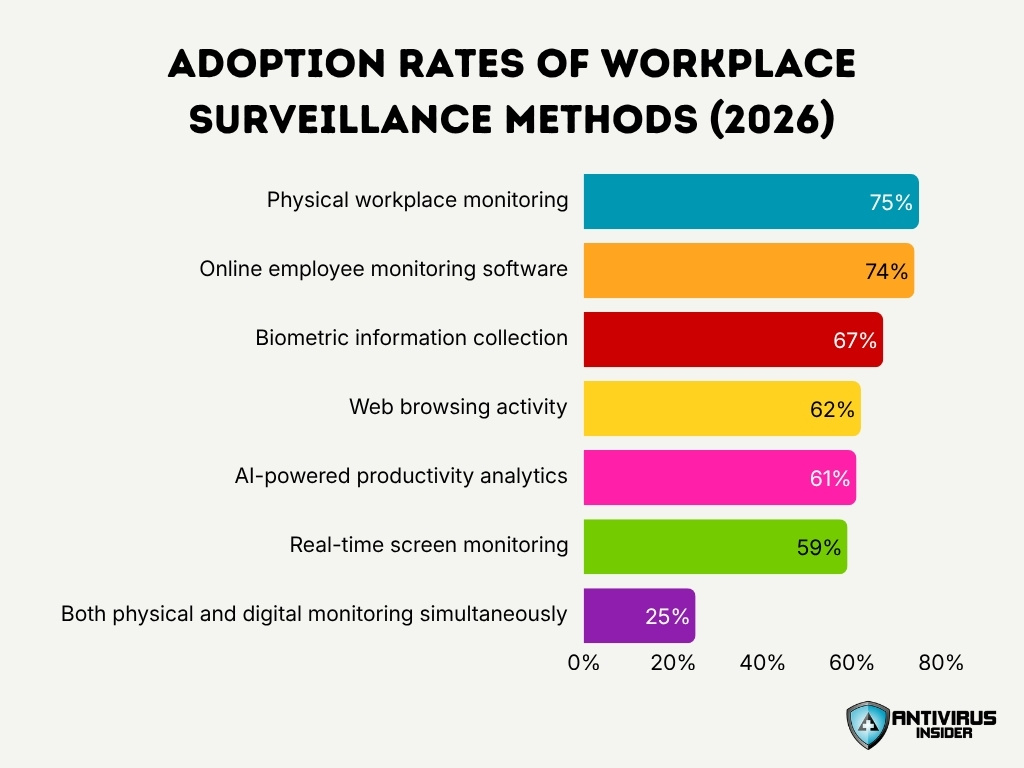
- 74% of employers currently use online employee monitoring software in daily operations.
- 62% of employers log employees’ web browsing activity while they use company devices.
- 59% of organizations perform real-time screen monitoring to observe employee activity.
- 61% of employers rely on AI-powered productivity analytics to assess workforce performance.
- 75% of organizations also monitor physical workplaces through surveillance technologies such as video systems and access controls.
- 67% of employers collect biometric information for attendance, authentication, or facility access.
- About 25% of employees report being subjected to both physical and digital workplace monitoring simultaneously.
- Government agencies and highly regulated industries continue to expand monitoring because of cybersecurity, compliance, and insider-risk management requirements.
Employee Monitoring by Company Size
- Over 96% of large enterprises deploy broader monitoring ecosystems to manage their workforces.
- AI agent activity grew 18 times year-over-year among large enterprises using workplace analytics.
- Nearly 93% of enterprise organizations combine monitoring software with identity and cybersecurity platforms.
- Around 67% of small businesses adopt cloud-based monitoring platforms due to lower upfront investments.
- Fully 94% of organizations with distributed workforces invest heavily in centralized workforce monitoring.
- Up to 75% of large employers deploy biometric authentication for facility access and attendance management.
- About 79% of enterprise HR teams integrate employee monitoring data into productivity analysis.
- The mid-sized business segment now accounts for 52% of all new intelligent monitoring tool purchases.
Employee Surveillance in Remote and Hybrid Workplaces
- Hybrid work continues to drive investment in digital employee monitoring software across industries.
- 48% of hybrid employees report that their employers monitor their online activity.
- 37% of fully remote employees say their employers monitor their online activity while working.
- Only 32% of employees report receiving formal workplace policies explaining online monitoring practices.
- Remote work has significantly increased employer demand for screen monitoring, application tracking, and browser activity logging.
- Many organizations now combine productivity monitoring with cybersecurity tools to protect company devices outside corporate offices.
- Researchers continue to identify a growing tension between organizational security requirements and employee privacy expectations in remote environments.
- Hybrid workplaces increasingly rely on cloud-based workforce analytics platforms that provide managers with real-time operational visibility across distributed teams.
Employee Monitoring Tool Adoption in the US
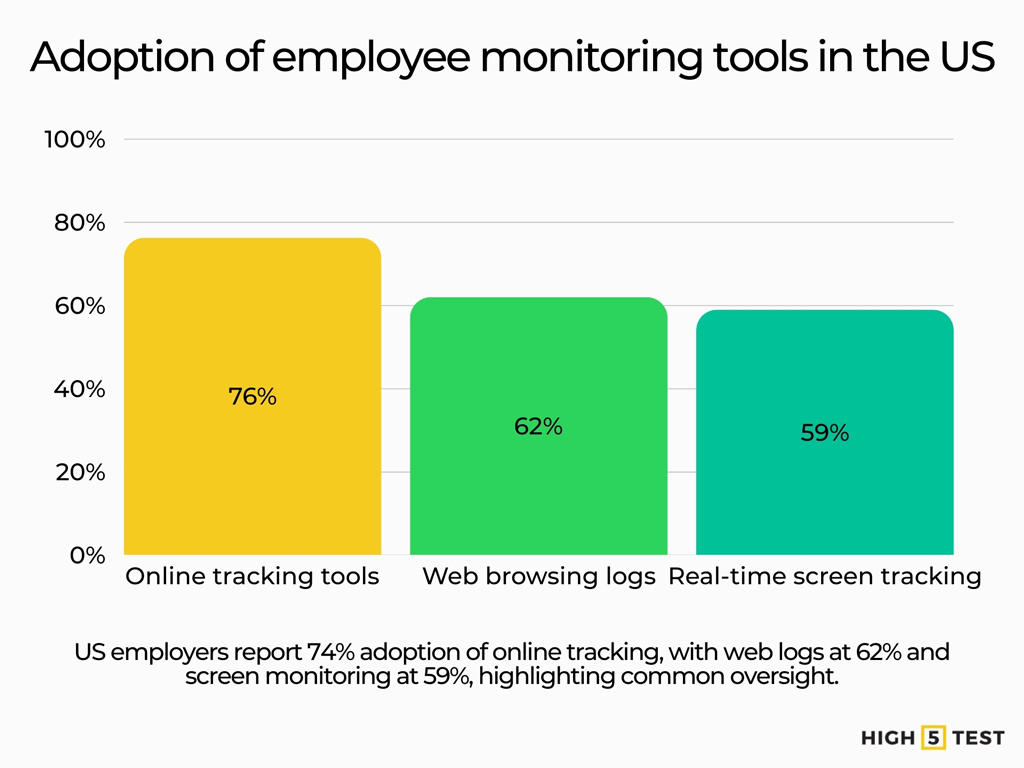
- Online tracking tools are the most widely adopted employee monitoring method, used by 76% of U.S. employers, indicating that digital activity tracking has become a common workplace practice.
- Web browsing logs are used by 62% of employers, allowing organizations to monitor employees’ website visits and online activity during work hours.
- Real-time screen tracking is used by 59% of employers, meaning nearly 6 in 10 organizations monitor employee screens as work happens.
- The adoption gap between online tracking tools and web browsing logs is 14 percentage points, showing stronger employer preference for broader online monitoring solutions.
- Only 3 percentage points separate web browsing logs (62%) and real-time screen tracking (59%), suggesting these two monitoring methods have similarly high adoption levels.
- Overall, all three monitoring methods have adoption rates near or above 60%, highlighting the widespread use of digital employee surveillance in U.S. workplaces.
Digital Activity, Screen, and Internet Monitoring Statistics
- 82% of organizations that monitor employees track application and website usage, making it the most common digital monitoring method in 2026.
- 41% of monitored organizations use screen capture or screen recording tools, up 8 percentage points compared with 2024.
- 76% of employers using surveillance software monitor employees’ web browsing activity, including visited websites and search activity.
- 71% of employers track application usage to measure active work time and identify productivity patterns.
- 52% of organizations use keystroke logging in some capacity, although adoption has slowed because of growing privacy concerns.
- AI-powered activity monitoring reached 37% adoption in 2026, representing the fastest-growing monitoring category since 2024.
- Organizations now use an average of 3.2 different monitoring methods simultaneously instead of relying on a single surveillance tool.
- Digital monitoring increasingly combines productivity analytics with cybersecurity controls to detect insider threats and unusual employee behavior.
Email and Communication Monitoring Statistics
- 54% of monitored organizations review employee email as part of their overall monitoring programs.
- 55% of U.S. organizations monitor employee emails strictly to support compliance and security.
- 31% of employers use communication sentiment analysis to precisely evaluate workplace message tone.
- 100%of examined monitoring platforms transmit employee communication data to third-party providers.
- 71%of financial services firms monitor employee communications to consistently ensure regulatory compliance.
- 56%of employers monitor communications specifically to prevent sensitive information from actively leaking.
- 78%of companies currently deploy employee monitoring tools to carefully watch staff activities.
- 23%of organizations explicitly read incoming and outgoing worker emails to prevent internal threats.
Time Tracking and Attendance Monitoring Statistics
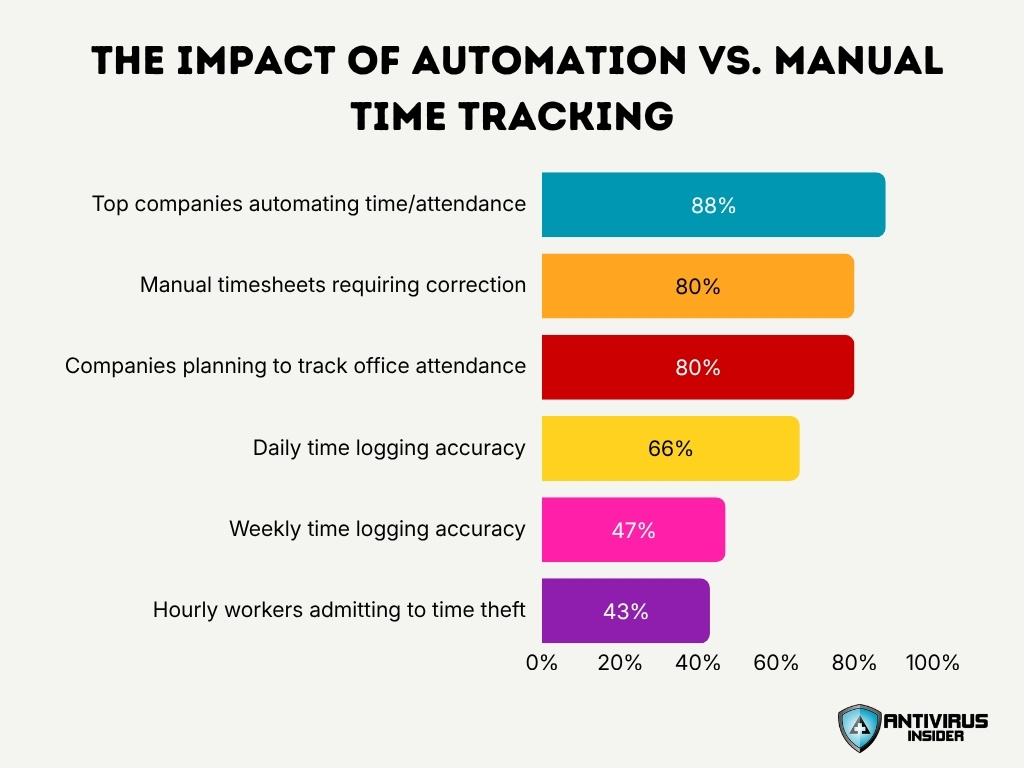
- 80%of companies plan to track office attendance to monitor employee presence and performance.
- 43%of hourly workers admit to time theft, leading to significant organizational financial losses.
- Buddy punching costs employers approximately $373 million every single year in lost wages.
- Organizations lose 50 million hours annually due to manual errors in employee timesheets.
- Daily time logging is 66% accurate, whereas weekly logging drops significantly to 47% accuracy.
- Switching to daily timesheets can recover up to $52,000 per employee on a yearly basis.
- Approximately 80% of manual timesheets require correction due to human data entry errors.
- Around 88% of top companies successfully automate their time and attendance tracking processes.
- Unrecorded emailing time creates a financial leak of $50,000 per employee annually for businesses.
Location, GPS, Video, and Biometric Monitoring Statistics
- 24% of monitored organizations use GPS or location tracking technologies for employees whose work involves travel or field operations.
- 63% of employers using workplace surveillance collect location information through GPS, IP addresses, or mobile devices.
- 82% of organizations use workplace video surveillance in offices, facilities, warehouses, or operational sites.
- 23% of employers collect biometric information such as fingerprints or facial recognition through workplace monitoring platforms.
- 67% of surveyed employers report using biometric technologies for authentication, attendance, or physical access management.
- Connected worker technologies increasingly combine wearable devices with environmental sensors to improve workplace safety and operational visibility.
- Modern surveillance systems integrate video feeds, access controls, and identity verification into unified workplace security platforms.
- Organizations handling sensitive infrastructure continue expanding biometric and location monitoring to strengthen physical security and regulatory compliance.
AI-Powered Employee Surveillance Statistics
- 78%of employers currently utilize online monitoring tools to track worker activity.
- 96%of remote companies implement some form of employee monitoring software.
- 68%of managers believe workplace monitoring positively improves overall productivity.
- 72%of workers argue that employee surveillance offers absolutely no positive impact.
- 66%of managers utilize AI algorithms to guide critical decisions regarding layoffs.
- 54%of employees would consider quitting if AI-powered surveillance increased further.
- 49%of workers intentionally fake being online to actively bypass automated detection.
- 68%of full-time staff actively oppose AI tracking of their daily physical movements.
- 64%of young adults strongly object to AI monitoring of their regular computer activity.
Productivity Impact of Employee Monitoring
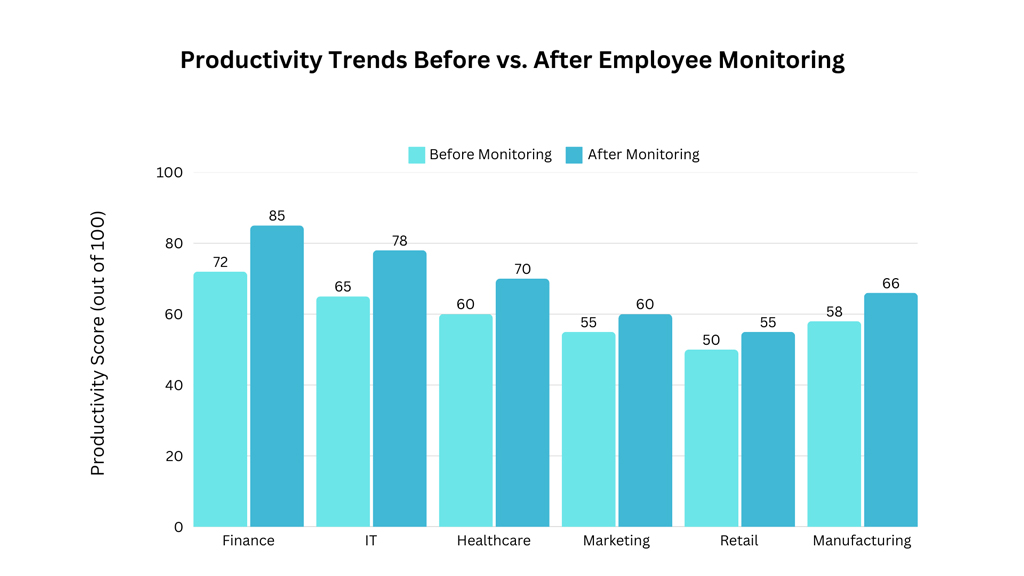
- Finance recorded the highest productivity score after employee monitoring, rising from 72 to 85, an increase of 13 points.
- IT also saw a strong 13-point improvement, with productivity increasing from 65 before monitoring to 78 after monitoring.
- Healthcare productivity climbed from 60 to 70, representing a notable 10-point increase after employee monitoring was introduced.
- Manufacturing showed an 8-point improvement, with its productivity score increasing from 58 to 66 following monitoring.
- Marketing experienced a more modest increase, with productivity moving from 55 to 60, a gain of 5 points.
- Retail had the lowest productivity scores among the industries analyzed, although monitoring still corresponded with an improvement from 50 to 55.
- Overall, all six industries recorded higher productivity scores after employee monitoring, with improvements ranging from 5 to 13 points.
Employee Awareness, Transparency, and Consent
- Only 22% of employees are fully aware that their online activities are being monitored.
- A staggering 85% of workers believe employers must disclose workplace monitoring practices.
- Just 30% of executives confirm their company actively communicates what employee data is collected.
- Approximately 77% of employers actively monitor employee email, internet, or phone usage.
- Over 50% of employees experience heightened anxiety when subjected to undisclosed workplace surveillance.
- Nearly 43% of remote workers consider covert monitoring to be a severe violation of trust.
- About 68% of workers would accept monitoring if it directly improved their safety or productivity.
- Only 1 in 3 organizations obtain explicit employee consent before implementing keystroke logging software.
- Roughly 62% of businesses still operate without a formal, written policy regarding data privacy.
- Over 40% of employees would resign if they discovered secret tracking or hidden cameras.
Employee Stress, Trust, Engagement, and Turnover
- 59%of employees report experiencing severe anxiety due to workplace surveillance.
- 43%of workers feel that monitoring is a violation of trust rather than a performance booster.
- 42%of monitored employees plan to leave their jobs compared to just 23% of unmonitored staff.
- 33%of personnel feel constant stress wondering if their daily activities are being watched.
- 1 in 9workers reported that they quit a job entirely because of excessive workplace monitoring.
- 31%of monitored workers state they feel micromanaged by their employers’ tracking systems.
- 24%of employees would willingly accept a pay cut to avoid being subjected to constant surveillance.
- 24%of workers actively take fewer breaks to avoid appearing idle to tracking software.
Employee Attitudes and Privacy Concerns
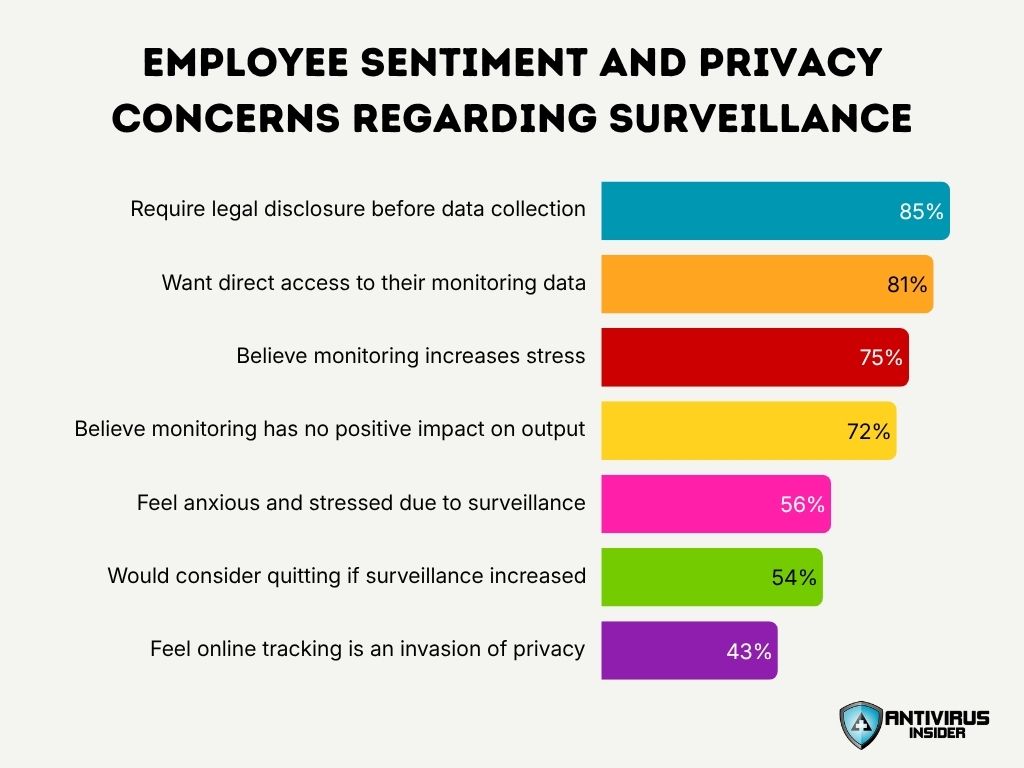
- 42% of monitored employees plan to leave their employer within a year, compared with 23% of unmonitored employees.
- Only 22% of employees know their employer monitors their online activity, highlighting a significant transparency gap.
- 85% of workers believe employers should be legally required to disclose monitoring practices before collecting data.
- Over 56% of employees report feeling anxious and stressed due to active workplace surveillance.
- Exactly 43% of workers feel that being tracked online is a direct invasion of their privacy.
- About 54% of employees say they would consider quitting if their employer increased current surveillance levels.
- Nearly 75% of employees using surveillance software report that monitoring increases stress rather than productivity.
- Around 81% of employees want direct access to their own monitoring data through transparent personal dashboards.
- Roughly 72% of employees believe that workplace monitoring has no positive impact on their actual work output.
- Over 53% of employees accept monitoring when employers clearly explain its purpose and share the collected data.
Workplace Surveillance and Cybersecurity
- 78% of employers now use workplace monitoring tools, compared to 60% before the pandemic.
- 12% of global cybersecurity incidents directly involve insider threats or internal negligence.
- 69% of security leaders view employee behavior as their most significant cyber risk vulnerability.
- 54% of organizations lack complete visibility into how employees use generative AI applications.
- 85% of companies integrate Data Loss Prevention with their employee monitoring platforms.
- 43% of unauthorized data exposures stem from internal workforce actions rather than external hackers.
- 68% of corporate security teams actively track behavioral anomalies to detect compromised accounts.
- 71% of IT executives cite expanded remote work as the primary driver for increased endpoint surveillance.
Employee Surveillance Laws and Data Protection Compliance
- Employers in the United States generally may monitor company-owned devices when they have legitimate business purposes and comply with applicable federal and state laws.
- 82% of privacy professionals report their organizations rely on formal privacy frameworks or regulations to manage compliance.
- 51% of surveyed privacy professionals identify GDPR as the primary privacy framework guiding organizational practices.
- 45% of organizations report using the NIST Privacy Framework as part of their privacy governance strategy.
- Only 46% of privacy professionals express strong confidence that their organizations can meet new privacy regulations successfully.
- Privacy experts increasingly recommend written monitoring policies, employee notification, and clearly defined retention periods for workplace data.
- Regulatory scrutiny continues to increase as AI-powered employee monitoring systems collect larger volumes of behavioral and biometric data.
- Organizations are expanding privacy-by-design practices to reduce compliance risks associated with AI-driven employee monitoring technologies.
Employee Surveillance Market Size and Software Adoption Trends
- The global employee surveillance and monitoring software market reached approximately $648.8 million in 2025.
- The market is projected to grow to $719.8 million in 2026, reflecting continued enterprise investment in workforce analytics.
- Industry forecasts estimate the market will reach $1.78 billion by 2034, representing a 12.1% CAGR from 2026 onward.
- North America accounted for 37.6% of global market revenue in 2025, making it the largest regional market.
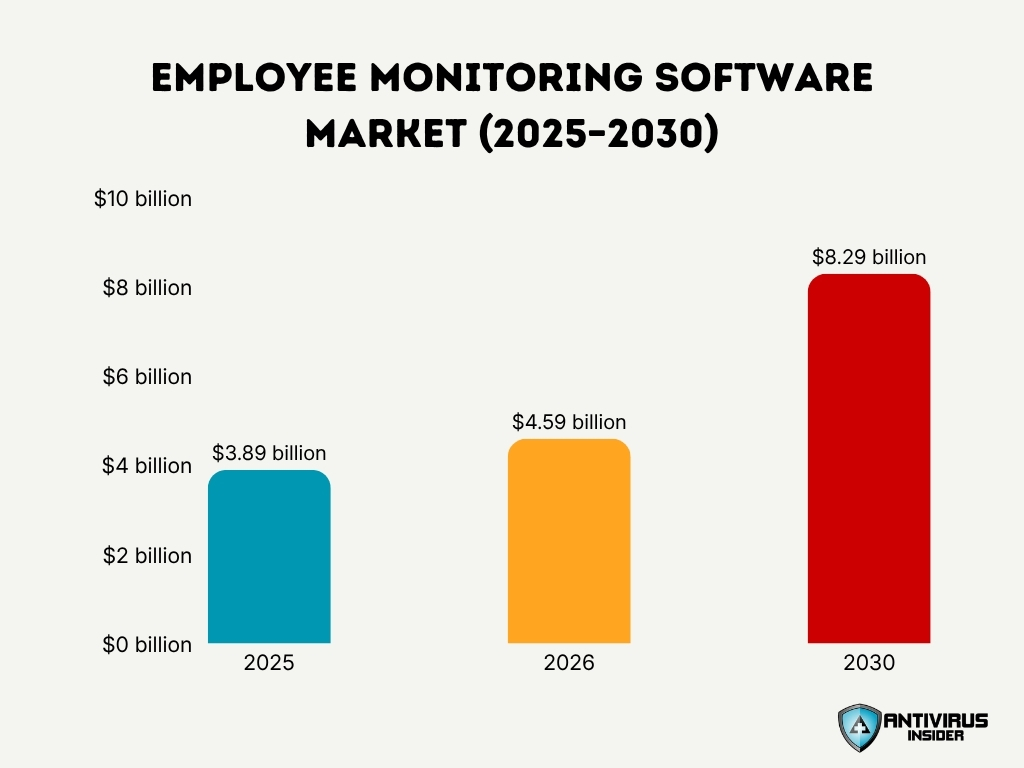
- Another industry forecast projects the employee monitoring software market to increase from $3.89 billion in 2025 to $4.59 billion in 2026.
- That same forecast estimates the market will reach $8.29 billion by 2030, supported by hybrid work, cybersecurity investment, and AI adoption.
- Cloud-based monitoring platforms continue gaining market share because organizations increasingly prefer scalable subscription-based deployments.
- AI-powered workforce analytics, insider-risk detection, and behavior analysis remain the fastest-growing software categories within the employee monitoring industry.
Frequently Asked Questions (FAQs)
78% of employers now use some form of employee monitoring, up from 60% before the pandemic.
43% of employees say their employer monitors their online activity during work hours.
The global employee surveillance and monitoring software market is projected to reach $719.8 million in 2026, with a forecast CAGR of 12.1% through 2034.
42% of monitored employees say they plan to leave their employer within a year, compared with 23% of unmonitored employees.
74% of U.S. employers use online tracking tools such as screen monitoring, web activity tracking, and application usage monitoring.
Conclusion
Employee surveillance continues to expand as organizations balance productivity, cybersecurity, regulatory compliance, and hybrid work management. The latest statistics show strong growth in AI-powered monitoring, cloud-based workforce analytics, and integrated security platforms. At the same time, employee trust increasingly depends on transparency, responsible data governance, and ethical AI practices. Organizations that balance operational visibility with privacy will be better positioned to improve productivity while maintaining employee confidence.
