



Artificial intelligence has become a core technology in modern fraud detection as businesses process billions of digital transactions every day. Banks, payment providers, insurers, retailers, and government agencies now rely on AI to identify suspicious behavior in real time, reduce false positives, and prevent financial losses before they occur. At the same time, cybercriminals increasingly use AI-powered techniques, which has accelerated investment in advanced fraud detection platforms. This article explores the latest AI in Fraud Detection Market Statistics, highlighting market size, growth, trends, and the data shaping the industry’s future.
Editor’s Choice
- The global fraud detection and prevention market reached $35.3 billion in 2025 and is projected to grow to $40.4 billion in 2026.
- The global AI-powered fraud detection segment generated $6.59 billion in revenue during 2025, reflecting increasing enterprise adoption across financial services and digital commerce.
- North America accounted for 39.0% of the global fraud detection and prevention market in 2025, making it the largest regional market.
- AI-driven fraud detection solutions are forecast to expand at a 24.6% CAGR between 2026 and 2033, outpacing many other cybersecurity software segments.
- Visa reported preventing more than $350 million in attempted scam losses during 2024 through its dedicated scam disruption initiatives, while blocking over $40 billion in attempted payment fraud across its network.
- The payment fraud segment remained the largest application category within the fraud detection market in 2025.
- Organizations continue to prioritize AI because real-time behavioral analytics helps detect sophisticated fraud schemes while reducing manual investigation workloads across banking, e-commerce, healthcare, and insurance.
Recent Developments
- In May 2026, Visa reported that scammers increasingly shifted toward AI-enabled social engineering, reflecting stronger payment network security against traditional attacks.
- Visa detected nearly $1 billion in scam-related activity between July and December 2025, identifying scams as the fastest-growing category of consumer payment fraud.
- The global fraud detection market forecast for 2026 increased to $40.4 billion, highlighting continued enterprise investment in AI-driven risk management.
- Market analysts identified Generative AI-powered phishing, synthetic identities, voice cloning, and fake documents as major fraud vectors influencing enterprise security investments during 2025–2026.
- Visa announced that it invested more than $12 billion in technology over the previous five years to strengthen fraud prevention and payment security capabilities.
- AI-enabled fraud prevention platforms increasingly integrate behavioral analytics, biometric authentication, and real-time anomaly detection to improve fraud accuracy across digital payment ecosystems.
- South Korea is expected to record one of the fastest growth rates in AI-powered fraud detection through 2033, reflecting rapid digital transformation across financial services.
- Industry investment continues shifting toward cloud-native AI fraud platforms that support instant payment systems and real-time transaction monitoring.
AI in Fraud Detection Market Overview
- AI fraud detection platforms analyze millions of transactions simultaneously using machine learning models that continuously improve as new fraud patterns emerge.
- Financial institutions remain the largest adopters because digital banking, mobile payments, and instant transfers continue expanding worldwide.
- North America led the market in 2025, supported by high digital payment volumes, strong cybersecurity spending, and early AI adoption.
- Enterprise demand increasingly focuses on AI systems capable of detecting account takeover, identity theft, payment fraud, and money laundering in real time.
- Large enterprises represented the dominant customer segment during 2025, reflecting higher transaction volumes and larger cybersecurity budgets.
- The BFSI sector maintained the largest industry share due to strict regulatory requirements and increasing financial crime risks.
- AI-based fraud detection adoption continues expanding beyond banking into healthcare, retail, telecommunications, government, and insurance as digital transactions increase.
- Organizations increasingly deploy cloud-based AI platforms because they support faster deployment, scalable analytics, and continuous model updates against emerging fraud threats.
U.S. Agentic AI Fraud Detection Market Growth
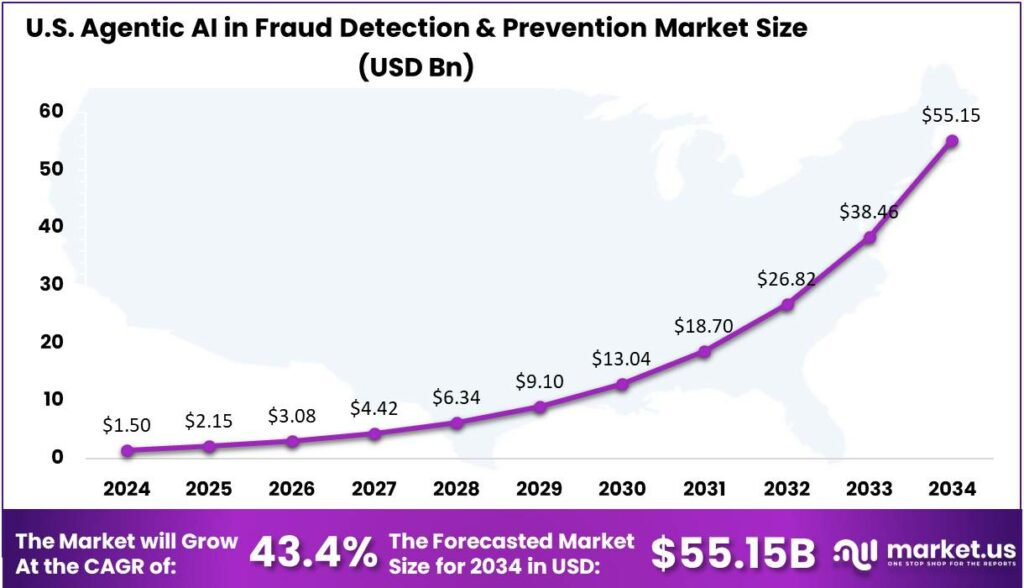
- The U.S. agentic AI fraud detection and prevention market is projected to grow from $1.50 billion in 2024 to $55.15 billion by 2034.
- The market is forecast to expand at a strong 43.4% CAGR during the projection period.
- Market revenue is expected to surpass $3 billion in 2026, reaching approximately $3.08 billion.
- By 2029, the market is projected to reach $9.10 billion, more than six times its 2024 value.
- The industry is expected to cross the $10 billion milestone in 2030, reaching $13.04 billion.
- Market size could increase to $18.70 billion in 2031 and $26.82 billion in 2032.
- Revenue is forecast to jump by $11.64 billion between 2032 and 2033, reaching $38.46 billion.
- The largest annual increase is expected between 2033 and 2034, when the market rises by $16.69 billion.
- Over the full forecast period, the market is projected to expand by nearly 36.8 times.
- The rapid growth indicates accelerating demand for autonomous AI systems capable of detecting, investigating, and preventing fraud.
AI in Fraud Detection Market Growth
- The global fraud detection and prevention market is expected to expand at an 18.1% CAGR between 2026 and 2033.
- The AI-specific fraud detection segment is projected to grow even faster, posting a 24.6% CAGR from 2026 to 2033.
- Growth is supported by increasing digital payment adoption across banking, retail, healthcare, insurance, and government sectors.
- Real-time payment systems continue increasing demand for AI engines capable of analyzing transactions within milliseconds.
- Rising use of Generative AI by cybercriminals has accelerated enterprise investment in advanced fraud analytics.
- Organizations increasingly combine AI with biometric authentication and behavioral analytics to improve fraud detection accuracy while reducing false positives.
- Cloud deployment continues supporting market growth by reducing implementation costs and enabling continuous AI model improvements.
- Regulatory initiatives around AML, KYC, PSD2, and digital identity verification continue encouraging broader adoption of AI-driven fraud prevention technologies.
AI in Fraud Detection Market CAGR
- The overall fraud detection and prevention market is forecast to reach $129.4 billion by 2033, registering an 18.1% CAGR.
- AI-powered fraud detection is expected to expand at a stronger 24.5% CAGR, reaching a projected $108.3 billion by 2033.
- Enterprise demand for automated decision-making and real-time solutions drives the market, capturing 67.2% of AI fraud detection share.
- North America maintains steady expansion, dominating the global landscape with a 39.0% revenue share.
- Asia-Pacific is projected to experience the fastest AI fraud detection growth, expected to capture a 21.7% market share by 2026.
- Cloud-native AI platforms are lowering deployment barriers, though large enterprises still dominate with a 68.0% adoption rate.
- Continued advances in machine learning are essential, especially since over 50% of modern fraud incidents now involve AI manipulation.
- Increasing sophistication in payment fraud is sustaining double-digit market growth, accounting for 49.4% of application segments.
AI Fraud Detection Market by Industry
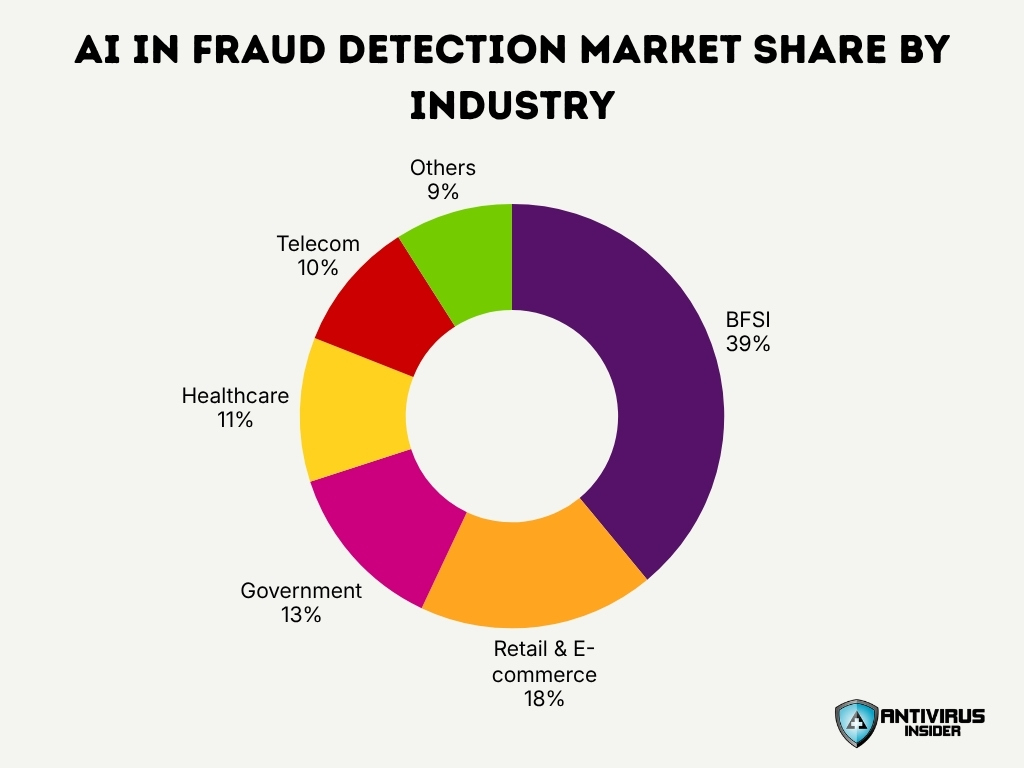
- BFSI leads the market with a 39% share, reflecting the sector’s strong need to detect payment fraud, identity theft, and suspicious transactions.
- Retail and e-commerce account for 18%, driven by rising online payment fraud, account takeovers, and chargeback risks.
- Government holds a 13% market share, supported by growing use of AI to prevent benefits fraud, tax fraud, and identity-related crimes.
- Healthcare represents 11% of the market, as providers and insurers adopt AI to identify fraudulent claims and billing irregularities.
- Telecom captures a 10% share, with AI increasingly used to combat subscription fraud, SIM swap attacks, and unauthorized account activity.
- Other industries contribute the remaining 9%, showing that AI-based fraud detection is expanding across multiple business sectors.
- The top two industries, BFSI and retail, collectively control 57% of the market, highlighting the concentration of demand in financial and digital commerce environments.
AI in Fraud Detection Market Drivers
- Reported U.S. internet crime losses exceeded $20 billion in 2025, creating a strong financial case for faster and more accurate fraud screening.
- U.S. authorities received 1,008,597 internet crime complaints in 2025, up from 859,532 complaints in 2024.
- Cyber-enabled fraud generated more than $17.7 billion in reported U.S. losses during 2025, increasing demand for automated transaction monitoring.
- Cryptocurrency investment fraud caused $7.2 billion in U.S. losses in 2025, making it the costliest reported internet fraud category.
- Investment scams represented nearly 49% of cyber-enabled fraud losses in 2025, encouraging financial institutions to apply behavioral and network analytics earlier in the customer journey.
- Americans age 60 and older reported approximately $7.7 billion in losses in 2025, a 37% increase from 2024.
- U.S. internet crime losses had already surpassed $16 billion in 2024, increasing 33% from the previous year.
- Analysts estimate generative AI could help push annual U.S. fraud losses to $40 billion by 2027, more than triple the $12.3 billion recorded in 2023.
AI in Fraud Detection Market Opportunities
- Organizations with mature verified-identity controls recorded 43% lower fraud losses, indicating a measurable opportunity for AI-enabled identity orchestration.
- The same high-performing organizations achieved 51% higher customer registration conversion rates, showing that stronger fraud controls can also reduce onboarding friction.
- Verified identity programs improved compliance readiness by 44%, supporting demand for platforms that connect fraud detection, identity verification and regulatory reporting.
- Organizations with stronger identity controls completed employee onboarding 47% faster, creating opportunities beyond customer-facing fraud prevention.
- The online payment fraud detection market could rise from $8.4 billion in 2026 to $20.3 billion by 2033, creating opportunities for real-time scoring vendors.
- Fraud management technology used by banks could expand from $11.6 billion in 2025 to $81.3 billion by 2035, based on one sector-specific forecast.
- Deepfake-powered identity fraud could increase 495% in 2026, supporting investment in biometric liveness, device intelligence and document authentication.
- One evaluated AI fraud detection framework produced a 6-to-1 benefit-cost ratio, demonstrating the potential financial return from carefully governed model deployment.
Key Challenges Facing the AI Fraud Detection Market
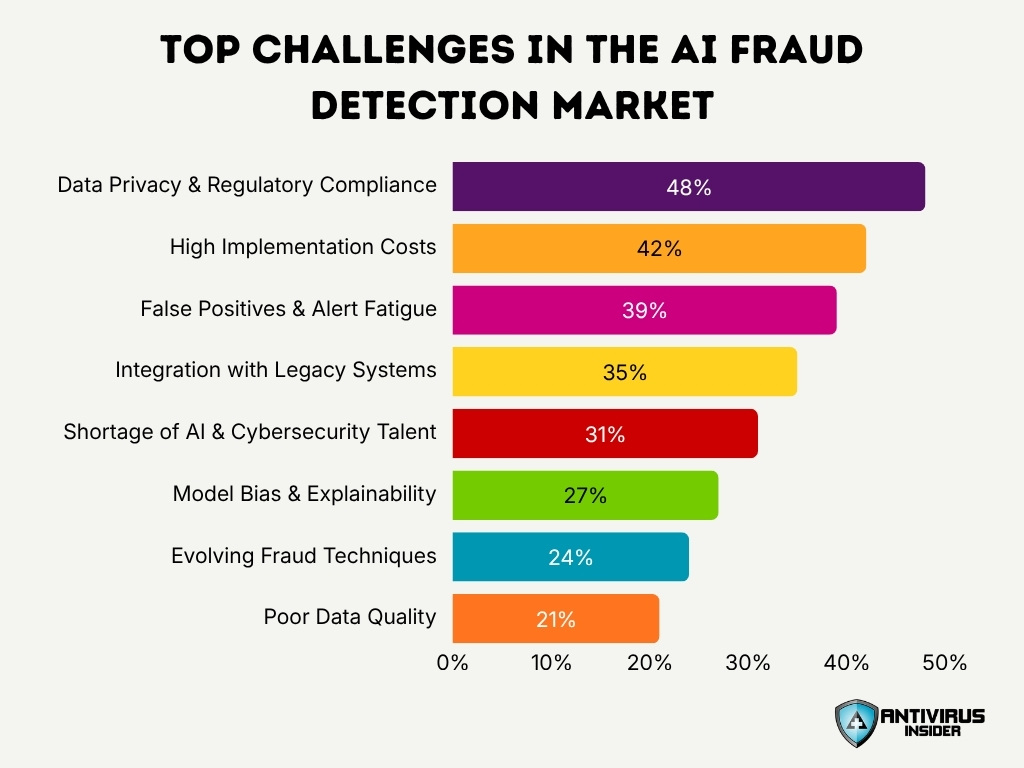
- Data privacy and regulatory compliance are the leading concern, reported by 48% of organizations.
- High implementation costs affect 42% of organizations, limiting adoption among smaller businesses.
- False positives and alert fatigue are reported by 39%, reducing the efficiency of fraud detection teams.
- Legacy system integration remains a major barrier for 35% of organizations.
- A shortage of AI and cybersecurity talent impacts 31%, making skilled professionals increasingly valuable.
- Model bias and explainability issues concern 27% of organizations, especially in regulated industries.
- Evolving fraud techniques challenge 24% of organizations as criminals adopt more sophisticated methods.
- Poor data quality affects 21%, weakening model accuracy and fraud detection performance.
- Overall, the data shows that organizations face a combination of regulatory, financial, technical, and workforce challenges when adopting AI-based fraud detection.
AI in Fraud Detection Market Segmentation
- The market commonly segments by four core dimensions: component, technology, application, and deployment model.
- Industry analysis also divides demand across at least seven major end-user groups, including banking, insurance, retail, health care, telecommunications, government and technology providers.
- Banking, financial services and insurance generated approximately 30% of global fraud detection and prevention revenue in 2025, the largest share among end users.
- Payment fraud represented about 53.1% of application revenue in 2025, making transaction screening the largest application segment.
- Professional services captured roughly 69.4% of service-related revenue in 2025, reflecting demand for integration, risk assessment and implementation support.
- Identity fraud remained the largest case type in one national fraud database during 2025, accounting for 54% of all filings.
- That database recorded 444,993 fraud-risk cases in 2025, an increase of 6% from 2024.
- Identity fraud contributed 242,003 cases to the same 2025 total, while account takeover activity gained prominence as criminal tactics changed.
AI in Fraud Detection Market by Component
- Software solutions represented approximately 63.1% of global fraud detection and prevention revenue in 2025, giving the component a clear lead over standalone services.
- Within the services category, professional services generated about 69.4% of 2025 revenue, ahead of managed service offerings.
- The broader financial fraud detection software market reached approximately $16.32 billion in 2024, highlighting the scale of the software component before the 2025–2026 expansion cycle.
- That software market could reach $53.96 billion by 2034, reflecting demand for transaction analytics, case management and identity-risk engines.
- Financial fraud detection software is forecast to grow at a 12.7% CAGR from 2025 through 2034.
- Financial crime and fraud management solutions generated an estimated $25.56 billion in 2025, covering software used for fraud detection, anti-money laundering and monitoring.
- That broader solutions segment could reach $36.90 billion by 2033, based on a 4.7% CAGR from 2026 onward.
- Services remain important because financial firms must validate models, monitor bias, test data drift, and document compliance across at least four major U.S. supervisory frameworks.
Key Insights on AI Fraud Detection Applications
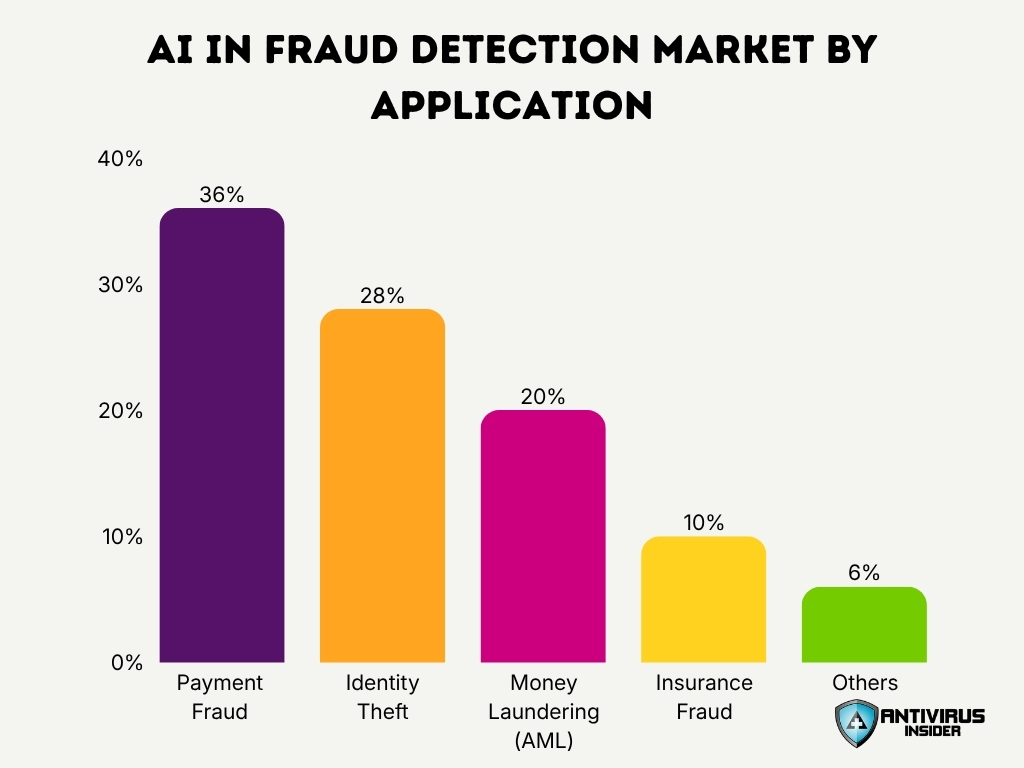
- Payment fraud leads the market with a 36% share, highlighting its status as the primary application of AI-based fraud detection.
- Identity theft detection accounts for 28%, making it the second-largest application segment.
- Together, payment fraud and identity theft represent 64% of the total market, showing strong demand for transaction and identity security.
- Money laundering detection and AML compliance hold a 20% market share, reflecting increased regulatory and financial monitoring requirements.
- Insurance fraud detection represents 10% of the market as insurers adopt AI to identify suspicious claims and behavioral patterns.
- Other applications contribute 6%, covering areas such as account takeover, loan fraud, document fraud, and internal financial misconduct.
- The top three applications collectively capture 84% of the market, indicating that AI adoption is concentrated in financial crime prevention.
AI in Fraud Detection Market by Technology
- A 2025 review evaluated 43 studies specifically focused on the effectiveness of AI-based identity fraud detection.
- Supervised learning algorithms were identified as the most prominent approach across a broad review of 118 publications.
- A 2026 benchmark analyzing 590,540 transactions revealed an LSTM and XGBoost ensemble as the highest-performing architecture.
- An additional test on 284,807 transactions confirmed that ensemble-based scoring effectively handles highly imbalanced data.
- XGBoost demonstrated superior production stability by recording a temporal AUC change of just -0.0017 versus -0.0626 for LSTM.
- The overall AI in fraud detection market is forecast to surge at a 24.5% CAGR, reaching $108.3 billion by 2033.
- AI-powered fraud prevention software is anticipated to dominate the market by capturing 57.3% of the solution segment in 2026.
- The machine learning technology segment officially accounted for the largest overall revenue share within the market in 2023.
AI in Fraud Detection Market by Deployment
- The global fraud detection and prevention market is projected to grow from $54.61 billion in 2025 to $67.12 billion in 2026.
- An alternative market estimate places the sector at $35.3 billion in 2025 and $40.4 billion in 2026.
- The core AI in fraud detection market is expected to reach an estimated base value of $15.6 billion in 2025.
- The agentic AI fraud detection market is projected to grow at an extraordinary 46.28% CAGR between 2026 and 2035.
- North America is anticipated to lead the AI deployment landscape with 38.7% of total global market revenue in 2025.
- Large enterprises dominated the AI deployment landscape by capturing approximately 79% of the revenue share in 2025.
- A review of 118 studies and institutional reports found that hybrid deployment models offered significantly greater adaptability.
- One 2026 experimental AI system completed critical automated responses in less than 0.43 milliseconds at the 95th percentile.
- AI-based fraud detection systems successfully contributed to a 45% reduction in phishing-related financial scams between 2021 and 2023.
Regional AI in Fraud Detection Market Insights
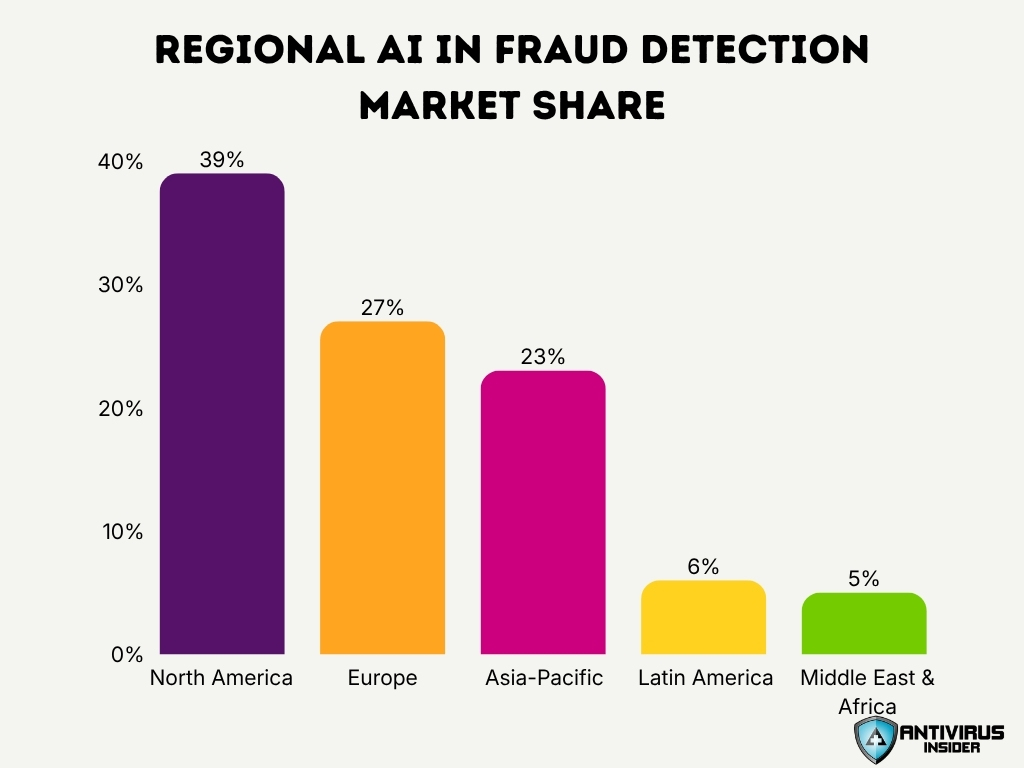
- North America leads the market with a dominant 39% share, reflecting strong AI adoption across banking, insurance, and digital payments.
- Europe accounts for 27% of the market, supported by strict fraud prevention, data protection, and financial compliance requirements.
- Asia-Pacific holds a 23% share, driven by rapid digital payment growth, expanding e-commerce, and rising cybersecurity investment.
- North America and Europe together represent 66% of the global market, highlighting their leadership in AI-powered fraud prevention.
- Latin America contributes 6%, as financial institutions increasingly adopt AI to combat payment fraud and identity theft.
- The Middle East and Africa account for 5%, indicating significant long-term growth potential as digital financial services expand.
- The 11-percentage-point gap between North America and Europe confirms North America’s clear regional advantage.
- Emerging regions collectively hold 11% of the market, creating opportunities for fraud detection vendors to expand into underserved economies.
AI in Fraud Detection Market Share
- North America held approximately 39% of global fraud detection and prevention revenue in 2025 under one market assessment.
- A separate estimate placed North America’s 2025 market share at 42%, with differences largely reflecting the services, technologies and applications included in each market definition.
- The United States remains the largest contributor within North America because of its high digital-payment volume, developed financial sector and large reported fraud losses.
- Software solutions represented approximately 63.1% of total market revenue in 2025, giving fraud analytics platforms a larger share than services.
- Payment fraud held about 53.1% of application revenue in 2025, ahead of identity fraud, money laundering and other use cases.
- Banking, financial services and insurance generated roughly 30% of 2025 revenue, the largest share among industry verticals.
- Professional services accounted for approximately 69.4% of service-segment revenue in 2025, reflecting demand for implementation, integration, consulting and model support.
- AI adoption has reached 90% among surveyed financial institutions, giving AI-enabled products a growing share of fraud-management technology spending.
- Asia-Pacific is positioned to gain market share as mobile payments, e-commerce, digital banking and fintech ecosystems expand across populous emerging economies.
AI in Fraud Detection Market Forecast
- One forecast projects the global fraud detection and prevention market will grow from $40.4 billion in 2026 to $129.4 billion by 2033.
- That projection represents an 18.1% compound annual growth rate from 2026 through 2033.
- A broader market definition estimates growth from $67.12 billion in 2026 to $243.72 billion by 2034, at a 17.5% compound annual growth rate.
- The payment fraud detection AI segment could rise from $14.3 billion in 2025 to $62.8 billion by 2034, based on one application-specific projection.
- That payment-focused segment is forecast to expand at a 17.8% compound annual growth rate between 2026 and 2034.
- Generative AI could help push annual U.S. fraud losses to approximately $40 billion by 2027, more than three times the $12.3 billion estimated for 2023.
- Deepfake fraud attempts against financial institutions increased 2,137% over three years, suggesting that biometric authentication and liveness detection will capture a larger share of future spending.
- Ninety percent of organizations believe fraud losses will increase unless they expand their use of AI-based prevention, which supports continued demand through the forecast period.
- Long-term growth will also depend on explainable models, data quality, regulatory compliance and human review because financial institutions must prove why automated systems approve, reject or investigate transactions.
Frequently Asked Questions (FAQs)
The market is projected to reach $129.4 billion by 2033, up from $40.4 billion in 2026.
The AI fraud detection/anti-fraud segment is forecast to grow at a 24.6% CAGR from 2026 to 2033.
North America led the market with a 39.0% revenue share in 2025.
Americans reported more than $17.7 billion in losses from cyber-enabled fraud during 2025.
The global AI fraud detection/anti-fraud market generated approximately $6.59 billion in revenue in 2025.
Conclusion
AI is becoming a key part of fraud detection as digital payments, online banking, and identity-based services continue to grow. Financial institutions already use AI to monitor transactions, detect unusual behavior, and respond to threats faster. At the same time, deepfakes, synthetic identities, and AI-powered scams are creating new risks. As a result, demand for fraud detection tools will likely keep rising through 2033 and beyond. However, companies will still need strong data controls, clear oversight, and human review to use these systems effectively.
