



Workplace data privacy has become a boardroom priority as employers collect more digital information to secure systems, manage hybrid teams, and meet compliance requirements. Organizations now rely on employee data to strengthen cybersecurity, improve workforce planning, and support AI-powered business operations. At the same time, employees expect greater transparency about how their personal information is collected, stored, and used. This article explores the latest workplace data privacy statistics, helping HR leaders, IT teams, compliance professionals, and business executives understand the trends shaping modern workplaces.
Editor’s Choice
- 90% of organizations report that AI has expanded the scope of their privacy programs, highlighting how AI governance is becoming central to workplace data management.
- 93% of organizations plan to increase investments in privacy and data governance over the next two years, reflecting growing regulatory and business demands.
- 43% of organizations increased spending on privacy initiatives during the past year.
- A May 2026 investigation found that 9 out of 9 leading workplace monitoring platforms shared identifiable worker data with third parties.
- The same 2026 study found that all nine monitored platforms transmitted information about employees’ online activities to external parties.
- 65% of privacy professionals say their jobs are more stressful today than they were five years ago because of expanding technology and regulatory responsibilities.
- Only 46% of privacy professionals are highly confident that their organizations can comply with new privacy laws and regulations.
- 82% of organizations use at least one recognized privacy framework or regulation to manage privacy programs.
Recent Developments
- In 2026, researchers reported that every workplace monitoring platform evaluated shared employee-identifying information with third parties, increasing scrutiny of workplace surveillance practices.
- Researchers also found that 3 of 9 workplace monitoring platforms collected or transmitted precise employee location data.
- The 2026 Data Privacy Benchmark Study shows 23% of organizations still lack a dedicated AI governance committee despite growing AI adoption.
- Only 12% of organizations describe their AI governance committees as mature and proactive.
- 46% of organizations identify clear communication about data usage as the most effective way to strengthen trust.
- The median privacy team size declined from 8 employees in 2025 to 5 in 2026, signaling increasing resource constraints.
- 52% of privacy professionals identify managing risks from emerging technologies as the biggest obstacle facing privacy programs.
- 66% of organizations now review and update privacy awareness training at least once each year, up from 59% in 2025.
- Legal experts note that more U.S. employers are reviewing monitoring policies as additional states require employee notification before electronic monitoring occurs.
Global Workplace Data Privacy Statistics
- More than 5,200 privacy, security, and technology professionals across 12 countries participated in the 2026 global privacy benchmark survey, making it one of the largest enterprise privacy studies published this year.
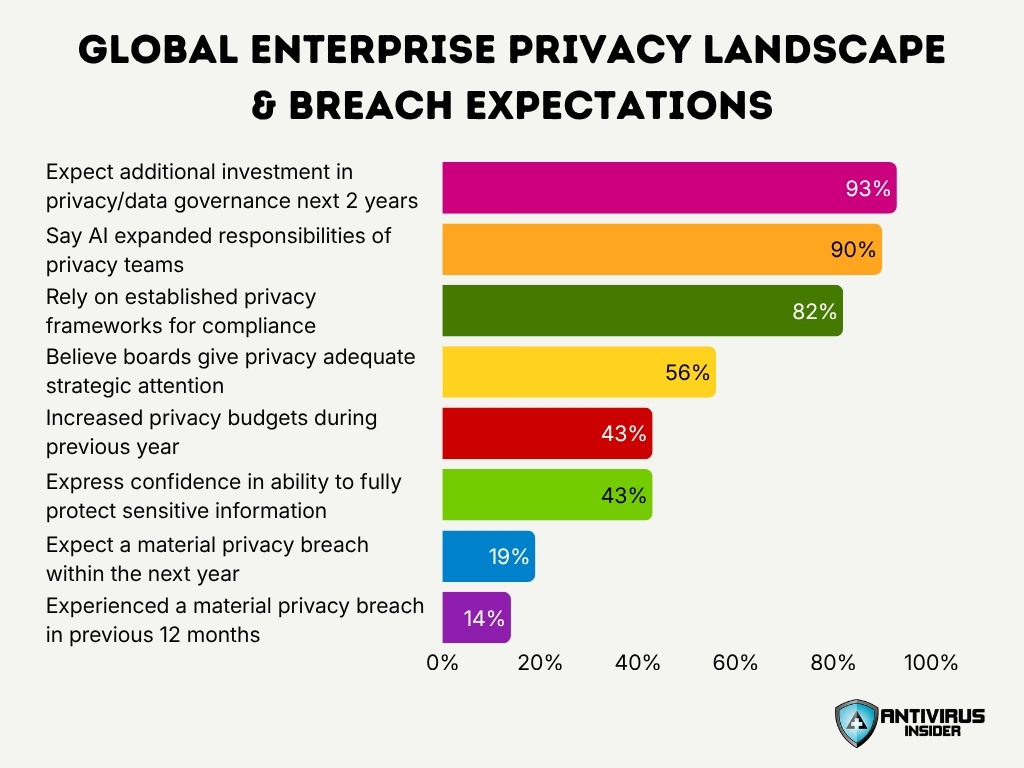
- 90% of surveyed organizations say AI has expanded the responsibilities of their privacy teams.
- 43% of organizations increased privacy budgets during the previous year to address AI and regulatory requirements.
- 93% expect additional investment in privacy and data governance over the next two years.
- 82% of organizations globally rely on established privacy frameworks or regulations to manage compliance efforts.
- 56% of privacy professionals believe their boards now give privacy adequate strategic attention.
- Only 43% of privacy professionals express confidence in their organization’s ability to fully protect sensitive information.
- 14% of organizations experienced a material privacy breach during the previous 12 months.
- 19% expect a material privacy breach within the next year, compared with 15% who expressed the same expectation in 2025.
Growth of Workplace Data Collection and Monitoring Statistics
- 100% of evaluated 2026 platforms collected behavioral or activity-related employee data during operations.
- 100% of examined platforms transmitted some form of employee activity information to third parties.
- 33% of the evaluated monitoring platforms included precise location-tracking capabilities.
- 90% of organizations report broader privacy responsibilities as AI expands employee data processing.
- 78% of U.S. employers now deploy monitoring tools to improve productivity and workplace safety.
- 94% of companies with remote workforces have adopted device activity tracking and application monitoring.
- 69% of organizations utilize camera systems and video surveillance as part of digital monitoring.
- 59% of businesses implement real-time screen tracking to protect confidential information and prevent insider threats.
Remote and Hybrid Work Monitoring Statistics
- Around 20% of U.S. full-time employees worked entirely remotely in early 2026, while another 28% followed hybrid schedules. This means monitoring policies can affect nearly half of the full-time workforce.
- A 2025 international employer study found that 90% of U.S. firms used at least one algorithmic tool to direct, monitor, or evaluate workers.
- Across the European countries included in the same study, 79% of firms used at least one algorithmic management tool.
- Adoption reached 81% in France, making it the highest rate among the four European countries examined.
- Approximately 78% of firms in Germany reported using tools that automate or support employee management.
- In Italy, the adoption rate stood at 76%, showing that automated oversight now extends well beyond fully remote organizations.
- Spain recorded a 78% adoption rate for algorithmic management tools in the 2025 survey.
- More than three-quarters of U.S. managers, or 76%, said their companies used at least 10 of the 15 workplace management tools covered by the research.
- A study involving more than 1 million employees found that roughly two remote workdays per week offered the strongest balance between promotion prospects and employee turnover.
Key Insights on Employee Data Collection
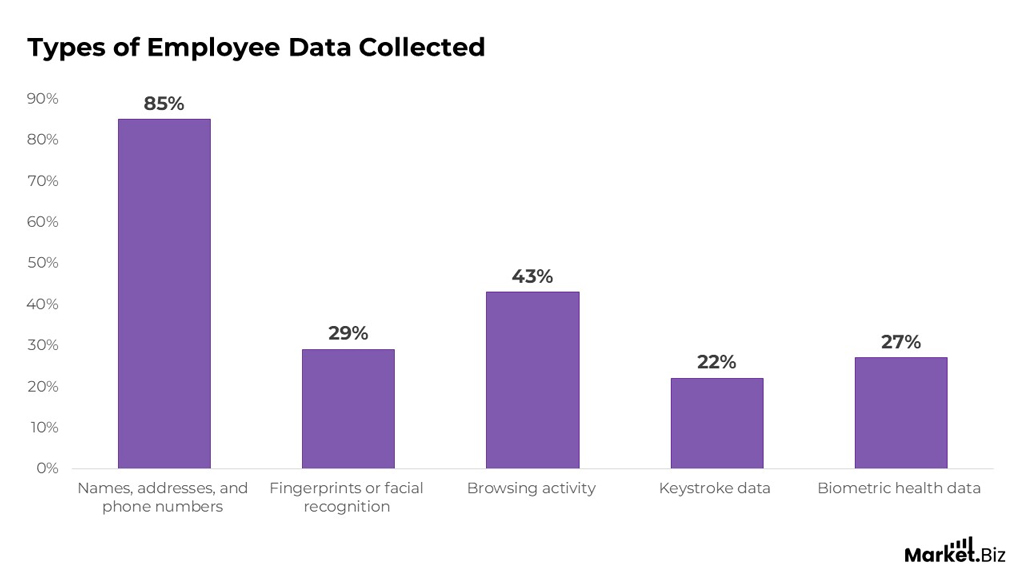
- Names, addresses, and phone numbers are the most commonly collected employee data, reported by 85% of organizations.
- Browsing activity ranks second, with 43% of employers tracking employees’ online behavior.
- Nearly 29% of organizations collect fingerprints or facial recognition data for identification and workplace access.
- Biometric health data is collected by 27% of employers, raising concerns about the handling of sensitive personal information.
- Keystroke data is the least commonly collected category, but it is still monitored by 22% of organizations.
- Basic contact information is collected at almost twice the rate of browsing activity, showing how widely employee identity data is stored.
- More than one in five employers collect highly sensitive data such as keystrokes, biometrics, or facial recognition information.
AI and Automation in Workplace Data Monitoring Statistics
- 90% of organizations said AI expanded the responsibilities and operational scope of their privacy programs in 2026.
- In 2025, 90% of U.S. firms used at least one system that could instruct, assess, or monitor employees through automated processes.
- 55% of U.S. employers in a six-country study monitored the content or tone of employee conversations, calls, or emails.
- Only 6% of European firms in the same research monitored communication content and tone, creating a 49-percentage-point gap with the U.S.
- In Japan, 8% of surveyed firms monitored the content or tone of workplace communications.
- 75% of managers said their organizations provided training on using algorithmic management software.
- Among large organizations with at least 250 employees, 40% used AI in 2024, compared with substantially lower adoption among smaller companies.
- Among Japanese small and midsize businesses, 23.5% reported using generative AI in 2025, compared with 38.7% in Germany.
- A 2025 workplace AI survey found that 65% of managers viewed employee resistance and dissatisfaction as a leading concern tied to AI adoption.
- In 2026, 95% of workers expressed concerns about AI operating autonomously without human oversight, while only 35% felt comfortable with independent AI actions.
Biometric Data and Physical Access Statistics
- 33% of U.S. firms monitored employee health and safety through workplace management technologies.
- Another 31% of U.S. employers monitored worker fatigue or alertness, often through cameras, vehicle sensors or wearable devices.
- In Europe, 15% of firms used technology to monitor worker health and safety.
- Only 5% of European employers monitored fatigue or alertness, compared with almost one-third of U.S. firms.
- A 2025 federal review assessed 122 methodologically qualified studies on the physical, mental, and employment effects of worker surveillance.
- 10 of 11 stakeholder groups consulted in that review said surveillance tools could alert employees to potential health or safety problems.
- Eight stakeholder groups said workplace monitoring technologies could reduce injuries when employers use them to identify verified safety hazards.
- Warehousing, manufacturing and construction workers experienced more than 700,000 nonfatal injuries and over 2,000 fatal accidents in 2022, helping drive employer interest in connected wearables and biometric safety devices.
- Researchers reviewing biometric privacy risks in 2025 tested a protective framework across six datasets to reduce the leakage of speech, facial movement and headset sensor data.
Employee Attitudes Toward Workplace Data Privacy Statistics
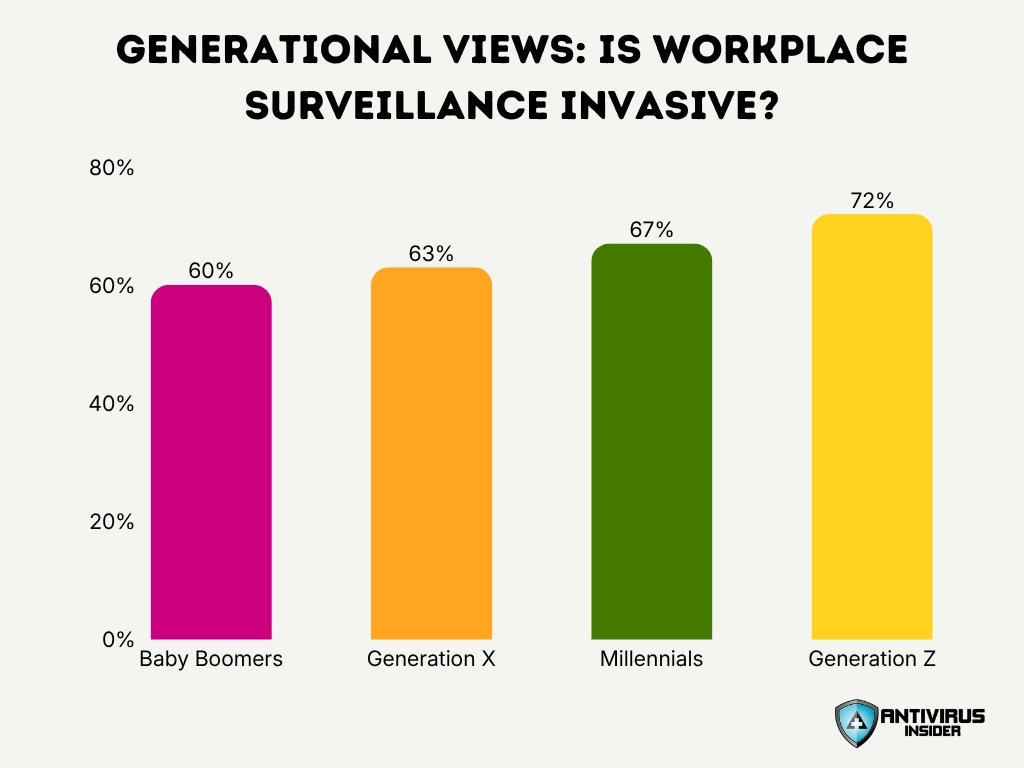
- 72% of Gen Z respondents said workplace surveillance invaded their privacy or reported uncertainty about whether it did.
- Among millennials, 67% expressed similar concern or uncertainty about privacy intrusion at work.
- The proportion fell to 63% among Gen X employees, but still represented a clear majority.
- 60% of baby boomers also viewed workplace surveillance as intrusive or remained unsure about its privacy implications.
- More than half of Gen Z workers, 54%, said they would consider accepting lower pay in exchange for stronger workplace privacy.
- In a 2026 survey, 75% of employees using surveillance software said monitoring increased stress rather than productivity.
- A separate survey found that 68% of employers believed monitoring improved work, while 72% of employees said it produced no positive effect.
- Public opinion research found that 71% of Americans opposed allowing AI to make final hiring decisions, while only 7% supported the practice.
- Views became more favorable when monitoring served a clear safety purpose: 43% supported AI analysis of company drivers’ behavior, while 34% opposed it.
Transparency and Disclosure of Monitoring Practices Statistics
- 46% of organizations identified clear explanations about data use as the most effective way to strengthen trust in 2026.
- 95% of surveyed organizations said customers would not purchase from a company that failed to protect personal data properly, showing the commercial value of transparent privacy practices.
- 53% of global consumers were aware of their country’s privacy laws in 2024, marking the first majority recorded since that research series began in 2019.
- Among people who knew their privacy laws, 81% felt confident in their ability to protect their information.
- Confidence fell to 44% among people who lacked awareness of applicable privacy laws.
- In the U.S., 48% of respondents demonstrated awareness of national or state privacy protections in the 2024 global survey.
- 67% of consumers said they had reviewed or changed privacy settings on apps and digital platforms during the previous 12 months.
- A 2024 governance survey found that 99% of privacy teams faced at least one challenge when delivering regulatory compliance.
- More than half of privacy teams, 55%, faced five or more separate compliance challenges, which can limit their ability to communicate monitoring practices clearly.
- 15% of privacy professionals reported dealing with 10 or more compliance challenges at the same time.
Workplace Data Breaches and Insider Threat Statistics
- The average global data breach cost fell to $4.4 million in 2025, a 9% decline from the previous year.
- Human error contributed to 26% of data breaches in the 2025 breach-cost analysis, making employee mistakes a leading privacy risk.
- IT failures accounted for another 23% of breaches, showing that workplace privacy failures often combine human and technical weaknesses.
- Security teams that extensively used AI and automation identified and contained breaches 80 days faster than organizations without those capabilities.
- Extensive security automation reduced average breach costs by $1.9 million, representing savings of more than 34%.
- The average ransomware breach cost reached $5.08 million in 2025, excluding the value of ransom payments.
- In 2024, 83% of surveyed organizations reported experiencing at least one insider attack during the previous year.
- The share of organizations reporting between 11 and 20 insider attacks rose from 4% to 21%, representing a fivefold increase.
- Malicious insider breaches cost an average of $4.99 million in 2024, making them the most expensive initial breach vector in that year’s analysis.
- Public-cloud breaches averaged $5.17 million, emphasizing the risk created when employees and contractors access workplace data through distributed cloud systems.
Consent and Employee Control Over Personal Data Statistics
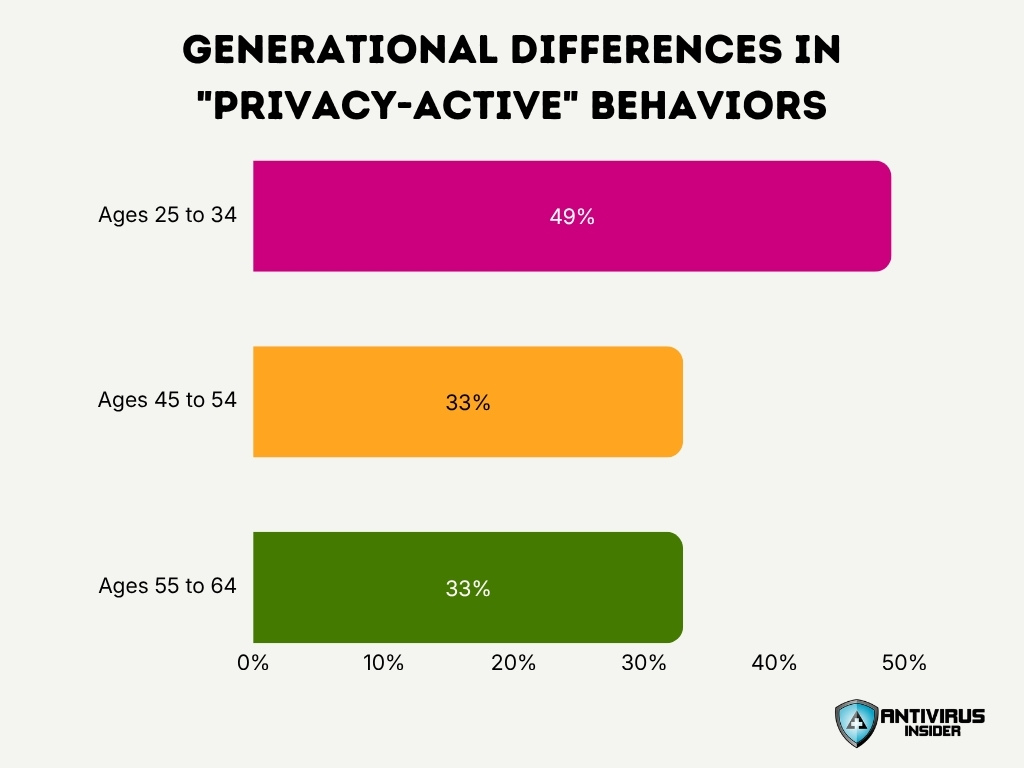
- 49% of adults ages 25 to 34 qualified as privacy-active consumers who cared about data protection and took practical steps to protect their information.
- Only 33% of adults ages 45 to 54 qualified as privacy-active, highlighting a generational difference in data-control behavior.
- The rate also stood at 33% among people ages 55 to 64, well below the level recorded among younger adults.
- 36% of generative AI users said they had entered work-related information into an AI tool, potentially exposing employer or employee data.
- 37% of users entered health information into generative AI services, raising concerns when employees use these tools through workplace accounts.
- Between 24% and 29% of users entered information such as financial details, account numbers, names or religion and ethnicity into generative AI tools.
- Illinois employment rules require notification and consent when employers use AI to analyze job interview videos, giving applicants more control over automated assessment.
- Maryland requires applicant consent before an employer can use facial recognition during a job interview.
- A 2026 U.S. privacy tracker recorded comprehensive privacy-law activity across a growing number of states, increasing employee expectations for access, deletion and opt-out rights.
Financial Impact of Workplace Data Breaches Statistics
- The global average cost of a data breach reached $4.44 million in 2025, down 9% from $4.88 million in 2024 as organizations detected and contained incidents faster.
- U.S. organizations faced an average breach cost of $10.22 million in 2025, a record high and a 9% annual increase.
- Healthcare breaches cost an average of $7.42 million in 2025, the highest figure among the industries studied for the 14th consecutive year.
- Organizations needed an average of 241 days to identify and contain a breach in 2025, the shortest period recorded in nine years.
- Healthcare organizations took an average of 279 days to identify and contain breaches, more than five weeks longer than the global average.
- Third-party vendor and supply-chain compromises produced an average breach cost of $4.91 million in 2025.
- Malicious insider incidents generated the highest average initial-vector cost at $4.92 million, narrowly exceeding third-party compromises.
- Phishing caused 16% of breaches and generated an average organizational cost of approximately $4.8 million.
- The use of unauthorized AI tools added an average of $670,000 to breach costs when organizations experienced related security incidents.
- The median ransomware payment stood at $115,000 in the 2025 incident dataset, although that amount excludes recovery, legal, and operational costs.
Third-Party Vendors and HR Tech Platform Statistics
- Third parties played a role in 30% of confirmed breaches analyzed in 2025, twice the 15% rate reported one year earlier.
- The 2025 breach study examined more than 22,000 security incidents, including 12,195 confirmed breaches across 139 countries.
- A separate global analysis linked 35.5% of 2024 breaches to third-party access, up 6.5 percentage points from 2023.
- Third-party access contributed to 41.4% of ransomware attacks, with remote-access and file-transfer software creating notable exposure.
- Technology products and services contributed to 46.75% of third-party breaches, showing how software and cloud providers can transmit risk across multiple employers.
- Retail and hospitality organizations recorded the highest third-party breach share at 52.4%.
- The technology sector followed with a 47.3% third-party breach rate, while energy and utilities recorded 46.7%.
- Nearly 24% of organizations experienced a third-party security incident in 2024, compared with 9% in 2020.
- Cyber-insurance claims data connected approximately 40% of breach claims to third parties.
- Organizations needed a median of 94 days to remediate leaked secrets discovered in public software repositories, extending the period in which vendors or unauthorized users could exploit credentials.
BYOD and Workplace Device Privacy Statistics
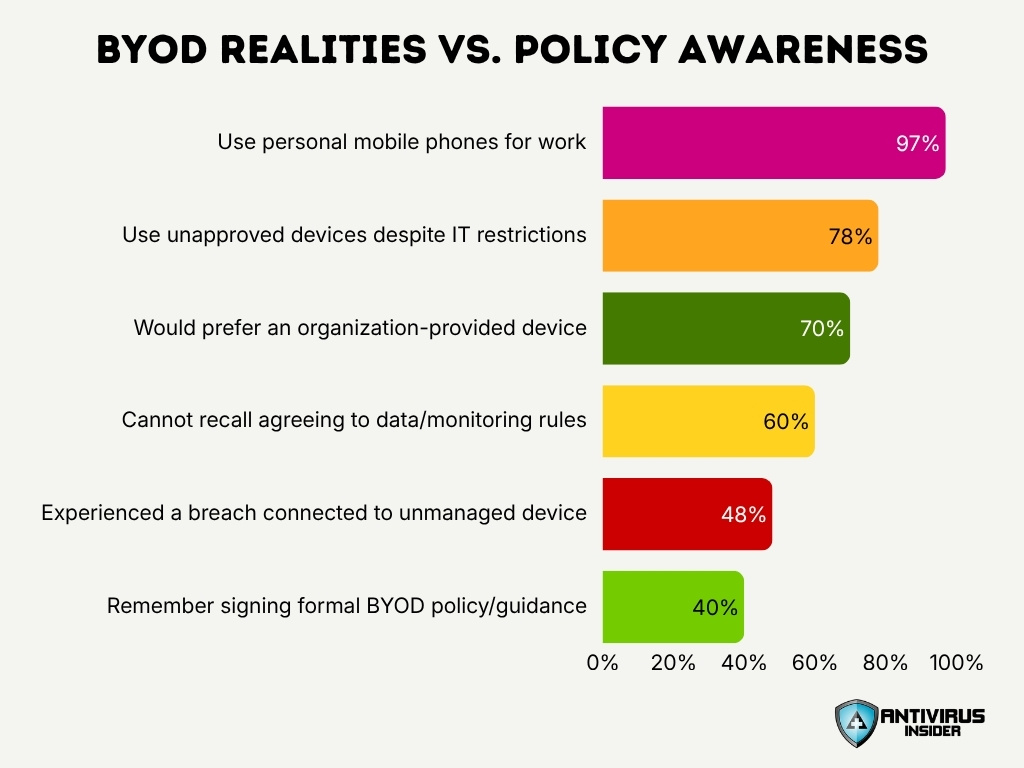
- A 2025 workplace study found that 97% of employees using personal devices for work relied on their own mobile phones.
- Only 40% of BYOD users remembered signing a policy or receiving formal guidance about using personal devices for work.
- As a result, 60% of surveyed BYOD users could not recall agreeing to rules that explained data access, security, or employer monitoring.
- 70% of employees said they would prefer an organization-provided device rather than use a personal device for work.
- Among employees providing face-to-face care, 70% used their own devices, despite frequently handling sensitive personal information.
- Around 48% of organizations reported experiencing a breach connected to an unsecured or unmanaged personal device during the previous year.
- Even at organizations that restricted BYOD, 78% of IT and security leaders said employees continued to use unapproved personal devices.
- The global BYOD market increased from $131.1 billion in 2024 to $153.1 billion in 2025, representing annual growth of about 16.8%.
- North America represented 39.1% of the global BYOD market and generated approximately $51.2 billion in 2024 revenue.
- The worldwide BYOD market could reach $619.5 billion by 2034, which would expand the number of personal endpoints that workplace privacy programs must govern.
Privacy Regulations and Workplace Compliance Statistics
- By the end of 2024, data protection laws covered approximately 6.3 billion people, or 79% of the global population.
- At the beginning of 2025, 144 countries had enacted data or consumer privacy legislation.
- 21 U.S. states, representing 42% of all states, had passed comprehensive privacy laws by early 2025.
- European data protection authorities issued more than €1.2 billion in fines during 2024.
- 63% of breached organizations studied in 2025 lacked formal AI governance policies, creating compliance gaps around employee use of automated tools.
- Only 37% of breached organizations had established AI approval processes or oversight mechanisms.
- Among organizations that experienced an AI-related security incident, 97% lacked adequate AI access controls.
- Data protection researchers identified 21 separate transparency requirements derived from European privacy rules when assessing privacy notices.
- The same 2025 research assembled a dataset of 703,791 English-language privacy policies, illustrating the scale of the compliance-review challenge.
- Researchers compared eight major language models to determine whether automated systems could identify transparency disclosures in privacy policies.
Industry and Regional Workplace Data Privacy Statistics
- Average U.S. breach costs reached $10.22 million in 2025, more than twice the global average of $4.44 million.
- India’s average organizational breach cost rose 13%, from INR 195 million in 2024 to INR 220 million in 2025.
- In India, phishing caused 18% of breaches, while third-party and supply-chain compromises caused 17%.
- Average breach costs declined by 27% in Italy, 24% in Germany and 21.5% in South Korea during 2025.
- In Europe, the Middle East and Africa, system-intrusion incidents represented 53% of breaches, up from 27% one year earlier.
- Internal actors contributed to 29% of breaches in that region, compared with 5% in North America and 1% in the Asia-Pacific region.
- Unintentional employee mistakes accounted for 19% of regional breaches, while deliberate or improper data use accounted for 8%.
- System intrusions produced 80% of Asia-Pacific breaches, rising from 38% in the previous year.
- Malware appeared in 83% of Asia-Pacific breaches, up from 58%, while ransomware appeared in 51%.
- Small and midsize organizations experienced ransomware in 88% of analyzed breaches, compared with 39% among larger organizations.
Frequently Asked Questions (FAQs)
In 2026, 90% of organizations said AI had expanded the scope of their privacy programs, while 43% increased privacy spending during the previous year.
93% of organizations plan to allocate more resources to privacy and data governance by 2028, and 38% spent at least $5 million on privacy programs in the previous year.
The global average data breach cost reached $4.44 million in 2025, down 9% from $4.88 million in 2024.
The average U.S. data breach cost climbed to a record $10.22 million in 2025, more than twice the worldwide average.
Third-party involvement accounted for 30% of breaches in 2025, double the 15% share recorded in the previous report.
Conclusion
Workplace data privacy extends beyond written policies and annual compliance exercises. Employers must govern employee monitoring, personal devices, AI systems, biometric tools and outside service providers as parts of the same data environment. The global average breach still costs $4.44 million, while U.S. organizations face average costs of $10.22 million. Third-party involvement has doubled from 15% to 30%, and human involvement remains present in about 60% of breaches. At the same time, unauthorized AI use can add an average of $670,000 to breach costs, while only 40% of surveyed BYOD users recalled signing workplace guidance. Privacy laws now protect roughly 79% of the global population, increasing compliance responsibilities for employers that operate across borders.
Organizations can reduce risk by limiting unnecessary data collection, documenting monitoring practices, reviewing vendor access, and explaining how employee information supports workplace decisions. Ultimately, effective workplace privacy depends on both technology and trust, and employers that use proportional monitoring and transparent data practices can protect systems without turning every employee interaction into a surveillance event.
