



Cybersecurity has become a core business priority as organizations protect cloud environments, connected devices, digital identities, and critical infrastructure from increasingly sophisticated attacks. The market continues to expand as enterprises invest in AI-powered security, zero-trust architecture, and managed security services.
Across the United States, cybersecurity spending supports industries such as banking, where financial institutions defend against fraud and ransomware, and healthcare, where providers secure electronic health records and connected medical devices. Government agencies, manufacturers, retailers, and technology companies also continue to increase investments to strengthen resilience and meet regulatory requirements. The statistics below highlight how the cybersecurity market is evolving.
Editor’s Choice
- The global cybersecurity market reached approximately $271.9 billion in 2025 and is projected to grow to $302 billion in 2026, reflecting sustained enterprise demand for security solutions.
- Worldwide end-user spending on information security is expected to increase from $213 billion in 2025 to $240 billion in 2026, representing 12.5% annual growth.
- North America accounted for 37.9% of global cybersecurity market revenue in 2025, making it the largest regional market.
- Cloud-based deployments represented 67.7% of the cybersecurity market in 2025, highlighting the continued shift toward cloud-native security platforms.
- Identity and Access Management (IAM) captured 29.3% of solution revenue in 2025, making it the largest cybersecurity solution category.
- Hardware remained the largest offering segment, accounting for 54.2% of global cybersecurity revenue in 2025.
- Asia-Pacific is forecast to deliver the fastest market growth through 2033 as governments and enterprises accelerate digital transformation and cyber resilience initiatives.
Recent Developments
- In July 2026, Rubrik announced a $500 million investment in the UK over five years while establishing London as its European headquarters to expand cyber resilience and sovereign cloud capabilities.
- Rubrik also confirmed its Security Cloud will be available on AWS European Sovereign Cloud, reflecting increasing demand for regional data sovereignty and regulated cloud security.
- Enterprises are increasingly adopting AI-assisted cyber defense, creating strong demand for professionals with expertise in both AI and cybersecurity, according to workforce research published in 2025.
- Industry analysts estimate that only 14% of organizations currently possess the cybersecurity talent required to address emerging AI-related security challenges.
- Palo Alto Networks raised its fiscal outlook in 2026 after reporting stronger enterprise demand for AI-powered cybersecurity, cloud security, and identity protection offerings.
- Cybersecurity stocks reached their highest levels in nearly a year during mid-2026, reflecting stronger investor confidence in the sector’s long-term growth.
- Large-scale industry consolidation continued after Palo Alto Networks announced a planned $25 billion acquisition of CyberArk, underscoring the growing importance of identity security.
- Organizations continue shifting toward identity-first security strategies as deepfake fraud, credential theft, and AI-assisted attacks reshape enterprise security priorities.
Cyber Security Market Size Statistics
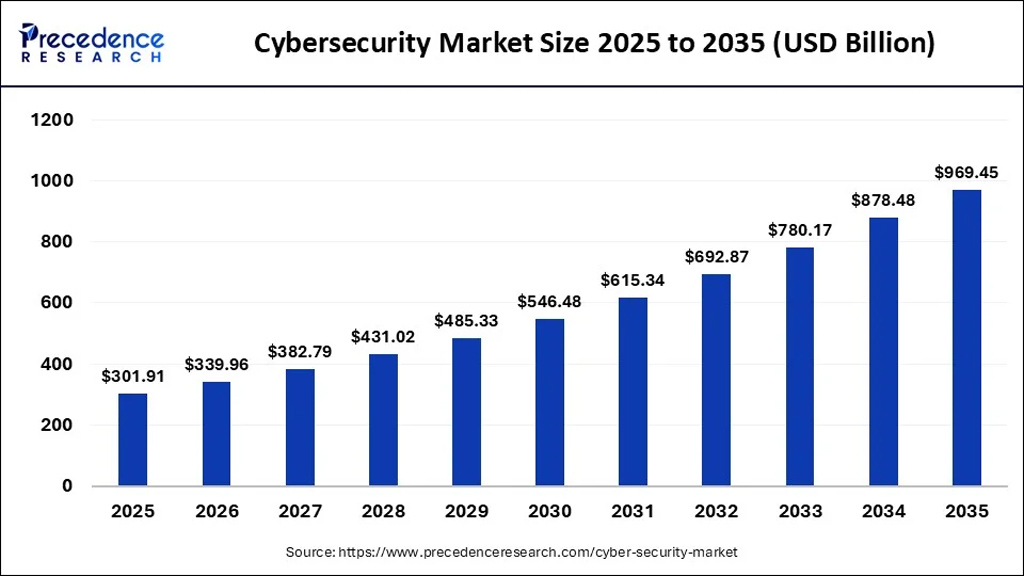
- The global cybersecurity market is projected to grow from $301.91 billion in 2025 to $969.45 billion by 2035.
- The market is expected to expand by $667.54 billion during the forecast period.
- Overall cybersecurity market value is projected to rise by approximately 221.1% between 2025 and 2035.
- The market is estimated to record a compound annual growth rate of approximately 12.4% over the decade.
- Cybersecurity spending is forecast to surpass $500 billion in 2030, reaching $546.48 billion.
- The market is projected to exceed $600 billion in 2031 and approach $700 billion in 2032.
- By 2033, the cybersecurity market is expected to reach $780.17 billion.
- Annual market growth accelerates toward the end of the forecast, adding more than $90 billion from 2033 to 2034.
- The largest yearly increase occurs between 2034 and 2035, when the market grows by $90.97 billion.
- By 2035, the global cybersecurity market is expected to be more than three times its 2025 size.
Cyber Security Market Growth Rate Statistics
- The global cybersecurity market is projected to grow at a compound annual growth rate (CAGR) of 11.7% between 2026 and 2033, driven by rising cybercrime, AI adoption, and stricter data protection regulations.
- Another industry forecast estimates a 13.8% CAGR from 2026 to 2034, reflecting continued investments in cloud security, endpoint protection, and managed security services.
- Worldwide end-user spending on information security is forecast to increase 12.5% year over year, rising from $213 billion in 2025 to $240 billion in 2026.
- Spending on security software is expected to record one of the fastest growth rates in 2026 as organizations strengthen identity security, application security, and cloud workload protection.
- The cloud security segment continues to outpace many traditional cybersecurity categories because enterprises are migrating workloads to public and hybrid cloud environments.
- Demand for managed security services (MSS) continues to grow at a double-digit pace as organizations address cybersecurity talent shortages and expand 24/7 threat monitoring.
- The Asia-Pacific cybersecurity market is projected to achieve the highest regional CAGR through the next decade due to rapid enterprise digitization across India, China, Southeast Asia, and Australia.
- Small and medium-sized businesses (SMBs) are expected to contribute a growing share of cybersecurity spending as ransomware attacks increasingly target organizations with limited security resources.
- The rapid adoption of AI-powered cybersecurity platforms is creating one of the fastest-growing investment areas within enterprise security, particularly for threat detection and automated incident response.
Cyber Security Market Forecast Statistics
- The global cybersecurity market is forecast to reach approximately $663.2 billion by 2033, more than doubling from its 2025 valuation.
- Fortune Business Insights projects the market will expand to nearly $699.4 billion by 2034, supported by sustained enterprise security investments.
- Worldwide information security spending is expected to exceed $240 billion in 2026, reflecting continued growth across software, services, and infrastructure protection.
- Identity and Access Management (IAM) is forecast to remain among the fastest-growing cybersecurity solution categories as organizations adopt passwordless authentication and Zero Trust architectures.
- Cloud-native application protection platforms (CNAPPs) are expected to become standard components of enterprise cloud security strategies over the next several years.
- Governments worldwide continue increasing cybersecurity investments to protect critical infrastructure, including energy grids, transportation systems, and public-sector networks.
- AI-driven security analytics and autonomous threat detection are expected to reshape security operations centers (SOCs), reducing manual workloads while improving detection speed.
- Cyber insurance requirements are forecast to encourage organizations to strengthen endpoint security, multifactor authentication, vulnerability management, and backup strategies.
- Regulatory frameworks such as NIS2, SEC cyber disclosure rules, and evolving privacy legislation are expected to remain key drivers of cybersecurity investments through the decade.
Key Factors Fueling Cybersecurity Market Growth
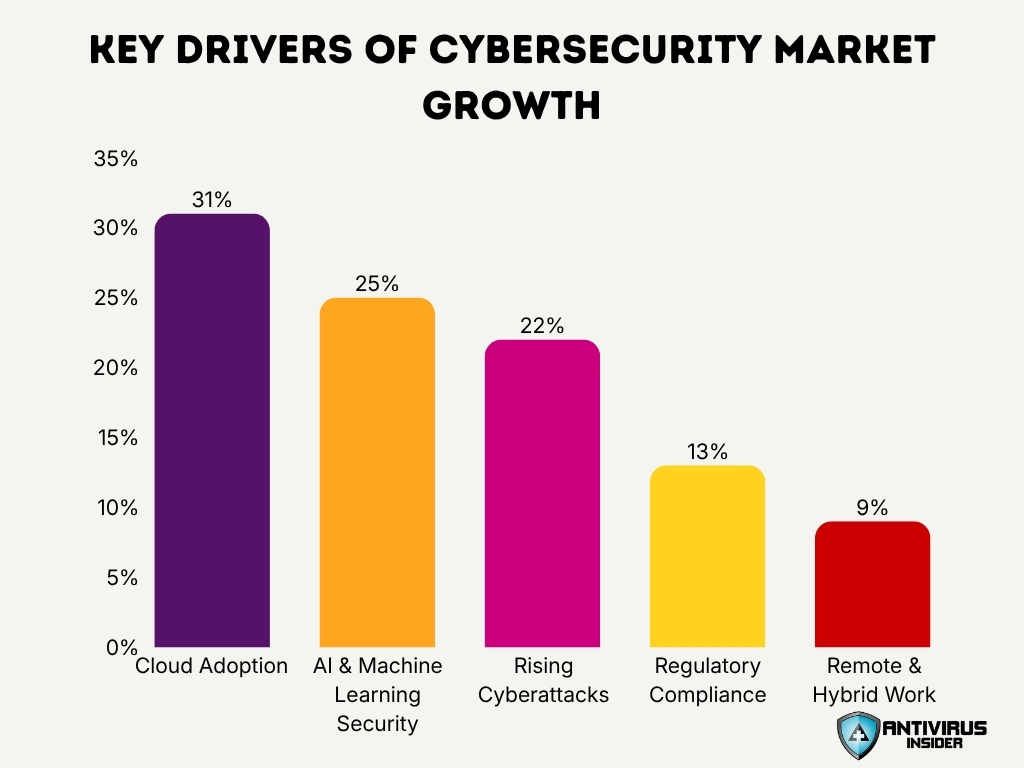
- Cloud adoption is the leading growth driver, accounting for 31% of the market’s relative impact.
- AI and machine learning security ranks second at 25%, driven by demand for automated threat detection and response.
- Rising cyberattacks contribute 22%, increasing pressure on organizations to strengthen digital defenses.
- Regulatory compliance represents 13%, as businesses invest in security controls to protect data and meet legal requirements.
- Remote and hybrid work contributes 9%, reflecting the need to secure distributed employees, devices, and networks.
- Together, cloud adoption and AI security account for 56% of the total relative impact.
- The top three drivers contribute 78%, showing that digital transformation and escalating threats dominate market growth.
Cyber Security Market Share Statistics
- North America accounted for approximately 37.9% of global cybersecurity revenue in 2025, maintaining the largest regional market share.
- The cloud deployment segment represented 67.7% of cybersecurity revenue in 2025, significantly outperforming on-premises deployments.
- Hardware solutions held approximately 54.2% of the market by offering in 2025, although software and security services continue to gain market share.
- Identity and Access Management (IAM) generated 29.3% of cybersecurity solution revenue in 2025, making it the leading solution category.
- Large enterprises continue to account for the majority of cybersecurity spending because of their larger IT environments, regulatory obligations, and complex threat landscapes.
- The BFSI sector remains one of the largest contributors to cybersecurity revenue, supported by increasing investments in fraud prevention, identity verification, and regulatory compliance.
- Cloud security vendors continue gaining market share as organizations consolidate multiple security tools into unified cloud-native security platforms.
- Endpoint security remains one of the most widely deployed cybersecurity technologies as hybrid work environments increase the number of connected devices requiring protection.
- The United States continues to represent the largest individual national cybersecurity market, supported by strong federal spending, enterprise digital transformation, and the presence of major cybersecurity vendors.
Cyber Security Market Trends Statistics
- The global cybersecurity market is expected to reach $271 billion by 2026.
- Global end-user spending on information security is forecast to hit $240 billion in 2026.
- Annual global cybercrime losses are projected to surpass $10.5 trillion in 2026.
- The average cost of a global data breach is anticipated to reach $4.88 million in 2026.
- Ransomware damage costs are forecasted to climb to $74 billion worldwide in 2026.
- Cloud security solutions account for approximately 33% of total cybersecurity industry revenue.
- The network security segment is projected to capture a 23.8% market share in 2026.
- Around 95% of organizations report facing significant cybersecurity skill gaps and shortages.
- Phishing attacks are expected to be involved in 42% of all global data breaches.
Cybersecurity Market Share by Component
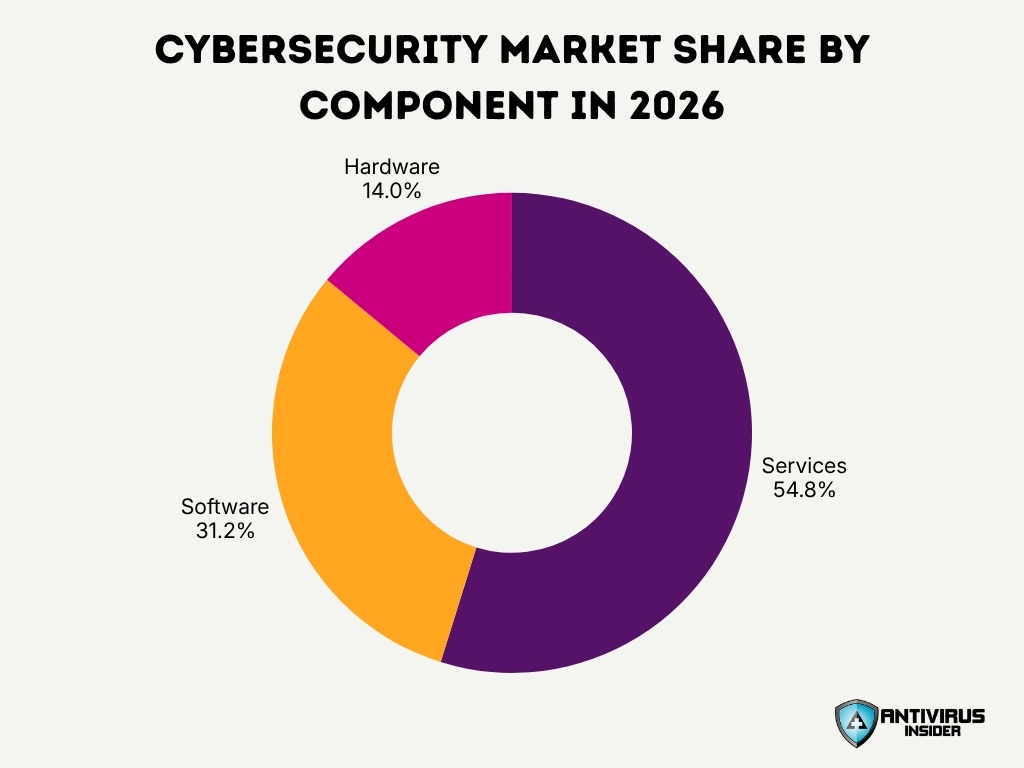
- Services dominate the cybersecurity market with a 54.8% share, accounting for more than half of total industry revenue.
- Software represents 31.2% of the market, making it the second-largest cybersecurity component.
- Hardware holds the smallest share at 14.0%, trailing both services and software.
- Services exceed software by 23.6 percentage points, highlighting strong demand for managed and professional security support.
- Combined, services and software account for 86.0% of the global cybersecurity market.
Cyber Security Market Segmentation Statistics
- By offering, hardware represented 54.2% of global cybersecurity revenue in 2025, while services remain the fastest-growing segment.
- Infrastructure protection accounted for 23.9% of the market by security type in 2025, making it the largest security category.
- Identity and Access Management (IAM) captured 29.3% of solution revenue, leading all cybersecurity solution segments.
- Cloud deployment generated 67.7% of total cybersecurity market revenue in 2025.
- Large enterprises represented 73.0% of cybersecurity spending, reflecting greater regulatory and infrastructure requirements.
- The market is commonly segmented into hardware, software, professional services, and managed services to address diverse enterprise security needs.
- Security categories continue expanding across endpoint security, cloud security, application security, network security, identity security, and data protection.
- End-user segmentation includes BFSI, healthcare, government, manufacturing, retail, energy, IT & telecommunications, and education, each with unique cybersecurity requirements.
- Regional segmentation continues to highlight North America as the largest market while Asia-Pacific delivers the fastest forecast growth.
Cyber Security Market by Deployment Mode Statistics
- Cloud deployment accounted for 67.7% of the global cybersecurity market revenue in 2025.
- The overall cloud security market is projected to grow at a 20.7% CAGR between 2026 and 2035.
- Public cloud deployments retained a massive 64.85% revenue share of cloud security software in 2025.
- Hybrid deployment configurations are forecast to expand at the highest rate of 14.76% CAGR through 2031.
- The global cybersecurity market is projected to reach a total value of $663.2 billion by 2033.
- On-premises hardware security segments still captured 54.2% of specific cybersecurity revenue in 2025.
- Cloud Identity and Access Management deployments led the software sector with a 34.42% market share in 2025.
- Small and medium enterprises adopting cloud security are growing at a rapid 15.03% CAGR globally.
- The dedicated cloud security market size is officially estimated to hit $50.18 billion by 2035.
Cybersecurity Market Share by Region
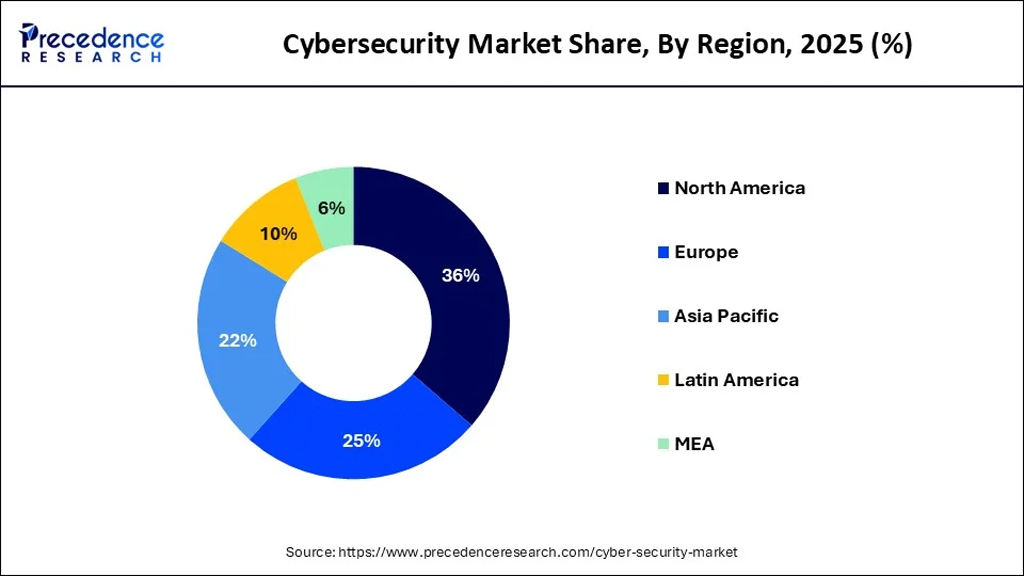
- North America led the cybersecurity market with a 36% share in 2025.
- Europe ranked second, accounting for 25% of the global market.
- Asia Pacific held a substantial 22% market share.
- Latin America represented 10% of the cybersecurity market.
- The Middle East and Africa recorded the smallest share at 6%.
- The top three regions, North America, Europe, and Asia Pacific, collectively accounted for 83% of the market.
Cyber Security Market by Organization Size Statistics
- Large enterprises dominated the industry by capturing 67.55% of the total cybersecurity market size in 2025.
- Small and medium enterprises (SMEs) represent the fastest-growing segment, expanding at a 13.5% CAGR through 2033.
- Approximately 68% of large enterprises in the Asia-Pacific region are increasing investments in network and cloud security.
- The global SME cybersecurity market generated $73.4 billion in 2025 and is projected to reach $201.3 billion by 2033.
- Around 39% of mid-sized enterprises face significant vulnerabilities due to highly restricted and limited security budgets.
- Large corporations drive advanced cybersecurity demand as they manage and protect more than 500 terabytes of enterprise data.
- A massive 47% shortage of skilled cybersecurity professionals forces many SMEs to heavily rely on managed security services.
- Within emerging markets, large enterprises accounted for a significant 69.72% of the overall regional cybersecurity spending in 2025.
Cyber Security Market by Industry Vertical Statistics
- The BFSI sector faces an average data breach cost of $6.4 million due to high-value financial data.
- The average cost of a healthcare data breach recently peaked at $11.2 million per incident.
- Government and defense agencies allocate over $25 billion annually toward modernizing digital security infrastructure.
- The manufacturing industry is the most targeted sector and accounts for 34.7% of all cyber incidents globally.
- The IT and telecommunications sector spends the highest average amount of $4,200 per employee annually on cybersecurity.
- Retail organizations currently allocate approximately 0.3% of their overall revenue to secure digital commerce platforms.
- The education sector is witnessing a specific 6% year-over-year increase in targeted ransomware attacks.
- Over 78% of cyber incidents in the finance industry involve the direct theft of customer login credentials.
Cyber Security Spending Statistics
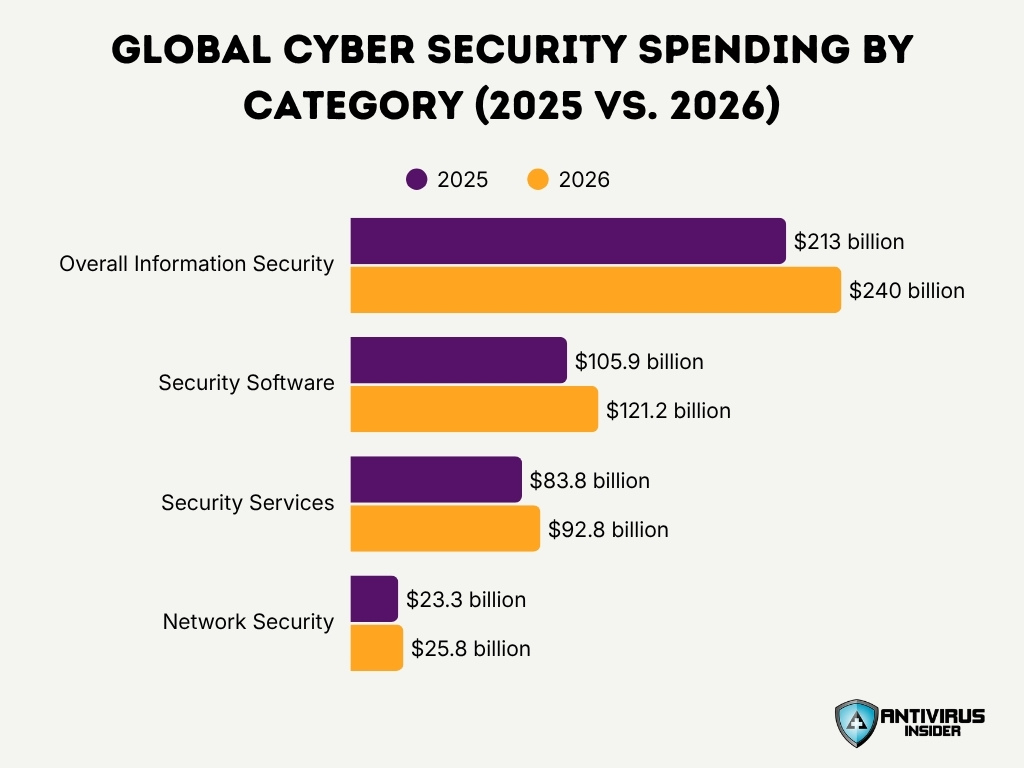
- Worldwide end-user spending on information security is projected to reach $240 billion in 2026, up from $213.0 billion in 2025, representing 12.5% year-over-year growth.
- Global information security spending increased from $193.4 billion in 2024 to $213.0 billion in 2025, demonstrating continued enterprise investment despite economic uncertainty.
- Security software is expected to remain the fastest-growing spending category, increasing from $105.9 billion in 2025 to $121.2 billion in 2026.
- Spending on security services is forecast to rise from $83.8 billion in 2025 to $92.8 billion in 2026, reflecting strong demand for managed security and incident response services.
- Network security spending is projected to grow from $23.3 billion in 2025 to $25.8 billion in 2026.
- Rising AI adoption, stricter regulations, and expanding cloud infrastructure remain the primary drivers behind cybersecurity budget increases through 2026.
- Many organizations continue reallocating IT budgets toward cyber resilience instead of reducing security investments during periods of economic pressure.
- Managed security services continue gaining budget share because organizations face persistent cybersecurity talent shortages and increasingly complex threat environments.
- Higher defense spending by governments and stronger cybersecurity awareness among small and medium-sized businesses continue supporting long-term market growth.
Cyber Threat and Attack Statistics
- Human factors contributed to 68% of data breaches, highlighting that employee mistakes, phishing, and insider actions remain major security risks.
- 83% of organizations experienced insider-related security incidents, emphasizing the need for stronger identity governance and access controls.
- Manufacturing remained the most-targeted industry, accounting for 27.7% of investigated cyber incidents in the latest global threat intelligence findings.
- North America represented 29% of investigated cyberattack cases, making it the most targeted region in the latest threat analysis.
- Attacks exploiting public-facing applications increased by 44%, demonstrating the growing importance of vulnerability management and application security.
- In the fastest recorded incidents, attackers moved from initial access to data exfiltration in just 72 minutes, roughly four times faster than the previous year.
- Identity weaknesses contributed to nearly 90% of investigated security incidents, making identity protection one of the highest cybersecurity priorities.
- More than 90% of investigated attacks involved security misconfigurations or gaps in security coverage that enabled threat actors.
- Phishing and social engineering remained the most common initial attack vector, accounting for 35.8% of organizational intrusions.
Cloud Security Market Statistics
- Cloud deployment represented 67.7% of the cybersecurity market in 2025, becoming the dominant model.
- The global cloud security market is projected to reach $140.71 billion by 2035, expanding at a 13.3% CAGR.
- North America dominated the global cloud security landscape with a revenue share of 39.9% in 2025.
- The Cloud Security Posture Management (CSPM) sector is expected to grow to $14.44 billion by 2035.
- Security software solutions held the largest market share of 67.2% in 2025 due to complex environments.
- The large enterprise segment accounted for the highest revenue share of 76% in the market in 2025.
- The services segment of cloud security is projected to grow at a rapid 14.52% CAGR in the coming years.
- The private deployment segment contributed significantly by holding more than 48% of the revenue share in 2025.
- The hybrid cloud security segment is anticipated to witness a notable 13.51% CAGR over the upcoming period.
- The IT and telecom end-use sector registered the highest revenue share of 18% in 2025.
AI in Cyber Security Market Statistics
- Worldwide cybersecurity spending continues increasing partly because organizations are securing both enterprise AI deployments and defending against AI-powered attacks.
- Gartner forecasts that AI and generative AI will remain major drivers of cybersecurity investment throughout 2026.
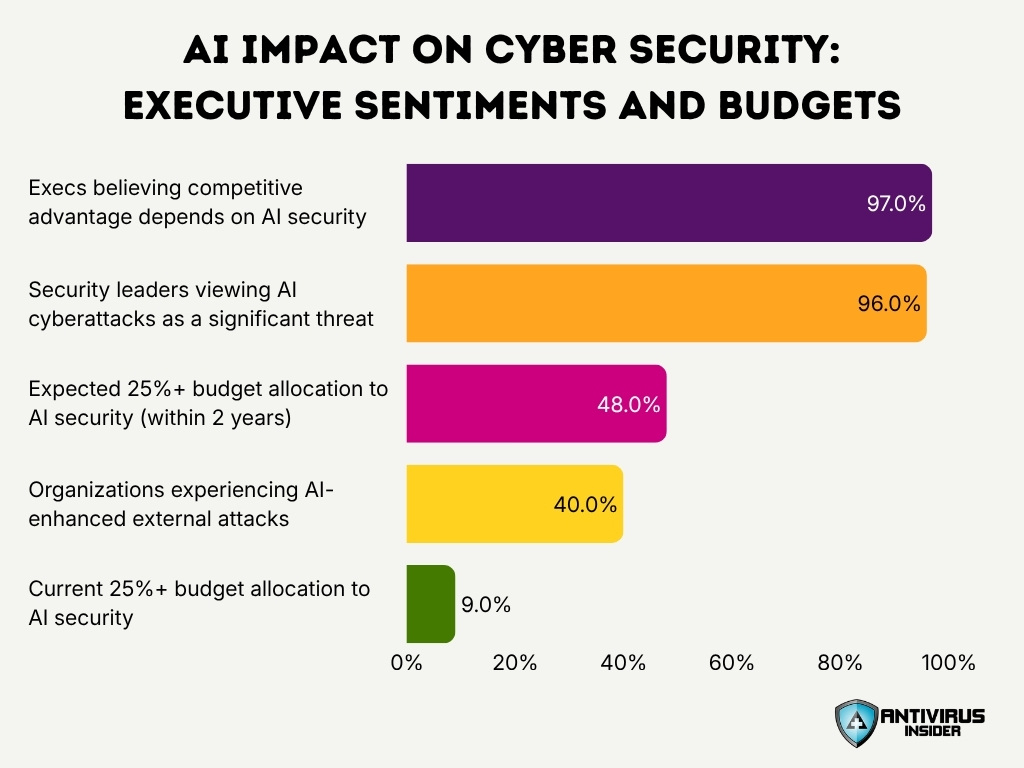
- 96% of senior security leaders consider AI-enabled cyberattacks a significant threat to their organizations.
- Currently, 9% of organizations allocate at least 25% of their cybersecurity budget to AI-related security, while that figure is expected to reach 48% within two years.
- 97% of executives believe their competitive advantage will increasingly depend on the maturity of AI-driven cybersecurity capabilities.
- AI-powered security automation continues reducing investigation time by accelerating threat detection, prioritization, and incident response workflows.
- Cybersecurity vendors continue introducing dedicated platforms to secure AI models, AI applications, and autonomous AI agents as enterprise AI adoption accelerates.
- Approximately 40% of organizations reported AI-enhanced external attacks using AI-driven automation for phishing, reconnaissance, or lateral movement.
- Identity-first security has become a strategic priority because AI-assisted credential theft and deepfake fraud continue expanding enterprise attack surfaces.
Competitive Landscape and Key Companies
- Palo Alto Networks planned a $25 billion acquisition of CyberArk to strengthen its identity security portfolio.
- Palo Alto Networks increased its 2026 revenue outlook to $11.28 billion–$11.31 billion for AI-powered solutions.
- Rubrik announced a $500 million investment over five years while establishing London as its European headquarters.
- The global cybersecurity market size is projected to reach $271 billion in 2026 and $411 billion by 2032.
- North America remains the dominant region, holding an estimated 43% market share of the cybersecurity industry in 2026.
- Global cybersecurity spending among key vendors and enterprises is projected to surpass $212 billion in 2025.
- The cloud security segment is rapidly expanding and is expected to account for approximately 33% of industry revenue in 2026.
- Cybersecurity software solutions are projected to hold the largest competitive market share at 61.73% in 2026.
- Around 68% of organizations are investing in AI and machine learning solutions to strengthen their competitive positioning.
- The cybersecurity workforce demand is currently facing a 35% gap, driving vendors toward autonomous incident response platforms.
Frequently Asked Questions (FAQs)
The global cybersecurity market is projected to reach $302.0 billion in 2026, up from $271.9 billion in 2025.
The global cybersecurity market is forecast to grow at a 11.9% CAGR between 2026 and 2033, according to recent market estimates.
North America accounted for 37.9% of global cybersecurity market revenue in 2025, making it the largest regional market.
Worldwide end-user spending on information security is expected to total $240 billion in 2026, increasing from $213 billion in 2025.
The cloud deployment segment represented 67.7% of the global cybersecurity market in 2025, making it the leading deployment model.
Conclusion
The cybersecurity market continues to grow rapidly as organizations respond to expanding digital ecosystems, increasingly sophisticated cyber threats, and stricter regulatory requirements. Spending on cloud security, AI-powered defense, identity protection, and managed security services is expected to remain strong.
North America continues to lead global cybersecurity spending, while Asia-Pacific is emerging as the fastest-growing regional market. At the same time, enterprises are shifting toward integrated security platforms that combine cloud protection, identity management, AI-powered detection, and cyber resilience into unified solutions.
Looking ahead, organizations that invest in proactive security strategies, Zero Trust architectures, AI-enabled security operations, and continuous cyber resilience will be better positioned to reduce risk, maintain regulatory compliance, and protect critical digital assets in an increasingly connected world.
