



Managed security services have become a core part of modern cybersecurity strategies as companies face more ransomware, phishing, and supply chain attacks. Organizations now rely on managed security service providers (MSSPs) to monitor networks, detect threats, and meet compliance requirements without building large in-house security teams. Industries such as healthcare and financial services increasingly use MSS to protect sensitive data and maintain business continuity. The growing demand for cloud security and 24/7 threat monitoring has also accelerated market growth worldwide. Explore the statistics below to understand how managed security services continue to reshape enterprise security.
Editor’s Choice
- The global managed security services market is estimated at $44.39 billion in 2026, up from $39.87 billion in 2025.
- The industry is expected to exceed $104.66 billion by 2034, reflecting strong long-term demand for outsourced cybersecurity services.
- North America accounted for 35.1% of global MSS revenue in 2025, maintaining its position as the largest regional market.
- The managed security services market is forecast to grow at a 10.9% CAGR between 2026 and 2033.
- Another industry estimate values the MSS market at $44.85 billion in 2026, with revenue projected to reach $80.42 billion by 2030.
- Asia-Pacific is projected to be the fastest-growing region, expanding at a CAGR of 13.2% through 2033.
- The Americas managed security services market generated more than $14.48 billion in revenue in 2023 and continues to post steady growth.
- Cybersecurity services remain among the strongest revenue drivers for service providers, with 71% year-over-year revenue growth reported by managed service providers.
Recent Developments
- In April 2026, industry research projected the managed security services market to reach $113.93 billion by 2034, representing a CAGR of 15.4%.
- Germany’s managed security services market is expected to grow from €2.095 billion in 2025 to €2.413 billion in 2026, a 15.2% annual increase.
- More than 1,000 managed service providers participated in the 2026 MSP industry survey, highlighting rising competition and changing customer demand.
- Around 71% of MSPs say customer acquisition has become their biggest business challenge in 2026.
- Only 41% of MSPs now report annual customer spending above $25,000, down sharply from 75% previously.
- Approximately 24% of providers report shrinking client IT budgets in 2026.
- About 48% of MSPs cite artificial intelligence as the top priority among customers this year.
- Just 13% of MSPs currently generate meaningful revenue from AI-related services, suggesting substantial room for expansion.
- Nearly 33% of new customers are switching from existing providers rather than adopting managed services for the first time.
Cyber Security Managed Services Market Growth Highlights
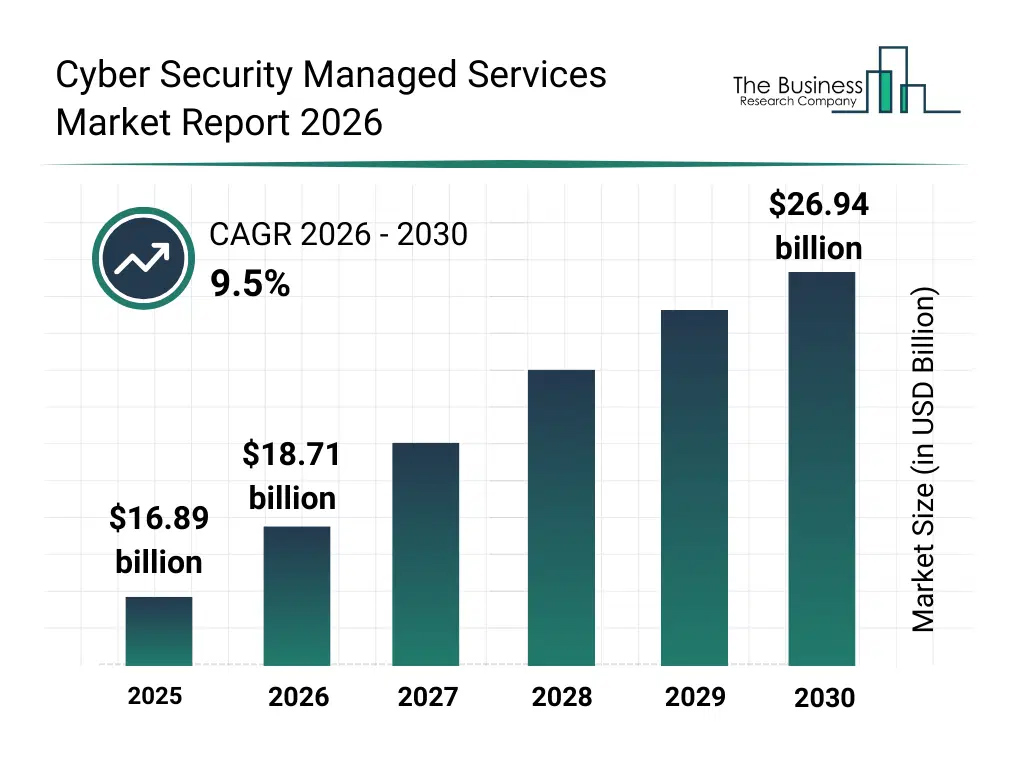
- The global cyber security managed services market is projected to grow from $16.89 billion in 2025 to $26.94 billion by 2030.
- The market is expected to reach $18.71 billion in 2026, marking the beginning of a strong growth period.
- Between 2026 and 2030, the market is forecast to expand at a 9.5% CAGR.
- The industry is estimated to surpass $20 billion in 2027, reflecting continued enterprise demand for managed security services.
- By 2028, the market is projected to exceed $22 billion, driven by increasing cybersecurity investments.
- The market is expected to approach $25 billion in 2029, highlighting sustained year-over-year growth.
- Overall, the market is forecast to add approximately $10.05 billion in value between 2025 and 2030.
Managed Security Services Revenue Growth Rate Statistics
- The managed security services market is expected to grow at a 10.9% CAGR from 2026 to 2033.
- Another widely cited estimate projects a 11.1% CAGR between 2025 and 2030.
- Industry forecasts from Mordor Intelligence suggest a 12.33% CAGR from 2026 to 2031.
- Stellar Market Research estimates annual growth at 13% through 2032.
- SkyQuest projects the market will expand at a 14.2% CAGR from 2026 to 2033.
- Zion Market Research expects an even stronger 15.4% CAGR through 2034.
- The Business Research Company forecasts a 15.7% CAGR between 2026 and 2030.
- Meticulous Research estimates an 18% CAGR from 2025 to 2032, one of the industry’s highest growth projections.
- The Americas market alone recorded a 10.2% annual growth rate in 2023 and is expected to continue expanding.
Regional Breakdown of Managed Security Services Market
- North America held a 35.1% revenue share in 2025, making it the world’s largest MSS market.
- Another industry estimate places North America’s share at 39% in 2026, reflecting continued regional dominance.
- The Americas managed security services industry generated more than $14.49 billion in revenue in 2023.
- Asia-Pacific is forecast to grow at a 13.2% CAGR, the fastest pace among all regions.
- Europe’s managed security services market reached $11.38 billion in 2025.
- The European market is projected to rise to $13.07 billion in 2026.
- Europe’s MSS industry could exceed $39.54 billion by 2034, driven by rising compliance requirements and cloud adoption.
- Germany alone is expected to post 15.2% annual market growth in 2026, one of the strongest performances in Europe.
- Rapid digital transformation initiatives across India, China, Japan, and ASEAN countries continue to accelerate MSS adoption throughout Asia-Pacific.
Industry Vertical Adoption of Managed Security Services
- The banking, financial services, and insurance (BFSI) sector accounted for nearly 24% of global MSS spending in 2025, making it the largest industry segment.
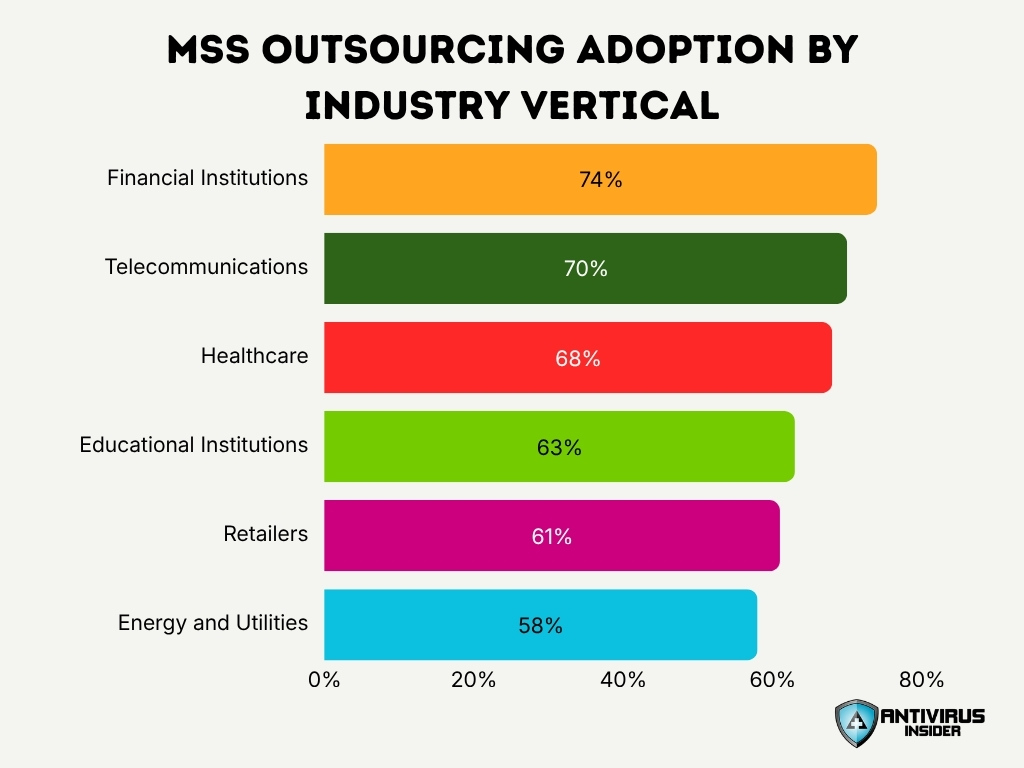
- More than 74% of financial institutions worldwide now outsource at least one cybersecurity function to an MSS provider.
- Around 68% of healthcare organizations use managed security services to strengthen ransomware defense and compliance programs.
- The manufacturing sector increased spending on managed security services by 16% year over year in 2025, driven by rising attacks on operational technology systems.
- Approximately 61% of retailers use MSS providers to monitor payment systems and e-commerce infrastructure.
- Government agencies represented nearly 13% of total MSS market revenue in 2025 as public-sector cyberattacks continued to rise.
- About 58% of energy and utilities companies use third-party managed security monitoring to protect critical infrastructure.
- Nearly 63% of educational institutions reported using managed security services to address staffing shortages and ransomware risks.
- More than 70% of telecommunications companies now rely on managed detection and response services to secure distributed networks.
Small and Mid-Sized Business Adoption of MSS
- Roughly 65% of small and mid-sized businesses (SMBs) use some form of managed security service in 2026.
- Around 73% of SMBs cite a lack of cybersecurity expertise as the primary reason for outsourcing security functions.
- Nearly 56% of SMBs experienced a cyberattack during the last year, increasing demand for MSS solutions.
- About 47% of SMBs outsource endpoint protection and network monitoring to third-party providers.
- More than 60% of SMBs say managed security services cost less than building an internal security team.
- Approximately 42% of SMB cybersecurity budgets now go toward managed services and outsourced protection.
- Nearly 66% of small businesses plan to increase cybersecurity spending in 2026, with MSS receiving the largest share of new investments.
- Around 80% of SMBs report that cybersecurity insurance requirements influenced their decision to adopt managed security services.
- About 58% of SMB leaders believe outsourced security operations improve their ability to recover from cyber incidents.
Large Enterprise Adoption of Managed Security Services
- More than 84% of large enterprises worldwide use managed security services for at least one cybersecurity function.
- Approximately 79% of Fortune 500 companies rely on MSS providers for continuous security monitoring and incident response.
- Around 72% of enterprises outsource Security Operations Center functions either partially or completely.
- Nearly 67% of large organizations use managed detection and response services to address increasingly sophisticated threats.
- About 61% of enterprises use MSS providers to secure multi-cloud environments and SaaS applications.
- Large enterprises spend an average of $2.4 million annually on outsourced cybersecurity services.
- More than 70% of enterprise security leaders expect to increase MSS investments over the next two years.
- Around 57% of enterprises cite talent shortages as the primary reason for expanding relationships with MSS providers.
- Approximately 76% of multinational corporations now use third-party security providers to support regulatory compliance requirements.
Managed Security Services Market Share Statistics
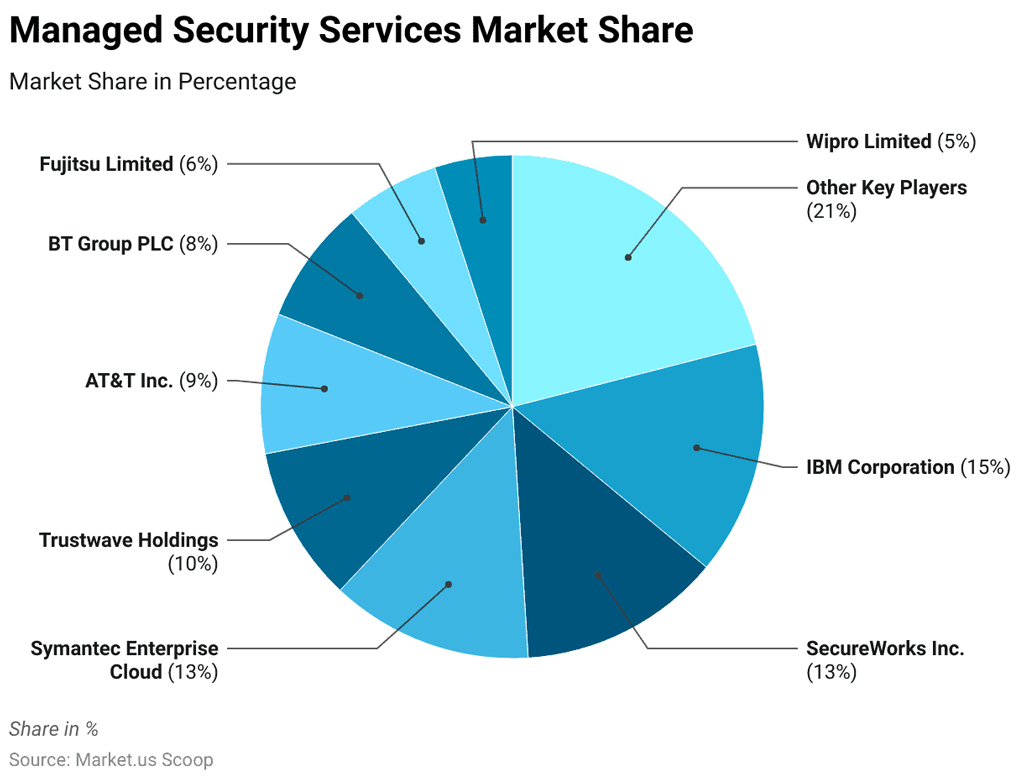
- Other Key Players collectively account for the largest market share at 21%, highlighting the fragmented nature of the MSS market.
- IBM Corporation is the leading individual provider, holding 15% of the global managed security services market.
- SecureWorks Inc. and Symantec Enterprise Cloud each hold 13% market share, making them joint second-largest individual vendors.
- Trustwave Holdings captures 10% of the market, maintaining a strong competitive position among MSS providers.
- AT&T Inc. represents 9% of the managed security services market, reflecting its significant enterprise presence.
- BT Group PLC accounts for 8% of the market, ranking among the top managed security service providers.
- Fujitsu Limited holds 6% of the market, contributing a notable share in the global MSS landscape.
- Wipro Limited captures 5% of the managed security services market, rounding out the top named providers.
- The top eight named vendors collectively control 79% of the market, while other key players account for the remaining 21%.
Spending on Managed Security Services vs In-House Security
- Organizations spend an average of $2.87 million annually on managed security services compared with $4.38 million for fully in-house security operations.
- Building and maintaining an internal Security Operations Center can cost two to three times more than outsourcing comparable services.
- Around 59% of organizations say cost optimization is a key driver behind MSS adoption.
- Enterprises that use MSS providers report cybersecurity operating costs that are 25% lower than companies relying entirely on internal teams.
- Approximately 48% of IT leaders shifted budget from in-house security operations to managed services in 2025 and 2026.
- More than 64% of companies believe outsourcing security functions provides better return on investment than expanding internal teams.
- Organizations using MSS providers reduce average hiring and training expenses by nearly 30%.
- Around 54% of businesses expect outsourced cybersecurity spending to grow faster than internal security spending through 2028.
- Nearly 43% of enterprises increased MSS budgets after calculating the long-term cost of recruiting cybersecurity professionals.
Penetration Rate of MSS Among Organizations Worldwide
- Approximately 69% of organizations globally use managed security services in some capacity in 2026.
- About 81% of large enterprises and 65% of SMBs now outsource at least one cybersecurity function.
- Around 72% of North American companies use managed security services, the highest regional adoption rate worldwide.
- The penetration rate across Europe reached 66% in 2025, supported by increasing regulatory requirements.
- Approximately 58% of Asia-Pacific organizations use MSS providers, and adoption continues to grow rapidly.
- More than 75% of organizations with cloud-first strategies rely on managed security partners.
- Around 53% of mid-market companies adopted managed detection and response services during the last two years.
- Nearly 60% of organizations plan to expand their use of outsourced security operations by 2027.
- About 45% of businesses that currently do not use MSS solutions expect to adopt them within the next three years.
Incident Response and Detection Times With MSS
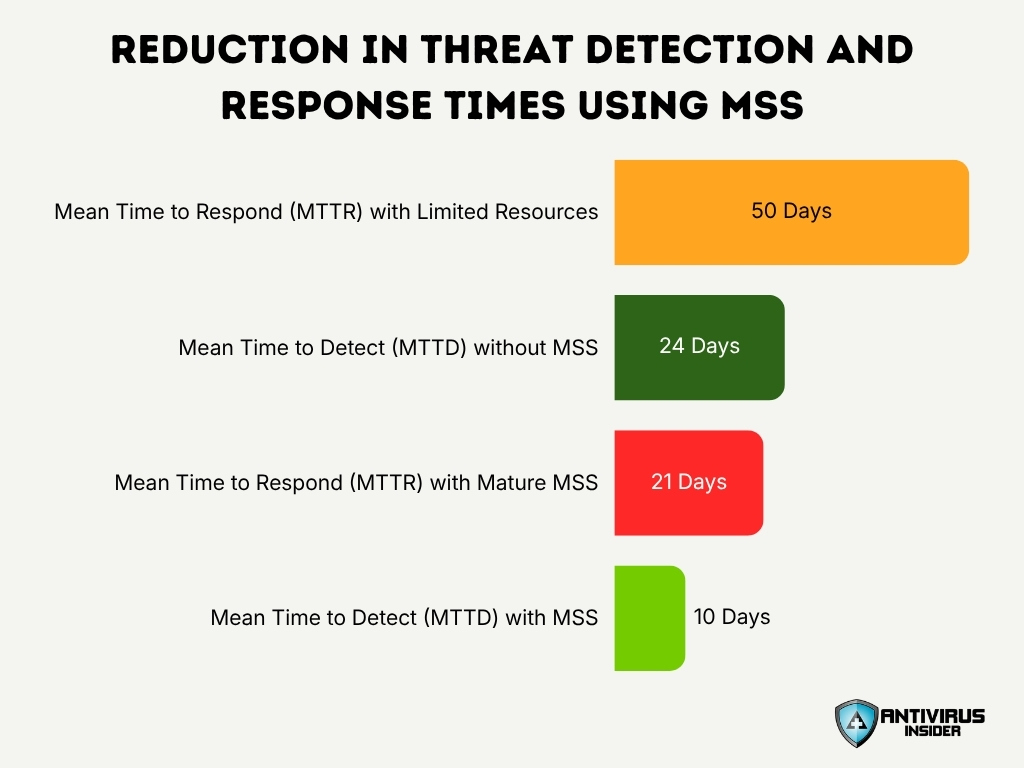
- Organizations using managed security services reduce their average mean time to detect (MTTD) to 10 days, compared with 24 days for companies without outsourced monitoring.
- The average mean time to respond (MTTR) for organizations with mature managed detection capabilities is approximately 21 days, versus more than 50 days for organizations with limited security resources.
- Around 73% of MSS customers report faster incident response after outsourcing Security Operations Center functions.
- Companies with managed detection and response capabilities identify breaches 54% faster than organizations relying solely on internal teams.
- Nearly 67% of enterprises using MSS providers receive around-the-clock monitoring and response services.
- About 58% of businesses reduced the number of severe cybersecurity incidents after implementing managed security services.
- Organizations using automated incident response through MSS providers report containment times that are up to 45% shorter.
- Approximately 61% of security leaders say outsourced monitoring improved their visibility into threats across cloud and on-premises environments.
- More than 70% of MSS customers consider rapid incident response one of the most valuable outcomes of outsourcing cybersecurity operations.
Impact of Regulatory Compliance on MSS Demand
- Around 76% of organizations say regulatory compliance requirements directly influence their decision to use managed security services.
- Nearly 68% of enterprises increased cybersecurity spending because of new privacy and data protection regulations.
- About 62% of organizations use MSS providers to help maintain compliance with industry-specific standards and reporting obligations.
- More than 70% of financial institutions depend on third-party security monitoring to meet regulatory requirements.
- Approximately 66% of healthcare organizations use managed security services to support compliance with healthcare privacy regulations.
- Organizations with mature compliance programs are 2.4 times more likely to outsource security operations than those with less mature programs.
- Around 57% of businesses report that increasing audit requirements accelerated their adoption of MSS solutions.
- Nearly 64% of organizations say compliance reporting capabilities are an important factor when selecting an MSS provider.
- About 59% of companies expect future regulations related to artificial intelligence and cloud security to increase demand for managed security services.
Adoption of Managed Detection and Response Statistics
- The global managed detection and response market is expected to surpass $5.6 billion in 2026, reflecting rising demand for advanced threat monitoring.
- Approximately 67% of enterprises use managed detection and response services as part of their cybersecurity strategy.
- Around 53% of mid-sized organizations adopted MDR solutions during the last two years.
- Nearly 72% of organizations cite ransomware protection as the primary reason for implementing MDR services.
- More than 60% of businesses say MDR services helped improve visibility into cloud-based threats.
- Around 58% of organizations plan to increase spending on MDR capabilities during 2026 and 2027.
- Companies using MDR solutions report a 50% reduction in time spent investigating security incidents.
- About 49% of organizations selected MDR services because they lacked internal cybersecurity expertise.
- Nearly 65% of security leaders believe MDR provides better outcomes than traditional managed security monitoring alone.
Most Commonly Outsourced Security Functions to MSSPs
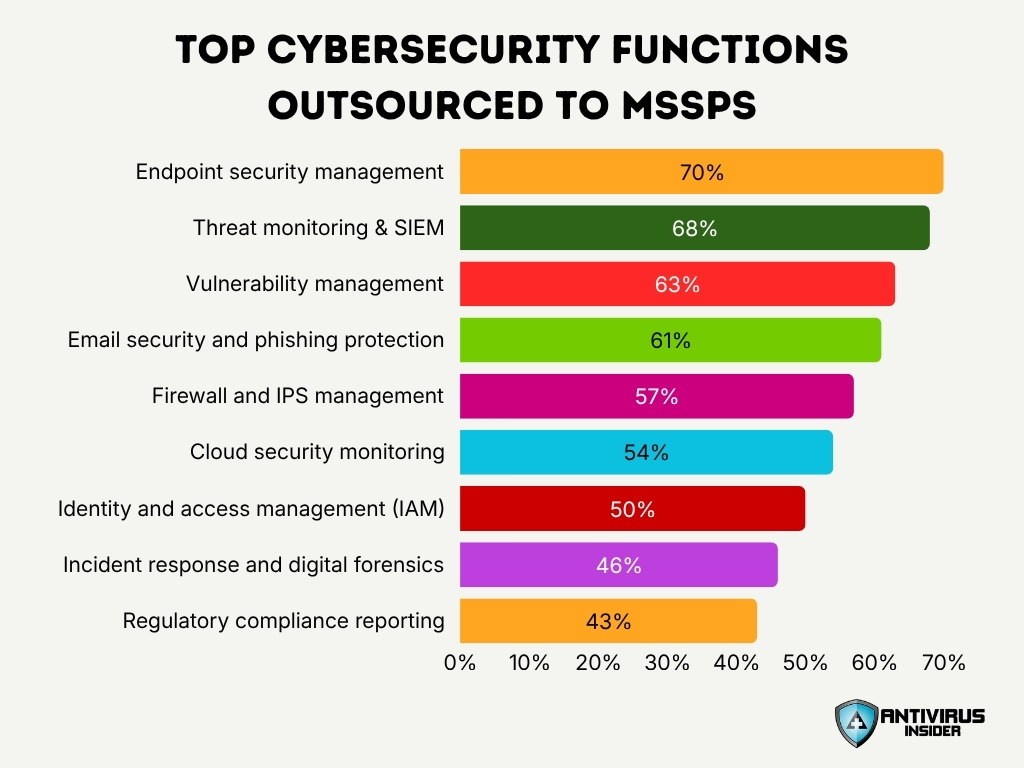
- Endpoint security management remains the most outsourced cybersecurity function, with adoption exceeding 70% among MSS customers.
- Approximately 68% of organizations outsource threat monitoring and Security Information and Event Management services.
- Around 63% of businesses rely on MSS providers for vulnerability management and patch monitoring.
- Nearly 61% of organizations outsource email security and phishing protection services.
- About 57% of companies use third-party providers for firewall management and intrusion prevention systems.
- Roughly 54% of enterprises outsource cloud security monitoring and configuration management.
- More than 50% of organizations rely on MSS providers for identity and access management support.
- Around 46% of companies outsource incident response planning and digital forensics capabilities.
- Approximately 43% of businesses use MSS providers to manage regulatory compliance reporting and risk assessments.
Cloud Security and SaaS Security Managed Services Usage
- More than 78% of organizations now use managed services to secure cloud infrastructure and SaaS applications.
- Around 61% of enterprises rely on MSS providers for multi-cloud security management.
- Approximately 73% of organizations experienced at least one cloud-related security incident in the last year, increasing demand for managed cloud security.
- Nearly 68% of businesses use managed security services to monitor Microsoft 365, Google Workspace, and other SaaS environments.
- About 59% of enterprises outsource cloud identity and access management functions.
- Around 55% of organizations adopted managed cloud security because they lacked internal expertise in cloud configuration and compliance.
- More than 64% of businesses use managed services for cloud threat detection and continuous monitoring.
- Approximately 52% of organizations increased spending on managed cloud security services during the last 12 months.
- Nearly 70% of cybersecurity leaders expect cloud security services to represent a larger share of their managed security budgets by 2028.
AI and Automation Usage in Managed Security Services
- Around 48% of managed service providers identify artificial intelligence as their customers’ top investment priority in 2026.
- Only 13% of providers currently generate significant revenue from AI-related services, indicating a large growth opportunity.
- Organizations using AI-powered security tools save an average of $2.22 million in breach-related costs compared with organizations that do not use AI extensively.
- Companies with extensive AI and automation capabilities detect and contain breaches 108 days faster than organizations without these technologies.
- Nearly 65% of MSS providers now use machine learning for threat detection and anomaly identification.
- Approximately 57% of organizations employ AI-driven automation to prioritize and investigate security alerts.
- Around 62% of security leaders believe AI will significantly improve managed security operations over the next three years.
- More than 50% of enterprises plan to increase investments in AI-enabled security services during 2026.
- About 45% of MSS providers use generative AI to improve incident reporting, threat intelligence, and customer communication.
Security Skills Shortage and Reliance on MSSPs
- The global cybersecurity workforce gap reached approximately 4.8 million professionals in 2024 and remains one of the industry’s biggest challenges.
- Around 67% of organizations report moderate or severe cybersecurity staffing shortages.
- Nearly 58% of businesses increased their reliance on managed security providers because they could not hire qualified cybersecurity personnel.
- About 71% of organizations say staffing shortages have increased their exposure to cyber risks.
- Approximately 60% of security leaders believe outsourcing is the fastest way to address cybersecurity talent gaps.
- More than 65% of companies expect cybersecurity hiring challenges to continue through 2027.
- Around 52% of organizations delayed security projects because of staffing shortages.
- Nearly 47% of businesses rely on MSS providers to access specialized skills such as threat hunting and digital forensics.
- About 69% of enterprises expect to expand partnerships with MSS providers to offset future talent shortages.
Frequently Asked Questions (FAQs)
The global managed security services market is estimated to reach $44.39 billion in 2026, up from $39.87 billion in 2025.
The market is projected to grow at a 10.9% to 11.4% CAGR between 2026 and 2033, depending on the research source.
North America accounts for approximately 35.1% to 39% of global managed security services revenue, making it the largest regional market.
Industry forecasts estimate the market could reach between $86.3 billion and $123.82 billion by 2033, depending on growth assumptions and market scope.
According to a 2026 industry survey, 48% of managed service providers say artificial intelligence is their customers’ top priority, while only 13% currently generate meaningful AI-related revenue.
Conclusion
Managed security services continue to move from an optional cybersecurity tool to a strategic business necessity. The market is on track to exceed $44 billion, supported by increasing ransomware activity, stricter compliance requirements, cloud adoption, and an ongoing cybersecurity talent shortage. Organizations of every size, from small businesses to multinational enterprises, now depend on MSS providers to improve threat detection, reduce response times, and control security costs.
The statistics also show that demand for managed detection and response, cloud security services, and AI-powered automation will continue to shape the industry over the next decade. As cyber threats become more sophisticated and internal security talent remains scarce, managed security services will likely play an even larger role in helping organizations strengthen resilience and maintain business continuity.
