


Two-factor authentication (2FA) has moved from an optional security feature to a standard layer of protection for businesses and consumers. Banks now use it to secure digital payments, while employers rely on it to protect remote work accounts and cloud applications. As cyberattacks continue to target passwords and stolen credentials, organizations increasingly view 2FA as one of the fastest ways to reduce account compromise risks. Explore the latest statistics to understand how adoption patterns, workplace usage, and consumer behavior are shaping the future of authentication.
Editor’s Choice
- More than 5 billion passkeys are currently in use worldwide, signaling a rapid shift toward phishing-resistant authentication methods.
- Workforce MFA adoption reached 70% in 2025, up from 66% a year earlier.
- Microsoft reports that enabling MFA can block over 99.9% of account compromise attacks.
- Around 94% of organizations now offer some form of customer MFA, but only 10% deploy it across all applications.
- The global multi-factor authentication market was valued at $16.85 billion in 2024 and is projected to reach $83.72 billion by 2034.
- 22% of all data breaches in 2025 began with stolen credentials, keeping authentication security at the center of cybersecurity strategies.
- The adoption of phishing-resistant authenticators increased 63% year over year in 2025.
- More than 58% of global SMBs remain unaware of the security benefits of MFA.
Recent Developments
- Microsoft started enforcing MFA requirements across several administrative platforms beginning in February 2025, affecting millions of enterprise users.
- Starting in October 2025, Microsoft expanded MFA enforcement to Azure CLI, PowerShell, mobile apps, and API endpoints.
- Microsoft announced plans in 2026 to phase out SMS-based authentication for personal accounts and replace it with passkeys and authenticator apps.
- The number of users adopting phishing-resistant authentication methods nearly doubled during 2025.
- The FIDO Alliance reported that 75% of consumers now recognize passkey technology, a major increase from early adoption years.
- Organizations increasingly deploy AI-powered adaptive authentication systems that assess login risk in real time.
- The Asia-Pacific region accounted for more than 40% of the global MFA market share in 2024, reflecting strong digital transformation initiatives.
- The average cost of a breach involving stolen credentials reached $4.67 million in 2025, increasing demand for stronger authentication controls.
Global Two-Factor Authentication Market Growth
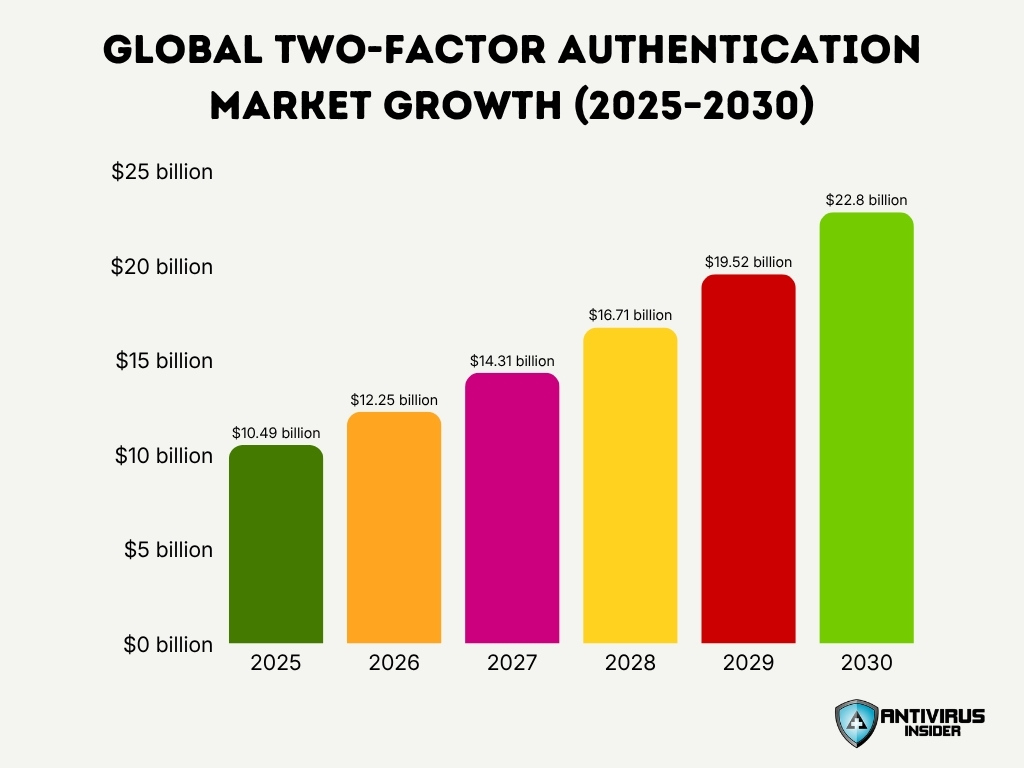
- The global two-factor authentication market is projected to grow from $10.49 billion in 2025 to $22.80 billion by 2030.
- The market is expected to expand by $12.31 billion over the 2025–2030 forecast period.
- The market size is forecast to reach $12.25 billion in 2026, reflecting strong early growth in demand for authentication solutions.
- By 2027, the global two-factor authentication market is expected to surpass $14.31 billion.
- The market is projected to exceed $16.71 billion in 2028, highlighting accelerating enterprise adoption.
- In 2029, the market is forecast to reach $19.52 billion, approaching the $20 billion milestone.
- By 2030, the market is expected to reach $22.80 billion, more than doubling its 2025 valuation.
- The consistent year-over-year increase indicates strong long-term demand for two-factor authentication driven by rising cybersecurity and identity protection needs.
Global Two-Factor Authentication Adoption Statistics
- Around 57% of organizations worldwide currently use MFA technologies.
- At least 98% of organizations support multiple authentication methods across their systems.
- Nearly 65% of global SMBs still do not use MFA solutions.
- Technology companies report an MFA adoption rate of 87%, among the highest across all industries.
- Financial institutions have achieved approximately 60% MFA adoption, driven by regulatory requirements.
- Government organizations report 48% adoption, leaving significant room for improvement.
- Education organizations have reached 64% MFA adoption, boosted by increasing ransomware threats.
- Healthcare organizations report MFA adoption rates of 56%, partly due to compliance and patient data protection needs.
- Professional services firms have reached 75% adoption, one of the strongest growth rates among knowledge industries.
- Insurance organizations have implemented MFA at a rate of 77%.
2FA Usage for Personal Accounts
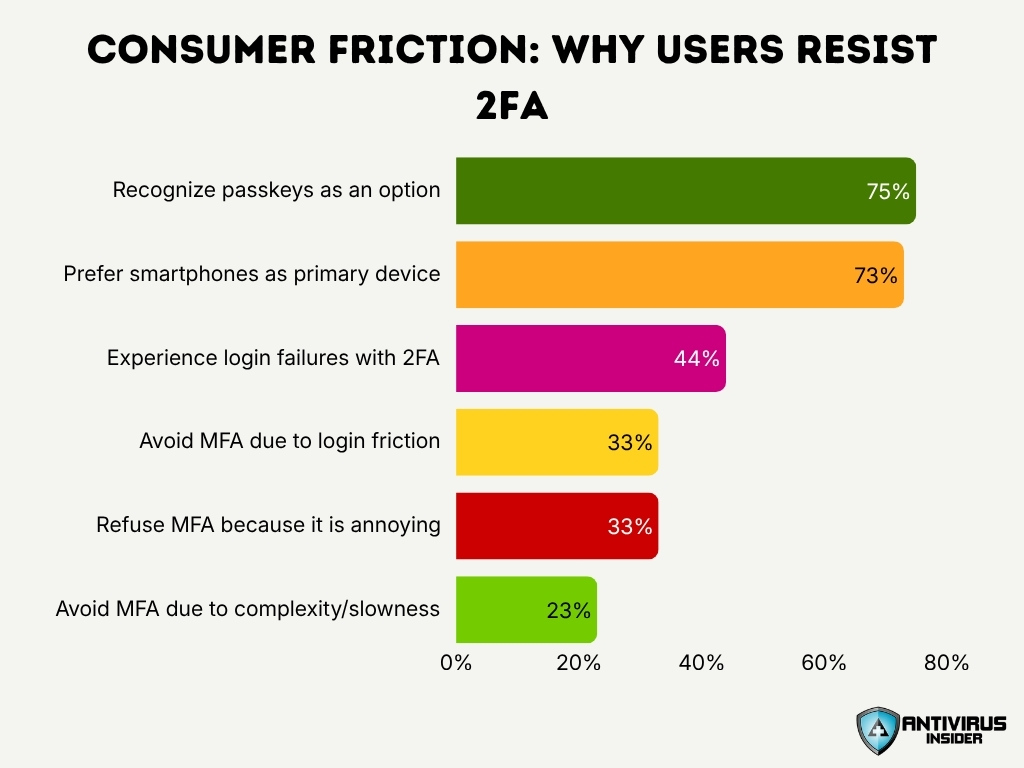
- Around 73% of consumers prefer using smartphones as their primary authentication device.
- More than one-third of consumers avoid MFA because they believe it adds friction to the login process.
- The FIDO Alliance reports that 5 billion passkeys are actively used worldwide, many tied to personal accounts.
- Around 75% of consumers recognize passkeys as an authentication option.
- Microsoft found that 99.9% of compromised accounts lacked MFA, highlighting the risk for personal users who rely only on passwords.
- More than 80% of accounts involved in a major cloud breach had previously exposed credentials.
- Passkey adoption continues to grow among major websites and applications, with implementation strongly correlated with site popularity.
- A large university study found that 43.86% of users experienced at least one login failure while using Duo 2FA.
- The same study reported an authentication failure rate of 4.35% due to incomplete second-factor tasks.
2FA Adoption by Company Size
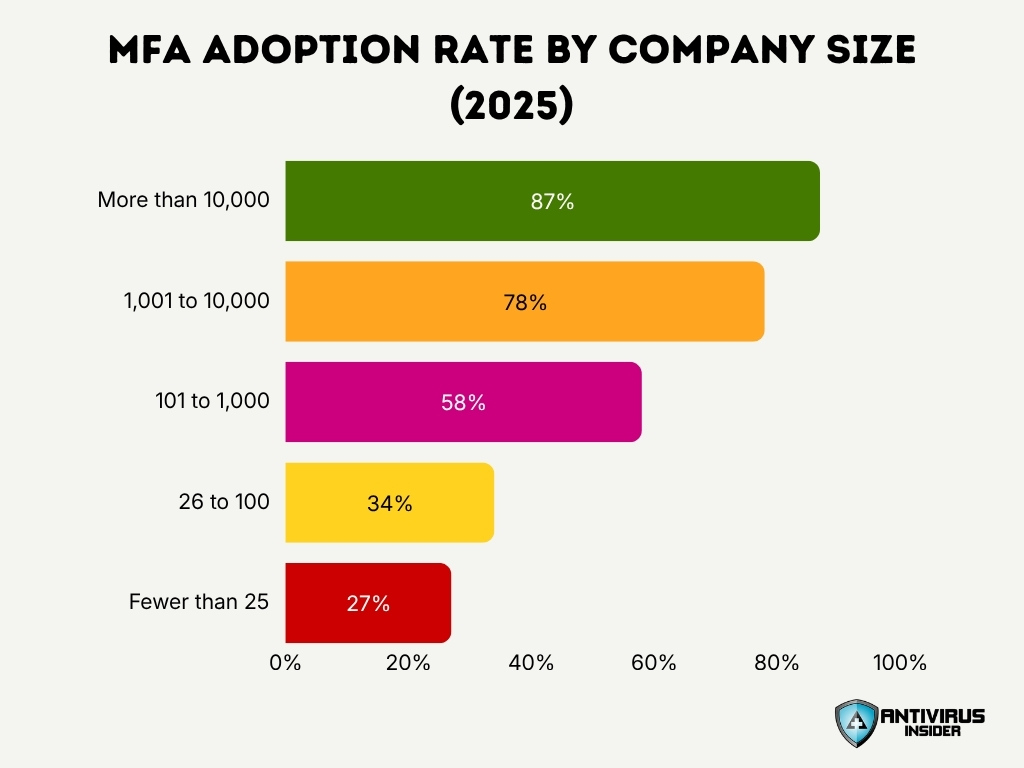
- Organizations with more than 10,000 employees report MFA adoption rates of approximately 87%, making large enterprises the most mature users of authentication technologies.
- Companies with 1,001 to 10,000 employees have an MFA adoption rate of 78%.
- Businesses employing 101 to 1,000 workers report MFA adoption of roughly 58%.
- Medium-sized companies with 26 to 100 employees have implemented MFA at a rate of 34%.
- Small businesses with fewer than 25 employees report only 27% adoption, leaving a large portion of the sector vulnerable to credential attacks.
- Nearly 65% of small and midsize businesses globally still do not use MFA despite increasing ransomware activity.
- Around 58% of SMBs say they do not fully understand the benefits of MFA or how to deploy it effectively.
- About 25% of organizations implemented MFA only after suffering a cybersecurity incident or account compromise.
- Companies with mature security programs are twice as likely to deploy phishing-resistant authentication methods compared with smaller businesses.
- Enterprises using cloud-based identity platforms report an average MFA deployment rate exceeding 80%, driven by regulatory and insurance requirements.
2FA Adoption in Workplaces
- Workforce MFA adoption increased to 70% in January 2025, compared with 66% a year earlier.
- Nearly one-third of employees still authenticate without MFA protection.
- Companies with more than 10,000 employees report an MFA adoption rate of 87%.
- Medium-sized organizations with 26 to 100 employees have MFA adoption rates of 34%.
- Small businesses with fewer than 25 employees report only 27% MFA adoption.
- Around 25% of organizations implemented MFA only after experiencing a cybersecurity incident.
- More than 50% of IT professionals prefer time-based one-time passwords for workplace authentication.
- The adoption of phishing-resistant authenticators increased by 63% in one year, largely driven by enterprise security teams.
- Microsoft’s administrative platforms now require MFA by default for many enterprise users, accelerating workplace adoption worldwide.
Regional and Country-Wise 2FA Adoption Statistics
- North America remains the largest MFA market, accounting for approximately 36% of global revenue in 2025.
- The Asia-Pacific region achieved a 40% market share globally, showing the strongest regional MFA adoption growth.
- The United States reports high enterprise deployment rates, with more than 70% of organizations utilizing MFA.
- Europe holds 21% of the global MFA market, driven by strict EU regulations like Strong Customer Authentication.
- Japan experienced significant authentication growth, with MFA adoption climbing from 53% to 62% within a single year.
- India is experiencing massive adoption, with its MFA market projected to reach $1.6 billion at a 12.8% CAGR.
- Australia reports that more than 50% of businesses actively deploy MFA to secure employee access to critical systems.
- The United Kingdom saw enterprise confidence in hardware security keys and passkeys surge from 17% to 37%.
- Latin America remains an emerging MFA market, currently accounting for 5% of the global authentication share.
- The Middle East and Africa region currently represents 3% of the global market amidst rising identity management investments.
Two-Factor Authentication Usage by Industry
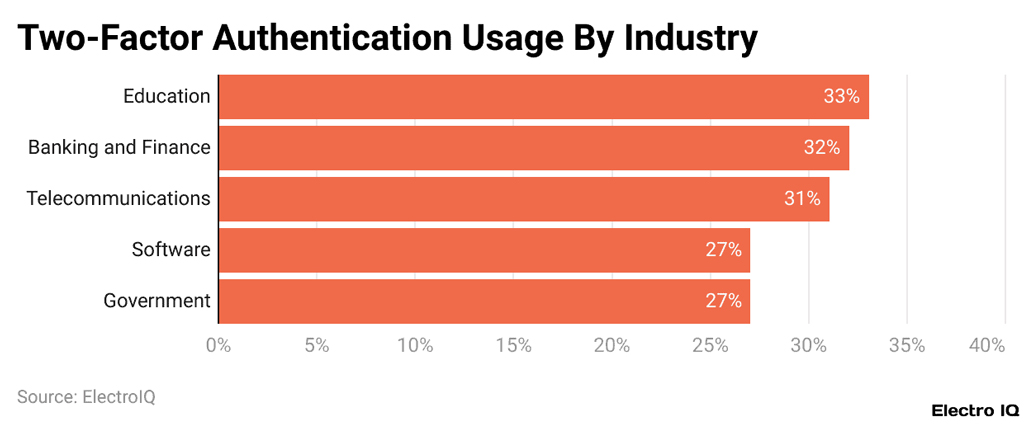
- Education leads all industries in two-factor authentication usage with 33% adoption.
- Banking and Finance closely follows with a 32% usage rate, highlighting its strong focus on account security.
- Telecommunications reports 31% adoption, reflecting widespread implementation of identity protection measures.
- Software organizations have a 27% two-factor authentication usage rate to enhance user and system security.
- Government agencies also record 27% adoption, emphasizing the need to protect sensitive public data.
- The gap between the highest (33%) and lowest (27%) adoption rates is only 6 percentage points, indicating relatively consistent usage across these industries.
- All five industries report more than one-quarter (27%+) adoption, showing that two-factor authentication has become a common cybersecurity practice.
SMS-Based 2FA Usage Statistics
- Nearly 56% of surveyed IT professionals continue to use SMS time-based one-time passwords for multifactor authentication.
- Around 41% of users still trust SMS-based authentication despite its well-documented vulnerabilities to SIM swapping attacks.
- The adoption of low-assurance SMS authentication among workforce users recently dropped from 17.5% to 15.3% over a twelve-month period.
- Approximately 30% of IT respondents state their organizations actively utilize non-time-based SMS one-time passwords to secure user access.
- In current corporate environments, roughly 25% of organizations still rely on SMS web links for their authentication processes.
- SMS remains a dominant form of 2FA because consumers successfully receive text messages on their mobile devices 99% of the time.
- Despite overall password usage edging down to 93%, legacy methods like SMS authentication still account for over 15% of workforce sign-ins.
- While mobile push notifications dominate at 68% of use, SMS one-time passwords consistently remain the most common alternative method globally.
App-Based Authenticator Usage Statistics
- Authenticator applications were adopted by 57.8% of companies in 2025 to replace vulnerable SMS verification.
- More than 50% of IT professionals identify authenticator apps as their preferred second authentication factor.
- Google Authenticator is utilized by 24% of employees, making it a leading authentication application globally.
- Utilizing authenticator apps reduces the overall risk of account compromise by an impressive 99.22%.
- Mobile device push notifications are actively used by 36.7% of users for convenient and fast enterprise logins.
- The technology sector currently leads authenticator application adoption with an 87% implementation rate.
- The number of organizations using phishing-resistant authenticators increased by 63% year over year in 2025.
- An overwhelming 95% of employees prefer software-based MFA apps over hardware tokens for better ease of use.
2FA Methods Most Commonly Used
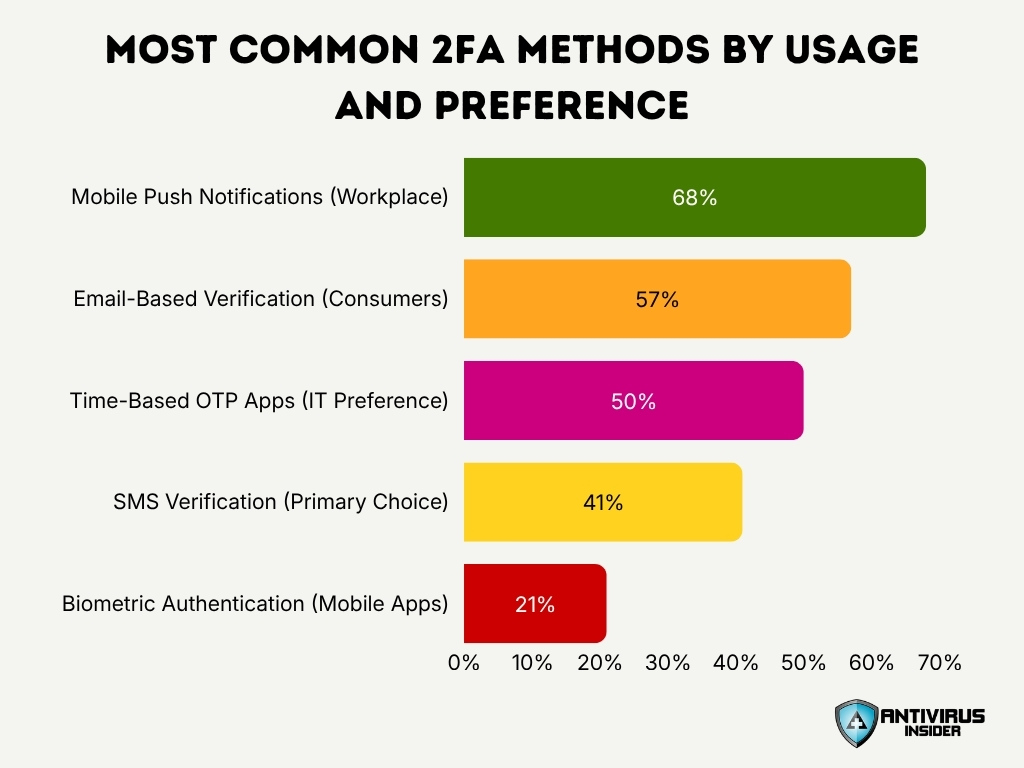
- SMS verification is chosen by 41% of users as their primary authentication method.
- Time-based one-time passwords via apps are preferred by more than 50% of IT professionals.
- Mobile push notifications hold a dominant 68% usage rate in modern workplace environments.
- Biometric authentication methods have surged to a 21% adoption rate in mobile applications.
- FIDO standard security keys experienced a massive 63% year-over-year growth in 2025.
- Passkeys have officially surpassed 5 billion active credentials globally as a passwordless alternative.
- Adaptive authentication is actively deployed by 70% of workforce users across leading platforms.
- Email-based verification is still relied upon by 57% of consumers despite offering weaker security.
- Approximately 67% of companies deploy a combination of authentication methods across their systems.
Hardware Token and Security Key Usage Statistics
- The global hardware token authentication market is projected to reach $3.82 billion by 2034 with a 6.8% CAGR.
- Enterprise integration of hardware tokens typically costs mid-market organizations between $50,000 and $500,000.
- Global workforce adoption of phishing-resistant authenticators surged by 63% year-over-year in 2025.
- The token devices segment captured the largest component share at 45.2% of the global hardware authentication market.
- The banking and financial sector led all industries in hardware token adoption with a 38.5% market share.
- The average cost of standardized FIDO2-compatible USB security keys has stabilized between $15 and $30 per unit.
- User confidence in the security of hardware security keys nearly doubled from 18% to 34% over a single year.
- Despite the rise of hardware tokens, a staggering 93% of organizations still rely on passwords for business access.
- Approximately 34% of medium-sized organizations deployed device-bound FIDO2 authenticators by the first quarter of 2025.
- Traditional SMS one-time passcode usage among enterprise users dropped from 17.5% to 15.3% as hardware adoption increased.
Biometric-Based 2FA Usage Statistics
- Over 81% of smartphones worldwide now feature biometric authentication capabilities.
- The global biometrics market is projected to hit $267.05 billion by 2033.
- Fingerprint recognition accounts for 60% of the biometric authentication market share in smartphones.
- Financial services report a 60% to 75% adoption rate for biometric authentication technologies.
- Globally, 72% of consumers prefer facial biometrics over traditional passwords for secure online processes.
- The healthcare industry has achieved a 50% to 60% adoption rate for biometrics to secure patient records.
- Government agencies lead adoption with 70% to 85% usage for national security and digital identity programs.
- Biometrically authenticated remote mobile payments are forecast to reach $1.2 trillion globally by 2027.
- The global biometrics market is expected to expand at a compound annual growth rate (CAGR) of 20.44%.
- Biometric 2FA adoption is projected to experience an 80% growth by the year 2027.
Impact of 2FA on Account Security
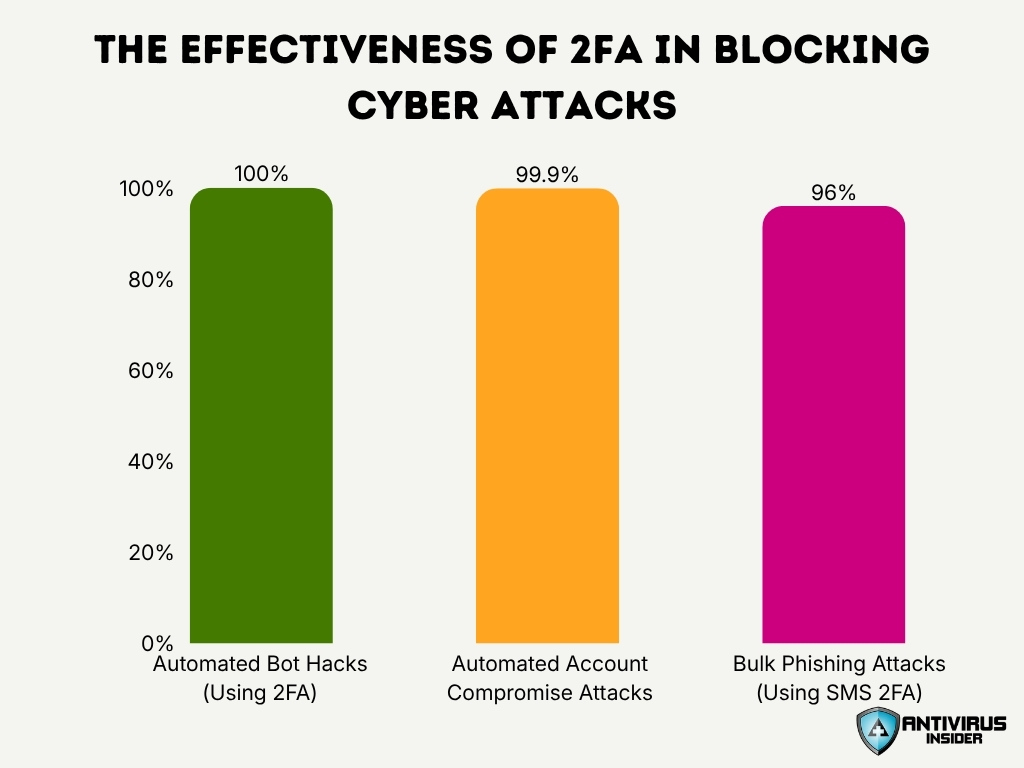
- Enabling MFA blocks more than 99.9% of account compromise attacks.
- Using two-factor authentication successfully blocks 100% of automated bot hacks.
- Utilizing SMS text authentication effectively stops 96% of bulk phishing attacks.
- Stolen user credentials are responsible for 88% of basic web application attacks.
- Approximately 87% of large enterprises now actively enforce multi-factor authentication.
- Around 22% of all data breaches strictly involve the use of stolen credentials.
- Roughly 61% of organizations still have at least one root cloud account lacking MFA.
- Around 65% of individuals admit to reusing passwords across multiple online accounts.
2FA Effectiveness Against Phishing Attacks
- Multi-factor authentication blocks 99.9% of automated account compromise attacks, including major phishing attempts.
- Enterprise usage of phishing-resistant authenticators rapidly increased by 63% throughout a single year.
- Global support for FIDO2 passkeys has expanded to reach over 8 billion devices as a strong anti-phishing measure.
- SMS phishing volume surged by 328% since 2020 because attackers easily intercept weak verification codes.
- Overall, phishing campaigns surpassed 3.8 million attacks in 2025, forcing immediate adoption of secure number matching.
- Approximately 68% of surveyed organizations are deploying passkeys to achieve secure 8.5-second average login times.
- Phishing remains the initial access point for 16% of all data breaches, with average costs hitting $4.8 million.
- The median user clicks a malicious phishing link in just 21 seconds, demanding robust adaptive authentication controls.
- Around 93% of businesses still use vulnerable passwords despite severe credential harvesting threats.
- Adding basic recovery numbers drops bulk phishing and automated bot attack success by 99% to 100%.
2FA and Data Breach Statistics
- Multi-factor authentication (MFA) can successfully block up to 99.9% of automated account compromise attacks.
- The global average cost of a data breach reached an alarming $4.88 million in 2024 before adjusting to $4.44 million in 2025.
- Stolen credentials and identity misuse were directly responsible for 49% of all analyzed data breaches.
- Phishing-resistant MFA blocks more than 99% of identity-based attacks even when cybercriminals possess valid passwords.
- Organizations fully implementing MFA report a 50% reduction in the overall risk of suffering a material security breach.
- Ransomware was heavily present in 44% of all data breaches in 2025, drastically increasing the associated recovery costs.
- Data breach lifecycle resolution for incidents utilizing stolen credentials took an average of 292 days to fully detect and contain.
- Approximately 22% of recent global data breaches utilized stolen or compromised credentials as the primary initial attack vector.
- Utilizing dedicated authenticator apps effectively reduces the risk of account compromise by 99.22% across the general population.
User Awareness and Attitudes Toward 2FA
- Approximately 75% of consumers now recognize passkeys and modern authentication technologies.
- Around 58% of SMBs remain unfamiliar with the benefits and implementation of MFA.
- More than one-third of users avoid MFA because they believe it creates additional login friction.
- About 73% of consumers prefer using smartphones as their primary authentication device.
- Approximately 33% of respondents refuse to implement MFA because they find the process annoying.
- Roughly 23% of users avoid multi-factor authentication because it is perceived as too complex or too slow.
- Over 75% of surveyed participants still rate two-factor authentication as the best method for security.
- Only 35% of small businesses globally implement MFA despite its proven security benefits.
- Nearly 44% of users report experiencing at least one login failure related to two-factor authentication.
- Over 40% of IT professionals cite reliance on legacy systems as a barrier to passwordless adoption.
Market Statistics for 2FA and MFA Solutions
- The global multi-factor authentication market was valued at $16.85 billion in 2024.
- The market is projected to reach $83.72 billion by 2034, representing a compound annual growth rate of approximately 17.4%.
- North America accounted for roughly 36% of the global MFA market revenue in 2025.
- Asia-Pacific represented more than 40% of market growth, making it the fastest-expanding region.
- Cloud-based MFA services continue to dominate new deployments because organizations prefer subscription-based identity platforms.
- Demand for passwordless authentication technologies has accelerated investment in FIDO and passkey solutions.
- Banking, financial services, and insurance remain among the largest buyers of authentication technologies.
- Small and midsize businesses represent one of the fastest-growing customer segments for MFA vendors because of increasing ransomware threats.
- Governments worldwide continue investing heavily in digital identity and citizen authentication initiatives.
- The identity and access management market is expected to maintain double-digit growth rates through the end of the decade.
Frequently Asked Questions (FAQs)
As of January 2025, 70% of users had multi-factor authentication enabled, continuing a steady increase in adoption across organizations.
The global multi-factor authentication market is projected to reach $25.04 billion in 2026, up from $21.71 billion in 2025.
The global MFA market is forecast to grow at a 15.36% CAGR between 2026 and 2034, with some estimates ranging as high as 17.39%.
By the end of 2025, nearly 70% of users had at least one passkey, highlighting the rapid shift toward passwordless authentication.
As of July 2025, 75.44% of devices worldwide were passkey-ready and capable of supporting modern passwordless authentication methods.
Conclusion
Two-factor authentication has become one of the most effective and widely adopted cybersecurity controls available today. Organizations across industries continue moving beyond passwords and embracing authenticator apps, hardware security keys, biometrics, and passkeys to defend against credential theft and phishing attacks. Although adoption gaps remain among smaller businesses and some consumer segments, current statistics show that strong authentication significantly reduces breach risks and strengthens digital trust. As cyber threats evolve, the shift toward passwordless and phishing-resistant authentication methods will likely define the next phase of online security.
