


Cybersecurity has become one of the most critical challenges facing the healthcare industry. Hospitals, insurers, pharmacies, and medical device manufacturers rely heavily on digital systems to deliver care, process claims, and manage patient records. As a result, cybercriminals increasingly target healthcare organizations because of the high value of medical and financial data.
Recent attacks have disrupted hospital operations, delayed treatments, and exposed millions of patient records. From ransomware incidents affecting nationwide healthcare networks to phishing campaigns targeting clinicians, cybersecurity now directly impacts patient safety and healthcare costs. Explore the latest healthcare cybersecurity statistics to understand the scale of the threat and how the industry is responding.
Editor’s Choice
- Healthcare organizations reported approximately 275 million breached records in 2024, more than double the previous year’s total and the highest annual figure ever recorded.
- The Change Healthcare cyberattack exposed data linked to an estimated 190 million individuals, making it one of the largest healthcare breaches in U.S. history.
- Ransomware attacks against healthcare organizations increased by 32% year over year through 2024.
- The average healthcare data breach cost reached $7.42 million in 2025, remaining the highest among all industries.
- U.S. organizations experienced an average data breach cost of $10.22 million in 2025, up 9.2% from 2024.
- Healthcare reported 772 large data breaches in 2025, establishing a new annual record.
- Social engineering attacks accounted for 88% of material healthcare cyber losses during the first half of 2025.
Recent Developments
- The healthcare sector recorded a historic 772 major breaches in 2025, surpassing previous annual records.
- More than 139.7 million individuals were affected by healthcare data breaches reported in 2025.
- At least 16 healthcare breaches exceeded one million victims each during 2025.
- The DentaQuest breach disclosed information belonging to approximately 2.6 million individuals in 2026 disclosures.
- Cyber extortion demands in healthcare reached as high as $4 million per incident in the first half of 2025.
- More than 35 million individuals were impacted by major healthcare breaches reported during 2025, with totals continuing to rise as investigations conclude.
- HHS investigations had already exceeded 300 healthcare breach cases during the first half of 2025.
- Healthcare organizations increasingly adopted AI-assisted detection and response tools, contributing to faster breach containment and lower global breach costs in 2025.
- Supply-chain and vendor compromise attacks continued to rise, becoming a major source of healthcare cyber incidents in 2025–2026.
General Healthcare Cybersecurity Statistics
- Healthcare remains one of the most targeted industries globally because medical records command higher black-market values than many financial records.
- Since mandatory reporting began, more than 7,400 large healthcare data breaches have been reported in the United States.
- Between 2009 and 2024, healthcare breaches affected approximately 846.9 million individuals in the U.S.
- Hacking and IT incidents represented 81% of healthcare breaches in 2024, compared with just 4% in 2010.
- Nearly 400 U.S. healthcare organizations reported cyberattacks during 2024.
- Hacking-related incidents accounted for 79.7% of healthcare breaches in 2023, highlighting the continued shift away from physical theft-based incidents.
- Social engineering remained the dominant attack vector, responsible for 88% of significant cyber losses during early 2025.
- Healthcare organizations continue to face elevated risk because clinical operations require continuous uptime, limiting opportunities for system downtime and patching.
- Weak data governance and backup deficiencies remain among the most common root causes of major healthcare cyber losses.
Global Healthcare Cybersecurity Market Size Statistics
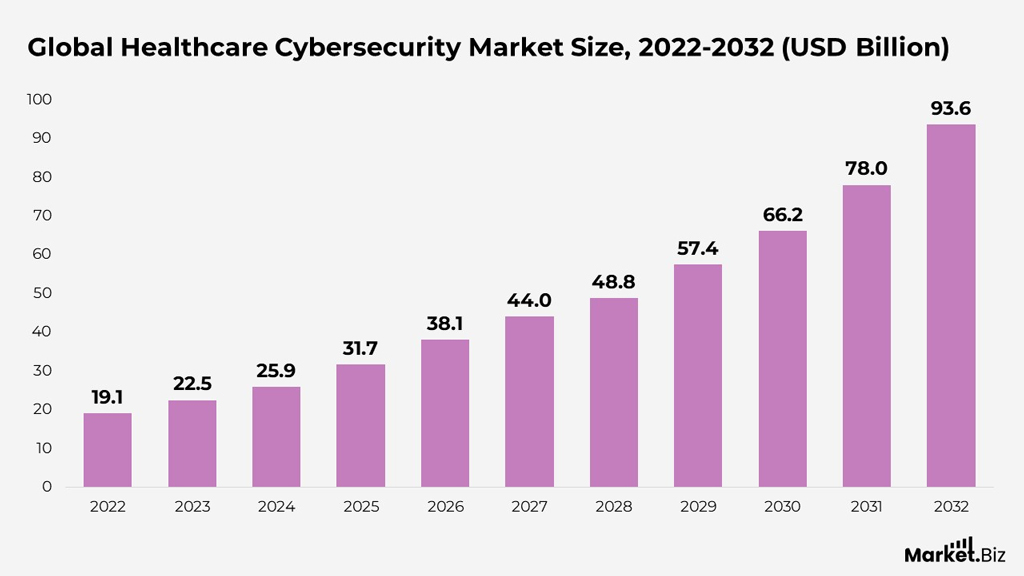
- The global healthcare cybersecurity market grew from $19.1 billion in 2022 to $22.5 billion in 2023, reflecting strong industry demand.
- Market size increased to $25.9 billion in 2024, marking continued investment in healthcare security solutions.
- The industry is projected to reach $31.7 billion in 2025, surpassing the $30 billion milestone.
- Healthcare cybersecurity spending is expected to climb to $38.1 billion in 2026, highlighting rapid market expansion.
- The market is forecast to hit $44.0 billion in 2027, more than doubling its 2022 value.
- Global market value is estimated at $48.8 billion in 2028, approaching the $50 billion mark.
- Healthcare cybersecurity revenue is projected to reach $57.4 billion in 2029, driven by rising cyber threats.
- The market is expected to grow to $66.2 billion in 2030, adding nearly $9 billion in one year.
- Industry value is forecast to reach $78.0 billion in 2031, reflecting the accelerating adoption of security technologies.
- The global healthcare cybersecurity market is projected to peak at $93.6 billion in 2032, nearly 5× larger than in 2022.
- Between 2022 and 2032, the market is expected to increase by $74.5 billion, demonstrating substantial long-term growth.
- The healthcare cybersecurity market is forecast to expand by approximately 390% from 2022 to 2032.
Healthcare Cyberattack Statistics
- Healthcare cyberattacks affected 275 million records in 2024, the largest annual exposure ever recorded for the sector.
- The Change Healthcare incident alone accounted for approximately 190 million affected individuals.
- Ransomware attacks targeting healthcare organizations increased by 32% during 2024.
- From January through October 2024, researchers recorded 149 ransomware attacks against healthcare organizations worldwide.
- The United States accounted for 52% of global healthcare ransomware attacks during that period.
- DaVita reported a ransomware incident affecting approximately 2.7 million people in 2025.
- More than 66 large healthcare breaches were reported in January 2025 alone.
- Researchers found that ransomware represented 31% of healthcare breaches in 2021, compared with 11% in 2024 after reporting patterns shifted.
- Cybercriminal groups such as BlackCat, Cl0p, LockBit, Medusa, and Interlock remained among the most active healthcare threat actors through 2025.
Financial Cost of Healthcare Data Breaches
- The average healthcare data breach cost reached $7.42 million in 2025, the highest of any industry sector.
- U.S. organizations incurred an average breach cost of $10.22 million in 2025.
- The global average cost of a data breach across industries was $4.44 million in 2025.
- Healthcare breach costs remain significantly higher than the global cross-industry average.
- UnitedHealth estimated total costs from the Change Healthcare breach at approximately $3.09 billion.
- DaVita reported approximately $13.5 million in costs tied to its ransomware incident in 2025.
- Extortion demands in healthcare incidents reached $4 million in some 2025 cases.
- Lost business, regulatory penalties, remediation efforts, and response costs continue to be major contributors to healthcare breach expenses.
- AI-assisted security operations helped reduce global breach costs by improving detection and containment speeds in 2025.
Impact of Cyberattacks on Patient Care and Safety
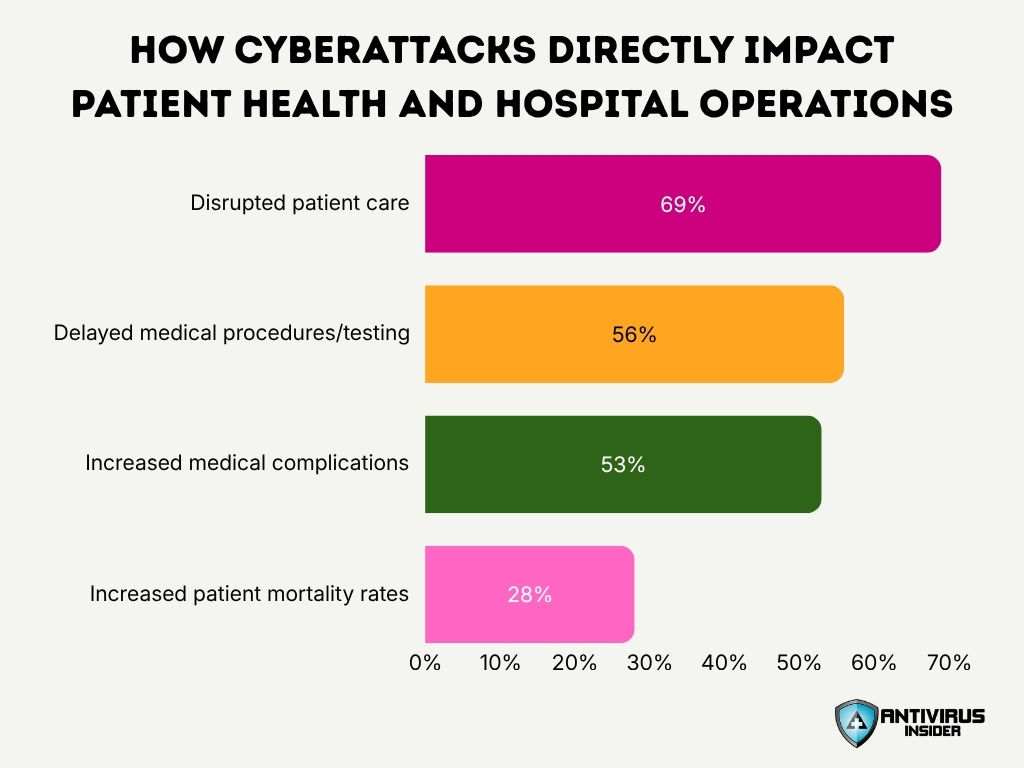
- 69% of surveyed organizations reported that cyberattacks directly disrupted patient care.
- 67% of healthcare organizations experienced crippling ransomware attacks in 2024.
- 56% of affected facilities observed critical delays in medical procedures or testing.
- 53% of healthcare providers recorded an increase in medical complications post-breach.
- 37% of targeted healthcare organizations took over a month to recover operations.
- 28% of compromised organizations noted an increase in patient mortality rates.
- 22% of healthcare ransomware victims successfully managed to recover fully within a week.
- 80% of stolen protected health information originated from vulnerable third-party vendors.
Patient Records Exposure Statistics
- The Change Healthcare breach affected approximately 190 million individuals, making it one of the largest healthcare exposures ever recorded.
- More than 275 million healthcare records were compromised during 2024.
- Patient records often contain over 20 different categories of personal information, increasing their black-market value.
- Medical records can sell for 10 to 20 times more than stolen credit card data on criminal marketplaces.
- Approximately 139.7 million individuals had healthcare information exposed in 2025 breaches.
- The DentaQuest breach disclosed data belonging to roughly 2.6 million individuals.
- Healthcare records frequently include Social Security numbers, insurance identifiers, treatment histories, and financial information, making them attractive to attackers.
- More than 70% of exposed healthcare records originated from hacking-related incidents rather than accidental disclosures.
- Large healthcare breaches increasingly involve cloud-hosted data repositories and third-party service platforms.
Ransomware Attack Statistics in Healthcare
- Healthcare ransomware incidents increased by 32% in 2024, continuing into 2025 at elevated levels.
- Researchers tracked 149 healthcare ransomware attacks worldwide during the first 10 months of 2024.
- The United States accounted for 52% of global healthcare ransomware incidents during that period.
- More than 67 million patient records were exposed through ransomware-related breaches in 2024.
- Healthcare organizations paid an average ransomware recovery cost of $2.57 million in 2025, excluding ransom payments.
- Approximately 67% of healthcare organizations affected by ransomware restored operations using backups rather than paying attackers.
- Only 22% of healthcare organizations fully recovered from ransomware attacks within one week.
- Nearly 95% of healthcare ransomware victims reported operational disruption following an attack.
- Double-extortion tactics, where attackers both encrypt and steal data, were involved in more than 70% of ransomware incidents during 2025.
February Healthcare Data Breach Statistics
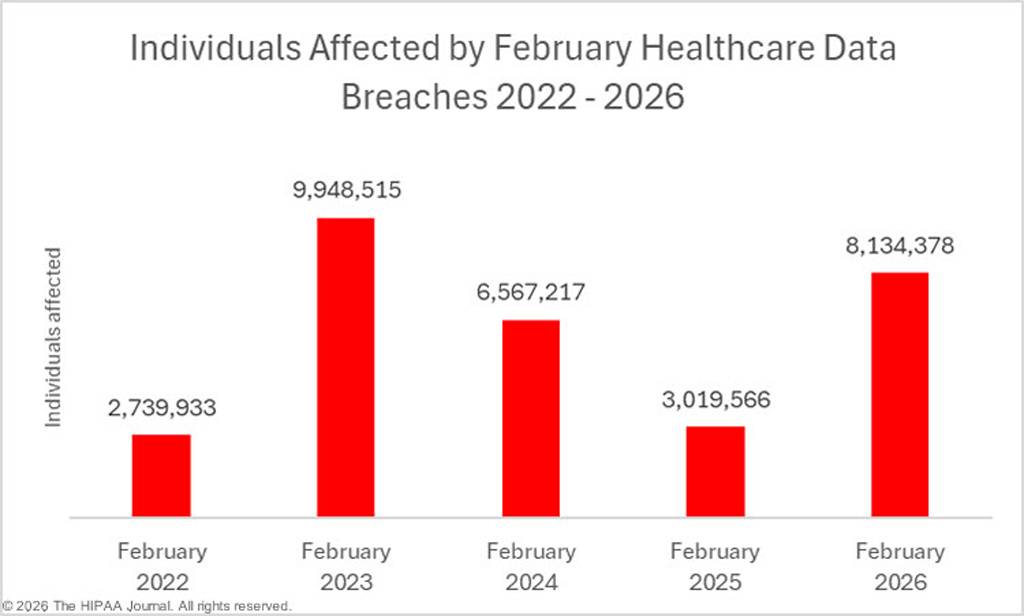
- February 2023 recorded the highest impact, with 9.95 million individuals affected by healthcare data breaches.
- February 2026 saw 8.13 million individuals affected, marking the second-highest total in the five years.
- Healthcare data breaches impacted more than 30.4 million individuals across all February periods from 2022 to 2026.
- February 2024 reported 6.57 million affected individuals, remaining well above the five-year average.
- February 2025 experienced 3.02 million affected individuals, a 54% decline from February 2024.
- February 2022 had the lowest breach impact, with 2.74 million individuals affected.
- The gap between the highest and lowest years reached 7.21 million individuals, highlighting major annual fluctuations.
- The average February healthcare breach impact was approximately 6.08 million individuals during 2022–2026.
- Three of the five years analyzed recorded more than 6.5 million victims in a single February.
- February 2026 showed a strong rebound, with affected individuals rising by 169% year over year from February 2025.
Phishing and Social Engineering Threats
- Social engineering attacks accounted for 88% of material healthcare cyber losses during the first half of 2025.
- Human error contributed to approximately 68% of data breaches across industries, including healthcare.
- Phishing remained the most common initial access method used in healthcare ransomware attacks.
- More than 90% of successful cyberattacks begin with a phishing email or social engineering tactic.
- Business email compromise attacks generated billions of dollars in losses globally and are increasingly targeting healthcare finance departments.
- Healthcare employees clicked simulated phishing links at rates between 10% and 20% before training interventions.
- Organizations implementing ongoing security awareness programs reduced phishing susceptibility by more than 70% over time.
- Credential harvesting campaigns targeting healthcare workers increased significantly throughout 2025.
- AI-generated phishing content improved attacker success rates by producing more convincing and personalized messages.
Insider Threats and Employee Negligence Data
- Internal actors caused 35% of data breaches in the healthcare sector through malice or simple mistakes.
- Negligent employees and accidental errors account for 55% of all insider security incidents globally.
- The healthcare industry faces the highest annual cost for insider threats at $28.8 million per year.
- Employee negligence was the direct cause of 31% of data loss incidents within healthcare organizations last year.
- Internal security incidents involving compromised credentials cost organizations an average of $779,707 per event.
- Non-malicious actions like email misdelivery and misconfigurations represent 75% of total insider incidents.
- Implementing a formal insider risk program helps organizations save an estimated $8.2 million annually in breach costs.
- Lost or stolen electronic devices contributed to an 85.7% increase in reported healthcare privacy incidents recently.
- Expanding remote workforce environments mean 78% of insider incidents now directly involve cloud or SaaS platforms.
Top Cyber Threats Facing Healthcare
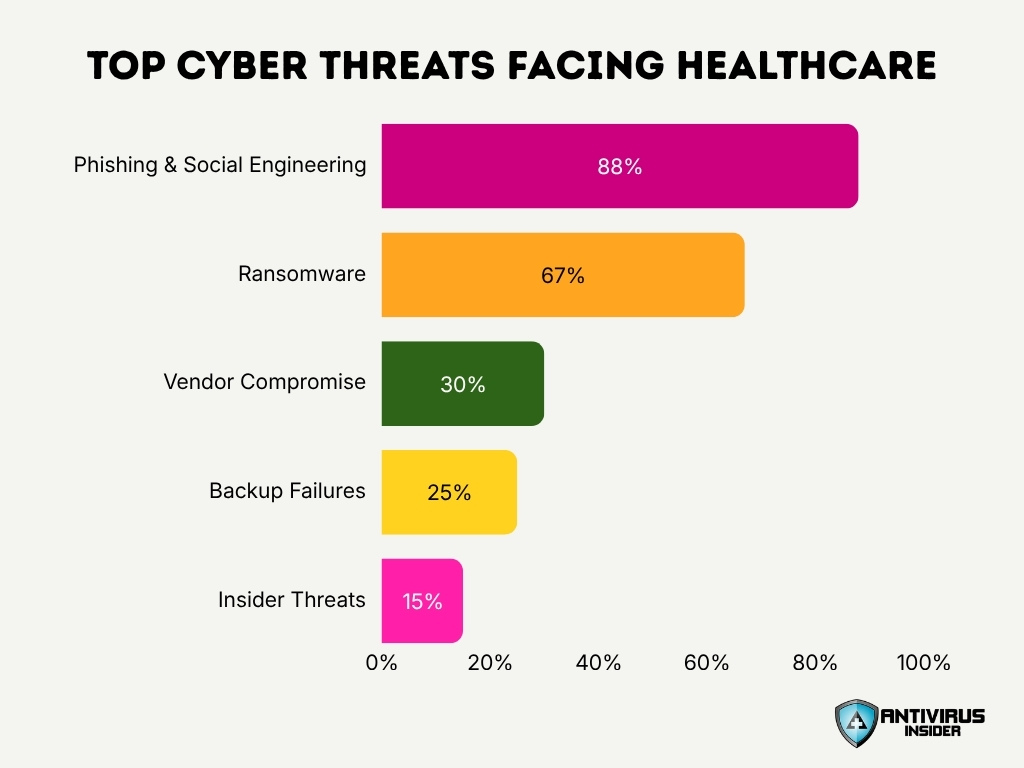
- Phishing & Social Engineering accounted for 88% of major healthcare cybersecurity incidents, making it the most prevalent threat.
- Ransomware attacks were involved in 67% of major incidents, highlighting their continued impact on healthcare organizations.
- Vendor Compromise contributed to 30% of significant healthcare cyber incidents, underscoring third-party security risks.
- Backup Failures were linked to 25% of major incidents, affecting organizations’ ability to recover from attacks.
- Insider Threats represented 15% of major healthcare security incidents, reflecting risks from employees and internal actors.
Third-Party and Supply Chain Breach Statistics
- Third-party compromise played a role in some of the largest healthcare breaches reported during 2024 and 2025.
- The Change Healthcare attack demonstrated how a single vendor incident can affect millions of patients and providers nationwide.
- Nearly 62% of organizations reported experiencing a supply-chain cyber incident during the past year.
- Third-party vendors often possess access to patient information, billing systems, and operational networks, increasing systemic risk.
- Supply-chain attacks increased by approximately 15% year over year during 2025.
- More than 54% of healthcare organizations identified vendor security as a top cybersecurity concern.
- Vulnerabilities in managed file transfer tools and software platforms contributed to several large-scale healthcare breaches in recent years.
- Organizations with mature vendor-risk management programs experienced fewer large-scale third-party security incidents.
- Regulatory agencies increasingly scrutinize healthcare organizations for insufficient oversight of business associates and external service providers.
Healthcare Infrastructure Security Limitations Statistics
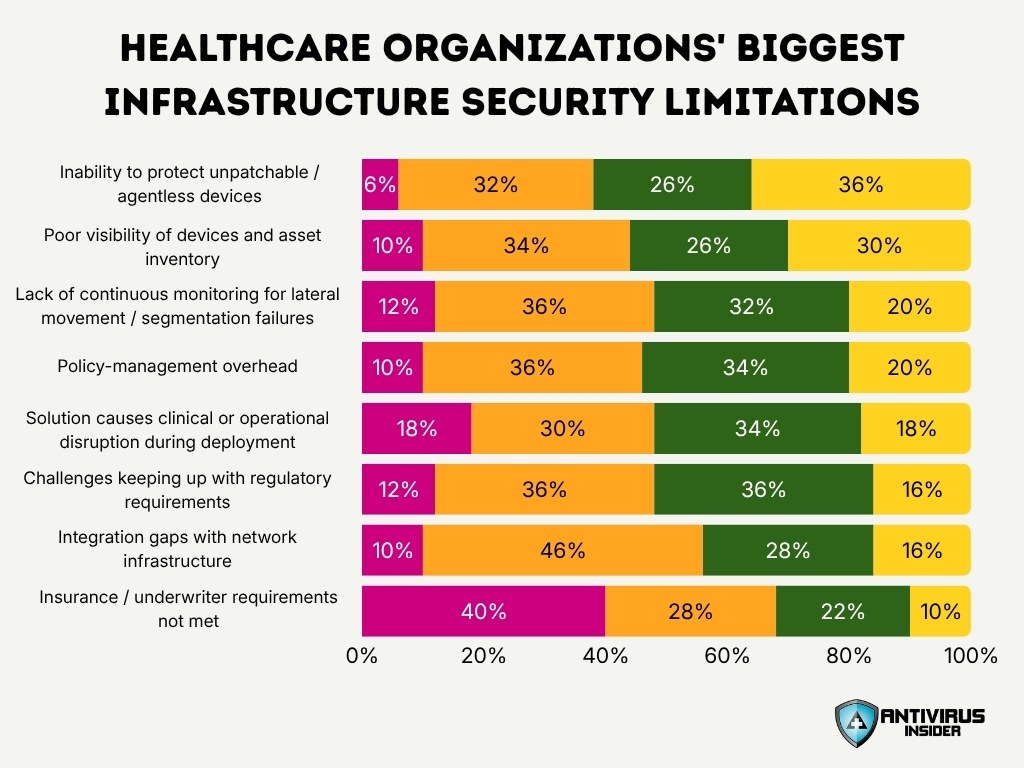
- 36% of healthcare organizations cite the inability to protect unpatchable or agentless devices as a major security issue, the highest among all limitations.
- 56% of respondents report poor visibility of devices and asset inventory as a moderate or major issue (26% and 30%, respectively).
- 52% identify lateral movement monitoring and segmentation failures as a moderate or major challenge, including 20% calling it a major issue.
- 54% say policy management overhead is a moderate or major issue, highlighting scalability and administration concerns.
- 52% report that security solutions can cause clinical or operational disruption during deployment, including 18% facing major impacts.
- 52% struggle with regulatory compliance requirements, with 36% rating it a moderate issue and 16% a major issue.
- 44% cite integration gaps with network infrastructure as a moderate or major issue, while 46% classify it as a minor concern.
- 40% say insurance or underwriter requirements not met are not an issue, the highest “not an issue” response in the survey.
- Only 6% consider unpatchable or agentless device protection to be not an issue, indicating widespread concern across healthcare organizations.
- The combined major issue rate across infrastructure limitations ranges from 10% to 36%, with device protection challenges ranking as the most critical concern.
Major Healthcare Data Breaches
- The Change Healthcare cyberattack exposed data linked to approximately 190 million individuals.
- A major breach involving DentaQuest affected approximately 2.6 million people.
- DaVita disclosed a ransomware-related breach impacting around 2.7 million individuals in 2025.
- More than 16 healthcare breaches exceeded one million affected individuals during 2025.
- Healthcare organizations reported 772 major breaches in 2025, setting a new annual record.
- The global average cost of a healthcare data breach reached $7.42 million in 2025.
- Third-party vendor compromises accounted for 30% of all healthcare data breaches in 2025.
- Over 80% of stolen patient records were taken from third-party vendors rather than hospitals directly.
- Approximately 67% of healthcare organizations were hit by ransomware attacks over the last year.
- The United States experienced the highest average breach cost globally at $10.22 million per incident.
Artificial Intelligence in Healthcare Security
- Organizations deploying AI security tools reduced breach lifecycles by an average of 108 days.
- Healthcare entities with AI-powered security saved approximately $1.9 million per data breach.
- Over 65% of healthcare organizations plan to increase AI cybersecurity investments throughout 2026.
- AI-driven automation successfully handles up to 70% of initial security alert triage in healthcare networks.
- Unsanctioned or shadow AI breaches cost organizations an additional $670,000 per incident on average.
- The integration of AI security lowers the time needed to identify a network breach by 28%.
- AI-based phishing filters proactively block up to 99% of malicious emails before reaching healthcare staff.
- Around 16% of recent data breaches involved attackers utilizing AI tools for sophisticated phishing attacks.
- Healthcare data breaches take the longest to identify and contain at an average of 279 days without AI intervention.
Healthcare Cybersecurity Budget Allocation Statistics
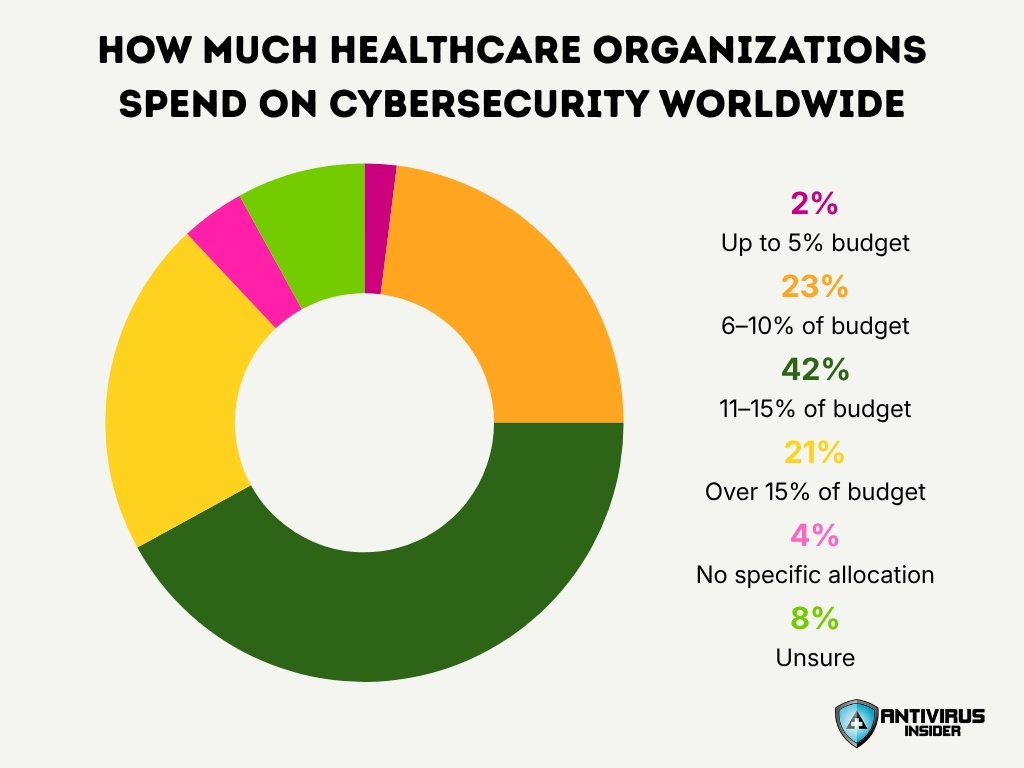
- 42% of healthcare organizations allocate 11–15% of their budget to cybersecurity, making it the most common spending range.
- 23% of healthcare organizations dedicate 6–10% of their budget to cybersecurity initiatives.
- 21% of organizations invest more than 15% of their total budget in cybersecurity, reflecting strong security priorities.
- Only 2% of healthcare organizations spend up to 5% of their budget on cybersecurity.
- 8% of respondents were unsure about their organization’s cybersecurity budget allocation.
- 4% of healthcare organizations reported having no specific cybersecurity budget allocation.
Regulatory Compliance and Penalty Statistics
- The average cost of a healthcare data breach reached $7.42 million in 2025, marking the highest of any industry for 14 consecutive years.
- Regulators finalized 21 OCR settlements in 2025, representing the second-highest annual total of HIPAA penalties on record.
- Third-party vendor involvement in healthcare data breaches doubled year-over-year to account for 30% of all reported incidents.
- Healthcare organizations required an average of 279 days to identify and contain a data breach, extending five weeks longer than the global average.
- Hacking and IT incidents drove the vast majority of enforcement actions, accounting for over 80% of large healthcare data breaches.
- Organizations faced maximum civil monetary penalties of up to $2,190,294 annually for uncorrected willful neglect violations.
- More than 80% of stolen protected health information was compromised through third-party vendors rather than direct hospital electronic health records.
- The largest single healthcare ransomware attack exposed the data of 192.7 million individuals, drawing unprecedented regulatory scrutiny.
- Over 61.5 million individuals had their protected health information exposed or impermissibly disclosed across 697 large healthcare data breaches in 2025.
Cybersecurity Recovery and Response Times
- The global average data breach lifecycle reached approximately 241 days, including detection and containment.
- Extensive use of AI and automation reduced breach containment times by more than 100 days.
- Only 22% of healthcare organizations fully recovered from ransomware within one week.
- Nearly 95% of ransomware victims experienced significant operational disruptions following attacks.
- The average business downtime after a successful ransomware attack is approximately 24 days.
- Dedicated incident response teams reduced the time to identify and contain breaches by 54 days.
- More than 70% of targeted organizations require over one month to fully restore operational capacities.
- Implementing zero-trust security reduced average breach recovery costs by approximately $1.76 million.
Frequently Asked Questions (FAQs)
Approximately 139.7 million individuals were affected by healthcare data breaches reported in 2025.
The average cost of a healthcare data breach was $7.42 million in 2025, the highest among all industries for the 14th consecutive year.
The Change Healthcare cyberattack affected approximately 192.7 million individuals, making it the largest healthcare data breach in U.S. history.
Hacking and other IT-related incidents accounted for more than 80% of large healthcare data breaches in recent reporting periods.
Ransomware attacks against healthcare organizations increased by 32% during 2024, with elevated activity continuing into 2025.
Conclusion
Healthcare cybersecurity risks continued to escalate. Record-breaking data breaches, rising ransomware activity, expanding attack surfaces from connected medical devices, and increasingly sophisticated social engineering campaigns have created unprecedented challenges for hospitals, insurers, and healthcare providers.
The statistics show that cyber incidents now affect far more than data privacy. They influence patient safety, operational continuity, regulatory compliance, and financial performance. At the same time, healthcare organizations are responding with larger cybersecurity budgets, stronger vendor oversight, AI-powered security tools, and more mature incident-response capabilities.
Looking ahead, the healthcare sector’s ability to balance digital innovation with robust security controls will play a critical role in protecting patient information and ensuring uninterrupted care delivery. Organizations that prioritize cybersecurity resilience today will be better positioned to manage emerging threats in the years ahead.
