



Identity theft reflects a broader shift from isolated financial fraud to persistent, digitally enabled identity abuse. Criminals now use stolen credentials, synthetic identities, account takeovers, phishing, compromised devices, and AI-generated impersonation to target consumers and businesses. Recent data show that identity theft reports, credit card fraud, new-account fraud, and account takeover remain widespread, while data breaches continue to expose large volumes of personal information. These trends affect banks, lenders, retailers, employers, and government systems, making identity protection an operational issue as well as a consumer concern. The statistics in this article show how identity theft is evolving, which groups face the greatest risks and where the financial impact is growing.
Editor’s Choice
- 1.36 million: Consumers filed 1,358,253 identity theft reports in 2025, compared with 1,135,265 in 2024.
- $27.3 billion: Traditional identity fraud losses remained at roughly this level in 2025 after reaching $27.2 billion in 2024.
- 18 million: This was the estimated number of traditional identity fraud victims in the U.S. during 2025.
- 597,770: Credit card identity theft reports climbed to this level in 2025, up 33% from 449,094 in 2024.
- 5.4 million: New-account fraud affected this many victims in 2025, a 31% increase from 4.2 million in 2024.
- 6 million: Account takeover affected an estimated 6 million victims in 2025, up 18% from 5.1 million in 2024.
- 3,322: U.S. organizations reported a record number of data compromises in 2025, exceeding 3,152 in the comparable 2024 count.
- $3.3 billion: U.S. lender exposure to synthetic identities across auto loans, bank cards, retail cards and unsecured personal loans reached an all-time high at the end of 2024.
Recent Developments
The 2026 picture shows an important shift: aggregate losses alone no longer explain identity risk. New-account fraud, account takeover, synthetic identities, data compromises and AI-assisted attacks increasingly shape the threat landscape.
- The 2026 identity fraud study found that identity fraud and scam losses combined fell from $47 billion in 2024 to $38 billion in 2025, a $9 billion decline.
- However, traditional identity fraud losses barely moved, rising from $27.2 billion to $27.3 billion between 2024 and 2025.
- Scam losses declined 45%, from $19.5 billion in 2024 to $10.7 billion in 2025, showing that lower scam losses did not translate into the same decline in identity fraud.
- New-account fraud became a key growth area: victims increased 31% year over year, from 4.2 million to 5.4 million.
- Account-takeover victims increased from 5.1 million in 2024 to 6 million in 2025, an 18% rise.
- Data compromises reached 3,322 in 2025, setting a new annual record and rising 5% from 2024.
- Data compromise volume in 2025 stood 79% above the level five years earlier, highlighting the longer-term expansion of breached identity data.
- A 2026 fraud analysis found that 33% of recently targeted consumers experienced phishing, making it the most frequently reported scheme among the surveyed group.
- In the same research, 26% of consumers said they had lost money to digital fraud during the previous year, while 77% ranked confidence in personal-data security as the most important feature when choosing an online organization.
Identity Theft Statistics Overview
Identity theft covers several forms of misuse rather than one single crime. Criminals can open credit cards, obtain loans, access bank accounts, misuse tax information or government benefits, and combine genuine personal data with fabricated information.
- The U.S. recorded 1,358,253 identity theft complaints in 2025, representing a 19.6% annual increase.
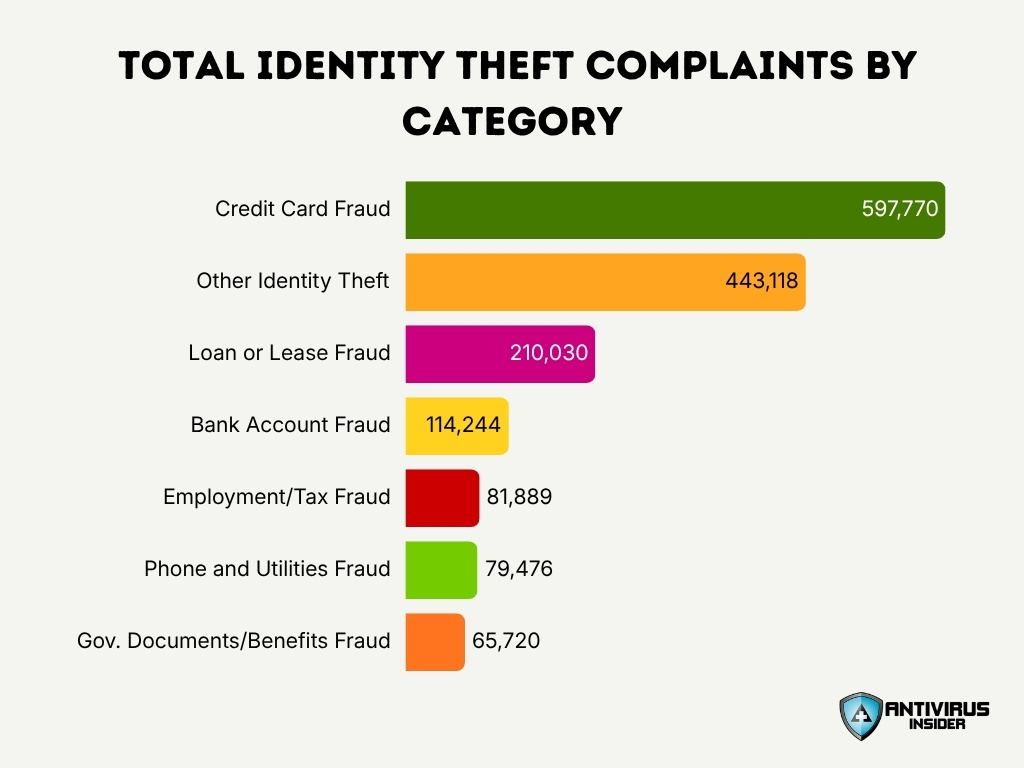
- Credit card fraud accounted for 597,770 identity theft complaints in 2025.
- “Other identity theft” generated 443,118 reports, making it the second-largest listed identity theft category in 2025.
- Loan or lease identity theft produced 210,030 complaints in 2025.
- Bank account identity theft accounted for another 114,244 reports during 2025.
- Employment- or tax-related identity theft generated 81,889 complaints in 2025.
- Phone and utilities identity theft accounted for 79,476 reports, showing that stolen identities also affect nonbank accounts.
- Government documents or benefits identity theft produced 65,720 complaints in 2025.
- For comparison, the 2024 data showed 1,135,291 identity theft reports, about 9.5% more than in 2023.
Total Identity Theft Reports and Trends
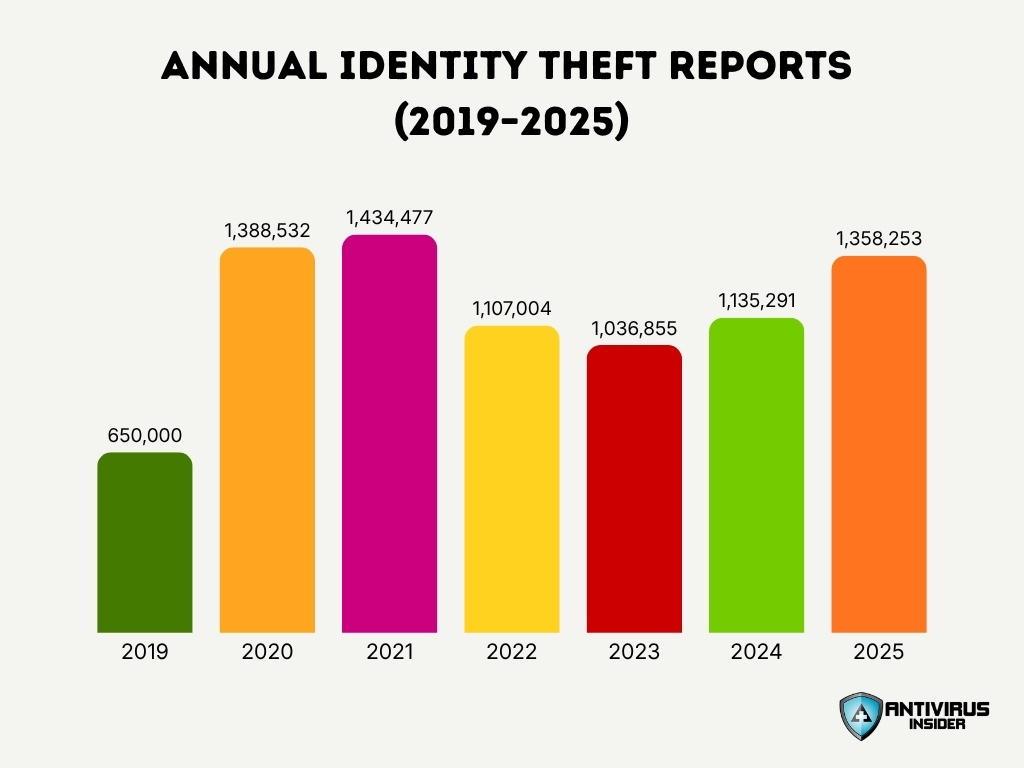
Long-term data show that identity theft reporting surged during the early 2020s, eased after its 2021 peak, and accelerated again in 2024 and 2025.
- Consumers submitted about 650,000 identity theft reports in 2019, providing a useful pre-pandemic benchmark.
- Reports more than doubled to 1,388,532 in 2020, marking one of the sharpest annual increases in the series.
- Identity theft reporting climbed further to 1,434,477 cases in 2021, the highest annual level in the 2019-2024 series.
- Reports declined to 1,107,004 in 2022 as the exceptional 2020-2021 surge eased.
- The total fell again to 1,036,855 in 2023.
- Reports rebounded to approximately 1.14 million in 2024, an increase of roughly 9.5% from 2023.
- By the first three quarters of 2025, consumers had already submitted 1,157,317 reports, exceeding the full-year 2024 total.
- The final 2025 count reached 1,358,253 identity theft reports, 19.6% above the comparable 2024 total.
- As a result, 2025 identity theft reporting was more than twice the 2019 level, showing that the post-2020 increase has not returned to its earlier baseline.
Identity Theft by Type
Credit-related identity theft remains prominent, but the 2025 numbers show substantial activity across loans, bank accounts, employment records, utilities and government benefits.
- Credit card identity theft led all listed categories with 597,770 reports in 2025.
- Credit card identity theft rose 33% from 2024, when the comparable total was 449,094 reports.
- Other identity theft generated 443,118 reports in 2025.
- Loan or lease fraud produced 210,030 reports, making lending products another significant target for stolen identities.
- Bank account identity theft resulted in 114,244 reports in 2025.
- Employment- or tax-related identity theft reached 81,889 reports.
- Phone and utility identity theft generated 79,476 reports during the year.
- Government documents and benefits fraud accounted for 65,720 reports in 2025.
- Looking specifically at credit cards, federal consumer-finance analysis found that new-account fraud represented 88.6% of reported credit card identity theft in 2024, compared with 11.4% for existing-account fraud.
- Across 2020-2024, new-account incidents consistently represented roughly nine in 10 reported credit card identity theft cases, underscoring the importance of application-stage identity verification.
Financial Impact and Losses
The financial impact of identity crime extends beyond money taken directly from consumers. Banks, lenders, merchants and other organizations also absorb investigation, compliance, technology, labor and customer-service costs.
- Traditional U.S. identity fraud produced $27.3 billion in losses in 2025, compared with $27.2 billion in 2024.
- Identity fraud and scams combined caused approximately $38 billion in losses in 2025, down from $47 billion the previous year.
- Scam losses alone totaled $10.7 billion in 2025, down sharply from $19.5 billion in 2024.
- Separately, consumers reported approximately $15.9 billion in fraud losses to federal authorities in 2025, compared with more than $12 billion in 2024. These complaint-based totals use a different methodology from survey-based identity fraud estimates and should not be added together.
- Investment scams generated $7.9 billion in reported losses in 2025, the largest loss total among fraud categories tracked in that reporting system.
- Imposter scams cost consumers $3.5 billion in 2025, with losses nearly tripling compared with 2020.
- In 2024, consumers reported $12.5 billion in overall fraud losses, 25% more than in 2023.
- The share of 2024 fraud reporters who said they lost money reached 38%, compared with 27% in 2023.
- Fraud also creates substantial indirect business costs. In 2025, every $1 of direct fraud loss cost U.S. financial services organizations an average of $5.75 after associated expenses were included.
- The 2026 retail and ecommerce study put the U.S. fraud multiplier at approximately $5.13 for every $1 directly lost, showing how fraud generates expenses beyond the original transaction value.
Identity Theft by Age Group
Age changes both the likelihood of reporting identity theft and the financial impact when fraud succeeds. Younger and middle-aged adults tend to generate more identity theft reports, while older adults often experience larger losses when criminals gain access to their savings or financial accounts.
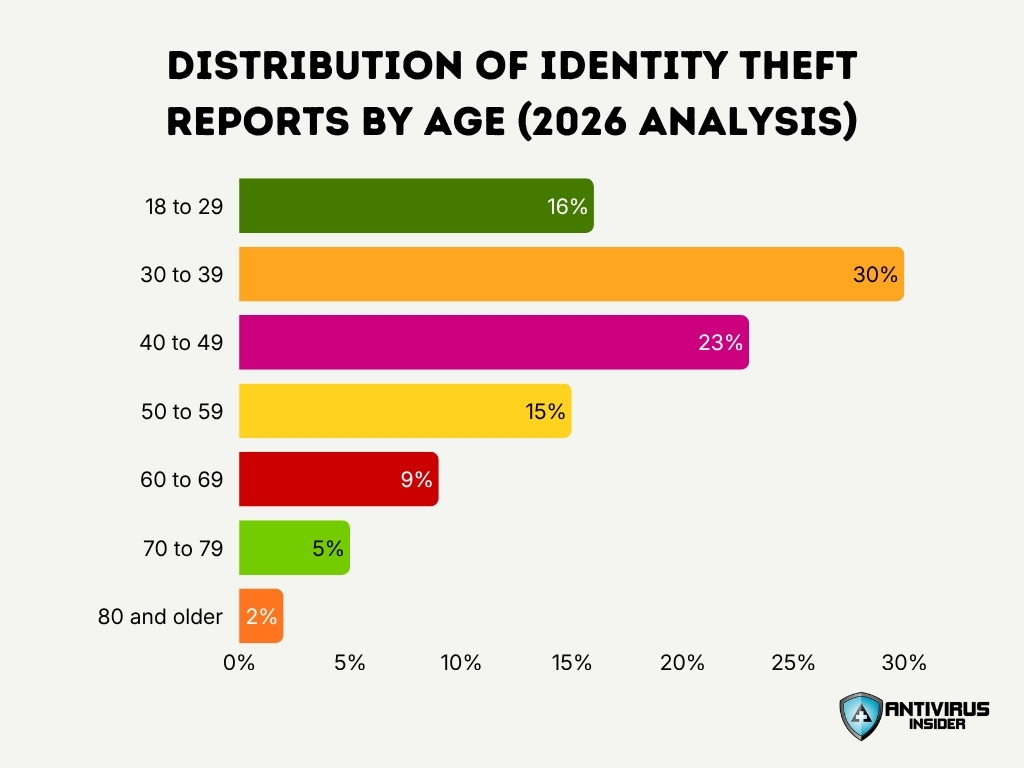
- Adults ages 30 to 39 remain the most frequently affected age group in federal identity theft reporting. Recent 2026 analysis of government data continues to place people in their 30s ahead of other age groups for total identity theft complaints.
- Adults ages 30 to 39 accounted for about 30% of identity theft reports in the latest detailed age breakdown, compared with 23% for ages 40 to 49 and 16% for ages 18 to 29.
- People ages 40 to 49 represented roughly 23% of reports, making them the second-largest age segment in the same breakdown.
- Adults ages 50 to 59 accounted for about 15% of identity theft reports, while consumers ages 60 to 69 represented roughly 9%.
- Although consumers ages 70 to 79 represented only about 5% of reports, their median loss reached about $1,000, roughly twice the $497 median reported for people ages 30 to 39.
- Consumers ages 80 and older accounted for only around 2% of identity theft reports, yet their reported median loss reached about $1,650, the highest among the age groups in the comparison.
- Fraud losses reported by adults ages 60 and older increased from roughly $600 million in 2020 to $2.4 billion in 2024, a fourfold rise. Large individual losses helped drive that increase.
- Reports from older adults involving losses of $10,000 or more to business and government impersonation scams increased more than fourfold between 2020 and 2024.
- In 2024, losses of at least $10,000 to government and business impersonation scams were more than twice as likely to be reported by consumers 60 and older as by younger consumers; losses above $100,000 were three times as likely.
- The threat continues to evolve in 2026. Among more than 6,000 people examined in recent identity-crime research, unauthorized device access overtook scams as the leading compromise method for adults ages 35 to 64.
Identity Theft by Demographics
Identity theft can affect consumers across income, gender and racial groups. However, survey and victimization data show meaningful differences in exposure, financial consequences and the types of accounts consumers use.
- A 2025 consumer survey included 51% women and 49% men, providing an almost evenly divided gender sample for evaluating identity misuse and fraud trends.
- Within that same 2025 consumer sample, adults ages 30 to 44 and 45 to 60 each represented 34% of respondents, while those over 60 represented 19%.
- Consumers ages 18 to 29 accounted for 14% of respondents, underscoring that the research covered both digitally active younger consumers and older adults.
- Household income varied widely: 17% earned $25,000 to $49,999, the largest single income category, while 15% earned $50,000 to $74,999.
- Another 14% of surveyed households earned $75,000 to $99,999, while 12% reported household incomes of $100,000 to $124,999.
- Higher-income households also appeared in the victim sample: 7% reported household income above $200,000, showing that identity crime extends across the income distribution.
- By device type, Android phones or tablets and iOS phones or tablets each accounted for 47% of consumer devices in the survey. Only 5% used desktop or laptop platforms as their primary listed device.
- Regionally, 23% of respondents lived in the Pacific region, followed by 19% in the South Atlantic and 17% in the Middle Atlantic.
- Longer-term government victimization research found that 52.3% of lifetime identity theft victims were female and 47.7% were male. About 22.8% of U.S. women and 22% of men age 16 or older had experienced identity theft during their lifetime as of the 2021 survey.
- The same nationwide research estimated lifetime identity theft prevalence at 26.3% among non-Hispanic White adults, 17% among non-Hispanic Black adults, and 14.6% among Hispanic adults. These figures describe reported lifetime victimization, not inherent vulnerability by race.
How Identity Theft Occurs
Identity thieves increasingly rely on digital contact methods rather than physical document theft alone. Text messages, email, phone calls, compromised websites, and social media can all provide a path to credentials or other personal information.
- Text messages generated 411,424 fraud complaints in 2025, more than any other individual contact method in the latest reporting. Reported text-related losses totaled about $639 million.
- Email accounted for 361,081 complaints and about $569 million in reported losses during 2025.
- Phone calls generated 290,427 complaints, with reported losses exceeding $1.1 billion and a median loss of $1,835.
- Websites and mobile apps accounted for 221,923 complaints and roughly $1.12 billion in losses in 2025.
- Social media produced fewer complaints than texts or email, at 197,776 reports, but generated more than $2.05 billion in reported losses.
- Social media account takeover became the most commonly reported form of identity misuse among surveyed general consumers in 2025, affecting 35.3% of victims, up from 29.4% in 2024.
- Phishing remains an important credential-theft route. Industry breach analysis has attributed around 15% of breaches to phishing, with phishing-related breaches averaging approximately $4.88 million in organizational costs.
- SMS phishing also carries measurable financial consequences. Academic research published in 2026 estimated that smishing produced approximately $470 million in U.S. losses during 2024.
- Identity crime increasingly involves repeat attacks. Among general-population victims surveyed in 2025, 31.5% reported two incidents and 24.6% reported three incidents in the previous year, versus 24.1% and 16.9%, respectively, in 2024.
- By 2026, 25.6% of victims seeking identity-crime assistance were managing two or more concurrent incidents, up from 23.5% a year earlier, showing how stolen information can fuel multiple types of misuse at once.
States Most Vulnerable to Identity Theft & Fraud
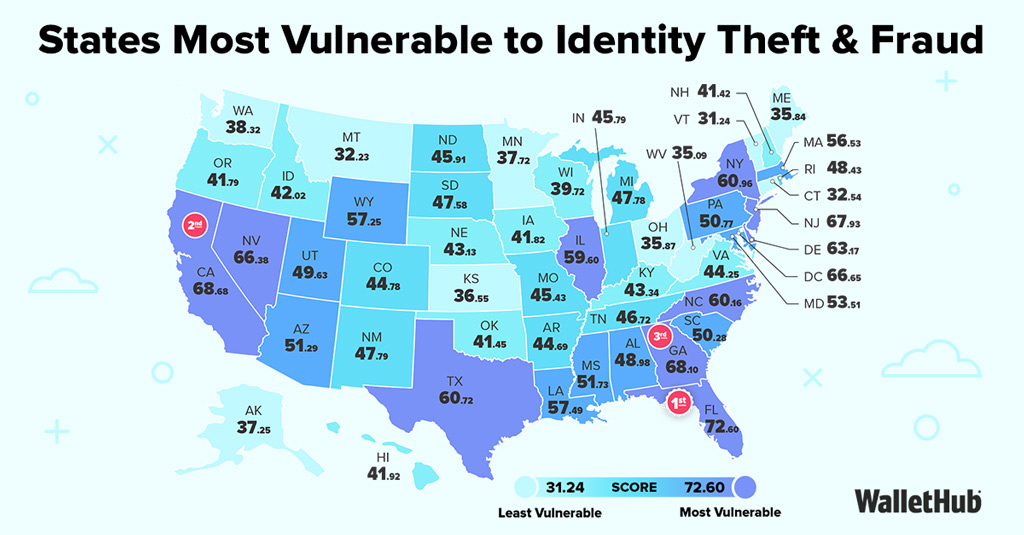
Geography remains an important part of the identity theft picture. Population size affects raw totals, so reports per 100,000 residents often provide a clearer comparison between states.
- Florida ranks as the most vulnerable state for identity theft and fraud, recording the highest score of 72.60.
- California follows in second place with a vulnerability score of 68.68, only 3.92 points behind Florida.
- Georgia ranks third with a score of 68.10, placing it among the states facing the greatest identity theft and fraud risks.
- New Jersey also shows particularly high vulnerability with a score of 67.93, while Nevada records 66.38.
- The District of Columbia posts a score of 66.65, putting it above most U.S. states represented in the analysis.
- New York, Texas, and North Carolina all score above 60 points, at 60.96, 60.72, and 60.16, respectively.
- At the lower end, Vermont is the least vulnerable state in the study, with a score of just 31.24.
- Montana and Connecticut are also among the least vulnerable areas, registering scores of 32.23 and 32.54, respectively.
- The gap between the highest-scoring state, Florida (72.60), and the lowest-scoring state, Vermont (31.24), is 41.36 points, highlighting substantial geographic differences in vulnerability.
- Overall, the data shows that identity theft and fraud vulnerability varies considerably across the U.S., with several states scoring above 60, while the least vulnerable states remain close to the 31–33 point range.
Credit Card and Bank Account Identity Theft Statistics
Financial accounts remain central targets because stolen identities can create immediate spending power or provide criminals with access to existing funds.
- Credit card identity theft produced 597,770 complaints in 2025, making it the most commonly reported identity theft category in the U.S.
- The 2025 credit card identity theft total increased 33% from 449,094 reports in 2024.
- As a result, credit card-related identity theft accounted for roughly 44% of the 1.36 million identity theft complaints reported in 2025. This percentage is calculated from the published complaint totals.
- Credit card identity theft had already exceeded its full-year 2024 total during the first three quarters of 2025, reflecting the rapid pace of growth during the year.
- Bank account identity theft generated approximately 114,244 reports in 2025, showing that deposit accounts remained a substantial target alongside credit cards.
- New-account fraud became increasingly important across financial services. The number of U.S. victims rose 31% from 4.2 million in 2024 to 5.4 million in 2025.
- New-account fraud matters because criminals can use stolen personal information to open credit cards, bank accounts or loans that the legitimate consumer may not discover until bills, collection notices or credit-report changes appear.
- In 2025, fraudulent applications for loans or credit cards represented 14.2% of identity crimes reported by consumers who sought specialized victim assistance.
- Earlier nationwide victimization research found that 76% of identity theft victims said their most recent incident involved misuse of a single existing account, such as a credit card or bank account.
- That nationwide research also found that 67% of identity theft victims contacted a credit card company or bank, demonstrating the central role financial institutions play in detecting and resolving account misuse.
Account Takeover Statistics
Account takeover occurs when criminals gain unauthorized control over an existing account, often after stealing a password, intercepting authentication information, or manipulating a victim or customer-service representative.
- Account takeover affected approximately 6 million U.S. victims in 2025, up from 5.1 million in 2024.
- The increase from 5.1 million to 6 million represents an 18% year-over-year rise in account-takeover victims.
- During the first half of 2025 alone, reported account-takeover fraud volume increased 20% compared with the first half of 2024.
- Across the full year, the suspected digital account-takeover fraud rate increased 37% from 2024 to 2025, even as the overall suspected digital fraud rate declined to 3.8%.
- Account creation remained the riskiest point in the digital customer journey during 2025, with 8.3% of account-creation attempts suspected of fraud in one major global analysis.
- Social media account takeover affected 35.3% of general-population identity misuse victims in 2025, up 5.9 percentage points from 29.4% in 2024.
- Among consumers who sought specialized help for more complex identity crimes, social media takeover represented only 3.2% of cases in 2025, indicating that victim profiles differ substantially by reporting channel and severity.
- Account-takeover attacks increasingly exploit compromised credentials obtained through breaches, phishing and impersonation. More severe data breaches and growing social-engineering activity contributed to the rise in ATO activity during 2025.
- A large-scale 2025 banking study tested an account-takeover detection model on a network containing more than 100 million nodes and roughly 1 billion edges; the approach reduced customer friction by more than 50% while improving fraud detection.
- Account takeover now represents one of the clearest examples of identity crime shifting from one-time theft toward persistent unauthorized access. The rise from 5.1 million victims in 2024 to 6 million in 2025 occurred alongside increasing repeat victimization and record data-compromise activity.
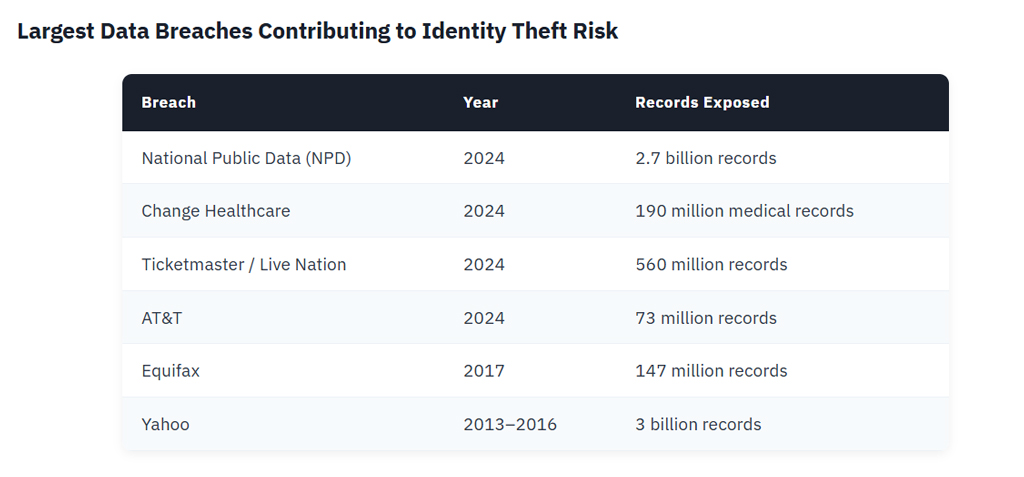
Largest Data Breaches Contributing to Identity Theft Risk
- Yahoo experienced the largest breach in the dataset, exposing approximately 3 billion records between 2013 and 2016.
- National Public Data (NPD) suffered a massive breach in 2024, involving around 2.7 billion records and creating significant potential identity theft exposure.
- The Ticketmaster / Live Nation breach affected approximately 560 million records in 2024, making it one of the largest incidents of the year.
- Change Healthcare reported exposure involving around 190 million medical records in 2024, raising concerns about the misuse of sensitive healthcare and personal information.
- The Equifax breach exposed approximately 147 million records in 2017, affecting a substantial number of consumers and highlighting the risks associated with compromised financial data.
- AT&T recorded the smallest breach among those listed, but its 73 million exposed records in 2024 still represented a major pool of potentially compromised personal information.
- Four of the six major incidents listed occurred in 2024, showing how large-scale data exposure remains a significant contributor to identity theft risk.
Synthetic Identity Theft Statistics
Synthetic identity theft combines real personal information with invented details to create an identity that can pass financial and digital verification checks. In 2026, generative AI has made document creation, application automation and biometric impersonation easier to scale.
- U.S. lenders had $3.3 billion in exposure to suspected synthetic identities across auto loans, credit cards, retail cards and unsecured personal loans at the end of 2024, an all-time high.
- That $3.3 billion exposure represented a 3% increase from the end of 2023, showing continued growth even before the latest wave of AI-assisted fraud.
- Synthetic identity fraud was the fastest-growing fraud type globally in 2025, with reported activity increasing eightfold from 2024.
- In 2024, suspected synthetic identities appeared in about 0.1% of all risky digital transactions analyzed in one large global fraud network. Given transaction volumes, that rate represented millions of potentially fraudulent transactions.
- More than 3,000 U.S. data breaches occurred in 2024, while the measured potential for breached information to result in fraud increased 34% during the year. Stolen personal information gives criminals raw material for building synthetic profiles.
- The associated breach-risk score reached 5.5 in 2024, its highest level since measurement began in 2020.
- In late 2024, 52% of consumers said criminals had targeted them with online, email, phone or text fraud attempts during a four-month period, increasing the opportunities for criminals to collect identity data.
- Telecommunications provides another measure of synthetic-account exposure: handset and device-related fraud represented $10.8 billion, or 27% of industry fraud losses, while subscription application fraud accounted for an estimated $2 billion.
- Generative AI can now automate several stages of synthetic identity fraud, from producing fake identity documents to submitting applications and passing facial-recognition checks. This matters because global deepfake selfie attempts increased 58% in 2025.
- Consequently, synthetic identity fraud increasingly affects the onboarding stage rather than only established accounts. In 2025, synthetic identities could use AI-generated documents, images, and conversations to target multiple institutions at once.
Child Identity Theft Statistics
Children present attractive targets because their personal information may remain unused for credit purposes for years. As a result, fraudulent activity can sometimes continue until a young person applies for a first loan, apartment, credit card, or job.
- Fraudulent employment became the most common identity crime involving minors and dependents in the latest 2026 victim-assistance data, representing 40% of reported child misuse cases.
- Earlier U.S. research estimated that identity fraud affects approximately one in every 50 children each year.
- Child identity fraud has been estimated to cost U.S. families nearly $1 billion annually, showing that the financial effects extend to parents and guardians as well as minors.
- Reported child identity theft increased approximately 40% between 2021 and 2024, indicating substantial growth before employment fraud emerged as the leading misuse category in the latest 2026 data.
- Among children who experienced identity theft in one national study, 58% lived in households earning more than $100,000 annually, suggesting criminals may target households where children have greater access to devices, payment products and online services.
- Social media creates a significant exposure channel: 96% of children victimized during a six-year study period were active social media users when their identities were compromised and later linked to financial fraud or scams.
- Children in foster care remain a particularly vulnerable group because personal information may pass through multiple caregivers, agencies and organizations, increasing the number of places where sensitive records exist.
- A child generally should not have an independent credit file unless a legitimate financial relationship created one. When a parent requests a minor’s credit file, a response confirming whether one exists can typically arrive within 10 to 15 days through one major reporting process.
- Parents and guardians can place a credit freeze on a minor’s file at no cost, limiting a criminal’s ability to use the child’s identity to obtain new credit.
- The 2026 rise of employment identity theft adds another challenge because credit-focused fraud controls may not detect misuse involving payroll or employment systems. Meanwhile, attempted misuse stopped by financial institutions increased 26.8%, suggesting credit detection is advancing faster than some employment and benefits controls.
Recovery Time and Resolution Statistics
Identity theft recovery varies sharply by crime type and financial impact. Simple card misuse may take hours to correct, while cases involving several accounts, employment records, or major financial losses can remain unresolved for months.
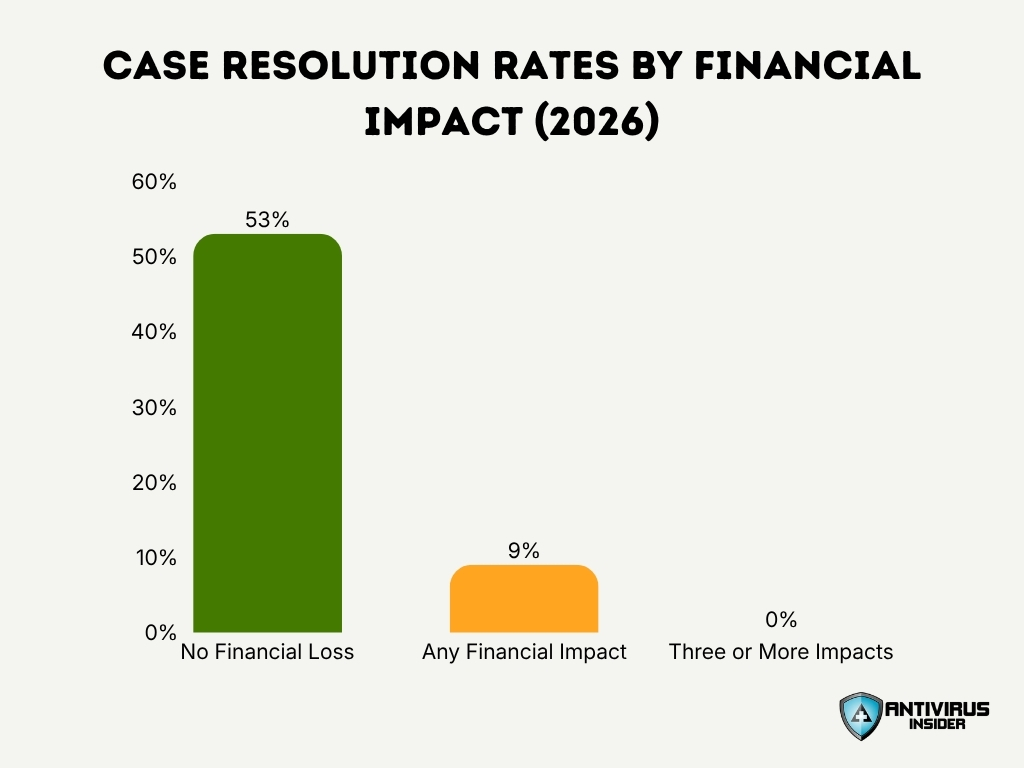
- In the latest 2026 victim-assistance data, 53% of victims with no financial loss reported that their identity crime had been resolved.
- By contrast, only 9% of victims who suffered any financial impact reported resolving their cases, showing how monetary damage can complicate recovery.
- Among victims who experienced three or more financial impacts, 0% reported full resolution in the same 2026 dataset.
- Identity recovery increasingly involves multiple problems at once: 25.6% of victims were handling two or more concurrent incidents in 2026, up from 23.5% in the previous reporting period.
- The 2026 victim dataset contained 9,253 cases from 6,188 unique individuals, illustrating how one person may require assistance with more than one identity-related issue.
- During 2025, specialist advisers responded to 7,192 requests for assistance made through phone calls, chats, emails and text messages.
- Those advisers directly helped 5,962 people with 8,753 identity-related concerns during 2025, or roughly 1.47 concerns per assisted individual.
- A national government victimization benchmark found that 56% of victims resolved associated financial or credit problems within one day or less.
- Among victims who completely resolved their cases in that national study, the mean recovery effort was four hours, while the median was one hour.
- However, about 10% of victims spent one month or longer resolving their identity theft problems, highlighting the wide gap between routine unauthorized-card cases and more complicated identity misuse.
Identity Theft Prevention Statistics
Consumers have several effective ways to reduce exposure, including multi-factor authentication, unique passwords, credit freezes and monitoring. However, 2025 data show that adoption of several basic safeguards remains uneven.
- In 2025, 44.9% of general consumers used multi-factor authentication, compared with 47.2% in 2024.
- Only 25.8% of consumers had frozen their credit in 2025, down sharply from 38.1% the previous year.
- Just 34.5% of consumers said they never reused passwords across different accounts in 2025, compared with 42.3% in 2024.
- Password manager use stood at 41.3% among general consumers in 2025, down slightly from 42.7% in 2024.
- The share paying for credit or identity monitoring dropped from 40.8% in 2024 to 29.3% in 2025, a decline of 11.5 percentage points.
- Victims who had already experienced more complex identity crimes showed higher security adoption: 54.3% used MFA before their 2025 incident, compared with 58.3% among the comparable 2024 group.
- In that same victim group, 46.5% had frozen their credit before the incident, compared with 35% in 2024.
- After an identity compromise, 55.9% of victims committed to using a different password for every online account, showing how direct victimization changes security behavior.
- Another 50.4% of victims said they would stop clicking unsolicited links in emails and texts following their 2025 incident.
- Multi-factor authentication remains one of the strongest technical controls available: security research found that MFA reduced overall account compromise risk by 99.22% and by 98.56% when criminals already possessed leaked credentials.
Emerging Threats and Future Trends
Identity theft is moving beyond stolen passwords. AI-generated faces, voices, documents, and automated personas now give criminals tools to imitate legitimate consumers at scale, while compromised devices can provide direct access to authenticated accounts.
- Unauthorized access to computers and mobile devices increased 78% year over year, rising from 15.3% to 27.2% of identity compromises in the latest 2026 victim data.
- At the same time, scams that persuaded victims to share personal information fell from 43.1% to 36.1% of compromises, indicating a shift toward direct technical access.
- Deepfakes now account for one in five biometric fraud attempts across a global identity-verification dataset covering more than 1 billion verification events.
- Injection attacks, in which manipulated media is fed directly into identity-verification systems, increased 40% year over year in the 2026 fraud analysis.
- Account takeover now represents 55% of fraud in digital banking in the same global dataset, showing how attackers increasingly focus on identities that have already passed onboarding controls.
- Approximately 82% of payment-related fraud in that analysis occurred during authentication, placing pressure on banks and payment providers to verify identity throughout the account lifecycle rather than only at signup.
- In 2025, more than 97% of identity attacks were password attacks, while identity-based attacks increased 32% during the first half of the year.
- Fraud prevention is also adopting AI: 76% of surveyed financial institutions identified fraud-related applications as their most valuable generative AI opportunity in 2025.
- More than two-thirds of identity theft, fraud, and scam victims and general consumers surveyed in 2025 believed AI would become a primary battleground for identity security.
- However, trust remains limited. Only 25.4% of specialist-help victims said they would completely or somewhat trust AI-powered security tools, while 47.5% were hesitant or would not trust them.
Frequently Asked Questions (FAQs)
Consumers filed 1,358,253 identity theft reports in 2025, with the latest 2026 reporting showing a substantial increase in reported identity theft.
Traditional identity fraud generated $27.3 billion in losses and affected about 18 million victims in 2025.
Account takeover affected approximately 6 million consumers, up 18% from 5.1 million victims in 2024.
Organizations recorded a record 3,322 data compromises, up 5% from 3,152 in 2024 and 79% over five years.
A Q1 2026 financial-services analysis found a 3.89% confirmed identity fraud rate, equivalent to nearly 1 in 26 identity verification requests.
Conclusion
Identity theft remains a significant financial and security challenge, but the nature of the threat is changing. Account takeover, synthetic identities, employment fraud, compromised devices, and AI-assisted impersonation are becoming more important alongside traditional credit card and bank account fraud. At the same time, rising data breach activity continues to give criminals access to personal information that can support repeated fraud attempts. For consumers and organizations, stronger authentication, credit controls, password security, monitoring, and continuous identity verification remain essential. The data suggest that effective identity protection now requires both prevention and fast detection across the full customer and account lifecycle.
