



Ecommerce fraud continues to grow as online shopping, digital wallets, and cross-border transactions expand. Retailers, payment providers, and marketplaces now invest heavily in fraud prevention because every fraudulent order affects profits, customer trust, and operational costs. For example, online merchants use AI-driven fraud detection to stop account takeovers, while payment processors deploy real-time monitoring to reduce chargebacks and identity abuse. The numbers behind ecommerce fraud reveal how quickly the threat landscape is changing. Explore the latest statistics to understand where risks are rising and how businesses are responding.
Editor’s Choice
- Global ecommerce fraud losses reached $48 billion in 2025, and losses could exceed $107 billion by 2029 if current trends continue.
- Merchants lose an average of 3.2% of annual ecommerce revenue to payment fraud worldwide.
- U.S. merchants lose $4.61 for every $1 of fraud, up sharply from previous years because of chargebacks, fulfillment costs, and operational expenses.
- The United States accounts for approximately 42% of global ecommerce fraud value, making it the world’s largest fraud target.
- Around 45% of merchant disputes now stem from first-party and third-party fraud activities.
- 79% of online marketplaces reported rising fraud rates during 2025.
- Fraud losses between 2023 and 2027 are projected to exceed $343 billion globally, highlighting the scale of the threat facing online retailers.
- Businesses worldwide are expected to lose $15 billion from fraudulent chargebacks in 2025 alone.
Recent Developments
- Generative AI has helped create a global fraud economy worth more than $400 billion annually, fueled by phishing, impersonation, and automated scams.
- AI has reduced the time needed to launch sophisticated fraud campaigns from 16 hours to under five minutes.
- Deepfake-related fraud incidents and losses have surged significantly since 2023, with businesses losing an estimated $20 billion to $40 billion annually.
- Synthetic identity document fraud jumped 311% between Q1 2024 and Q1 2025.
- Fraudsters created more than 680 synthetic identities in one Canadian fraud operation that caused roughly $4 million in losses.
- The FBI received more than 5,100 complaints related to account takeover fraud in 2025, with losses exceeding $262 million.
- A record 444,000 fraud cases were reported in the UK during 2025, representing a 6% annual increase.
- Fraud-as-a-service platforms and AI-powered scam kits have become mainstream, enabling organized criminal groups to scale attacks globally.
- Merchants increasingly rely on machine learning, behavioral analytics, and automated decision engines to identify suspicious transactions in real time.
Global Ecommerce Fraud Overview
- Global ecommerce fraud losses reached approximately $48 billion in a single year, up sharply from previous years.
- North America generates 42% of global ecommerce fraud value, more than any other region.
- Merchants worldwide lose roughly 3% of total ecommerce revenue to fraud every year.
- High-risk markets can lose as much as 5% of annual ecommerce revenue to fraud-related activities.
- Latin America experiences the highest fraud burden, losing up to 20% of ecommerce revenue in some markets.
- Ecommerce ranks among the top 10 industries most affected by fraud worldwide.
- More than 2.2% of all identity verification attempts globally are fraudulent.
- Identity theft affects nearly 40% of non-member businesses surveyed in the payments and fraud ecosystem.
- Cross-border and transnational fraud operations continue to rise as organized criminal groups exploit digital marketplaces and payment systems.
Key Ecommerce Fraud Statistics
- Ecommerce fraud losses are projected to rise to $107 billion by 2029, more than doubling from 2025 levels.
- Fraud-related losses from 2023 to 2027 are expected to surpass $343 billion globally.
- Around 70% of card fraud losses now come from card-not-present transactions.
- Friendly fraud accounts for roughly 36% of all ecommerce fraud cases.
- Account takeover attempts increased by more than 300% year over year.
- About 57.8% of U.S. ecommerce fraud originates domestically rather than internationally.
- Nearly 79% of marketplaces reported increased fraud pressure during 2025.
- AI-assisted impersonation and deepfake fraud now rank among the most urgent threats facing digital commerce platforms.
- Merchants increasingly view refund abuse, payment fraud, and account takeover attacks as their most serious fraud challenges.
Growth of Ecommerce Fraud Over Time
- Global ecommerce fraud losses increased from $41 billion in 2022 to nearly $48 billion in 2025, representing a growth rate of about 17% in three years.
- Worldwide ecommerce fraud losses are projected to exceed $107 billion by 2029, more than doubling from current levels.
- Businesses are expected to lose over $343 billion to online payment fraud between 2023 and 2027.
- Account takeover attacks increased by more than 300% year over year as fraudsters adopted automation and credential-stuffing tools.
- Synthetic identity fraud cases surged by 311% between early 2024 and early 2025, marking one of the fastest-growing fraud categories.
- Online merchants reported a 61% increase in payment fraud attacks during major shopping periods compared with pre-pandemic levels.
- The value of global digital payment fraud is forecast to grow by more than 80% between 2024 and 2029.
- Fraudulent chargeback losses are expected to climb from $15 billion in 2025 to more than $20 billion by 2028.
- Nearly 79% of online marketplaces say fraud pressure has increased over the last 12 months.
- AI-powered scams have reduced the time needed to launch sophisticated fraud campaigns from hours to minutes, accelerating fraud growth worldwide.
Key Types of Fraud Causing the Highest E-Commerce Merchant Losses
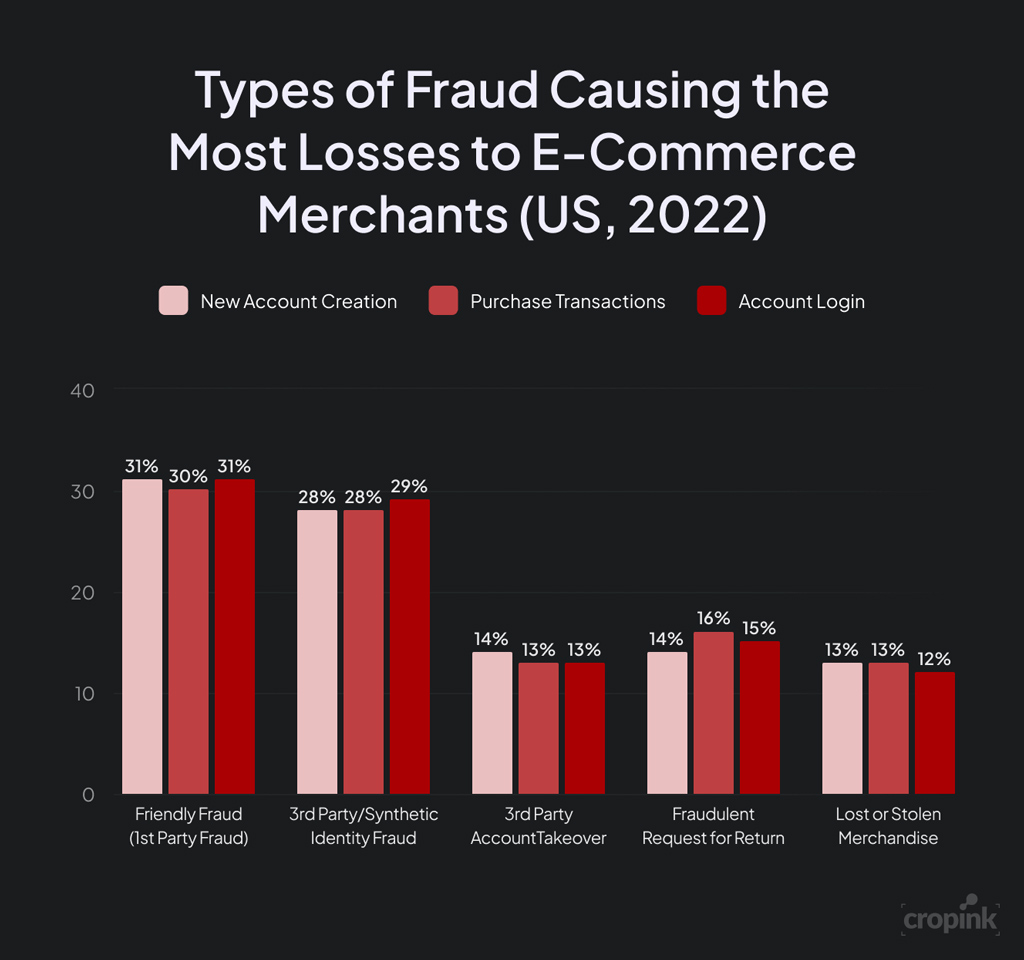
- Friendly Fraud (1st Party Fraud) was the largest source of losses, accounting for 31% of new account creation, 30% of purchase transactions, and 31% of account login fraud.
- 3rd Party/Synthetic Identity Fraud ranked second, contributing 28% of losses in new account creation and purchase transactions, and 29% in account login.
- Fraudulent Return Requests represented 14% of new account creation losses, 16% of purchase transaction losses, and 15% of account login losses.
- 3rd Party Account Takeover caused 14% of new account creation losses and 13% across both purchase transactions and account login.
- Lost or Stolen Merchandise accounted for 13% of losses in both new account creation and purchase transactions, while making up 12% of account login losses.
- Purchase transactions experienced the highest impact from fraudulent return requests, reaching 16%, more than any other fraud type except friendly and synthetic identity fraud.
- Account login fraud losses were led by Friendly Fraud (31%) and 3rd Party/Synthetic Identity Fraud (29%), highlighting these as the most significant login-related threats.
- Across all three stages, Friendly Fraud and 3rd Party/Synthetic Identity Fraud consistently remained the top two contributors, each accounting for 28% to 31% of merchant losses.
Online Payment Fraud Losses
- Global ecommerce businesses lose approximately 3.2% of annual revenue to payment fraud.
- U.S. merchants lose $4.61 for every dollar of fraud, including indirect costs such as labor and chargebacks.
- Every $100 in fraudulent orders costs merchants roughly $207 in total losses.
- Global chargeback losses are expected to reach $33.79 billion in 2025.
- Worldwide chargeback losses could climb to $41.69 billion by 2028.
- Fraudulent chargebacks alone are expected to cost businesses $15 billion in 2025.
- More than half of businesses with revenue under $1 billion report recovering at least some payment fraud losses.
- Real-time payment fraud ranks as the second-largest fraud concern among merchants globally.
- Payment fraud remains one of the biggest profitability threats for online merchants because direct losses often exceed net profit margins.
Chargeback and Friendly Fraud Statistics
- Businesses globally are expected to lose $15 billion to fraudulent chargebacks in 2025.
- Global chargeback losses are projected to reach $33.79 billion in 2025 and rise to $41.69 billion by 2028.
- Friendly fraud accounts for approximately 36% of all ecommerce fraud cases worldwide.
- Nearly 45% of merchant disputes are linked to first-party and third-party fraud activities.
- About 72% of merchants reported an increase in friendly fraud and chargeback abuse during the past year.
- More than 60% of chargebacks stem from cardholders who recognize the purchase but dispute it anyway.
- Merchants win only 20% to 30% of chargeback disputes, leaving most losses unrecovered.
- Subscription businesses experience chargeback rates that are 30% higher than traditional ecommerce merchants.
- Retailers spend an average of $40 in administrative costs per chargeback case, excluding the original transaction value.
- Approximately one in four consumers has filed a chargeback for a purchase they later admitted was legitimate.
Card-Not-Present and Credit Card Fraud Statistics
- Card-not-present (CNP) fraud now represents approximately 70% of all card fraud losses globally.
- Worldwide CNP fraud losses are expected to exceed $28 billion annually by 2026.
- More than 80% of ecommerce payment fraud incidents involve stolen card credentials or compromised account information.
- Online transactions are estimated to be seven times more likely to experience fraud than in-store card transactions.
- The United States remains the world’s largest target for credit card fraud, accounting for about 42% of global card fraud value.
- Around 57.8% of U.S. ecommerce fraud originates domestically, indicating that local fraudsters continue to pose significant risks.
- Digital wallets and tokenization have helped reduce certain forms of payment fraud, but fraudsters increasingly target stored credentials and mobile wallets.
- The average value of a fraudulent card-not-present transaction is three times higher than that of an in-person fraud transaction.
- Nearly 65% of merchants rank CNP fraud as their top payment security concern.
- Criminal marketplaces continue to sell millions of compromised card records every year, fueling ecommerce fraud worldwide.
Account Takeover Fraud Statistics
- Account takeover attacks increased by more than 300% year over year, making them one of the fastest-growing ecommerce threats.
- The FBI received more than 5,100 complaints related to account takeover fraud in 2025, with reported losses exceeding $262 million.
- More than 24 billion username and password combinations are currently circulating on cybercrime forums and underground marketplaces.
- Credential stuffing attacks account for nearly one-third of all login attempts on some ecommerce platforms.
- Approximately 29% of consumers have experienced an account takeover attempt or unauthorized account access.
- Retailers report that account takeover fraud causes significant losses because fraudsters often exploit saved payment cards and loyalty balances.
- Over 50% of account takeover attacks now target mobile applications and digital wallets.
- Businesses that deploy multi-factor authentication can reduce account takeover incidents by up to 99% compared with password-only systems.
- Automated bots now drive a large share of credential attacks, with some ecommerce sites experiencing millions of login attempts per day.
- Account takeover fraud frequently leads to long-term customer attrition, with affected consumers significantly less likely to return to the same merchant.
Identity Theft in Ecommerce
- Identity fraud and scams generated more than $12.5 billion in losses in the United States during 2024, the highest amount on record.
- Consumers filed over 1.1 million identity theft reports in the United States in 2024.
- Synthetic identity fraud increased by 311% between Q1 2024 and Q1 2025.
- More than 2.2% of global identity verification attempts are now considered fraudulent.
- Approximately 40% of businesses outside major fraud networks report experiencing identity-related fraud incidents.
- The financial services and ecommerce sectors account for a significant share of identity theft reports because of their reliance on digital onboarding.
- Deepfake-enabled identity fraud has emerged as one of the fastest-growing cybercrime categories, with annual losses estimated between $20 billion and $40 billion globally.
- Fraudsters increasingly use stolen identities to create synthetic customer profiles, open accounts, and commit payment fraud across online marketplaces.
- Nearly one in three consumers worry that their personal information could be used to commit fraud when shopping online.
- Businesses are increasing investment in identity verification technologies, biometrics, and behavioral analytics to combat identity-related ecommerce fraud.
Refund and Returns Fraud Statistics
- Retailers worldwide lose an estimated $103 billion annually to return fraud and policy abuse.
- Approximately 13.7% of all retail returns are fraudulent, costing merchants more than $100 billion each year.
- Ecommerce return rates averaged 16.9% of total merchandise sales in 2024, creating more opportunities for fraudsters.
- Around 15% of consumers admit to engaging in some form of return policy abuse, including wardrobing and false claims.
- Nearly 60% of retailers report an increase in refund abuse and false refund claims compared with the previous year.
- More than one-third of merchants have experienced cases where customers claimed non-delivery despite receiving the product.
- “Wardrobing,” where shoppers use products and then return them, represents one of the fastest-growing forms of ecommerce return fraud.
- Around 93% of retailers say return fraud has become a significant operational concern because of rising return volumes and policy abuse.
- Businesses increasingly deploy AI-powered return monitoring systems to detect suspicious refund patterns and serial abusers.
Ecommerce Fraud and Abuse Trends Among U.S. and U.K. Merchants
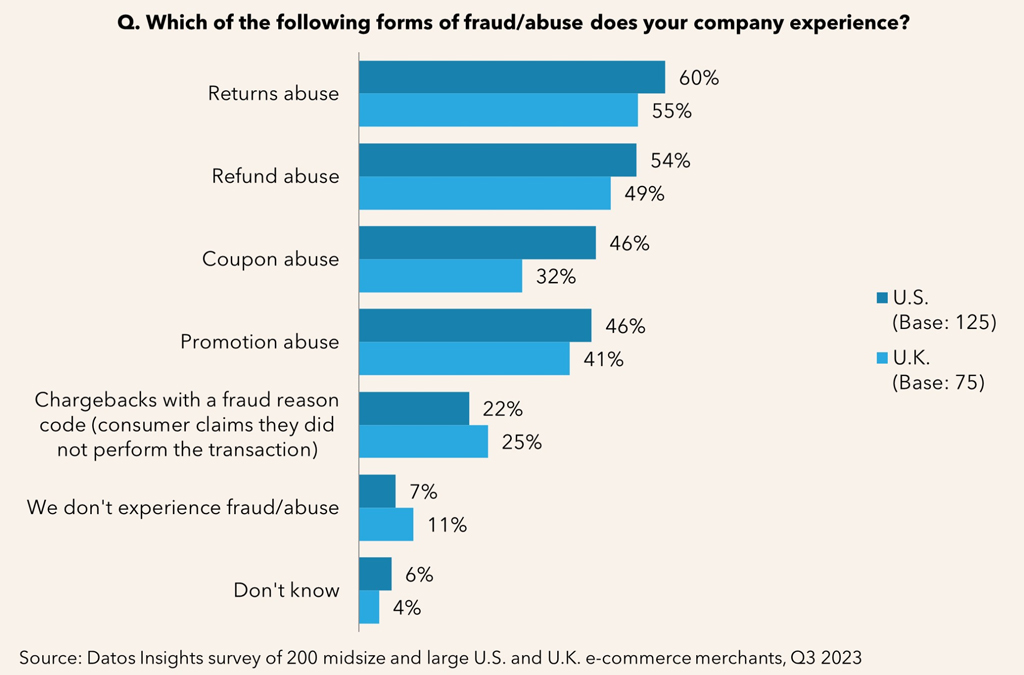
- Returns abuse was the most common form of fraud, reported by 60% of U.S. merchants and 55% of U.K. merchants.
- Refund abuse affected 54% of U.S. businesses compared to 49% of U.K. businesses.
- Coupon abuse was significantly higher in the U.S. (46%) than in the U.K. (32%), a 14 percentage point gap.
- Promotion abuse impacted 46% of U.S. merchants and 41% of U.K. merchants.
- Chargebacks with a fraud reason code were reported by 25% of U.K. merchants, slightly above the 22% reported in the U.S.
- Only 7% of U.S. merchants and 11% of U.K. merchants said they do not experience fraud or abuse.
- A small share of respondents were unsure, with 6% in the U.S. and 4% in the U.K. selecting “Don’t know.”
- Overall, U.S. merchants reported higher rates of most fraud and abuse categories than U.K. merchants, except for fraud-related chargebacks.
Promotion, Coupon, and Loyalty Abuse Statistics
- Promotional abuse accounts for an estimated 8% to 10% of total ecommerce fraud losses at many online retailers.
- Approximately 27% of businesses experienced increased coupon and discount abuse in 2025.
- More than one in five online shoppers admit to exploiting promotional loopholes at least once.
- Loyalty fraud incidents increased by 89% year over year, driven by account takeovers and stolen reward balances.
- Businesses lose billions annually to fraudulent coupon stacking, referral abuse, and fake account creation.
- Roughly 35% of loyalty program operators report that fraud directly affects customer trust and engagement.
- Fraudsters increasingly target rewards accounts because loyalty balances often have weaker security controls than payment accounts.
- Merchants that implement real-time fraud screening for promotions reduce abuse-related losses by up to 40%.
- Ecommerce platforms continue to tighten promotion rules and identity checks to reduce fake referrals and coupon exploitation.
False Declines and Checkout Friction Statistics
- Merchants lose more revenue to false declines than to confirmed fraud in many ecommerce sectors.
- Global ecommerce businesses are estimated to lose more than $443 billion annually because legitimate transactions are incorrectly declined.
- Approximately 70% of falsely declined customers never return to the same merchant.
- Around 42% of consumers abandon a purchase if they encounter payment friction or repeated authentication requests.
- More than one-third of online shoppers say they switched retailers after a legitimate transaction was declined.
- Businesses that optimize fraud screening and authentication can reduce false declines by up to 70%.
- Nearly 48% of merchants cite balancing fraud prevention and customer experience as one of their biggest operational challenges.
- Excessive checkout friction can reduce conversion rates by 10% to 20%, particularly on mobile devices.
- Merchants increasingly adopt behavioral biometrics and machine learning to approve more legitimate transactions while blocking fraud.
Consumer Attitudes Toward Online Payment Security
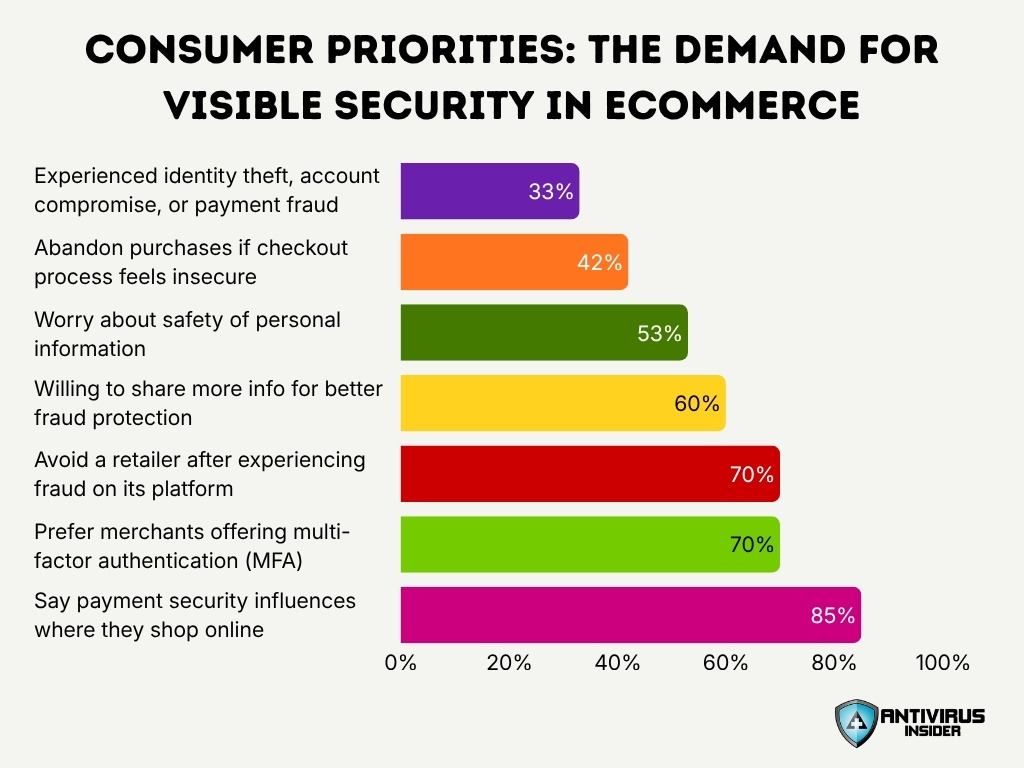
- Approximately 85% of consumers say payment security influences where they shop online.
- Around 53% of consumers worry about the safety of their personal information during online purchases.
- More than 70% of shoppers prefer merchants that offer additional security features such as multifactor authentication.
- Nearly one in three consumers has experienced identity theft, account compromise, or payment fraud.
- Approximately 42% of shoppers abandon purchases when the checkout process feels insecure or overly complicated.
- Around 60% of consumers are willing to share additional information if it improves fraud protection and reduces unauthorized transactions.
- Nearly 70% of consumers say they would avoid a retailer after experiencing fraud on its platform.
- Younger consumers are more likely to adopt biometric authentication methods, including fingerprint and facial recognition.
- Trust and security remain among the most important factors influencing repeat online purchases and brand loyalty.
Mobile Ecommerce Fraud Statistics
- Mobile devices now account for more than 60% of global ecommerce transactions.
- Mobile fraud attacks increased by more than 80% year over year, outpacing desktop-based fraud growth.
- Approximately 70% of digital fraud attempts now target mobile channels, including apps and mobile browsers.
- Mobile account takeover incidents increased substantially as fraudsters shifted toward app-based credential attacks.
- Around 53% of consumers worry about payment security when shopping through mobile applications.
- Businesses report that mobile transactions experience higher rates of identity fraud and account abuse than desktop transactions.
- More than half of account takeover attacks now target mobile applications and digital wallets.
- Mobile wallets and biometric authentication have helped reduce some forms of payment fraud, but fraudsters increasingly exploit stolen devices and social engineering tactics.
- Retailers continue to invest heavily in mobile fraud detection tools as mobile commerce approaches three-quarters of global ecommerce activity.
Cross-Border Ecommerce Fraud Statistics
- Cross-border transactions carry a 2x to 3x higher fraud risk compared to standard domestic payments.
- Global ecommerce fraud losses are projected to reach $48 billion in a single year.
- North America accounts for 42% of global ecommerce fraud by value due to its immense market size.
- Merchants in Latin America lose up to 20% of their ecommerce revenue to fraudulent activities.
- The cumulative global cost of online payment fraud is expected to exceed $343 billion by 2027.
- International ecommerce orders face a high average rejection rate of 5.3% to 6.1% due to suspected fraud.
- First-party misuse or friendly fraud currently represents 36% of all global ecommerce fraud cases.
- Global merchants spend between 10% and 15% of annual revenue managing payment fraud prevention.
- Asia-Pacific businesses lose an average of 5% of annual revenue to fraudulent online transactions.
Industry-Wise Ecommerce Fraud Breakdown
- Global ecommerce fraud losses across the retail sector reached $48 billion in 2025, marking a 16% annual increase.
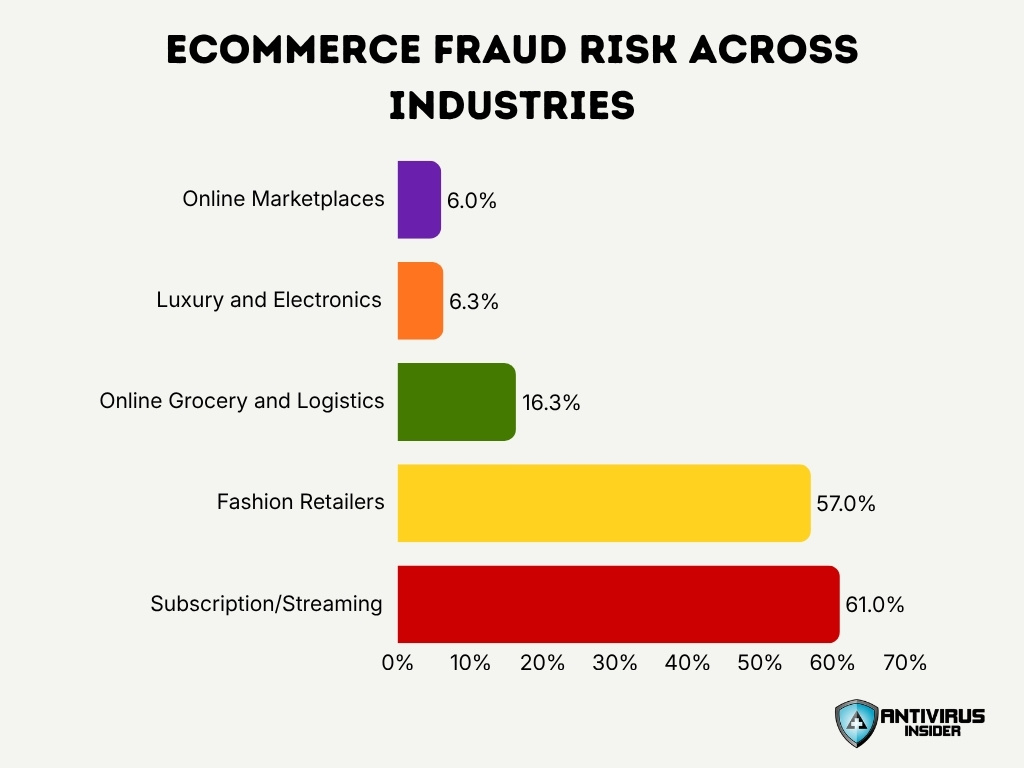
- Luxury and electronics merchants face a severe 6.3% account takeover rate due to the high resale value of their merchandise.
- Travel and ticketing platforms experienced a massive 117% increase in suspected digital fraud amid surging transaction values.
- The digital goods sector encounters fraud attack rates up to three times higher than standard physical merchandise categories.
- Subscription and streaming platforms report that friendly fraud now accounts for 61% of all chargeback disputes.
- Over 57% of fashion retailers experienced a significant rise in refund and policy abuse, particularly return fraud and wardrobing.
- Online grocery and logistics services currently suffer the highest digital fraud rate globally at 16.3%.
- Online marketplaces are forced to reject an estimated 6% of all received orders annually due to immense fraud exposure.
- Financial services and fintech platforms saw a 44% spike in digital fraud attempts focused heavily on synthetic identity creation.
Frequently Asked Questions (FAQs)
Global ecommerce fraud losses are projected to reach $107 billion by 2029, up from $44.3 billion in 2024, representing 141% growth.
Merchants are expected to lose a cumulative $343 billion to online payment fraud during the 2023-2027 period.
The United States accounts for approximately 42% of all global ecommerce fraud by value, the highest share of any country or region.
The average merchant loses $4.61 for every $1 of fraud, once chargebacks, operational expenses, and replacement costs are included.
Card-not-present (CNP) fraud accounts for nearly 80% of all ecommerce credit card fraud losses worldwide.
Conclusion
Ecommerce fraud continues to evolve alongside digital commerce, creating significant financial and operational challenges for businesses worldwide. Fraud losses now reach tens of billions of dollars annually, while account takeovers, chargeback abuse, synthetic identities, and return fraud continue to accelerate. At the same time, merchants face a difficult balancing act: they must block fraudulent transactions without creating checkout friction that drives away legitimate customers.
As ecommerce expands and cross-border transactions increase, businesses are investing more heavily in AI-driven fraud detection, behavioral analytics, and identity verification technologies. The statistics in this report show that fraud prevention is no longer just a security issue; it has become a critical factor in customer trust, revenue protection, and long-term growth.
