



Cybersecurity has become a boardroom priority as organizations face growing threats from ransomware, phishing, data breaches, and AI-powered attacks. From protecting hospital records and financial transactions to securing cloud infrastructure and remote work environments, cyber defense now influences nearly every industry. As attack methods evolve and costs continue to rise, understanding the latest cybersecurity statistics helps businesses make informed security decisions. Let’s explore the most important cybersecurity statistics.
Editor’s Choice
- Global cybercrime damages are projected to reach $10.5 trillion annually, making cybercrime one of the world’s largest economic threats.
- The global average cost of a data breach reached $4.44 million in 2025, down from $4.88 million in 2024.
- Organizations using extensive security AI and automation save an average of $1.9 million per breach.
- Ransomware now appears in 44% of all data breaches, up from 32% a year earlier.
- More than 2,200 cyberattacks occur every day worldwide, or roughly one attack every 39 seconds.
- The United States accounted for 24.8% of the analyzed cyberattacks in 2025, remaining the most targeted country.
- AI-driven security tools reduced breach detection time by up to 51 days compared with organizations that lacked automation.
Recent Developments
- Verizon’s 2026 breach analysis found that 31% of breaches now begin with vulnerability exploitation, surpassing stolen credentials for the first time.
- AI-assisted attackers can now shrink exploitation windows from months to mere hours, increasing pressure on security teams.
- Ransomware groups generated an estimated $529.2 million during Q1 2026, a 39% increase from the same period in 2025.
- Nearly 98% of security professionals have adopted or plan to adopt AI-enabled technologies within a year.
- Shadow AI has become the third most common non-malicious cause of data loss incidents in enterprises.
- Global cybercrime losses are forecast to increase from $10.5 trillion in 2025 to $15.63 trillion by 2029.
- Around 71% of chief risk officers expect severe operational disruption from cyber risks within the next year.
- Indian websites experienced more than 265 million cyberattacks in 2025, highlighting the rapid escalation of regional threats.
- AI is increasingly used across the entire attack chain, including reconnaissance, initial access, malware creation, and vulnerability discovery.
Cybercrime Damage Cost Over the Past Decade
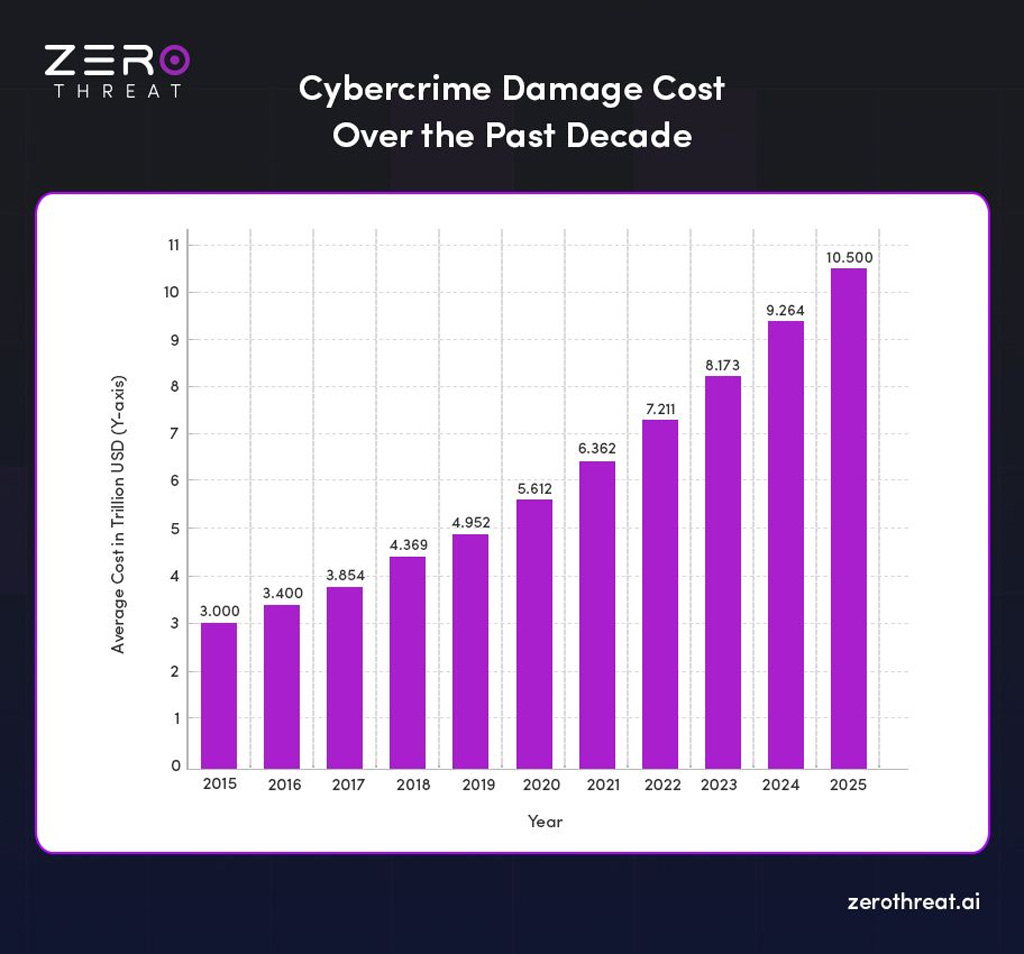
- Global cybercrime damage costs surged from $3.0 trillion in 2015 to $10.5 trillion in 2025, a 250% increase in just ten years.
- Cybercrime losses exceeded $10 trillion for the first time in 2025, reaching a record $10.5 trillion.
- The annual cost of cybercrime grew by $7.5 trillion between 2015 and 2025, highlighting escalating digital threats.
- 2024 recorded $9.264 trillion in cybercrime damages, up from $8.173 trillion in 2023.
- Cybercrime costs nearly doubled from $5.612 trillion in 2020 to $10.5 trillion in 2025.
- The largest year-over-year increase occurred between 2024 and 2025, with damages rising by $1.236 trillion.
- Global cybercrime losses crossed the $7 trillion mark in 2022, reaching $7.211 trillion.
- Cybercrime damage costs increased every year from 2015 to 2025, showing a consistent upward trend.
- By 2021, cybercrime losses had already surpassed $6.362 trillion, reflecting accelerated attack activity worldwide.
- The decade-long trend demonstrates that cybercrime has become one of the costliest global economic threats, with damages reaching $10.5 trillion annually.
Data Breach Statistics
- The average breach lifecycle in 2025 was 241 days from identification through containment.
- Organizations required an average of 181 days to identify a breach.
- Breach containment took approximately 60 additional days after detection.
- Breaches involving third parties accounted for 30% of incidents, doubling year over year.
- Human involvement played a role in 68% of breaches.
- Stolen credentials generated an average breach cost of $4.81 million.
- Breaches with lifecycles longer than 200 days cost organizations an average of $5.01 million.
- Nearly 97% of organizations emphasize faster detection and containment as a key resilience strategy.
- The industrial sector experienced average breach costs of $5.56 million, up 18% from the previous year.
Ransomware Statistics
- Ransomware appeared in 44% of all breaches in 2025, compared with 32% a year earlier.
- Ransomware attacks surged by 58% during 2025, according to industry tracking.
- Global ransomware damages are estimated at approximately $57 billion annually.
- Annual ransomware damages could reach $265 billion by 2031.
- Around 73% of organizations reported experiencing at least one ransomware attack during 2024.
- Microsoft observed a 2.75-fold increase in ransomware-linked encounters between mid-2022 and mid-2024.
- Ransomware-related breaches cost organizations an average of $5.08 million per incident.
- More than 7,000 organizations were publicly listed on ransomware leak sites by 2026, compared with 5,010 in 2024.
- Global ransomware payments fell to $813 million in 2024, down from $1.25 billion in 2023, as more victims refused to pay.
- Approximately 15 organizations become ransomware victims each day.
Primary Cybersecurity Threat Vectors Statistics
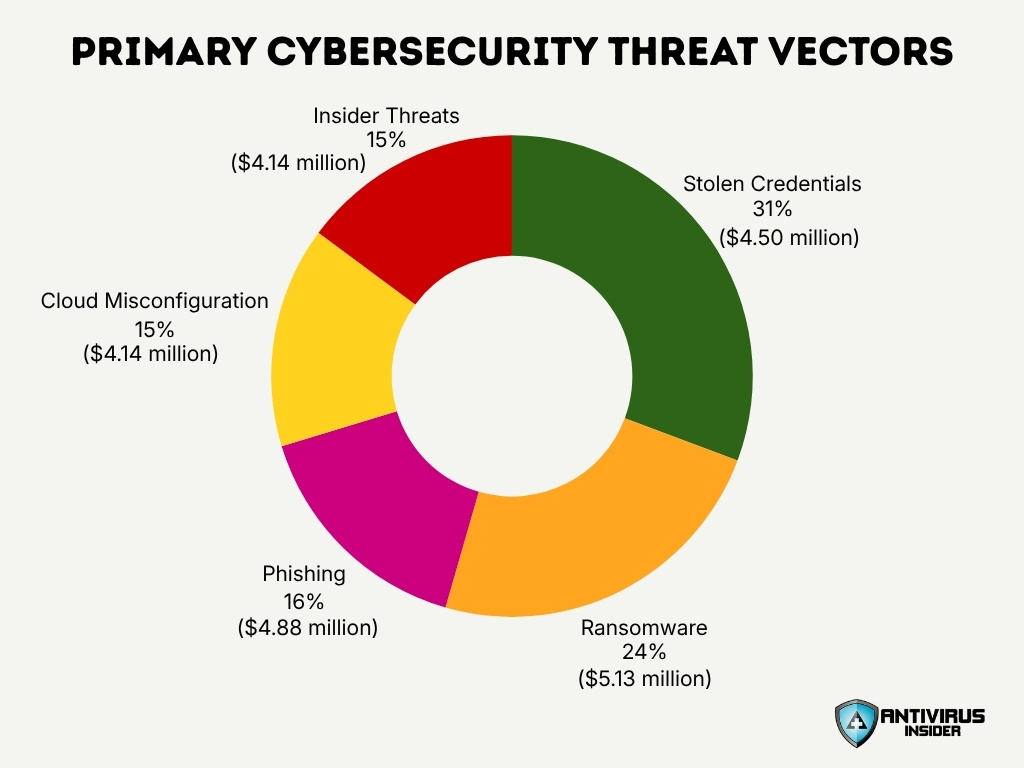
- Stolen Credentials accounted for the largest share of breaches at 31%, causing an average loss of $4.50 million per incident.
- Ransomware was responsible for 24% of breaches and had the highest average financial impact at $5.13 million.
- Phishing attacks made up 16% of breaches, with organizations facing an average cost of $4.88 million.
- Cloud Misconfigurations contributed to 15% of breaches, resulting in an average impact of $4.14 million per breach.
- Insider Threats represented 15% of breaches and generated an average cost of $4.99 million, among the most expensive attack vectors.
- Ransomware incidents cost 14% more on average than breaches caused by stolen credentials ($5.13M vs. $4.50M).
- The combined share of stolen credentials and ransomware reached 55% of all breaches, highlighting the importance of access security.
- Every listed attack vector generated an average breach cost exceeding $4 million, underscoring the severe financial risks of cyberattacks.
Phishing and Social Engineering Statistics
- Phishing remains the most common cyber threat affecting businesses and individuals.
- IBM identified phishing as the initial attack vector in 16% of breaches during 2025.
- Human actions contributed to 68% of all breaches, underscoring the importance of social engineering defenses.
- Stanford research cited in breach studies found that 88% of breaches involve human error.
- Nearly 1 billion email accounts were exposed in a single year, affecting roughly one in five internet users.
- Cybercriminals increasingly use generative AI to create convincing phishing messages and impersonation campaigns.
- AI-powered phishing campaigns can automate targeting, message creation, and credential harvesting at scale.
- Identity-related incidents affected 71% of organizations in 2025, often leading to ransomware and financial losses.
- Two-thirds of ransomware attacks now involve identity vulnerabilities or compromised credentials.
Malware and Virus Statistics
- Malware attacks increased by approximately 30% year over year in 2025, driven by the growing use of automation and AI-assisted malware development.
- More than 6 billion malware attacks were detected globally during 2025 across enterprise and consumer environments.
- Around 560,000 new malware variants emerge every day, creating significant challenges for threat detection teams.
- Fileless malware accounted for nearly 70% of successful malware intrusions, making traditional signature-based defenses less effective.
- Cryptojacking incidents rose by 27% in 2025, particularly across cloud and containerized environments.
- Trojans remained among the most common malware families, accounting for roughly 58% of malware infections targeting businesses.
- Malware-related downtime costs organizations an average of $2.6 million per incident when recovery expenses are included.
- Approximately 94% of malware infections arrive through email, reinforcing the connection between malware and phishing campaigns.
- Mobile malware attacks increased by over 50% year over year, largely targeting Android devices.
- Security researchers identified more than 1.2 billion malware programs in active malware repositories by early 2026.
Artificial Intelligence (AI) in Cybersecurity Statistics
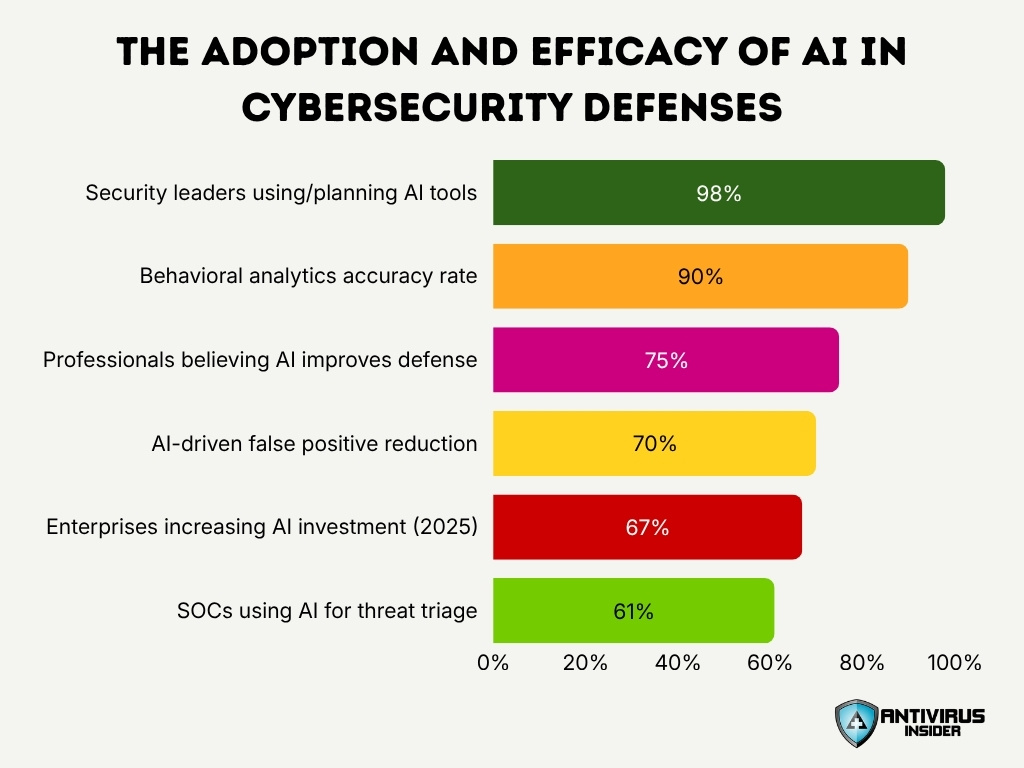
- Nearly 98% of security leaders report using or planning to implement AI-powered cybersecurity tools within the next 12 months.
- Organizations that extensively deploy security AI reduce breach costs by an average of $1.9 million compared to organizations without AI.
- AI-enabled security teams identify and contain breaches 51 days faster than organizations relying solely on manual processes.
- More than 67% of enterprises increased AI security investments during 2025.
- AI-driven threat detection systems can reduce false positives by up to 70%, improving analyst productivity.
- Approximately 61% of security operations centers now use AI for automated threat triage and investigation.
- Generative AI tools assist analysts with incident response, vulnerability prioritization, and threat intelligence enrichment.
- Around 75% of cybersecurity professionals believe AI will significantly improve defensive capabilities over the next three years.
- Security teams using AI-assisted automation report up to 40% faster incident response times compared with traditional workflows.
- AI-powered behavioral analytics can detect insider threats with accuracy rates exceeding 90% in controlled environments.
AI-Driven Cyberattack Statistics
- Over 87% of security professionals report being targeted by AI-powered cyberattacks in the past year.
- AI-enabled adversaries have driven an 89% year-over-year increase in overall cyberattack volume.
- AI-generated phishing emails achieve a massive 78% open rate and a 21% click-through rate.
- The volume of phishing attacks has surged by 1,265% due to the adoption of generative AI tools.
- Deepfake-related fraud incidents have experienced a staggering 2,137% growth over the past three years.
- Approximately 82.6% of all phishing emails are now crafted using artificial intelligence technologies.
- Cybercriminals compose phishing emails 40% faster by leveraging advanced generative AI capabilities.
- The average financial cost of an AI-powered data breach has escalated to $5.72 million.
- AI-driven automation has slashed the average attacker breakout time to just 29 minutes.
- Nearly 77% of victims targeted by AI voice clone scams ultimately suffer direct financial losses.
Cloud Security Statistics
- Approximately 45% of data breaches now involve data stored across cloud environments.
- Misconfigured cloud settings remain one of the leading causes of cloud-related security incidents.
- More than 80% of organizations operate in multi-cloud environments, increasing security complexity.
- Around 61% of organizations experienced a cloud security incident during the past year.
- Cloud intrusions take an average of only a few minutes for attackers to establish persistence after successful compromise.
- Identity-based attacks account for the majority of successful cloud environment breaches.
- Nearly 39% of businesses cite cloud security as their top cybersecurity concern.
- Organizations continue moving critical workloads to cloud infrastructure despite increasing threat activity.
- Cloud-native application attacks increased by more than 40% year over year during 2025.
- Security teams report visibility gaps across cloud assets as one of their most persistent operational challenges.
Global Cybersecurity Spending Statistics
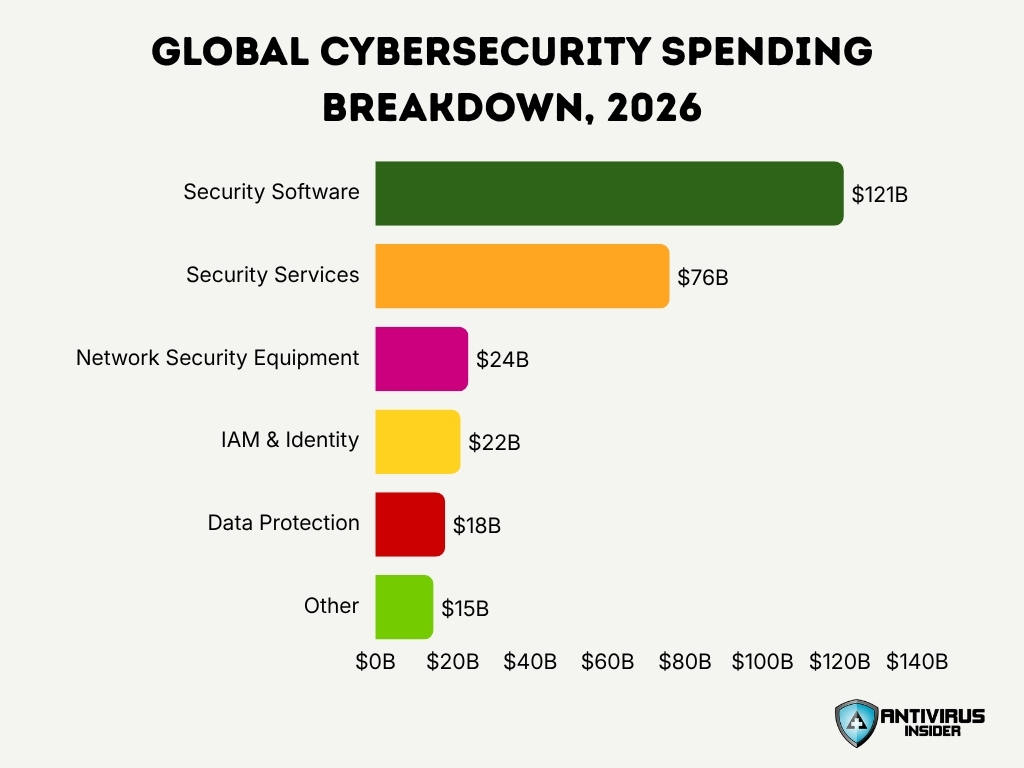
- Global cybersecurity spending is projected to reach $276 billion in 2026.
- Security Software dominates spending with $121 billion, accounting for 43.8% of the total market.
- Security Services ranks second at $76 billion, representing 27.5% of global cybersecurity spending.
- Network Security Equipment is expected to attract $24 billion, making up 8.7% of total expenditures.
- IAM & Identity solutions are projected to receive $22 billion, accounting for 8.0% of the market.
- Data Protection spending is forecast to reach $18 billion, representing 6.5% of total cybersecurity investments.
- The Other cybersecurity category is estimated at $15 billion, contributing 5.4% of global spending.
- Combined spending on Security Software and Security Services totals $197 billion, capturing 71.3% of the market.
- Organizations are expected to spend 5.5 times more on Security Software ($121B) than on Other cybersecurity categories ($15B).
- Identity and access management spending of $22 billion highlights the growing focus on digital identity security and access control.
Mobile Cybersecurity Statistics
- Mobile devices now account for more than 60% of global web traffic, expanding the mobile attack surface.
- Mobile phishing attacks increased by approximately 85% year over year as users increasingly access email and business applications through smartphones.
- More than 70% of fraud transactions originate from mobile channels in several digital commerce sectors.
- Android devices continue to experience the majority of mobile malware infections worldwide.
- Roughly 43% of organizations experienced a mobile-related security compromise during the past year.
- Mobile malware detections increased by over 50% compared with the previous year.
- More than 95% of organizations allow employees to access corporate resources through mobile devices.
- Lost or stolen devices remain a major contributor to unauthorized access incidents.
- Mobile banking trojans continue targeting financial institutions and consumers at scale across multiple regions.
- Security experts estimate that billions of personal records remain accessible through vulnerable mobile applications and APIs.
Internet of Things (IoT) Security Statistics
- The number of connected IoT devices is expected to exceed 30 billion devices in 2026, creating one of the largest cybersecurity attack surfaces.
- More than 57% of IoT devices remain vulnerable to medium- or high-severity attacks because of outdated firmware and weak authentication controls.
- Approximately 98% of IoT device traffic is transmitted without encryption, exposing sensitive data to interception risks.
- IoT-based attacks increased by nearly 30% year over year during 2025 as organizations expanded connected infrastructure.
- Manufacturing and industrial environments account for some of the highest IoT security incident rates due to widespread operational technology deployments.
- Researchers identified billions of exposed IoT credentials across publicly accessible devices and services.
- Distributed denial-of-service (DDoS) attacks continue to rely heavily on compromised IoT botnets.
- Nearly 80% of organizations using IoT devices report concerns about device visibility and asset management.
- Smart building systems, connected healthcare devices, and industrial sensors rank among the most targeted IoT assets.
- Security analysts estimate that unsecured IoT devices contribute to millions of automated attack attempts every day.
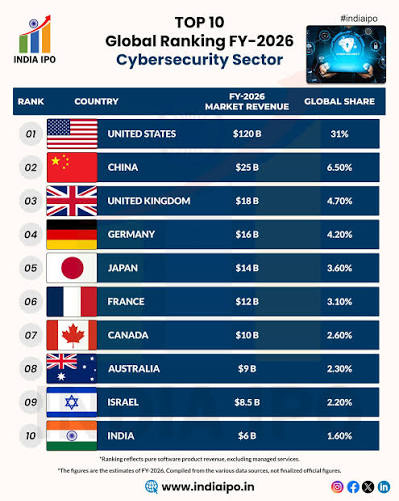
Global Cybersecurity Market Rankings (FY 2026)
- The United States dominates the cybersecurity sector with $120 billion in revenue, accounting for 31% of the global market.
- China ranks second with $25 billion in market revenue and a 6.5% global share.
- The United Kingdom holds third place, generating $18 billion and capturing 4.7% of worldwide cybersecurity revenue.
- Germany secured fourth position with $16 billion in revenue and a 4.2% market share.
- Japan contributed $14 billion to the cybersecurity market, representing 3.6% of the global total.
- France recorded $12 billion in cybersecurity revenue, giving it a 3.1% global share.
- Canada generated $10 billion, making up 2.6% of the worldwide cybersecurity market.
- Australia reached $9 billion in revenue and accounted for 2.3% of the global sector.
- Israel earned $8.5 billion from cybersecurity activities, representing 2.2% of the market.
- India entered the global top 10 with $6 billion in revenue and a 1.6% share of the cybersecurity industry.
- The top 10 countries collectively generated approximately $238.5 billion in cybersecurity market revenue during FY 2026.
- The United States’ $120 billion market is nearly 4.8 times larger than China’s $25 billion cybersecurity sector.
Identity Theft and Cyber Fraud Statistics
- Identity fraud losses exceeded $43 billion globally in recent reporting periods, reflecting the growing sophistication of cybercriminals.
- More than 1 million identity theft complaints are filed annually in the United States.
- Account takeover attacks increased by over 24% year over year as attackers target online banking, retail, and social media accounts.
- Synthetic identity fraud remains one of the fastest-growing financial crime categories worldwide.
- Approximately 71% of organizations reported experiencing identity-related security incidents during 2025.
- Credential theft remains among the most common attack methods used in ransomware and business email compromise attacks.
- Consumers lose billions of dollars annually through phishing-enabled fraud and impersonation scams.
- Deepfake-enabled fraud attempts increased by more than 200% across financial institutions between 2024 and 2025.
- Multi-factor authentication can block more than 99% of automated credential attacks when implemented correctly.
- Financial services organizations continue reporting record levels of digital identity fraud across online and mobile channels.
Software Vulnerabilities and Exploit Statistics
- More than 40,000 new CVEs were disclosed during 2025, setting another annual record.
- Vulnerability exploitation accounted for 31% of confirmed breaches in recent investigations.
- The average enterprise manages tens of thousands of software vulnerabilities at any given time.
- Security teams successfully patch less than 50% of critical vulnerabilities within recommended timeframes.
- Only 26% of known critical vulnerabilities were fully remediated by organizations throughout 2025.
- The median remediation time for patching critical vulnerabilities across enterprises worsened to 43 days.
- Nearly 60% of organizations cite vulnerability management as their most resource-intensive security activity.
- Attackers increasingly weaponize newly disclosed vulnerabilities within days or hours of public disclosure.
- Exploitation of edge devices and VPN appliances remained a leading intrusion vector throughout 2025.
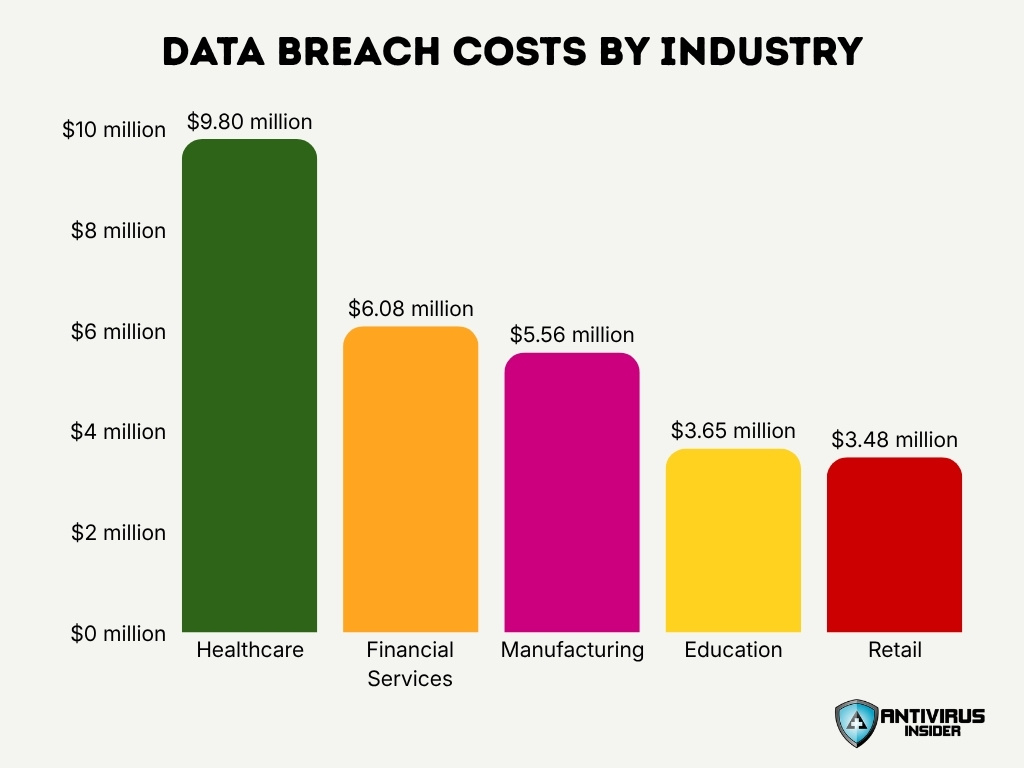
Data Breach Costs by Industry
- Healthcare recorded the highest average breach cost at $9.80 million, increasing 10.6% year over year.
- Financial Services faced an average breach cost of $6.08 million, with a modest 2.3% annual increase.
- Manufacturing experienced one of the fastest cost increases, with breach expenses reaching $5.56 million, up 18.0%.
- Education was the only sector to report a decline, with average breach costs falling 10.6% to $3.65 million.
- Retail organizations incurred average breach costs of $3.48 million, despite a significant 18.0% year over year increase.
- Healthcare breaches cost nearly 2.8 times more than retail breaches, highlighting the value of sensitive patient data.
- Manufacturing and Retail shared the highest annual cost growth rate at 18.0%, indicating rising cyber risks across both sectors.
- The gap between the highest-cost industry (Healthcare, $9.80 million) and the lowest-cost industry (Retail, $3.48 million) was $6.32 million.
Enterprise Cybersecurity Statistics
- More than 70% of enterprises experienced at least one significant cyber incident during the past 12 months.
- Large organizations manage an average of thousands of security alerts daily, creating significant operational challenges.
- Approximately 60% of enterprises report difficulty maintaining visibility across hybrid and multi-cloud environments.
- Human error continues to contribute to 68% of security breaches affecting enterprise organizations.
- Enterprises using security AI and automation reduce breach costs by an average of $1.9 million compared with organizations that do not.
- Nearly 80% of enterprise security leaders rank ransomware among their top cybersecurity concerns.
- Third-party and supply-chain risks continue to increase as organizations rely on larger partner ecosystems.
- Identity security remains one of the fastest-growing enterprise cybersecurity investment categories.
- Security leaders increasingly prioritize zero-trust architecture initiatives to reduce lateral movement within networks.
- Enterprise boards now treat cybersecurity as a business risk issue rather than solely an IT concern.
Cybersecurity Workforce and Skills Gap Statistics
- The global cybersecurity workforce gap exceeded 4.8 million professionals in recent industry assessments.
- Nearly 67% of organizations report moderate-to-severe cybersecurity staffing shortages.
- More than 90% of security leaders express concern over talent shortages impacting organizational resilience.
- Over 88% of organizations experienced significant cybersecurity consequences due to severe staffing shortages.
- The global cybersecurity workforce must increase by 87% to adequately meet current global demand.
- About 84% of organizations report that AI-enhanced tools are compensating for workforce shortages.
- Women account for approximately 25% to 30% of the global cybersecurity workforce, highlighting diversity challenges.
- Around 60% of respondents state their top recruiting challenge is finding talent with AI and cloud security skills.
- Exactly 92% of organizations plan to invest in cybersecurity upskilling programs over the next 12 months.
- Approximately 81% of organizations globally report significant gaps in required cybersecurity skills hindering resilience.
Frequently Asked Questions (FAQs)
Global cybercrime is projected to cost $10.5 trillion annually, making it one of the largest economic threats worldwide.
The global average cost of a data breach in 2025 is $4.44 million, down 9% from $4.88 million in 2024.
The global cybersecurity workforce gap stands at approximately 4.8 million unfilled positions.
Organizations using extensive security AI and automation save an average of $1.9 million per data breach compared with those that do not.
Organizations took an average of 241 days to identify and contain a data breach in 2025.
Conclusion
Cybersecurity risks continue to grow as organizations expand their digital operations, cloud environments, mobile ecosystems, and AI deployments. The statistics show that ransomware, phishing, identity theft, software vulnerabilities, and AI-powered attacks remain among the most significant threats facing businesses worldwide. At the same time, investments in AI-driven security tools, zero-trust architectures, cloud protection, and workforce development are helping organizations strengthen their defenses.
Looking ahead, cybersecurity will remain a strategic priority for enterprises, governments, and consumers alike. Organizations that combine strong security practices, skilled personnel, proactive threat detection, and continuous risk management will be best positioned to reduce cyber risk and protect critical assets in an increasingly connected world.
